

P0300 on 2011-2016 Chevrolet Cruze 1.4L Turbo: Random Misfire Causes and Fixes
On a 2011-2016 Cruze with the 1.4L Turbo engine, code P0300 is most often caused by a failed PCV system, creating a major vacuum leak. This usually requires replacing the entire valve cover assembly after verifying the intake manifold check valve is still present. Expect to pay $60-$150 for the part, with a DIY difficulty of 2/5.
- For a P0300 on a 1.4L Cruze, immediately suspect a failed PCV system. Listen for hissing and check for strong vacuum at the oil cap.
- The most common repair is replacing the entire valve cover assembly, which contains the faulty PCV diaphragm.
- If the PCV system is okay, the next most likely cause is a failed ignition coil pack and worn spark plugs.
- A flashing check engine light is serious. Do not drive the vehicle, as you risk destroying the catalytic converter.
- Always check for other codes like P0171 (System Too Lean), which strongly reinforces the diagnosis of a vacuum leak.
What's Unique About the 2011-2016 Chevrolet Cruze
The first-generation Cruze with the 1.4L turbo engine (LUJ/LUV) is uniquely susceptible to P0300 due to a flawed Positive Crankcase Ventilation (PCV) system. A non-serviceable rubber diaphragm inside the valve cover is known to tear, and a small orange check valve inside the intake manifold can become dislodged and ingested by the engine. Both issues create a significant vacuum leak that the engine computer cannot manage, leading directly to random misfires. This PCV system failure is the most common cause of P0300 on this specific vehicle and its platform mates.
Generation note: The 2011-2016 model years primarily cover the first generation of the Chevrolet Cruze. A redesigned second generation was introduced late in the 2016 model year, so it's important to confirm which version a 2016 model is. This guide is specific to the first-generation platform with the 1.4L turbo engine (LUJ/LUV). The PCV system design was a primary point of failure and was changed in the second generation.
Symptoms You May Notice
- Rough or shaking idle
- Hesitation or stumbling during acceleration
- Flashing or solid Check Engine Light
- Reduced engine power
- Poor fuel economy
- Audible hissing or whistling sound from the engine bay at idle
- High-pitched chirping or squealing sound at idle that may disappear when the oil dipstick is removed (indicates a failed front crankshaft seal due to high crankcase pressure)
- Replacing only the spark plugs when the underlying cause is a failed PCV system or a bad ignition coil.
- Replacing oxygen sensors, as they may report issues due to the misfire but are not the root cause.
- Replacing the valve cover without checking for the presence of the intake manifold check valve, leading to a repeat failure of the new valve cover.
Most Likely Causes
- Failed PCV System (Valve Cover Diaphragm or Intake Manifold Check Valve) 🔴 High Probability The 1.4L turbo engine's PCV system has two common, high-failure-rate components: a rubber diaphragm in the valve cover that tears, and a check valve in the intake manifold that can degrade or become dislodged. The failure of the intake check valve often causes the valve cover diaphragm to rupture due to exposure to turbo boost pressure.
How to confirm: Listen for a distinct hissing sound from the PCV diaphragm area on the valve cover. You can also try to remove the oil filler cap while the engine is idling; if strong vacuum holds it down, the diaphragm is ruptured. Before replacing the valve cover, you MUST visually inspect the intake manifold port (after removing the PCV hose) to confirm the small orange check valve is still present. If it is missing, the intake manifold must be repaired or replaced.
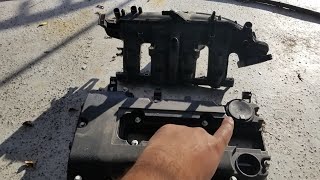
Typical fix: Replace the entire valve cover assembly. If the intake manifold check valve is missing, replace the intake manifold or install an aftermarket external check valve kit 🎬 See this diagnosis walkthrough for P0300 and PCV issues. (e.g., from CruzeKits.com). Replacing only the valve cover without addressing the missing check valve will result in repeat failure.
Est. part cost: $60 - $250 - Failed Ignition Coil Pack 🔴 High Probability The single coil pack design is a very common failure item on this engine due to heat and vibration, often after 100,000 miles. Oil leaks from a bad valve cover gasket can also seep into the spark plug tubes and damage the coil boots, leading to failure.
How to confirm: A scan tool may show misfire counts concentrated on one or two cylinders even with a P0300 code. Visually inspect the coil pack for cracks and the boots for oil contamination or corrosion. A shorted coil pack can sometimes blow the injector control fuse.
Typical fix: Replace the entire ignition coil pack assembly. It is strongly recommended to replace all four spark plugs at the same time with high-quality parts (ACDelco, Delphi, NGK) to prevent premature failure of the new coil.
Est. part cost: $70-$150 - Worn or Incorrect Spark Plugs 🟡 Medium Probability These engines are sensitive to spark plug type and condition. Using non-OEM plugs or extending service intervals can lead to misfires. The increased resistance of worn plugs can also overwork and damage the ignition coil.
How to confirm: Inspect the spark plugs for wear (worn electrode), fouling (black, sooty, or oily deposits), or incorrect gap. Oil in the spark plug well is a clear sign of a leaking valve cover gasket.
Typical fix: Replace all four spark plugs with the correct OEM-spec (ACDelco Iridium) plugs. Always replace plugs when installing a new ignition coil. 🎬 Watch: How to replace your spark plugs and coil pack.
Est. part cost: $30-$60 - Vacuum Leak (Other than PCV) ⚪ Low Probability Hoses and gaskets can become brittle with age and heat, leading to cracks and leaks. A common secondary failure from a bad PCV system is a blown front crankshaft seal, which creates a vacuum leak.
How to confirm: A smoke test is the most effective way to find hidden vacuum leaks. Often accompanied by a P0171 (System Too Lean) code. A high-pitched chirp from the belt area that stops when the dipstick is pulled is a tell-tale sign of a failed crankshaft seal.
Typical fix: Replace the cracked hose or failed gasket. The crankshaft seal is a more involved repair.
Est. part cost: $10-$200
Rare But Worth Checking
- Cracked Piston / Broken Piston Ring Land: A serious mechanical failure documented in GM TSB 18-NA-171 and 19-NA-090. It causes low compression, oil consumption, and a P0300 code, and may be preceded by other codes like P0171. This requires an engine compression test to confirm and is a major repair, often requiring an engine rebuild.
- Faulty Fuel Injector: While less common than ignition or PCV issues, a clogged or failing fuel injector can cause misfires. This may be accompanied by a specific injector circuit code, like P0201 for cylinder 1 or P0261/P0263. TSB Bulletin #PIP5353F notes that for vehicles with a rough idle or misfire and P0300 set, technicians should use schematics to compare Fuel Injector Control Circuit wire colors.
- Faulty Negative Battery Cable: Covered under GM Special Coverage 14311B, a faulty negative battery cable can cause a host of random electrical issues, including stalling and seemingly unrelated error codes, due to insufficient grounding. Symptoms include the radio display flickering, Stabilitrak warnings, and loss of power steering assist.
Diagnosis Steps
- Read all stored fault codes with an OBD-II scanner. Pay close attention to codes like P0171 or P1101, which point to a vacuum leak. TSB Bulletin #PIP5628G provides preliminary information for diagnosing vehicles with misfire and codes P0300 through P0308.
- With the engine idling, listen for a loud hissing or whistling sound from the valve cover, indicating a ruptured PCV diaphragm.
- Perform the 'oil cap test': while idling, try to remove the oil filler cap. If it is held on by strong vacuum, the PCV diaphragm in the valve cover has failed and the cover must be replaced.
- CRITICAL: Before ordering a new valve cover, remove the PCV tube from the intake manifold and visually inspect the port for the small, orange, rubber check valve. A missing valve requires intake manifold replacement or an aftermarket fix kit.
- Inspect the ignition coil pack and spark plug wells for any signs of oil. Oil presence indicates a leaking valve cover gasket that must be replaced along with the coil and plugs.
- Inspect the spark plugs for wear, damage, or fouling. Ensure they are the correct type for the engine (ACDelco Iridium is OEM).
- If no obvious PCV failure is found, perform a smoke test to check for other vacuum leaks in hoses or the intake manifold gasket.
- As a final step if all else fails, perform an engine compression test to check for mechanical issues like a cracked piston, which is a known but rare issue covered by TSB 18-NA-171.
Parts You'll Likely Need
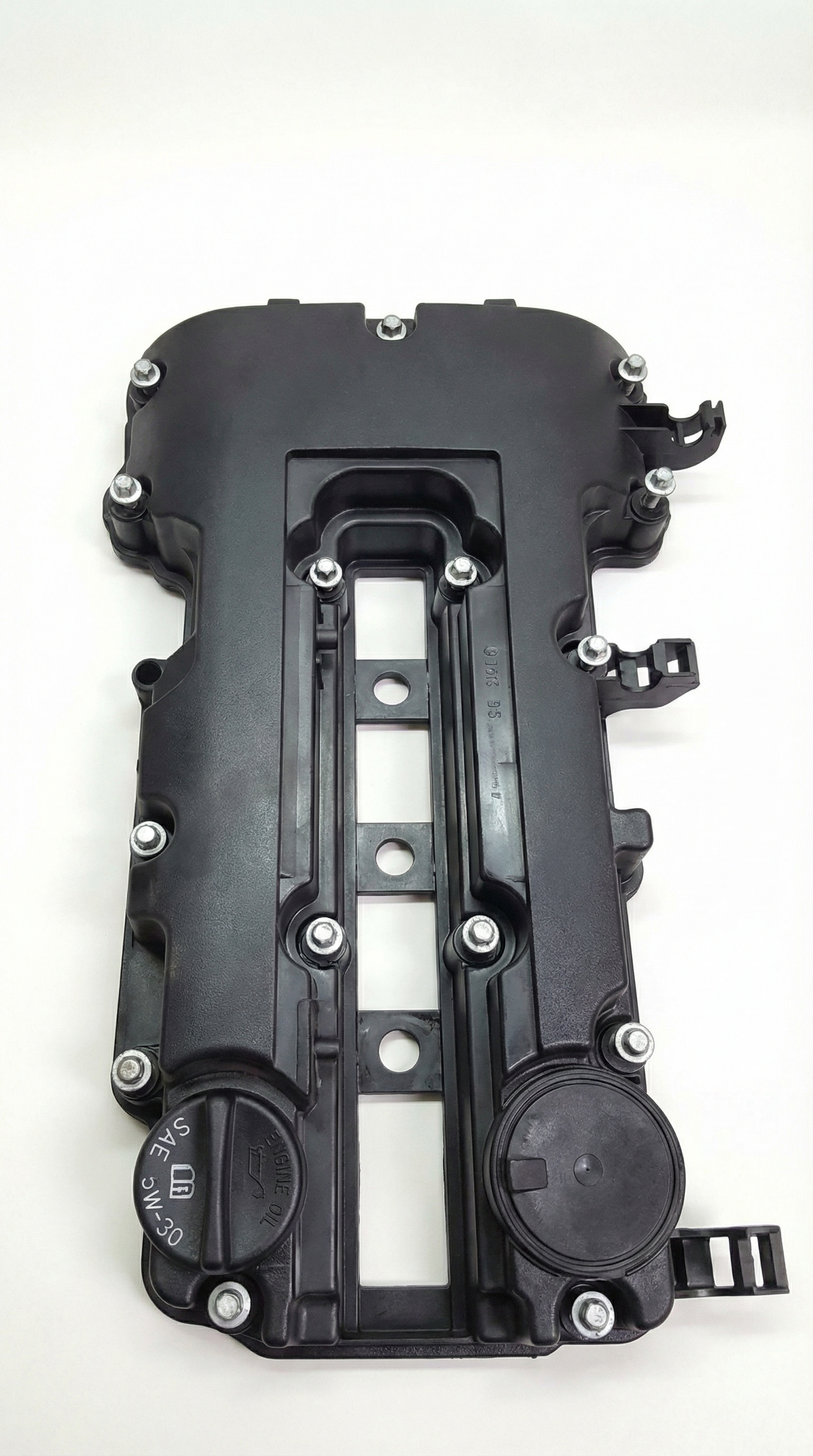
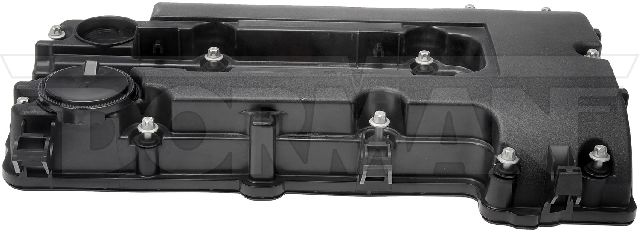
- Valve Cover / Camshaft Cover Assembly
(OEM #25198874, 55573746 (superseded))— This is the most common fix. The PCV diaphragm is integrated into the cover and is not sold separately by GM. A ruptured diaphragm creates a massive vacuum leak causing the P0300 code. Failure is often a direct result of the intake manifold check valve failing first.
Trusted brands: ACDelco (OEM), Dorman (Aftermarket, sometimes includes helpful instructions warning about the intake check valve)
OEM price range: $120-$180
Aftermarket price range: $60-$100
Related Codes That Often Appear With This One
- P0171 — System Too Lean. This code is very common with P0300 on the Cruze and strongly indicates a vacuum leak, most likely from the failed PCV system.
- P0299 — Turbocharger Underboost. A massive vacuum leak from the PCV system can sometimes affect turbo pressure and trigger this code alongside the misfire.
- P1101 — MAF Sensor Out of Self-Test Range. This code can also be triggered by the large unmetered air leak from a failed PCV system.
- P0301, P0302, P0303, P0304 — Cylinder-specific misfire codes. Sometimes the ECU will log a random P0300 code before or along with a code for a specific cylinder that is misfiring most frequently.
Technical Service Bulletins (TSBs) & Recalls
- 18-NA-171 / 19-NA-090: Documents diagnosis for P0300 caused by low compression from a cracked piston.
- 14311B: Special Coverage for faulty negative battery cable causing various electrical issues.
- PIP5197H: Discusses oil consumption and notes that a broken piston ring land can cause P0300 and P0171.
- TSB Bulletin #PIP5628G: Provides diagnostic information for TAC regarding misfires and DTC codes P0300 - P0308.
- TSB Bulletin #PIP5353F: Addresses rough idle or misfire with P0300, directing technicians to verify Fuel Injector Control Circuit wiring.
Platform-Specific Known Issues
- PCV System Chain Reaction Failure: The most significant issue is the sequential failure of the PCV system. The check valve in the intake manifold gets dislodged, allowing boost pressure into the crankcase, which then ruptures the weaker diaphragm in the valve cover. This creates the vacuum leak that triggers P0300 and P0171. A user on Reddit detailed their experience replacing the intake with a Dorman upgrade after a PCV fix kit failed, only to then get a P0300, highlighting the complexity.
- Owner Repair Story: Melting Coil Pack: A technician on YouTube shared a story of a 2014 Cruze that kept melting the #1 position on new ignition coil packs. The root cause was found to be coolant leaking from the coolant temperature sensor connector on the thermostat housing, shorting the circuit.
Mechanic-Grade Diagnostic Values
- Low-Side Fuel Pressure (Pump Commanded On, Engine Off) — expected: 50 - 94 PSI. Failure: Pressure below 50 PSI indicates a weak fuel pump, clogged filter, or wiring issue.
- Low-Side Fuel Pressure (At Idle) — expected: 40 - 58 PSI. Failure: Pressure significantly below 40 PSI at idle can indicate a failing fuel pump.
- Ignition Coil Primary Resistance — expected: 0.4 - 2.0 Ohms. Failure: A reading outside this range indicates a faulty primary winding in the coil pack.
- Ignition Coil Secondary Resistance — expected: 6,000 - 12,000 Ohms. Failure: A reading outside this range or an open circuit (OL) indicates a faulty secondary winding.
- MAP Sensor Voltage (Key On, Engine Off) — expected: ~4.5 Volts. Failure: Voltage significantly different from atmospheric pressure reading indicates a faulty sensor or wiring.
- MAP Sensor Voltage (Engine at Idle) — expected: 1.0 - 2.0 Volts. Failure: Voltage that is stuck high or does not respond to changes in engine vacuum suggests a sensor failure.
- Fuel Injector Resistance — expected: ~12 Ohms. Failure: An open circuit (OL) or a reading significantly different from 12 Ohms points to a bad injector coil.
Scan Tool Commands That Help
- GDS2 / Tech2: Crankshaft Position Variation Learn — Required after replacing the crankshaft position sensor, ECM, or performing major engine repairs. Failure to perform this can leave a persistent P0300 or set a P0315 code, even if the mechanical repair is correct.
- GDS2: Throttle Body Idle Air Flow Compensation Reset — After major mechanical repairs like piston replacement, as recommended by TSB 19-NA-090. An incorrect idle airflow value can be learned by the ECM due to the original fault, causing idle instability or stalling after the fix.
Wiring & Ground Locations
- G100 — On the vehicle body frame near the battery tray.. This is the main battery ground stud. The faulty negative battery cable detailed in TSB 14311B connects here. A poor connection at this point due to the faulty cable crimp causes high resistance and widespread electrical issues that can manifest as a P0300 code.
- ECM/PCM Fuse — Under-hood fuse block.. A shorted ignition coil or other component can blow the main fuse for the engine control module, causing a no-start or stalling condition that may be preceded by misfires.
- ECM Connectors (X1, X2) — On the Engine Control Module (ECM).. For advanced diagnostics, ECM pinout diagrams for the Delphi MT80 ECU are available. This allows a technician to test for correct voltage and ground signals at the ECM for the ignition coil, fuel injectors, and various sensors to isolate a wiring or component fault.
Real Owner Repair Stories
- 2CarPros Forum User (2016 Chevrolet Cruze 1.4L, 50,000 miles) — Stalling, shutting off, Check StabiliTrak light on, P0300 code.
❌ Tried (didn't work) Initial diagnosis was inconclusive.
✅ What actually fixed it The engine was found to have a cracked piston in cylinder 1. The engine was replaced under the powertrain warranty. The user noted this was apparently a known issue for a number of these cars. - Go-Parts Article / YouTube Channel 'GQnnostics and Repair' (2017 Chevrolet Cruze LT 1.4L Turbo, 151,000 miles) — P0300 and P0302 (Cylinder 2 Misfire).
❌ Tried (didn't work) Initial thought was to perform a full tune-up due to high mileage.
✅ What actually fixed it Upon inspection, two of the four spark plugs were found to be loose in the cylinder head. The looseness was sufficient to cause compression leakage and misfires. Replacing and correctly tightening all four spark plugs resolved the issue. - YouTube user 'P0300...How I fixed My code....P0300. Simple steps!' (Not specified, but general auto repair context) — Persistent P0300 code after checking plugs, coils, and compression.
❌ Tried (didn't work) Spark plug replacement, Ignition coil inspection, Compression test (which passed)
✅ What actually fixed it The issue was traced to a poor electrical connection at the camshaft position sensor connector. After unplugging, inspecting, and reconnecting the sensor, the P0300 code did not return, suggesting a contact issue was causing erratic signals that the ECU interpreted as a random misfire. - NHTSA ODI #11129698 — An owner reported a rough start along with Service StabiliTrak, Traction Control, and a P0300 code for a cylinder #3 misfire. Despite replacing spark plugs and cleaning fuel injectors, the rough start persisted.
"I Checked Everything" — The Actual Cause
- Cracked Piston / Broken Ring Land: This internal mechanical failure will not be found with a smoke test. It must be diagnosed with an engine compression test, followed by a cylinder leak-down test.
- Faulty Negative Battery Cable: This electrical fault (TSB 14311B) creates unstable voltage and grounding for the entire vehicle's electronic systems, including the ignition and fuel systems. It will not cause a vacuum leak and is diagnosed with a voltage drop test or by inspecting the cable for the faulty crimp design.
- Loose Spark Plugs: Plugs that are not torqued correctly can leak compression, causing a misfire. This is a mechanical sealing issue at the cylinder head, not a vacuum leak in the intake path that a smoke test would identify.
OEM Part Supersession History
55573746→25198874— Standard part revision by GM. The design remains functionally identical.Original Negative Battery Cable (pre-TSB 14311B)→Revised Negative Battery Cable (e.g., P/N 22754271)— The original cable had an insufficient terminal crimp that failed over time. The revised part has a more robust connection.
Heads up: The revised cable design requires a separate bolt (GM P/N 11561025) to attach the small regulated voltage cable, as it no longer has an integrated stud like the original.
Model Year Variations Within This Range
- 2011-2016: Per GM TSB 19-NA-090, an ECM software calibration was released specifically for Cruze vehicles to help reduce the possibility of a cracked piston. If diagnosing a P0300 with low compression, ensure the vehicle has the latest software version.
- 2011-2015: These model years are covered by GM Special Coverage 14311B for the faulty negative battery cable. 2016 models are not included in this specific TSB.
Diagnostic Flowchart
Other Known Issues on This Vehicle
Issues unrelated to this code that are worth knowing about as an owner of this generation:
- Chronic Coolant System Leaks 🔴 High — Extremely common. The plastic water pump, thermostat housing, and water outlet are all prone to cracking and leaking, often starting around 60,000-80,000 miles. (Ref: Special Coverage 14329 for water pump (10yr/150k miles))
- Leaking Oil Cooler Gaskets 🟠 Medium — Common failure after 75,000 miles. Gaskets between the oil cooler and engine block degrade, causing oil to leak onto the hot exhaust manifold, creating a burning smell and fire risk.
- Faulty Negative Battery Cable 🟠 Medium — Widespread issue on 2011-2015 models. An insufficient crimp on the terminal causes high resistance, leading to a wide range of bizarre electrical problems, random warning lights, and stalling. (Ref: Special Coverage 14311B (10yr/120k miles))
- Transmission Failure / Harsh Shifting 🟠 Medium — More prevalent in early (2011-2012) models. Owners report harsh shifting, getting stuck in gear, and complete failure.
- Turbocharger Wastegate Actuator Failure 🟡 Low — A small retaining clip on the wastegate actuator arm can fall off, causing the wastegate to stay open and triggering a P0299 underboost code. This is a very cheap fix often misdiagnosed as a failed turbo.
Used vs. New Parts: Buying Guide for This Vehicle
When a used part is the smart pick: For this specific repair, sourcing a used Intake Manifold can be a cost-effective choice, provided it comes from a low-mileage donor and you can physically verify that the internal orange PCV check valve is present and intact before purchase. Most other causal parts are wear items and should not be purchased used.
Donor-vehicle mileage cap: roughly under 70000 miles for the part to have meaningful remaining life.
What to inspect on the donor part:
- For an intake manifold, shine a light into the PCV port to ensure the orange check valve is not missing or damaged.
- Check for cracks or damage around mounting points and sensor ports.
- Avoid parts from vehicles that show signs of severe overheating (melted plastic, warped surfaces).
OEM-only on this vehicle (don't cheap out):
- While not strictly 'OEM-only', using a high-quality, reputable brand for the Ignition Coil Pack is critical. Cheap, unbranded coils have a very high failure rate on this engine.
Aftermarket brands forum-validated for this vehicle:
- Ignition Coils & Spark Plugs: ACDelco (OEM), NGK, Delphi
- Valve Cover: Dorman (often includes updated instructions), ACDelco (OEM)
- PCV Fix Kits: CruzeKits.com (for external check valve solutions)
Brands owners have reported issues with on this vehicle:
- Unbranded, no-name ignition coils and valve covers from online marketplaces are frequently reported on forums as failing quickly, sometimes within weeks or months.
Real Owner Stories
Aggregated from forums and TSBs cited above. Mileages and costs reflect what owners reported in those sources.
2014 Chevrolet Cruze 1.4L Turbo
Symptoms: The engine was repeatedly melting the ignition coil pack at the #1 cylinder position.
What fixed it: Repaired a coolant leak at the coolant temperature sensor connector on the thermostat housing that was shorting the circuit.
Source hint: YouTube technician story in vehicle_specific_issues
2011-2016 Chevrolet Cruze 1.4L Turbo
Symptoms: Owner experienced a P0300 after a PCV fix kit failed and they replaced the intake with a Dorman upgrade.
What fixed it: The story highlights the complexity of the PCV failure chain, involving the intake manifold and valve cover.
Source hint: reddit.com/r/Cruze thread mentioned in vehicle_specific_issues
2011-2016 Chevrolet Cruze 1.4L Turbo — ~100000 miles
Symptoms: Misfire counts concentrated on one or two cylinders; visual cracks found on the coil assembly.
What fixed it: Replacement of the entire ignition coil pack assembly and all four spark plugs.
Source hint: common_causes for Failed Ignition Coil Pack
2015 Chevrolet Cruze
Symptoms: Rough start and Service StabiliTrak/Traction Control warnings with a P0300 code for cylinder #3 misfire.
What fixed it: An owner reported that replacing spark plugs and cleaning fuel injectors did not resolve the rough start (NHTSA ODI #11129698).
Source hint: NHTSA ODI #11129698
Related OBD-II Codes
Frequently Asked Questions
My 2014 Cruze is melting the #1 ignition coil pack repeatedly. Is there a known cause for this?
Does TSB 18-NA-171 apply to my P0300 misfire code?
I found a hissing sound near my valve cover. Do I just need to replace the cover to fix the P0300?
Is there a special warranty for the water pump on my 2011-2016 Cruze?
Can a bad battery cable cause a P0300 misfire on this car?
Why does my engine chirp at idle, and why does it stop when I pull the dipstick?
Helpful Videos

Used OEM Parts in Stock
New Aftermarket Parts Available


The information in this article is provided for general reference and educational purposes only. Vehicle specifications, procedures, and part compatibility can vary by production date, trim level, and region. Always consult your vehicle's factory service manual and verify part numbers before purchasing or performing repairs. Safety-critical components such as airbags, seat belts, and braking systems should be installed by a qualified professional.
- Chevrolet Cruze:
- 🎬 Helpful Videos
- 🛍️ Shop This Part
- What's Unique About the 2011-2016 Chevrolet Cruze
- Symptoms You May Notice
- Most Likely Causes
- Rare But Worth Checking
- Diagnosis Steps
- Parts You'll Likely Need
- Related Codes That Often Appear With This One
- Technical Service Bulletins (TSBs) & Recalls
- Platform-Specific Known Issues
- Mechanic-Grade Diagnostic Values
- Scan Tool Commands That Help
- Wiring & Ground Locations
- Real Owner Repair Stories
- "I Checked Everything" — The Actual Cause
- OEM Part Supersession History
- Model Year Variations Within This Range
- Diagnostic Flowchart
- Other Known Issues on This Vehicle
- Used vs. New Parts: Buying Guide for This Vehicle
- Real Owner Stories
- 2014 Chevrolet Cruze 1.4L Turbo
- 2011-2016 Chevrolet Cruze 1.4L Turbo
- 2011-2016 Chevrolet Cruze 1.4L Turbo — ~100000 miles
- 2015 Chevrolet Cruze
- Related OBD-II Codes
- Frequently Asked Questions
- 🎟️ Get 5% Off