

P0277 on 2001-2012 Hyundai Santa Fe: Cylinder 6 Injector Circuit High Causes and Fixes
This code means there's a high voltage fault in the cylinder 6 fuel injector circuit. The most common causes are a failed fuel injector or a damaged wire. On V6 Santa Fe models, cylinder 6 is on the firewall side, requiring intake manifold removal for access, making the repair more complex.
- P0277 on a V6 Santa Fe points specifically to an electrical issue with the cylinder 6 fuel injector, not an ignition component.
- The most probable causes are a bad injector or a wiring fault.
- Repair is complex for DIYers because cylinder 6 is on the rear bank, requiring removal of the upper intake manifold.
- Always replace the intake manifold gasket during this repair to prevent future vacuum leaks.
- Before replacing parts, test the injector's resistance and check the wiring harness for a signal pulse with a noid light.
What's Unique About the 2001-2012 Hyundai Santa Fe
On the V6 engines in the 2001-2012 Santa Fe, the engine is mounted transversely, placing cylinder 6 on the rear bank against the firewall. This location makes diagnosis and repair significantly more labor-intensive than for the front cylinders, as the upper intake manifold must be removed to access the injector and its wiring. While there are no major recalls for this specific code, injector circuit faults are a known issue for this platform.
Generation note: The 2001-2012 model years span two Santa Fe generations. The first generation (SM, 2001-2006) used the 2.7L 'Delta' and 3.5L 'Sigma' V6 engines. The second generation (CM, 2007-2012) used a different 2.7L 'Mu' V6, a 3.3L 'Lambda' V6, and a 3.5L 'Lambda II' V6. The fundamental cause of P0277 is the same across generations, but the specific part numbers for injectors and gaskets will vary by engine.
Symptoms You May Notice
- Check Engine Light is on
- Rough or unstable idle
- Engine misfires, which may feel like a stumble or shake
- Noticeable loss of power and poor acceleration
- Reduced fuel economy
- Engine may hesitate or stall
- Burning smell from the engine bay if the injector is stuck open and leaking fuel
- Replacing the spark plug or ignition coil for cylinder 6. While these can cause a misfire (P0306), they do not cause an injector circuit code like P0277. The code specifically points to an electrical fault in the injector circuit, not a combustion or ignition problem.
Most Likely Causes
- Failed Cylinder 6 Fuel Injector 🔴 High Probability Injectors can fail electrically over time due to internal coil windings breaking down or shorting. This is a common failure point on higher mileage vehicles.
How to confirm: After accessing the injector, measure its resistance with a multimeter. It should be within the OEM spec, which is approximately 13.8-15.2 Ohms for many models. A reading of infinity (open circuit) or significantly outside this range indicates a bad injector. A practical test is to swap the cylinder 6 injector with another cylinder (e.g., cylinder 4 on the same bank) and see if the trouble code follows the injector (e.g., changes to P0271 for cylinder 4).
Typical fix: Replace the failed fuel injector. It is often recommended to replace all injectors on the same bank (rear bank: cylinders 2, 4, 6), or all six, if they are original and have high mileage, as the others may fail soon.
Est. part cost: $50-$150 - Damaged or Shorted Wiring Harness 🟡 Medium Probability The engine wiring harness, particularly the section running to the rear bank of cylinders, is exposed to significant heat cycles. Over time, the plastic conduit can become brittle and the wire insulation can crack, leading to a short-to-voltage on the injector's control wire. Rodents can also chew on wiring, causing opens or shorts.
How to confirm: Visually inspect the wiring harness leading to the cylinder 6 injector for any signs of chafing, melting, or broken wires. Pay close attention to where the harness bends or contacts other components. Perform a continuity test on the wires between the injector connector and the PCM connector to check for opens. Check for a short to voltage by testing for battery voltage on the control wire at the PCM with the injector disconnected.
Typical fix: Repair the damaged section of the wire. If the damage is extensive or near the connector, replacing the injector pigtail connector is the best practice.
Est. part cost: $15-$40 - Poor Electrical Connection ⚪ Low Probability
How to confirm: Inspect the connector at the fuel injector and the corresponding pins at the PCM. Look for corrosion, bent pins, or a loose fit. A noid light can be used at the injector connector to verify if the PCM is sending a pulse signal. If the noid light stays on constantly, it points to a short to voltage in the circuit.
Typical fix: Clean the connector terminals with electrical contact cleaner or repair the bent pins. Ensure the connector is fully seated and the locking tab clicks into place.
Est. part cost: $0-$20
Rare But Worth Checking
- Faulty Powertrain Control Module (PCM): This is the least likely cause. The internal driver circuit in the PCM that controls the injector can fail, causing it to send a continuous high voltage signal. This should only be considered after all other possibilities (injector, wiring, connections) have been thoroughly ruled out with testing.
Diagnosis Steps
- Read the trouble codes with an OBD-II scanner and confirm P0277 is present. Note any other codes like P0306.
- Disconnect the battery. To access cylinder 6, the upper intake manifold (plenum) must be removed. This is a multi-step process involving disconnecting various hoses, sensors (like the MAP sensor and throttle body), and EGR components.
- Once the intake is removed, locate the cylinder 6 fuel injector on the rear fuel rail. It is the cylinder on the driver's side of the rear bank.
- Visually inspect the injector's electrical connector and the surrounding wiring for any obvious damage, melting, or corrosion.
- Disconnect the injector. Use a multimeter set to Ohms to measure the resistance across the two pins of the injector itself. Compare the reading to the specification (approx. 13.8-15.2 Ohms for many models, though some 3.3L/3.8L injectors are closer to 12 Ohms). If it's out of spec (especially an open circuit or zero resistance), the injector is faulty.
- If the injector resistance is good, check the wiring. Reconnect the battery. Use a noid light plugged into the injector's harness connector. Have a helper crank the engine. The noid light should flash, indicating the PCM is sending a pulse signal. If it does not flash, or if it stays on continuously, there is a wiring or PCM issue.
- If the noid light test points to a problem, perform a continuity test on the two wires from the injector connector back to the PCM connector to check for breaks or shorts. Check for voltage on the signal wire; it should be near zero when the injector is commanded on.
- If the injector and wiring are confirmed to be good, the fault may lie with the PCM, but this is rare and requires professional diagnosis.
Parts You'll Likely Need
- Fuel Injector (Cylinder 6)
(OEM #35310-37150, 35310-23600, 35310-3C000)— This is the most common component to fail, either electrically or mechanically. Part number varies by engine: 35310-37150 is common for 2.7L/3.5L (Gen 1), 35310-23600 for 2.7L (Gen 2), and 35310-3C000 for 3.3L (Gen 2). Always verify with VIN.
Trusted brands: Bosch, Standard Motor Products, Beck/Arnley, Genuine Hyundai
OEM price range: $120-$180
Aftermarket price range: $50-$100 - Upper Intake Manifold (Plenum) Gasket
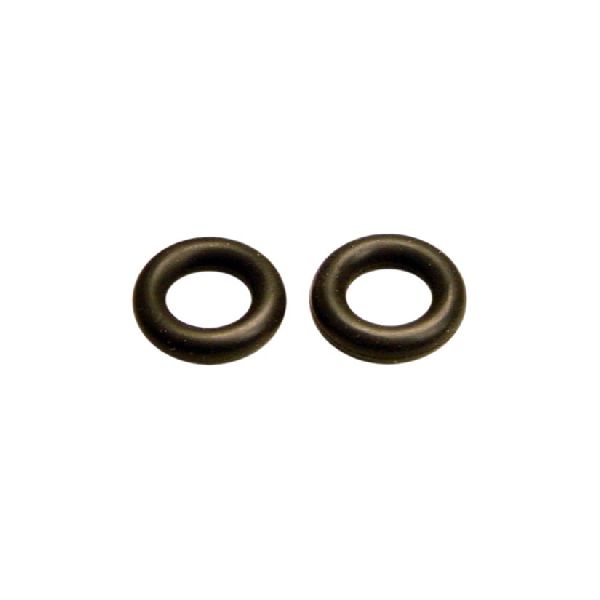
(OEM #28411-37200, 29215-3C100)— This gasket must be replaced whenever the upper intake manifold is removed to access the rear injectors. Reusing the old gasket will likely cause a vacuum leak. Part number varies by engine.
Trusted brands: Fel-Pro, Victor Reinz, Mahle
OEM price range: $25-$40
Aftermarket price range: $15-$30 - Throttle Body Gasket — The throttle body is removed as part of the intake manifold disassembly. It is best practice to replace its gasket to prevent vacuum leaks.
Trusted brands: Fel-Pro, Mahle
OEM price range: $5-$15
Aftermarket price range: $3-$10
Related Codes That Often Appear With This One
- P0306 — P0306 is 'Cylinder 6 Misfire Detected'. Since P0277 prevents the injector from delivering fuel correctly, it directly causes cylinder 6 to misfire.
- P0300 — This is a 'Random/Multiple Cylinder Misfire' code. It can sometimes appear alongside P0277 if the engine is running very poorly and the instability is detected across other cylinders.
- P0206 — P0206 is 'Injector Circuit/Open - Cylinder 6'. This code may appear with P0277 if the PCM detects both a general malfunction and a specific high voltage condition in the same circuit.
Platform-Specific Known Issues
- source — A user on hyundai-forums.com with a 2007 Santa Fe 3.3L experienced codes P0277 and P0306. After following diagnostic steps, they confirmed the #6 injector was faulty. The thread details the process of removing the intake plenum to access the rear injectors, confirming the significant labor involved. The fix was replacing the single failed injector, which resolved both codes.
Mechanic-Grade Diagnostic Values
- Fuel Injector Coil Resistance (2.7L/3.5L Delta/Sigma Engines) — expected: 13.8 - 15.2 Ohms at 68°F (20°C). Failure: A reading of infinity (open circuit), near zero (short circuit), or a value significantly outside the expected range. All injectors should measure within 0.5 Ohms of each other.
- Fuel Injector Coil Resistance (General, all V6 engines) — expected: Approximately 10 - 16 Ohms. Failure: A reading significantly outside this range, or one injector that is an outlier compared to the others.
- Injector Control Wire Voltage (at PCM or Injector Connector) — expected: Should show battery voltage with Key On, Engine Off. Should pulse towards ground when the engine is cranking or running.. Failure: If the voltage remains high (stuck at battery voltage) when it should be pulsing to ground, this indicates an open in the control circuit or a faulty PCM driver. This is the direct cause of a 'Circuit High' code.
Scan Tool Commands That Help
- Hyundai GDS (Global Diagnostic System): Actuation Test - Fuel Injector Cut-Off — This function allows a technician to command individual fuel injectors off, one by one, while the engine is idling. If cutting off cylinder 6 causes no change in engine RPM or smoothness, it confirms that cylinder was not contributing, supporting the P0277 diagnosis. This is useful for verifying the fault before disassembly.
- Hyundai GDS (Global Diagnostic System): Resetting Adaptive Values — After replacing a fuel injector or repairing a circuit fault, this function should be used to clear the PCM's long-term fuel trim adaptations. This forces the computer to relearn fuel delivery strategies with the new, functioning component, ensuring smooth operation and preventing the old adaptations from causing new issues.
Wiring & Ground Locations
- G52 — Located in the left rear of the engine compartment.. This is a primary ground point for the Powertrain Control Module (PCM) and multiple engine sensors on the second generation (2007-2012) Santa Fe. A corroded or loose G52 ground can cause a floating ground reference for the PCM's injector drivers, potentially leading to incorrect voltage readings and fault codes like P0277.
- Cylinder 6 Injector Control Wire — Runs from a specific pin on the PCM connector to the cylinder 6 fuel injector connector. The rear bank harness is routed near the firewall and is susceptible to heat damage.. A 'Circuit High' fault is often caused by an open in this wire or a short-to-voltage. An open prevents the PCM from pulling the circuit to ground, so it stays at the supply voltage. Technicians must test continuity from the PCM pin to the injector connector pin to rule out a wire break.
OEM Part Supersession History
35310-37150→35310-37150 (current)— This part number remains the primary OEM number for the Gen 1 2.7L V6 engines.
Heads up: This part is often cross-referenced to aftermarket numbers like GB Remanufacturing 842-12255 and Kefico 9260930004. While it fits many 2.5L and 2.7L Delta engines, it is not compatible with the Gen 2 2.7L 'Mu' or 3.3L/3.5L 'Lambda' engines.
Model Year Variations Within This Range
- 2001-2006 (Gen 1): These models used the 2.7L Delta V6 and the 3.5L Sigma V6. The Sigma engine is a cast-iron block design based on a Mitsubishi architecture, while the Delta is an all-aluminum Hyundai design. They use different fuel injectors (e.g., 35310-37150 for the 2.7L) and intake gaskets.
- 2007-2009 (Gen 2, pre-facelift): These models introduced the 2.7L 'Mu' V6 and the 3.3L 'Lambda' V6. The Mu is an evolution of the Delta, adding Continuously Variable Valve Timing (CVVT). The Lambda is a more modern, all-aluminum DOHC engine family with timing chains. Parts are not interchangeable with the first generation.
- 2010-2012 (Gen 2, facelift): The 2.7L and 3.3L V6 engines were replaced by a new 3.5L 'Lambda II' V6 (and a 2.4L I4). This 3.5L engine is part of the same family as the 3.3L but has different displacement and part numbers (e.g., injector 35310-3C000 may fit some Lambda engines but verification is critical).
Diagnostic Flowchart
Other Known Issues on This Vehicle
Issues unrelated to this code that are worth knowing about as an owner of this generation:
- Crankshaft Position Sensor (CKP) Failure 🔴 High — Very common across all V6 engines in this range. Often causes intermittent stalling or no-start conditions, typically when the engine is hot.
- Valve Cover Gasket Oil Leaks 🟠 Medium — Common on the 3.3L V6, where the front valve cover can leak oil directly onto the alternator, causing charging system failure. Also occurs on the 2.7L engines, where oil can fill the spark plug wells. (Ref: Service Campaign 936 (TSB 15-01-031) for 2007-2009 3.3L models. Later updated by TSB 23-01-076H-1.)
- Subframe and Rear Trailing Arm Corrosion 🔴 High — Significant rust issues, particularly for vehicles operated in 'Salt Belt' states, can lead to perforation of the front subframe or rear trailing arms, creating a major safety hazard. (Ref: Recall/Service Campaign 090 for 2001-2003 models and a service campaign for 2007-2012 models.)
- Faulty Fuel Level Sending Unit 🟡 Low — Widespread on 2007-2009 models, causing erratic and inaccurate fuel gauge readings. The gauge may show empty after a fill-up or fluctuate randomly. (Ref: Often triggers code P0463.)
- Automatic Transmission Shift Issues 🟠 Medium — Owners report hesitation, jerky shifting, or harsh engagement, particularly on second-generation (2007-2012) models. Ensuring the correct fluid and latest TCM software is installed is a common first step.
Used vs. New Parts: Buying Guide for This Vehicle
When a used part is the smart pick: For this repair, buying a used fuel injector is generally not recommended. The cost savings are minimal compared to the labor required to access the rear bank injectors. If a used injector fails prematurely, the entire labor-intensive job must be repeated. A used wiring harness pigtail from a junkyard can be a viable option if the connector is damaged and a new pigtail is unavailable.
Donor-vehicle mileage cap: roughly under 80000 miles for the part to have meaningful remaining life.
What to inspect on the donor part:
- For a wiring pigtail, inspect for any brittleness, cracking, or melting of the plastic connector body.
- Ensure the wire insulation is flexible and not cracking.
- Check that the connector's locking tab is intact and functional.
- Avoid parts from vehicles with obvious signs of engine fire, flood damage, or rodent infestation.
OEM-only on this vehicle (don't cheap out):
- Powertrain Control Module (PCM) - Aftermarket or used PCMs can have compatibility and programming issues. A new or professionally remanufactured OEM unit is the safest choice.
Aftermarket brands forum-validated for this vehicle:
- Standard Motor Products (SMP): Widely regarded in forums as a reliable OE-quality alternative for sensors and electrical components, including fuel injectors.
- Fel-Pro, Victor Reinz, Mahle: These are trusted brands for the required intake plenum and throttle body gaskets.
- Bosch: As an OEM supplier for many brands, their injectors are a high-quality choice.
Brands owners have reported issues with on this vehicle:
- Unnamed/unbranded injectors from online marketplaces: These often lack proper quality control, may not be flow-matched, and have a high failure rate. The low price is not worth the risk of having to redo the repair.
Real Owner Stories
Aggregated from forums and TSBs cited above. Mileages and costs reflect what owners reported in those sources.
2007 Hyundai Santa Fe 3.3L V6
Symptoms: The owner experienced a Check Engine Light with codes P0277 and P0306.
What fixed it: Replacing the single failed fuel injector for cylinder 6 resolved both trouble codes.
Source hint: Real-world repair on Hyundai-Forums
Related OBD-II Codes
Frequently Asked Questions
Where is the cylinder 6 fuel injector located on my Santa Fe V6, and is it hard to access?
What is the correct resistance for a fuel injector on my 2.7L or 3.3L Santa Fe?
I have code P0277. Should I replace just the one bad injector or all of them?
My scanner shows both P0277 and P0306. Are these codes related?
How can I test the wiring harness for the P0277 code?
What other Hyundai or Kia vehicles share this same potential injector problem?
Helpful Videos


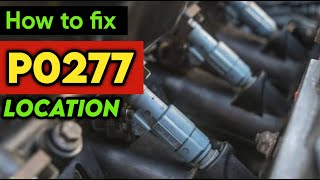

Used OEM Parts in Stock


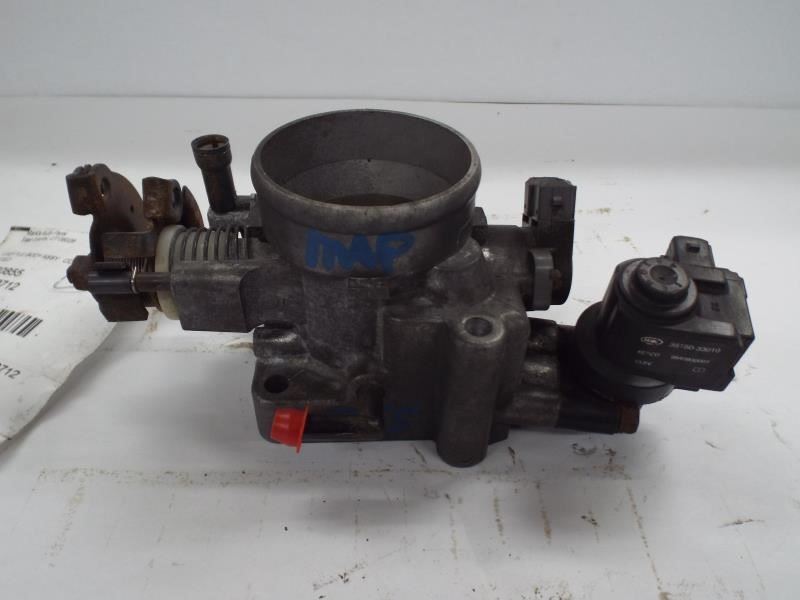
New Aftermarket Parts Available


The information in this article is provided for general reference and educational purposes only. Vehicle specifications, procedures, and part compatibility can vary by production date, trim level, and region. Always consult your vehicle's factory service manual and verify part numbers before purchasing or performing repairs. Safety-critical components such as airbags, seat belts, and braking systems should be installed by a qualified professional.
- Hyundai Santa Fe:
- 🎬 Helpful Videos
- 🛍️ Shop This Part
- What's Unique About the 2001-2012 Hyundai Santa Fe
- Symptoms You May Notice
- Most Likely Causes
- Rare But Worth Checking
- Diagnosis Steps
- Parts You'll Likely Need
- Related Codes That Often Appear With This One
- Platform-Specific Known Issues
- Mechanic-Grade Diagnostic Values
- Scan Tool Commands That Help
- Wiring & Ground Locations
- OEM Part Supersession History
- Model Year Variations Within This Range
- Diagnostic Flowchart
- Other Known Issues on This Vehicle
- Used vs. New Parts: Buying Guide for This Vehicle
- Real Owner Stories
- 2007 Hyundai Santa Fe 3.3L V6
- Related OBD-II Codes
- Frequently Asked Questions
- 🎟️ Get 5% Off