

P0217 on 2009-2019 Ford Flex 3.5L: Engine Overheating Causes and Fixes
Code P0217 means your Ford Flex engine is overheating. While simple issues like a stuck thermostat are possible, the most notorious cause on the 3.5L V6 is a failing internal water pump. A water pump replacement is a major, expensive repair often costing $2,000-$4,000. A leak near the passenger side of the engine is the key symptom.
- P0217 is a critical overheat code. Stop driving immediately to prevent engine damage.
- The most likely serious cause on a 3.5L Flex is the internal water pump, a very expensive repair.
- Check for coolant leaks on the passenger side of the engine, below the alternator, as a key sign of water pump failure.
- Always check simple things first: coolant level, fan operation, and thermostat function before assuming the worst-case scenario.
- If the water pump has failed, it is critical to check if coolant has contaminated the engine oil.
What's Unique About the 2009-2019 Ford Flex
The defining issue for the 3.5L Cyclone V6 in the Ford Flex is its internal water pump. Unlike most engines where the water pump is an external, belt-driven accessory, Ford designed this one to be inside the engine, driven by the timing chain. This design means a simple water pump failure becomes an extremely labor-intensive and expensive repair requiring removal of the entire front timing cover. A special weep hole is designed to leak coolant externally when the pump's internal seal fails, but if the secondary seal also fails, coolant can mix directly with the engine oil, leading to sludge and complete engine destruction.
Generation note: The Ford Flex spans one generation from 2009 to 2019, with a significant facelift in 2013. However, the 3.5L Cyclone V6 engine and its internal water pump design were used throughout the entire production run, making the information here applicable to all model years.
Symptoms You May Notice
- Temperature gauge reading in the red or 'H'
- Engine temperature warning light illuminated
- Check engine light on
- Reduced engine power or 'limp mode' activation
- Steam or smoke coming from the engine bay
- Loud boiling or gurgling sounds from the engine
- Sweet smell of coolant from outside the vehicle
- Visible coolant dripping from the passenger side of the engine bay, near the serpentine belt area
- Replacing only the thermostat when the water pump is the actual cause of the leak and overheat.
- Mistaking the water pump weep hole leak for a leaking freeze plug, head gasket, or cracked block.
- Topping off coolant repeatedly without identifying the source of the leak, which is almost certainly the water pump.
Most Likely Causes
- Internal Water Pump Failure 🔴 High Probability The timing-chain-driven internal water pump is a known, widespread failure point on the Ford 3.5L Cyclone V6 engine across multiple vehicle platforms, including the Flex. Failure is common after 80,000-120,000 miles.
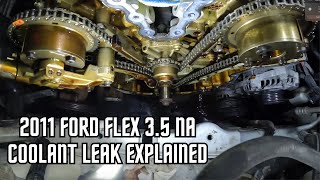
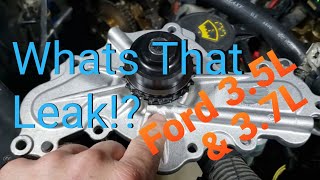
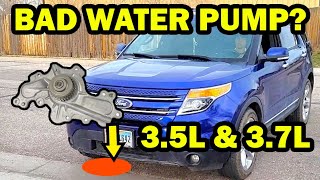
How to confirm: Look for a coolant leak dripping down the passenger side of the engine, often appearing near the A/C compressor or alternator. 🎬 Watch: How to identify a water pump leak on this engine. The leak originates from a specific 'weep hole' designed to channel coolant out of the timing cover when the pump's internal seal fails. NHTSA ODI #11639979 describes a case where a dealer retrieved codes P0217 and P1285, confirming a coolant leak at the water pump weep hole. In severe cases, check the engine oil for a milky, 'milkshake' appearance, which indicates coolant has mixed with the oil internally—a sign of catastrophic pump failure requiring immediate attention.
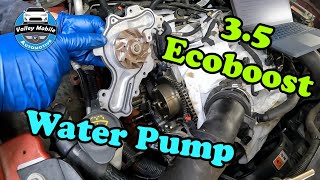
Typical fix: This requires a complete replacement of the water pump. It is highly recommended to replace the timing chain, tensioners, and guides at the same time due to the extensive labor involved. This is a very complex job often requiring 12+ labor hours.
Est. part cost: $250-$500 for a pump and timing kit - Stuck-Closed Thermostat 🟡 Medium Probability
How to confirm: After starting a cold engine, feel the large upper radiator hose. It should remain cool for several minutes and then become hot suddenly as the thermostat opens. If the engine overheats but the hose remains cool or only lukewarm, the thermostat is likely stuck closed.
Typical fix: Replace the thermostat and its housing assembly. It is recommended to use an OEM Motorcraft part to ensure correct operating temperature. This is often replaced as a 'first step' before committing to the water pump job.
Est. part cost: $40-$100 - Cooling Fan Assembly Failure 🟡 Medium Probability The cooling fan control module is a common failure item on the Flex, which can prevent the fans from activating.
How to confirm: With the engine at operating temperature, or by turning on the A/C, both cooling fans should activate. If they do not spin, the issue could be the fan motors, the fan control module, a relay, or a fuse. A module failure can also cause the fans to run constantly, even with the engine off.
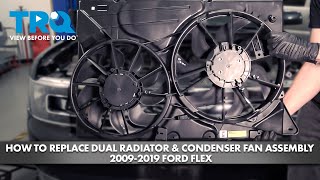
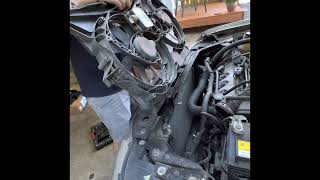
Typical fix: Diagnose the failed component within the fan circuit. Often, the entire dual fan shroud assembly 🎬 See this step-by-step guide for replacing the cooling fan assembly. or just the fan control module is replaced.
Est. part cost: $150-$400 for a fan assembly - Low Coolant Level / External Leak ⚪ Low Probability While any car can develop a leak, this is listed as 'low' probability as a root cause because on this platform, a coolant leak is often a *symptom* of the failing internal water pump.
How to confirm: Visually inspect the coolant reservoir to see if it is below the 'MIN' line. Check for obvious signs of leaks from radiator hoses, the radiator itself, or the coolant reservoir. If a leak is present on the passenger side of the engine, it is highly suspect to be the water pump.
Typical fix: Identify the source of the leak and replace the failed component (e.g., hose, radiator). If no obvious source is found, suspect the internal water pump.
Est. part cost: $20-$300 depending on the part
Rare But Worth Checking
- Clogged Radiator: Internal or external blockages in the radiator can prevent proper heat dissipation, leading to overheating, especially at highway speeds.
- Faulty Cylinder Head Temperature (CHT) Sensor: Unlike many vehicles with a traditional Engine Coolant Temperature (ECT) sensor, this engine uses a Cylinder Head Temperature (CHT) sensor. A faulty CHT can send an incorrect high-temperature signal to the PCM, triggering the P0217 code even if the engine is not actually overheating.
Diagnosis Steps
- SAFETY FIRST: Do not open the coolant reservoir or radiator cap when the engine is hot.
- Check Coolant Level: Once the engine is completely cool, check the level in the coolant reservoir. If low, top it off with the correct Ford-spec coolant (Motorcraft Orange or the backward-compatible Yellow) and look for obvious leaks.
- Verify Overheating: Use an OBD-II scanner to monitor the live Cylinder Head Temperature (CHT) data. Confirm if the temperature is actually exceeding the normal range (typically above 220-230°F).
- Inspect for Water Pump Leak: This is the most crucial step for this vehicle. Carefully inspect the passenger side of the engine block, near the alternator and A/C compressor, for signs of a coolant leak (typically orange or yellow residue). This is the exit point for the internal water pump's weep hole.
- Inspect Cooling Fans: Start the engine and turn the A/C to its coldest setting. Both radiator fans should turn on. If they don't, inspect fuses, relays, and the fan control module.
- Check Thermostat: With a cold engine, start the vehicle and feel the upper radiator hose. It should stay cool for a few minutes and then get hot quickly. If it never gets hot as the temperature gauge climbs, the thermostat is likely stuck closed.
- Check for Coolant in Oil: Remove the oil filler cap and check the underside for a milky, brown sludge. Check the oil dipstick for the same contamination. If present, this indicates a severe internal water pump failure and the vehicle should not be driven.
- Pressure Test System: If no external leaks are obvious, a cooling system pressure test can help identify hard-to-see leaks. NHTSA ODI #11566450 notes that after a cooling system was pressurized and left overnight, most pressure was lost, and a borescope revealed coolant intrusion in the cylinder.
Parts You'll Likely Need
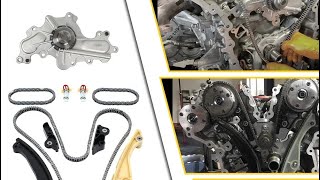
- Water Pump & Timing Chain Kit
(OEM #AT4Z-8501-CA, DG1Z-8501-A, DG1Z-8501-D (Part numbers supersede; verify by VIN).)— This is the most common major failure causing overheating on the 3.5L V6. The repair is so labor-intensive that replacing the timing components simultaneously is standard practice.
Trusted brands: Motorcraft, Gates, Dayco
OEM price range: $100-$160 for pump only
Aftermarket price range: $200-$400 for a full kit - Thermostat Housing Assembly
(OEM #AA5Z-8575-B (example, verify by VIN))— A stuck thermostat is a common cause of overheating and is a logical part to replace during diagnosis due to its low cost compared to the water pump.
Trusted brands: Motorcraft, Dorman
OEM price range: $50-$90
Aftermarket price range: $30-$60
Related Codes That Often Appear With This One
- P1299 — This is a Ford-specific code for 'Cylinder Head Overtemperature Protection Active', which is often triggered alongside P0217 as the PCM takes action to protect the engine. NHTSA ODI #11569516 confirms P0217 appearing with P1285, P1299, and misfire codes P0303 and P0316.
- P0128 — While P0217 is for overheating, P0128 ('Coolant Temperature Below Thermostat Regulating Temperature') can appear if the thermostat is stuck open. A failing cooling system can sometimes exhibit erratic behavior before a complete failure.
- P0302 / P0303 — Misfire codes often accompany P0217 when coolant enters the combustion chamber. NHTSA ODI #11520798 reports P0217 alongside P0302 and P0316 after finding coolant in the cylinder.
Technical Service Bulletins (TSBs) & Recalls
- While no specific TSB addresses the P0217 code directly, the root cause (water pump failure) can lead to oil contamination, which is discussed in TSBs related to timing and VCT solenoids, such as SSM 47170 and SSM 48423 for the 3.5L engine family.
Platform-Specific Known Issues
- Owner Experience: Water Pump Failure: An owner on a forum reported their 2008 3.5L Edge (a platform mate) had its first water pump replaced at 235,000 miles for $1,600 at a Ford dealership, indicating that while failure is common, lifespan can vary.
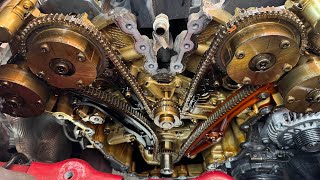
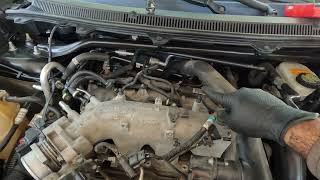
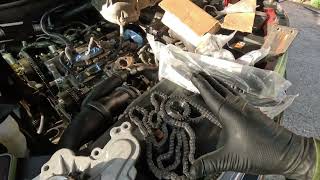
- Repair Video Documentation: Multiple detailed YouTube videos by mechanics demonstrate the complexity of the water pump replacement job, often showing the engine being partially dropped or fully removed from the vehicle for access.
Documented NHTSA Reports
- NHTSA ODI #11593017 describes a vehicle that provided codes P0217 (engine coolant over temperature) along with P0087 (fuel rail pressure), P0219 (engine over speed), and various transmission gear ratio codes (P0732, P0733).
Hidden / Shadow Codes Worth Checking
- P1299: Cylinder Head Overtemperature Protection Active. This Ford-specific code is set by the PCM when it detects a critical overheat from the CHT sensor and actively reduces engine power to prevent damage. (see via Most standard OBD-II scanners can read this P-code, but it confirms the PCM's response to the P0217 condition.)
Scan Tool Commands That Help
- FORScan / Ford IDS: Cooling Fan Control (FC) Variable Command — This bidirectional control allows a technician to command the cooling fans to run at various speeds, bypassing the PCM's automatic control. It is essential for diagnosing a faulty fan control module by proving the fan motors work when commanded directly.
- FORScan / Ford IDS: Monitor CHT PID — Continuously monitoring the Cylinder Head Temperature (CHT) PID is crucial to determine if the engine is truly overheating or if the sensor is providing erratic or false readings. A reading that jumps wildly or goes to a default low value (e.g., -56°F) points to a sensor or wiring failure.
Wiring & Ground Locations
- G104 — Located on the right rear of the engine.. This is a primary engine ground. A poor connection here can cause erratic sensor readings, including from the CHT sensor, potentially leading to a false P0217 code.
- G107 — On non-turbo models, it's at the right rear of the engine compartment. On turbo models, it's at the rear of the right cylinder head.. This ground is used by various engine components. Verifying it is clean and tight is a key step in diagnosing any electrical fault related to engine management.
- Cylinder Head Temperature (CHT) Sensor — On the naturally aspirated 3.5L, the CHT is located on the right-hand (rear) cylinder head, often requiring removal of the intake manifold for access.. This sensor provides the primary temperature reading to the PCM. Damage to its wiring during other engine repairs or sensor failure can directly cause a P0217 or P1299 code.
- Cooling Fan Control Module — For 2009-2011 models, it's mounted directly to the fan shroud behind the radiator. For later models like the 2013, it may be located under the glove box inside the passenger cabin.. This module receives a signal from the PCM to control fan speed. A failure of the module or its wiring/ground will prevent the fans from running, causing overheating in traffic.
OEM Part Supersession History
AA5Z-8501-C→AT4Z-8501-A, AT4Z-8501-CA, DG1Z-8501-A, DG1Z-8501-D— Ford has updated the internal water pump part number multiple times. While specific design changes are not officially published, it is generally assumed that later revisions aim to improve seal longevity and durability.
Model Year Variations Within This Range
- 2009-~2018: Vehicles in this range were typically factory-filled with Motorcraft Orange Antifreeze/Coolant (WSS-M97B44-D).
- ~2019 onwards (and for service): Ford discontinued the Orange coolant and replaced it with Motorcraft Yellow Antifreeze/Coolant (WSS-M97B57-A2). The Yellow coolant is officially approved by Ford as backward-compatible and can be used to top off or completely replace the Orange coolant without requiring a system flush, provided the system is not contaminated.
- 2013-2019: The 2013 model year received a major facelift. While the core engine design remained, some component locations, like the cooling fan control module, may have changed. For example, some sources place the module under the dash for 2013+ models, whereas it was on the fan shroud for earlier years.
Diagnostic Flowchart
Other Known Issues on This Vehicle
Issues unrelated to this code that are worth knowing about as an owner of this generation:
- Power Transfer Unit (PTU) Failure (AWD Models) 🔴 High — Commonly occurs between 50,000 and 100,000 miles. The unit's fluid is subjected to high heat from the nearby exhaust with no cooling and often no drain plug, leading to fluid breakdown and gear failure.
- Electronic Power Assisted Steering (EPAS) Rack Failure 🔴 High — Can fail without warning, resulting in a sudden loss of power steering. Failures are common enough that a recall (15S18) was issued for 2011-2013 models, but earlier models like the 2010 use identical parts and also fail frequently. (Ref: Ford Recall 15S18)
- Detaching Exterior B-Pillar Appliques 🟡 Low — The black glossy trim panels on the front doors can separate and fly off while driving due to improper adhesion from the factory. This is primarily an issue on 2017-2019 models. (Ref: Ford Recall 25SB8 / NHTSA 25V732000)
- Electronic Throttle Body (ETB) Failure 🟠 Medium — Internal electronic faults can cause the vehicle to enter limp mode with various warning lights. Ford acknowledged this with Customer Satisfaction Program 13N03, extending the warranty on the part. (Ref: Customer Satisfaction Program 13N03)
- Cracked/Sticking Brake Calipers 🟠 Medium — The original front caliper brackets can cause uneven pad wear and sticking brakes. An updated caliper and bracket design was released to fix the issue.
Used vs. New Parts: Buying Guide for This Vehicle
When a used part is the smart pick: For this specific repair, used parts are generally not recommended for core components. However, a used cooling fan assembly from a low-mileage, verified-running donor vehicle could be a cost-effective option if the entire assembly is needed. A used coolant reservoir or hoses in good condition are also acceptable.
Donor-vehicle mileage cap: roughly under 60000 miles for the part to have meaningful remaining life.
What to inspect on the donor part:
- For a fan assembly, check for excessive blade wobble or bearing noise when spun by hand.
- Inspect plastic components like the radiator or reservoir for chalkiness, brittleness, or fine cracks.
- Check hoses for softness, bulging, or cracking, especially near the ends.
OEM-only on this vehicle (don't cheap out):
- Water Pump: Given the catastrophic failure mode and extreme labor cost, using anything other than a new OEM (Motorcraft) or a top-tier OEM-supplier aftermarket part is an unacceptable risk.
- Thermostat: Aftermarket thermostats can have slightly different opening temperatures, which can affect engine performance and efficiency. A Motorcraft thermostat is strongly recommended.
- Cylinder Head Temperature (CHT) Sensor: This is a critical sensor. Using a cheap aftermarket version risks inaccurate readings, leading to incorrect diagnosis or persistent issues.
Aftermarket brands forum-validated for this vehicle:
- Water Pump / Timing Kit: Gates, Dayco (These are often OEM suppliers and are well-regarded for timing components).
- Radiator / Fan Assembly: Dorman (for fan assemblies), Spectra Premium.
Brands owners have reported issues with on this vehicle:
- Avoid unbranded, 'white-box' water pumps and electronic sensors from online marketplaces. The potential for premature failure far outweighs the initial cost savings, especially for a labor-intensive job like the internal water pump.
Real Owner Stories
Aggregated from forums and TSBs cited above. Mileages and costs reflect what owners reported in those sources.
2008 Ford Edge 3.5L (Platform Mate) — 235000 miles
Symptoms: Internal water pump failure requiring replacement.
What fixed it: Complete water pump replacement at a Ford dealership.
Cost: $1,600-$1,600
Source hint: vehicle_specific_issues: Owner Experience: Water Pump Failure
Ford Flex 3.5L — 131000 miles
Symptoms: Engine self-destructing, likely related to the internal water pump design flaw.
What fixed it: Not specified, though the failure was catastrophic.
Source hint: Reddit r/FordFlex - Thread titled 'Who else has had their power transfer unit go out?'
Ford 3.5L / 3.7L Cyclone V6 — ~100000 miles
Symptoms: Discussion of the dreaded internal water pump design flaw and its tendency to fail between 80,000-120,000 miles.
What fixed it: Water pump replacement.
Cost: $1,600-$1,600
Source hint: BobIsTheOilGuy.com - Thread titled 'Dreaded Ford 3.5L / 3.7L water pump - How to extend the life.'
Related OBD-II Codes
Frequently Asked Questions
Is there a TSB for the 3.5L engine regarding oil contamination caused by the water pump?
Where is the water pump leak usually visible on a Ford Flex?
Why is my Ford Flex cooling fan running constantly even after I turn the engine off?
What specific coolant should I use to top off my 2009-2019 Ford Flex?
Can I just replace the water pump alone on my 3.5L Cyclone V6?
How can I tell if my water pump failure has become catastrophic?
Helpful Videos
Used OEM Parts in Stock
New Aftermarket Parts Available


The information in this article is provided for general reference and educational purposes only. Vehicle specifications, procedures, and part compatibility can vary by production date, trim level, and region. Always consult your vehicle's factory service manual and verify part numbers before purchasing or performing repairs. Safety-critical components such as airbags, seat belts, and braking systems should be installed by a qualified professional.
- Ford Flex:
- 🎬 Helpful Videos
- 🛍️ Shop This Part
- What's Unique About the 2009-2019 Ford Flex
- Symptoms You May Notice
- Most Likely Causes
- Rare But Worth Checking
- Diagnosis Steps
- Parts You'll Likely Need
- Related Codes That Often Appear With This One
- Technical Service Bulletins (TSBs) & Recalls
- Platform-Specific Known Issues
- Documented NHTSA Reports
- Hidden / Shadow Codes Worth Checking
- Scan Tool Commands That Help
- Wiring & Ground Locations
- OEM Part Supersession History
- Model Year Variations Within This Range
- Diagnostic Flowchart
- Other Known Issues on This Vehicle
- Used vs. New Parts: Buying Guide for This Vehicle
- Real Owner Stories
- 2008 Ford Edge 3.5L (Platform Mate) — 235000 miles
- Ford Flex 3.5L — 131000 miles
- Ford 3.5L / 3.7L Cyclone V6 — ~100000 miles
- Related OBD-II Codes
- Frequently Asked Questions
- 🎟️ Get 5% Off