

P0206 on 2007-2014 Ford Edge: Injector Circuit Fixes for Cylinder 6
Code P0206 on a Ford Edge almost always means the cylinder 6 fuel injector has failed or its wiring is damaged. Expect to pay $40-$90 for a new injector and consider replacing it yourself if you're comfortable removing the upper intake manifold.
- P0206 is an electrical code for the cylinder 6 fuel injector, not a mechanical or fuel pressure problem.
- The most likely cause is a failed fuel injector, followed by a wiring/connector issue.
- Cylinder 6 is located on the front bank (near the radiator) on the driver's side.
- Do not drive the vehicle with this code, especially if the Check Engine Light is flashing, to avoid costly catalytic converter damage.
- Accessing the injector requires removing the upper intake manifold, so replacing the intake gaskets is a mandatory part of the job.
What's Unique About the 2007-2014 Ford Edge
On the Ford Edge with the 3.5L or 3.7L V6 engine, the fuel injectors are located under the upper intake manifold. This makes accessing them more involved than on some other engines. Cylinder 6 is on the front bank of cylinders (closest to the radiator), on the driver's side. While the issue is typically a straightforward electrical fault, the location requires a bit more disassembly to diagnose and repair.
Symptoms You May Notice
- Check Engine Light is on (may be flashing)
- Rough or shaky idle
- Engine misfire or stumbling during acceleration
- Noticeable loss of power
- Reduced fuel economy
- Engine vibration
- Black smoke from the exhaust
- Replacing the spark plug or ignition coil for cylinder 6. While these parts can cause a misfire code (P0306), they will not cause an injector circuit code like P0206. The P0206 code specifically points to an electrical fault in the injector circuit.
Most Likely Causes
- Faulty Cylinder 6 Fuel Injector 🔴 High Probability Fuel injectors are a common wear item, and an internal electrical failure (open coil) is a frequent cause for this specific code. Some owners report the injector fails intermittently, often getting stuck when the engine is hot.
How to confirm: Disconnect the injector and measure its resistance with a multimeter; it should typically be between 11-14 ohms. An easier method is to swap the cylinder 6 injector with an adjacent one (like cylinder 5). Clear the codes, run the engine, and see if the code changes to P0205. If it does, the injector is confirmed to be faulty.
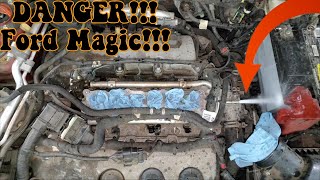
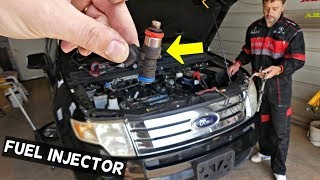
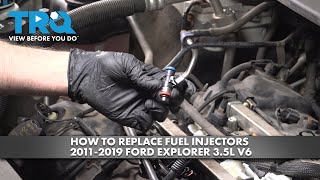
Typical fix: Replace the failed fuel injector. 🎬 Watch: Step-by-step fuel injector replacement on a Ford 3.5L engine. It is often recommended to replace all injectors on the same bank (or all six) at the same time, especially on higher mileage vehicles.
Est. part cost: $40-$90 per injector - Wiring Harness or Connector Issue 🟡 Medium Probability Engine vibrations and heat can cause wires to chafe, break, or corrode over time. The connector itself can become loose, corroded, or have a broken locking tab. In some cases, simply unplugging and securely replugging the connector can resolve the issue by re-establishing a solid connection.
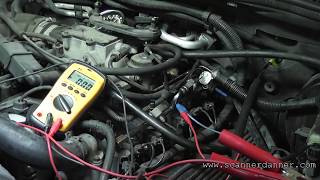
How to confirm: Visually inspect the wiring harness leading to the cylinder 6 injector for any signs of damage. Unplug the connector and check for corrosion or damage on the pins. A "noid light" can be plugged into the connector to verify if the PCM is sending a pulse signal. 🎬 See how to test an injector circuit with basic tools. If the light flashes when the engine is running, the wiring and PCM are likely okay.
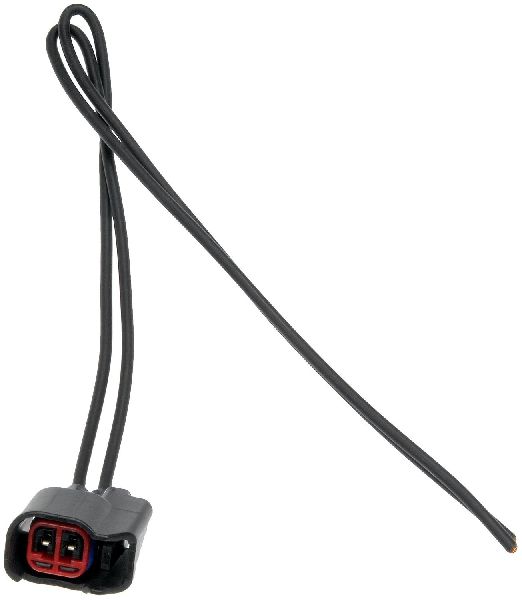
Typical fix: Repair the damaged section of wire or replace the injector connector pigtail.
Est. part cost: $10-$25 for a connector pigtail - Powertrain Control Module (PCM) Failure ⚪ Low Probability While rare, the internal driver circuit in the PCM that controls the injector can fail, often due to voltage spikes or moisture intrusion. On some Ford models, water leaks from the A-pillar or windshield cowl area can drip onto the PCM and cause corrosion and failure, though this is not as widely documented for the Edge as for other models.
How to confirm: This is typically diagnosed by exclusion. If the injector and wiring have both been tested and confirmed to be good using a multimeter and noid light, the PCM is the likely culprit. This requires advanced diagnostics, often with a professional scan tool to check communication.
Typical fix: The PCM must be replaced and programmed for the vehicle.
Est. part cost: $300-$800+
Diagnosis Steps
- Confirm the presence of code P0206 with an OBD-II scanner. Note any other codes, such as P0306.
- Locate cylinder 6. On the 3.5L/3.7L V6, the cylinders against the firewall are 1-2-3 (passenger to driver side), and the cylinders against the radiator are 4-5-6 (passenger to driver side). Cylinder 6 is on the front bank, driver's side.
- Visually inspect the wiring and connector at the cylinder 6 fuel injector for obvious damage, corrosion, or loose connections. Sometimes, simply unplugging and replugging the connector can resolve the issue due to a poor connection.
- Use a noid light to test the signal at the injector connector. Unplug the injector, plug in the noid light, and start the engine. The light should flash, indicating the PCM and wiring are sending the signal. If it does not flash or stays on continuously, there is a problem with the wiring or the PCM.
- If the noid light test passes, test the injector itself. Turn the engine off and disconnect the injector. Set a multimeter to ohms (Ω) and measure the resistance between the two pins on the injector. A typical reading is 11-14 ohms. If it's significantly higher (open) or lower (short), the injector is bad.
- As a final confirmation, swap the cylinder 6 injector with the cylinder 5 injector. Clear the codes and run the engine. If the code returns as P0205, the injector is faulty and needs to be replaced. If P0206 returns, the problem is in the wiring or PCM.
- If the injector and signal are good, perform a continuity test on the two wires from the injector connector back to the PCM to check for an open or short in the harness.
Parts You'll Likely Need
- Fuel Injector (Cylinder 6)
(OEM #Motorcraft CM-5188 (for 2011-2014 models), Motorcraft CM-5138 (check application, often for earlier models or different engines). Part numbers can vary by production date, always verify with VIN.)— This is the most common failure point for a P0206 code, where the internal coil of the injector fails electrically.
Trusted brands: Motorcraft, Bosch, Standard Motor Products (SMP)
OEM price range: $70-$110
Aftermarket price range: $40-$90 - Fuel Injector Connector Pigtail — If the wiring or connector itself is damaged, replacing the pigtail is the standard repair.
Trusted brands: Motorcraft, Dorman
OEM price range: $20-$35
Aftermarket price range: $10-$25 - Upper Intake Manifold Gasket Set
(OEM #Motorcraft MS-96425 or Fel-Pro MS 97428 (verify for specific year))— The upper intake manifold must be removed to access the fuel injectors on the 3.5L/3.7L V6. The gaskets are single-use and should always be replaced to prevent vacuum leaks. 🎬 Watch this walkthrough for removing the intake manifold and injectors.
Trusted brands: Motorcraft, Fel-Pro, Mahle
OEM price range: $30-$50
Aftermarket price range: $15-$30
Related Codes That Often Appear With This One
- P0306 — P0306 means "Cylinder 6 Misfire Detected." Since P0206 indicates the injector isn't firing, the cylinder will not combust properly, which the PCM detects as a misfire. A P0206 will almost always be accompanied by a P0306.
- P0300 — This code for "Random/Multiple Cylinder Misfire" can sometimes appear alongside P0206 if the engine is running very poorly.
- P0316 — This code indicates a misfire was detected within the first 1,000 engine revolutions after startup, which is common when an injector is completely inoperative.
Mechanic-Grade Diagnostic Values
- Fuel Injector Resistance — expected: 11-14 Ohms. Failure: A reading of infinity (Open Loop/OL) or significantly outside the expected range indicates a failed injector coil.
- Injector Connector Voltage (Key On, Engine Off) — expected: Battery Voltage (approx. 12V). Failure: Voltage below 10V or no voltage indicates an open circuit in the power supply wire.
- Injector Pulse Width (at idle) — expected: 0.8 ms to 2.5 ms. Failure: A pulse width for cylinder 6 that is zero or significantly different from other cylinders points to a control or injector issue.
- Injector Control Circuit Voltage (while cranking) — expected: Pulsing ground signal, causing voltage to fluctuate. A DVOM may show an average voltage lower than 12V.. Failure: A steady 12V with no pulse indicates the PCM is not grounding the circuit. No voltage at all points to a break in the control wire.
Hidden / Shadow Codes Worth Checking
- Mode $06, Test ID $0A, Component ID $06: This is not a DTC, but a specific data parameter showing the raw misfire count for cylinder 6 for the current and last ten driving cycles. A high count confirms the misfire is consistently on cylinder 6. (see via Advanced scan tool with Mode $06 capabilities (e.g., FORScan, Ford IDS).)
Scan Tool Commands That Help
- Ford IDS (Integrated Diagnostic System) or FORScan: Power Balance Test — This is a critical diagnostic function that allows a technician to disable one cylinder at a time to see the corresponding drop in RPM. If disabling cylinder 6 causes no change in RPM, it confirms that cylinder is not contributing, which is expected with a P0206 code.
- FORScan: Injector Pulse Width Comparison Mode — This live data mode allows for direct comparison of the pulse width commanded to each injector by the PCM. A significant deviation on cylinder 6 can help confirm a control-side problem or a clogged injector causing the PCM to attempt compensation.
Wiring & Ground Locations
- G104 — Left front of the engine compartment.. This is a primary engine bay ground point. A loose or corroded connection at G104 can cause a variety of electrical issues, including intermittent faults in sensor and actuator circuits like the fuel injectors.
- G102 / G103 — Left side of the engine compartment.. These are additional chassis grounds in the engine bay. Verifying they are clean and tight is a crucial step in ruling out a bad ground as the source of an electrical circuit code.
- Injector Power Wire — One of the two wires at the injector connector.. This wire should have constant battery voltage (approx. 12V) with the key in the 'ON' position. It provides the power for the injector solenoid. Lack of voltage here points to a problem upstream, possibly in the Battery Junction Box or related wiring.
- Injector Control Wire (Ground Pulse) — The second wire at the injector connector, leading back to the PCM.. The PCM pulses a ground signal on this wire to fire the injector. A noid light test directly verifies if this signal is being sent. If the noid light flashes, the PCM and control wire are good. If it doesn't, the fault is in this wire or the PCM itself.
Real Owner Repair Stories
- Ford Edge Forum (Ford Edge with 3.5L V6) — Rough running, Check Engine Light with codes P0206 and P0306. The problem was intermittent and seemed to occur after the engine reached operating temperature.
❌ Tried (didn't work) Initial diagnosis pointed towards common ignition or wiring issues.
✅ What actually fixed it The owner suspected the fuel injector for cylinder #6 was getting stuck when hot. Replacing the fuel injector resolved both codes. - Ford Edge Forum - Thread: 'P0206 and P0306 easy fix???' (Ford Edge (year not specified)) — Car was riding rough and throwing codes P0206 and P0306.
❌ Tried (didn't work) Swapping ignition coils made no difference.
✅ What actually fixed it The owner unplugged the electrical connector for the cylinder 6 fuel injector and plugged it back in securely. This simple act of reseating the connector fixed the problem, indicating a poor electrical connection was the root cause.
OEM Part Supersession History
BR3Z-9F593-B→Motorcraft CM-5188— Standard part lifecycle update.
Heads up: The injector for 2011+ models (CM-5188 / Bosch 0280158191) is specified for the higher horsepower 3.5L and 3.7L engines. While it may physically fit earlier models, using the correct part number for the specific model year (like CM-5138 for some pre-2011 models) is critical to ensure correct flow rate and engine performance. Always verify with VIN.
Model Year Variations Within This Range
- 2011-2014: For the 2011 model year, the 3.5L V6 engine received a power increase from 265 hp to 285 hp. The 3.7L V6 (305 hp) was also introduced for the Sport model. While the P0206 diagnostic process is the same, the fuel injectors may have different part numbers (e.g., CM-5188) compared to the 2007-2010 models to accommodate the different power levels.
- 2007-2014: The 3.5L and 3.7L engines are part of the same family and are largely interchangeable. It is a known swap to replace a failed 3.5L with a 3.7L, as the PCM and wiring harnesses are predominantly the same, making it a 'plug-and-play' upgrade for more power.
Diagnostic Flowchart
Other Known Issues on This Vehicle
Issues unrelated to this code that are worth knowing about as an owner of this generation:
- Internal Water Pump Failure 🔴 High — A major design flaw, especially in pre-2011 models. If the pump fails, it can leak coolant directly into the engine oil, causing catastrophic engine damage. Repair is extremely labor-intensive (12+ hours).
- AWD Power Transfer Unit (PTU) Failure 🔴 High — Common on AWD models. The PTU fluid becomes overheated and breaks down, leading to seal and gear failure. Ford claimed it was a 'lifetime' fluid, but it requires regular changes (e.g., every 20-30k miles) to prevent failure. Repair costs can be $1600-$2000.
- Electronic Throttle Body (ETB) Failure 🟠 Medium — Widespread issue where the ETB fails electronically, causing the vehicle to suddenly enter 'limp mode' with a wrench light, severely limiting power. Cleaning does not fix it; replacement is required. (Ref: Ford Customer Satisfaction Program 13N03 (now expired))
- Door Ajar Sensor Failure 🟡 Low — A very common annoyance where the sensor within the door latch fails, causing the 'door ajar' light to stay on. This can prevent doors from locking and drain the battery. The entire latch assembly must be replaced to fix it.
- Brake Booster Diaphragm Tear 🟠 Medium — Affects 2007-2015 models. A tear in the brake booster's diaphragm causes a hissing noise when the brake is pressed and can lead to a hard or spongy pedal feel, reducing braking effectiveness. (Ref: Recall 23S12 / Customer Satisfaction Program 13N02)
Used vs. New Parts: Buying Guide for This Vehicle
When a used part is the smart pick: A used fuel injector from a reputable salvage yard can be a cost-effective option, especially if you are replacing all six as a preventative measure. Given that the failure is typically electrical, a functional used injector is likely to have a good lifespan. A used PCM is also a viable option, but it MUST be reprogrammed to your vehicle's VIN.
Donor-vehicle mileage cap: roughly under 80000 miles for the part to have meaningful remaining life.
What to inspect on the donor part:
- Check for a clean donor vehicle with no signs of front-end collision or engine fire.
- Inspect the injector's electrical connector for any cracks, corrosion, or damage.
- Look at the injector tip and O-rings; avoid parts that are heavily caked with carbon or have brittle, cracked O-rings.
- If possible, ask the salvage yard to test the resistance of the injector before purchase; it should be within the 11-14 ohm range.
OEM-only on this vehicle (don't cheap out):
- Upper Intake Manifold Gaskets: These are single-use items and should always be purchased new to prevent vacuum leaks. Aftermarket brands like Fel-Pro are acceptable and often preferred.
Aftermarket brands forum-validated for this vehicle:
- Bosch (often the OEM supplier)
- Standard Motor Products (SMP)
- Fel-Pro (for gaskets)
Brands owners have reported issues with on this vehicle:
- Unbranded, no-name injectors from online marketplaces should be avoided. They often have inconsistent flow rates and high failure rates, leading to poor engine performance and the need to do the labor-intensive job a second time.
Real Owner Stories
Aggregated from forums and TSBs cited above. Mileages and costs reflect what owners reported in those sources.
2007-2014 Ford Edge 3.5L V6 / 3.7L V6
Symptoms: Check Engine Light on with codes P0206 and P0306 stored.
What fixed it: The owner simply unplugged and securely replugged the electrical connector for the cylinder 6 fuel injector. This re-established a solid connection and resolved the codes.
Source hint: Ford Edge Forum - Thread: 'P0206 and P0306 easy fix???'
Related OBD-II Codes
Frequently Asked Questions
Where is cylinder 6 located on my 2011 Ford Edge 3.5L V6?
I'm getting codes P0206 and P0306 together. Are they related?
What is the correct resistance for a fuel injector on this engine?
How can I test the injector without a multimeter?
Is it true that I have to remove the intake manifold to replace the injectors?
If I need to replace the cylinder 6 injector, should I replace all of them?
Could a bad computer (PCM) cause just the P0206 code?
Helpful Videos
Used OEM Parts in Stock


New Aftermarket Parts Available



The information in this article is provided for general reference and educational purposes only. Vehicle specifications, procedures, and part compatibility can vary by production date, trim level, and region. Always consult your vehicle's factory service manual and verify part numbers before purchasing or performing repairs. Safety-critical components such as airbags, seat belts, and braking systems should be installed by a qualified professional.
- Ford Edge:
- 🎬 Helpful Videos
- 🛍️ Shop This Part
- What's Unique About the 2007-2014 Ford Edge
- Symptoms You May Notice
- Most Likely Causes
- Diagnosis Steps
- Parts You'll Likely Need
- Related Codes That Often Appear With This One
- Mechanic-Grade Diagnostic Values
- Hidden / Shadow Codes Worth Checking
- Scan Tool Commands That Help
- Wiring & Ground Locations
- Real Owner Repair Stories
- OEM Part Supersession History
- Model Year Variations Within This Range
- Diagnostic Flowchart
- Other Known Issues on This Vehicle
- Used vs. New Parts: Buying Guide for This Vehicle
- Real Owner Stories
- 2007-2014 Ford Edge 3.5L V6 / 3.7L V6
- Related OBD-II Codes
- Frequently Asked Questions
- 🎟️ Get 5% Off