

P0204 on 2011-2015 Kia Optima 2.4L: Injector Circuit Malfunction Causes and Fixes
This code indicates an electrical problem with the fuel injector circuit for cylinder 4. The most common cause is a failed fuel injector, followed by wiring issues. Expect to pay $50-$150 for an aftermarket injector and around 1-2 hours of labor for a DIY replacement.
- P0204 on your Kia Optima means cylinder #4 has an electrical issue with its fuel injector circuit.
- The most likely cause is a bad fuel injector, which is a common failure point on GDI engines.
- A simple diagnostic step is to swap the injector from cylinder 4 with another cylinder (like #3) and see if the code follows (changes to P0203).
- Always replace the injector seals when you remove a GDI injector to prevent dangerous high-pressure fuel leaks.
- If the injector and wiring are good, the problem could be a rare failure in the engine computer (PCM).
What's Unique About the 2011-2015 Kia Optima
The 2.4L Theta II GDI engine in this generation of Optima is known for significant issues, including engine bearing failures from metallic debris left during manufacturing (recall SC147) and fuel system problems. While P0204 is a standard electrical code, on this specific GDI (Gasoline Direct Injection) engine, the high-pressure fuel injectors can be prone to failure or clogging from carbon buildup, a common issue on GDI engines which lack the valve-cleaning effect of port injection. Owners should also be aware of recall SC187 for a low-pressure fuel tube that can crack due to engine heat, which, while not directly causing P0204, points to the general sensitivity of the fuel system in this engine bay.
Symptoms You May Notice
- Check Engine Light is on
- Rough, shaking idle
- Noticeable engine misfire
- Poor acceleration and reduced engine power
- Worse fuel economy
- Engine may stall
- Hard starting
- Raw fuel smell from the exhaust
- Replacing spark plugs or ignition coils. While these can cause a misfire (like P0304), they will not cause an injector circuit code like P0204.
- Replacing the catalytic converter. A misfire from P0204 can cause a P0420 (catalyst inefficiency) code to appear due to unburnt fuel, but the converter is the victim, not the cause. Fixing the injector issue first is critical.
Most Likely Causes
- Faulty Fuel Injector (Cylinder 4) 🔴 High Probability GDI injectors operate under high pressure and are susceptible to internal failure or clogging from carbon buildup, a common issue on direct injection engines that lack fuel washing over the intake valves. The internal solenoid coil can burn out, causing an open or short in the circuit.
How to confirm: Swap the cylinder 4 injector with another cylinder (e.g., cylinder 3). If the code changes to P0203, the injector is bad. Alternatively, check the injector's resistance with a multimeter; it should be within the manufacturer's specified range (typically 11-16 ohms for gasoline injectors). A reading of infinite resistance indicates an open circuit, while a near-zero reading indicates a short.
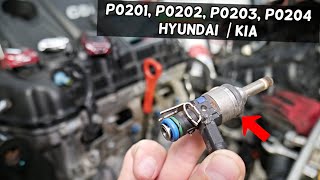
Typical fix: Replace the faulty fuel injector 🎬 Watch: How to diagnose and replace GDI fuel injectors and its single-use seals.
Est. part cost: $50 - $150 - Wiring Harness or Connector Issue 🟡 Medium Probability Engine bay heat can make wiring and plastic connectors brittle over time. The injector harness can also be damaged during other engine repairs. Rodents are also known to chew through wires.
How to confirm: Visually inspect the wiring going to the cylinder 4 injector for any signs of cracking, fraying, melting, or rodent damage. Check the connector for corrosion, backed-out pins, or a loose fit. Use a noid light to confirm the PCM is sending a pulse signal to the connector; a flashing light indicates the wiring and PCM driver are likely good.
Typical fix: Repair the damaged section of wire or clean/replace the connector pigtail.
Est. part cost: $10 - $30 - Powertrain Control Module (PCM) Failure ⚪ Low Probability While rare, the internal driver circuit (a transistor) in the PCM that controls the injector can fail. This is more common in older, high-mileage vehicles but can happen at any time.
How to confirm: This is a diagnosis of exclusion. If the injector and wiring have been tested and confirmed to be good (injector has correct resistance, wiring has continuity, and there are no shorts to power or ground), the PCM is the likely culprit. The definitive test is to check for a pulse signal directly at the PCM pin for the cylinder 4 injector.
Typical fix: The PCM needs to be repaired by a specialist or replaced and programmed to the vehicle.
Est. part cost: $200 - $900
Rare But Worth Checking
- Blown Fuse or Faulty Relay:
Diagnosis Steps
- Read the codes with an OBD-II scanner to confirm P0204 and check for any other codes, like P0304.
- Perform a visual inspection of the cylinder 4 fuel injector wiring and connector. Look for obvious damage, loose connections, or corrosion.
- Disconnect the injector and test for a pulse signal using a noid light. If the light flashes when the engine is cranked, the PCM and wiring are likely okay, pointing towards the injector.
- If you have a multimeter, measure the resistance across the two pins of the fuel injector. Compare this reading to the manufacturer's specification (typically 11-16 ohms). An out-of-spec reading indicates a failed injector.
- The most definitive DIY test is to swap the cylinder 4 fuel injector with an adjacent one (e.g., cylinder 3). Clear the codes and run the engine. If the code returns as P0203, you have confirmed the injector is the problem.
- If the code remains P0204 after the swap, the issue is in the wiring or the PCM.
- If no pulse was detected with the noid light, check for continuity on the wiring between the injector connector and the PCM. Also check for a short to ground or a short to power on the signal wire. If the wiring is good, the PCM's injector driver is the most likely failure point.
Parts You'll Likely Need
- GDI Fuel Injector
(OEM #35310-2G710)— This is the most common failure point for a P0204 code, as the internal coil windings can fail or the injector can become mechanically stuck or clogged. This part number is confirmed for the 2011-2015 Optima 2.4L.
Trusted brands: Bosch, Standard Motor Products, Hyundai/Kia OE
OEM price range: $120-$200
Aftermarket price range: $50-$150 - Fuel Injector Seal Kit — The seals for GDI injectors are single-use and must be replaced anytime an injector is removed to prevent high-pressure fuel leaks. The injector itself often comes with new seals included.
Trusted brands: Fel-Pro, Mahle, Hyundai/Kia OE
OEM price range: $15-$30
Aftermarket price range: $10-$20
Related Codes That Often Appear With This One
- P0304 — P0304 means "Cylinder 4 Misfire Detected." Since P0204 indicates a problem with fuel delivery to cylinder 4, it's very common for the engine to misfire on that cylinder as a direct result.
- P0200 — P0200 stands for "Injector Circuit/Open" and is a more general code indicating a fault in the injector circuit system, which may be set alongside the more specific P0204.
Technical Service Bulletins (TSBs) & Recalls
- SC147: Theta II Engine Inspection and/or Replacement
- SC187: Low-Pressure Fuel Feed Tube Inspection and Repair/Replacement
- PI1802: Knock Sensor Detection System (KSDS) ECU Upgrade
Platform-Specific Known Issues
- The Theta II GDI engine was subject to safety recall SC147 for potential engine bearing failure due to metallic debris from manufacturing restricting oil flow. While not directly causing P0204, it highlights the engine's troubled history and can lead to catastrophic failure.
- Safety recall SC187 was issued for some 2013-2014 models due to a low-pressure fuel tube that could crack from engine heat, increasing fire risk.
- Product Improvement Campaign PI1802 involved a software update for the Knock Sensor Detection System (KSDS) to help detect early signs of engine bearing wear. This system listens for vibrations and can put the vehicle into Limp Home Mode, setting a P1326 code, if it detects a problem.
Mechanic-Grade Diagnostic Values
- Fuel Injector Coil Resistance — expected: 11-16 Ω (for high-impedance type used in this engine). Failure: A reading of infinite ohms (open circuit) or near-zero ohms (short circuit).
- Injector Power Supply Voltage (Key On, Engine Off) — expected: ~12.0 - 14.5 V (near battery voltage). Failure: No voltage or significantly low voltage suggests a problem with the power supply wire, fuse, or relay.
- Injector Pulse Width (at idle) — expected: 1-10 ms (varies with engine load and temperature). Failure: An oscilloscope showing an inconsistent, missing, or malformed square wave indicates a problem with the PCM driver or wiring. A significant delay in opening time (e.g., 1.8ms vs a normal 1.2ms) indicates a failing injector.
Scan Tool Commands That Help
- Kia GDS (Global Diagnostic System) or advanced aftermarket scanner: Injector Actuation Test / Active Test — This function allows a technician to command the PCM to fire a specific injector while the engine is off. It's used to verify if the PCM driver and wiring are capable of activating the injector solenoid, which can be heard as an audible click. This helps isolate the fault between the injector itself and the control circuit.
- Kia GDS or equivalent: Resetting Adaptive Values / ECM Adaptation Reset — After replacing a fuel system component like an injector, this function should be used to clear the PCM's learned fuel trim adjustments. This forces the computer to relearn fuel delivery strategy with the new component, ensuring optimal performance.
Wiring & Ground Locations
- Engine Block / Cylinder Head Ground — There are multiple grounding points on the engine itself. A primary engine ground strap connects the engine block to the chassis. Look for black wires with eyelets bolted directly to the cylinder head or engine block.. A poor engine ground can cause a voltage potential difference between the engine sensors (including injectors) and the chassis, leading to erratic behavior and setting circuit codes like P0204.
- Chassis Ground (Strut Tower) — The bolts on the top of the strut towers in the engine bay are typically excellent, unpainted chassis ground points.. When testing the injector circuit, this provides a reliable ground reference for multimeter or oscilloscope readings.
- Injector Wiring Harness — This harness (Part No. 35341-2G001, which supersedes 35341-2G000) connects all four fuel injectors and the high pressure sensor to the main engine harness.. The entire harness can become brittle from heat and vibration. A fault within this sub-harness can cause a P0204. If damage is found, replacing this specific harness is often easier than repairing individual wires.
- Interior Ground Bolt — There is often a main grounding bolt with multiple wires attached located near the interior fuse panel, behind the driver's side kick panel.. While less likely to directly cause a P0204, a loose or corroded interior ground can cause a host of bizarre electrical issues, including problems with the PCM and its outputs.
Real Owner Repair Stories
- AliExpress User Review / Forum-style post (2013 Kia Sorento 2.4L GDI (85,000 miles)) — Noticeable hesitation during highway merging, intermittent flashing check engine light with codes P0301 and P0304.
❌ Tried (didn't work) Compression test (passed), Smoke test for vacuum leaks (passed), Ultrasonic cleaning of injectors (twice, no improvement)
✅ What actually fixed it Using an oscilloscope, the owner observed inconsistent injector opening times (some injectors took 1.8ms to open while others took 1.2ms). This indicated a delayed electrical response, not a complete failure. Replacing the injectors with a new set (Part No. 35310-2G710) resolved the issue. - AliExpress User Review / Forum-style post (2015 Hyundai Sonata 2.4L GDI) — Rough idle, misfires on cylinder 3, and a persistent P0203 code.
❌ Tried (didn't work) Initial diagnosis pointed to a single bad injector.
✅ What actually fixed it The owner replaced all four fuel injectors with part number 35310-2G710, which resolved the rough idle and misfire code. This corroborates the part number and the commonality of the failure across the Theta II engine family.
"I Checked Everything" — The Actual Cause
- In a documented case on a related vehicle with the same engine, a smoke test for vacuum leaks and a compression test both came back clean. The root cause of misfires and hesitation was found to be electrically slow fuel injectors. The injectors weren't fully 'bad' (open or shorted), but their response time was delayed, which was only identifiable by analyzing the injector waveforms on an oscilloscope. This highlights a failure mode that basic electrical tests (resistance, noid light) would miss.
OEM Part Supersession History
35341-2G000→35341-2G001— Standard part revision or improvement by the manufacturer.
Heads up: The new part number is a direct replacement for the old one and is fully compatible.
Model Year Variations Within This Range
- 2014-2015: The 2014 model year introduced a mid-cycle refresh which included updated front and rear fascias, new wheel designs, and revised interior trim. However, the 2.4L Theta II GDI engine and its associated fuel system components relevant to a P0204 code remained fundamentally the same as the 2011-2013 models.
Diagnostic Flowchart
Used vs. New Parts: Buying Guide for This Vehicle
When a used part is the smart pick: For this repair, a used part from a junkyard is only advisable for the injector wiring harness (35341-2G001), provided it is visually inspected for brittleness, cracks, and intact connector tabs. A used PCM could be a cost-effective option, but it will require professional programming to match the vehicle's VIN and immobilizer system.
Donor-vehicle mileage cap: roughly under 80000 miles for the part to have meaningful remaining life.
What to inspect on the donor part:
- For a wiring harness, check for flexibility (not stiff or brittle), absence of cracks in the loom, and clean, corrosion-free connector pins.
- For a PCM, ensure the donor vehicle was not involved in a flood or fire, and check for any physical damage to the case or connectors.
OEM-only on this vehicle (don't cheap out):
- Fuel Injector (35310-2G710). It is STRONGLY recommended to use new OEM or high-quality, professionally remanufactured GDI injectors. Used junkyard injectors are a significant gamble due to the high risk of internal carbon clogging, worn needle seats, and degraded spray patterns that are impossible to see visually.
Aftermarket brands forum-validated for this vehicle:
- Bosch (often the OEM supplier)
- Standard Motor Products (SMP)
- Carquest Premium (often remanufactured OEM cores)
- GB Remanufacturing (specializes in remanufactured injectors)
Brands owners have reported issues with on this vehicle:
- Unnamed, no-brand injectors from online marketplaces. These often have inconsistent flow rates and poor longevity, leading to a repeat failure. It is better to buy a professionally remanufactured genuine injector than a cheap new knock-off.
Real Owner Stories
Aggregated from forums and TSBs cited above. Mileages and costs reflect what owners reported in those sources.
2013 Kia Optima 2.4L GDI — ~112000 miles
Symptoms: The check engine light came on and the engine developed a rough, shaking idle, especially when stopped at a light. There was a noticeable misfire.
What fixed it: After confirming the wiring was okay with a noid light, the owner replaced the cylinder 4 fuel injector, which resolved the issue.
Source hint: Kia-Forums.com (https://www.kia-forums.com/)
2012 Kia Optima 2.4L GDI
Symptoms: Car felt down on power and had poor acceleration. The check engine light was on for P0204.
What fixed it: The owner followed a diagnostic guide and swapped the fuel injector from cylinder 4 with the one from cylinder 3. The code changed to P0203, confirming the injector was bad. A new injector was installed in the cylinder 4 position.
Source hint: OptimaForums.com (https://www.optimaholics.com/)
2014 Kia Optima 2.4L GDI
Symptoms: Noticed a significant drop in fuel economy and could sometimes smell raw fuel from the exhaust when the car was running rough.
What fixed it: The problem was diagnosed as a failed fuel injector. Replacing the injector for cylinder 4 fixed the fuel smell and rough running condition.
Source hint: Reddit r/kia
Related OBD-II Codes
Frequently Asked Questions
My Optima has a P0204 code. Is this related to the big Theta II engine recall (SC147)?
I have a 2014 Optima and heard about a fuel leak recall. Could that cause this P0204 code?
My car is in 'Limp Mode' and showing a P1326 code along with P0204. What's going on?
What's the most reliable way to confirm my cylinder 4 injector is bad before buying a new one?
Should I buy a used fuel injector from a junkyard to save money?
Is this P0204 problem common on the Hyundai Sonata as well?
Helpful Videos
Used OEM Parts in Stock


New Aftermarket Parts Available


The information in this article is provided for general reference and educational purposes only. Vehicle specifications, procedures, and part compatibility can vary by production date, trim level, and region. Always consult your vehicle's factory service manual and verify part numbers before purchasing or performing repairs. Safety-critical components such as airbags, seat belts, and braking systems should be installed by a qualified professional.
- Kia Optima:
- 🎬 Helpful Videos
- 🛍️ Shop This Part
- What's Unique About the 2011-2015 Kia Optima
- Symptoms You May Notice
- Most Likely Causes
- Rare But Worth Checking
- Diagnosis Steps
- Parts You'll Likely Need
- Related Codes That Often Appear With This One
- Technical Service Bulletins (TSBs) & Recalls
- Platform-Specific Known Issues
- Mechanic-Grade Diagnostic Values
- Scan Tool Commands That Help
- Wiring & Ground Locations
- Real Owner Repair Stories
- "I Checked Everything" — The Actual Cause
- OEM Part Supersession History
- Model Year Variations Within This Range
- Diagnostic Flowchart
- Used vs. New Parts: Buying Guide for This Vehicle
- Real Owner Stories
- 2013 Kia Optima 2.4L GDI — ~112000 miles
- 2012 Kia Optima 2.4L GDI
- 2014 Kia Optima 2.4L GDI
- Related OBD-II Codes
- Frequently Asked Questions
- 🎟️ Get 5% Off