

P0203 on 2011-2016 Kia Sportage: Injector Circuit Malfunction Causes and Fixes
For the 2011-2016 Kia Sportage, code P0203 almost always means the cylinder 3 fuel injector has failed or there's a problem with its wiring. A replacement GDI injector (like OEM part 35310-2G710) costs around $70-$150 for aftermarket or $200-$300 for OEM. This is a very common issue on the Theta II GDI engines due to their high-pressure operation.
- P0203 on your Sportage points to an electrical problem with the cylinder 3 fuel injector.
- The most likely cause is a failed fuel injector itself, a common problem on these GDI engines.
- A simple 'injector swap' is the best DIY method to confirm if the injector is the problem before buying parts.
- Do not drive extensively with this code, as a flashing check engine light indicates a severe misfire that can quickly destroy your expensive catalytic converter.
- Always check for vehicle recalls, as the Theta II engine has a significant history of warranty extensions and service campaigns.
What's Unique About the 2011-2016 Kia Sportage
The 2.0L and 2.4L GDI (Gasoline Direct Injection) engines in this generation of Sportage are part of the wider Hyundai/Kia Theta II engine family, which has a well-documented history of reliability issues, including recalls for catastrophic engine failure. For this specific code, the GDI injectors are a known weak point. They operate under very high pressure and are located directly in the combustion chamber, exposing them to extreme heat. This harsh environment leads to a higher rate of internal electrical coil failure compared to traditional, cooler-running port injectors.
Generation note: The 2011-2016 range covers two generations of the Kia Sportage: the third generation (SL; 2011-2015) and the start of the fourth generation (QL; 2016). However, both generations in this period used versions of the Theta II engine, so the causes and diagnostic procedures for code P0203 are virtually identical.
Symptoms You May Notice
- Check Engine Light is on (may be flashing if the misfire is severe)
- Rough, shaky engine idle
- Noticeable loss of power and sluggish acceleration
- Engine misfiring, which can feel like a jerking or popping sensation
- Increased fuel consumption
- Difficulty starting the engine
- Engine may go into 'limp mode'
- Replacing the spark plug or ignition coil for cylinder 3. While these can cause a misfire (P0303), they will not cause an injector circuit code (P0203). The P0203 code is specifically for an electrical fault in the injector circuit, not a combustion problem. 🎬 Watch: Understanding the causes and fixes for the P0203 code.
Most Likely Causes
- Faulty Cylinder 3 Fuel Injector 🔴 High Probability The GDI injectors on the Theta II engine are exposed to high heat and pressure directly within the combustion chamber, leading to a higher rate of internal electrical failure of the injector's coil compared to port-injected designs.
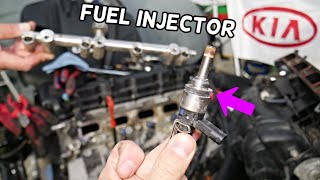
How to confirm: Swap the cylinder 3 injector with one from another cylinder (e.g., cylinder 2). Clear the codes and run the engine. If the code changes to P0202, the injector is confirmed to be faulty. Alternatively, disconnect the injector and measure its resistance with a multimeter. A healthy GDI injector for this engine should read between 10.5-13.5 Ohms. A reading of infinity (Open Loop) or near zero indicates a failed injector. 🎬 See how to test GDI fuel injectors for electrical failure.
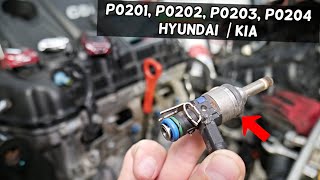
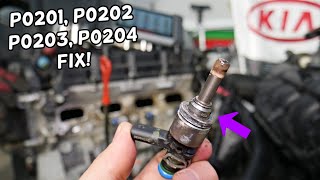
Typical fix: Replace the faulty fuel injector. It's recommended to replace the high-pressure fuel line and all injector seals (Teflon tip seal, O-rings) at the same time, as they are considered one-time use. 🎬 Watch: Step-by-step guide to fuel injector removal and replacement.
Est. part cost: $70-$300 - Wiring Harness or Connector Issue 🟡 Medium Probability Engine vibrations and heat cycles can cause the wires in the engine harness to chafe, break, or become brittle over time. The plastic connector itself can also become loose or have its locking tab break, leading to a poor connection at the injector.
How to confirm: Visually inspect the wiring going to the cylinder 3 injector for any signs of damage, melting, or corrosion. Unplug the connector and check for bent or corroded pins. With the engine running, carefully wiggle the connector and harness to see if the engine's idle changes, which would indicate an intermittent connection.
Typical fix: Repair the broken/shorted wire or replace the injector connector pigtail.
Est. part cost: $15-$50 - Faulty Powertrain Control Module (PCM) ⚪ Low Probability
How to confirm: This should be the last resort after confirming the injector and wiring are good. A 'noid light' test that shows no flashing signal at the injector connector points to a wiring or PCM issue. If the wiring has been verified to have continuity back to the PCM, the PCM's internal injector driver is likely faulty.
Typical fix: Replace and reprogram the PCM. This typically requires a professional shop or a specialized mail-in service.
Est. part cost: $400-$900
Diagnosis Steps
- Scan the vehicle's computer to confirm P0203 is the active code. Note any other codes, especially P0303.
- Check your vehicle's VIN for any open recalls or warranty extensions related to the Theta II engine (like SC147). Some repairs may be covered.
- Locate the cylinder 3 fuel injector (third from the belt side). Visually inspect its electrical connector and the surrounding wiring for obvious damage, corrosion, or loose connections.
- Perform a 'noid light' test. Disconnect the injector's electrical connector and plug in a noid light. Start the engine. The light should flash steadily. If it flashes, the PCM and wiring are sending a signal, and the injector is the most likely problem. If it does not flash, the problem is in the wiring or the PCM.
- If the noid light flashes, perform an injector resistance test. Disconnect the injector and use a multimeter set to Ohms. The resistance across the two pins should be between 10.5 and 13.5 Ohms. If it's out of spec, the injector is bad.
- As a final confirmation, perform an injector swap. Move the cylinder 3 injector to cylinder 2, and the cylinder 2 injector to cylinder 3. Clear the codes and restart the engine. If the code returns as P0202, you have confirmed the injector is bad. If P0203 returns, the problem is in the wiring to that specific connector.
- If the noid light does not flash, check for power (12V) at one of the pins on the injector connector with the key on. Then, check the continuity of the other wire (the signal wire) from the injector connector back to the PCM connector.
- If all else fails, the final possibility is a failed injector driver inside the PCM, which requires professional diagnosis and replacement.
Parts You'll Likely Need
- Fuel Injector (Cylinder 3)
(OEM #35310-2G710 (for GDI) or 35310-2G300 (for MPI))— This is the most common failure point for a P0203 code on this GDI engine due to high heat and pressure causing internal electrical failure. Note: Part number 35310-2G300 is for the less common MPI engine, while GDI engines use a different part like 35310-2G710. Always verify with VIN.
Trusted brands: Hyundai/Kia (OEM), Bosch, Standard Motor Products
OEM price range: $200-$300
Aftermarket price range: $70-$150 - Fuel Injector Seal Kit — The seals for GDI injectors (Teflon tip seal and rubber O-rings) are one-time use and must be replaced anytime an injector is removed and reinstalled to prevent high-pressure fuel leaks and intake vacuum leaks.
Trusted brands: Fel-Pro, Mahle, Kia/Hyundai OEM
OEM price range: $15-$30
Aftermarket price range: $10-$20
Related Codes That Often Appear With This One
- P0303 — P0303 means 'Cylinder 3 Misfire Detected.' Since the P0203 code indicates a circuit problem that prevents the injector from firing, the cylinder doesn't get fuel, which directly causes a misfire.
- P0201, P0202, P0204 — If multiple injector circuit codes appear at once, it strongly suggests a problem common to all injectors, like a blown fuse, a faulty relay, or a damaged section of the main engine wiring harness that powers all injectors.
Technical Service Bulletins (TSBs) & Recalls
- SC147 (Rev 1, June 2017) - 'THETA II ENGINE INSPECTION AND/OR REPLACEMENT': While not for the P0203 code itself, this safety recall TSB is critical for owners as it addresses the widespread engine bearing failure issue in 2011-2013 Sportage models with 2.0L T-GDI engines, among others.
Platform-Specific Known Issues
- The Theta II GDI engines are known for significant carbon buildup on the intake valves, which can cause misfires and other performance issues over time. While not a direct cause of the P0203 electrical code, it's a related maintenance issue to be aware of that requires periodic cleaning (e.g., walnut blasting).
- These engines were part of a major class-action lawsuit and recall campaign (SC147) for connecting rod bearing failure due to manufacturing debris. While unrelated to the injector circuit, it highlights the engine's troubled history and the importance of checking for open recalls and maintaining proper oil level and quality.
Mechanic-Grade Diagnostic Values
- GDI High-Pressure Fuel Line Pressure — expected: 290 - 3,626 PSI (Varies by model and operating conditions). Failure: Pressure that is significantly low or fails to build may indicate a high-pressure fuel pump issue, not necessarily an injector circuit fault, but can cause similar symptoms.
- Injector Circuit Voltage (at connector, Key On Engine Off) — expected: ~12V (Battery Voltage). Failure: No voltage on the power supply pin of the connector indicates a problem with the wiring, fuse, or relay upstream of the injector.
- Injector Pulse Width (Live Scan Tool Data) — expected: Varies with engine load/RPM, but should be stable and consistent across all cylinders at idle.. Failure: A value of zero or an erratic reading for cylinder 3 while other cylinders are normal confirms the PCM has detected a fault and has shut down the injector circuit.
- Wiring Continuity (from injector connector to PCM) — expected: < 0.5 Ohms. Failure: A high resistance or 'OL' (Open Loop) reading indicates a break in the wire between the PCM and the injector connector.
Scan Tool Commands That Help
- Kia GDS (Global Diagnostic System) or equivalent professional scan tool: Injector Actuation Test / Bidirectional Control — This command allows a technician to manually command the PCM to fire a specific injector. If the injector clicks when commanded, it confirms the PCM driver and wiring are functional, pointing towards a mechanically stuck or clogged injector rather than an electrical circuit fault. If it does not click, it confirms a fault in the injector coil or the circuit (wiring/PCM).
Wiring & Ground Locations
- Engine Block Ground — Main ground strap from the battery negative terminal to a bolt on the engine block, typically near the alternator or starter.. A poor engine ground can cause a host of electrical issues, including erratic sensor readings and insufficient grounding for components like fuel injectors, potentially leading to intermittent circuit codes.
- Cylinder Head Ground — Smaller ground wires are often bolted directly to the cylinder head or intake manifold.. The fuel injectors are mounted in the cylinder head (GDI) or intake manifold (MPI). A compromised local ground can directly affect the injector control circuit's return path, causing voltage drops and triggering fault codes.
- Injector Connector Pins — The two-pin connector directly on top of the fuel injector for cylinder #3.. One pin is the 12V power supply (Key On), and the other is the ground-side trigger from the PCM. Testing voltage and continuity at these specific pins is the core of diagnosing a P0203 code.
Real Owner Repair Stories
- YouTube Channel 'World Mechanics' (Vehicle appears to be a mid-2010s Kia/Hyundai with a Theta II engine, similar to the Sportage.) — Check engine light on, engine running rough with a misfire, code P0204 (Injector Circuit Cylinder 4) stored.
❌ Tried (didn't work) Initial diagnosis pointed towards a bad injector.
✅ What actually fixed it The wiring harness near the injector connector was damaged. A rodent had chewed through the signal wire for the #4 injector. Repairing the broken wire by splicing in a new section resolved the P0204 code and the misfire.
OEM Part Supersession History
35310-2G710→N/A, still current— This part number is the standard GDI injector for the 2.4L and 2.0L Theta II engines in this vehicle range.
Heads up: While this is the correct part, be aware that Hyundai/Kia use shared OEM numbers. The part may arrive in a red Kia box or a blue Hyundai box, but it is the same component.
Model Year Variations Within This Range
- 2011-2013 vs 2014-2016: The 2014 model year introduced a facelift with styling changes and engine updates. The 2.4L engine received an improved direct-injection system, increasing power from 176 hp to 182 hp. While the fundamental cause of P0203 remains the same (injector/wiring fault), the earlier 2011-2013 models are noted as having more potential engine and electronic concerns in general.
- 2011-2016: The base engine in some early models was a 2.4L MPI (Multi-Port Injection) unit, which uses a different, lower-pressure fuel injector (e.g., 35310-2G300). The more common 2.4L GDI and 2.0L Turbo GDI engines use a high-pressure direct injector (35310-2G710). The parts are not interchangeable.
Diagnostic Flowchart
Other Known Issues on This Vehicle
Issues unrelated to this code that are worth knowing about as an owner of this generation:
- Catastrophic Engine Failure (Rod Bearing Wear) 🔴 High — Widespread enough to trigger a massive recall and class-action lawsuit. Can occur at any mileage, but often seen between 60,000 and 120,000 miles. (Ref: Recall SC147 / NHTSA 17V-224)
- Excessive Oil Consumption 🔴 High — Very common, often starting around 60,000-80,000 miles. Can be as severe as 1 quart per 1,000 miles. Caused by carbon-stuck piston rings. (Ref: Hyundai TSB 23-EM-007H outlines a cleaning procedure.)
- Intake Valve Carbon Buildup 🟠 Medium — An inherent issue with all GDI engines. Symptoms like rough idle and misfires typically appear between 60,000 and 100,000 miles.
- Engine Compartment Fire Risk 🔴 High — Less common than engine failure but subject to multiple recalls for different causes (HECU short circuit, electric oil pump issues). (Ref: Multiple recalls, including for the HECU on 2010-2013 models.)
- Cooling System Leaks 🟡 Low — Radiators and thermostats may begin to fail around 85,000 miles, leading to potential overheating.
Used vs. New Parts: Buying Guide for This Vehicle
When a used part is the smart pick: For this repair, using a used part is generally not recommended for the fuel injector itself. A used wiring harness pigtail or a section of the engine harness from a low-mileage donor vehicle can be a cost-effective solution if the fault is confirmed to be in the wiring.
Donor-vehicle mileage cap: roughly under 60000 miles for the part to have meaningful remaining life.
What to inspect on the donor part:
- For wiring: Check for any signs of brittleness, cracking, or previous repairs.
- Ensure connectors have intact locking tabs and no corrosion on the pins.
- Verify the donor vehicle was not involved in a front-end collision that could have stressed the engine harness.
OEM-only on this vehicle (don't cheap out):
- Fuel Injector: Due to the high pressures and fine tolerances of GDI systems, a new OEM (Hyundai/Kia) or a direct OEM-supplier (Bosch, if applicable) injector is strongly recommended for reliability and performance.
Aftermarket brands forum-validated for this vehicle:
- Bosch (Often the OEM manufacturer)
- Standard Motor Products (SMP)
Brands owners have reported issues with on this vehicle:
- No-name, unbranded injectors from online marketplaces should be avoided. They often have incorrect flow rates or poor build quality, leading to repeat failures or other engine performance issues.
Real Owner Stories
Aggregated from forums and TSBs cited above. Mileages and costs reflect what owners reported in those sources.
2006 Kia Sportage
Symptoms: The injector was functional but not receiving a pulse after the owner cleaned the EGR valve.
What fixed it: Repairing the wiring issue that was created during the initial maintenance/repair process.
Source hint: JustAnswer: Kia Sportage 3 injector not pluseing
2011-2016 Kia Sportage (Theta II GDI)
Symptoms: Intermittent P0203 code that triggers limp mode, specifically occurring at higher RPMs and when the engine warms up.
What fixed it: Addressing a heat-related wiring issue or a failing injector harness that expands and loses connection as the engine temperature rises.
Source hint: Reddit r/AskMechanics: P0203 - Injector 3 Circuit Malfunction
2011-2016 Kia Sportage (Theta II GDI)
Symptoms: Misfire codes and electrical circuit malfunctions; owner noted the injector connector's locking tab was not fully engaged.
What fixed it: Ensuring the injector connector's locking tab is fully engaged to prevent loose connections.
Source hint: YouTube: CODE P0201 P0202 P0203 P0204 FUEL INJECTOR KIA SORENTO, KIA SPORTAGE
Related OBD-II Codes
Frequently Asked Questions
Does the SC147 recall for the Theta II engine cover my P0203 fuel injector issue?
Why are the GDI injectors on my Sportage 2.4L/2.0L more prone to failure than standard injectors?
What is the correct resistance for a healthy fuel injector on a Kia Sportage 2.4L MPI / 2.0L Turbo GDI?
Can I reuse the fuel line and seals when replacing the Cylinder 3 injector?
Could carbon buildup be causing my P0203 code?
How can I tell if the problem is the injector itself or the wiring harness?
Helpful Videos

Used OEM Parts in Stock


New Aftermarket Parts Available


The information in this article is provided for general reference and educational purposes only. Vehicle specifications, procedures, and part compatibility can vary by production date, trim level, and region. Always consult your vehicle's factory service manual and verify part numbers before purchasing or performing repairs. Safety-critical components such as airbags, seat belts, and braking systems should be installed by a qualified professional.
- Kia Sportage:
- 🎬 Helpful Videos
- 🛍️ Shop This Part
- What's Unique About the 2011-2016 Kia Sportage
- Symptoms You May Notice
- Most Likely Causes
- Diagnosis Steps
- Parts You'll Likely Need
- Related Codes That Often Appear With This One
- Technical Service Bulletins (TSBs) & Recalls
- Platform-Specific Known Issues
- Mechanic-Grade Diagnostic Values
- Scan Tool Commands That Help
- Wiring & Ground Locations
- Real Owner Repair Stories
- OEM Part Supersession History
- Model Year Variations Within This Range
- Diagnostic Flowchart
- Other Known Issues on This Vehicle
- Used vs. New Parts: Buying Guide for This Vehicle
- Real Owner Stories
- 2006 Kia Sportage
- 2011-2016 Kia Sportage (Theta II GDI)
- 2011-2016 Kia Sportage (Theta II GDI)
- Related OBD-II Codes
- Frequently Asked Questions
- 🎟️ Get 5% Off