

P0203 on 2007-2012 Hyundai Santa Fe: Injector Circuit Malfunction Causes and Fixes
Code P0203 on a 2007-2012 Hyundai Santa Fe means there's an electrical problem with the fuel injector circuit for cylinder #3. The most common causes are a bad fuel injector, a damaged wiring connector, or a wiring fault. Cylinder #3 is on the difficult-to-access rear cylinder bank, requiring removal of the upper intake manifold. If the injector itself is the issue, expect to pay between $50-$150 for the part.
- P0203 points to an electrical issue with the cylinder 3 fuel injector circuit, not a spark or compression problem.
- The most likely culprit is a failed fuel injector, but wiring and connector issues must be ruled out.
- Repair is significantly more labor-intensive than on an inline engine because cylinder #3 is on the rear bank, requiring intake manifold removal.
- While replacing the single failed injector is possible, replacing all three rear injectors and the intake gaskets is a common preventative measure to save on future labor.
What's Unique About the 2007-2012 Hyundai Santa Fe
For the second-generation (CM) Hyundai Santa Fe V6, the biggest challenge with a P0203 code is the physical location of cylinder #3. On both the 2.7L and 3.3L V6 engines, cylinder #3 is on the rear bank of cylinders, tucked against the firewall. This means accessing the fuel injector and its connector requires removing the upper intake manifold, turning a potentially simple electrical diagnosis into a more labor-intensive job of 2.5-4 hours.
Symptoms You May Notice
- Check Engine Light is on (may be flashing)
- Rough idle or engine rumbling
- Engine misfire (can feel like shaking or stumbling)
- Poor acceleration and loss of power
- Decreased fuel economy
- Difficulty starting the engine
- In rare cases, the engine may stall
- Replacing the spark plug or ignition coil for cylinder #3. While these parts can cause a misfire code (P0303), they will not cause an injector circuit code (P0203). The code P0203 is specifically for the electrical circuit of the fuel injector.
Most Likely Causes
- Faulty Fuel Injector #3 🔴 High Probability Fuel injectors are wear-and-tear items that operate under high heat and pressure. Over time, the internal coil can fail, creating an open circuit (infinite resistance) or a short.
How to confirm: The most definitive test is to swap the cylinder #3 injector with another one (e.g., cylinder #1). Clear the codes and drive. If the code changes to P0201, the injector is confirmed bad. You can also test the injector's internal resistance with a multimeter; it should be within manufacturer specs. A forum user with a similar Hyundai reported a spec of 15.8 Ohms, while other sources suggest 13.8-15.2 Ohms. A reading of infinity (OL) or zero indicates a failed injector.
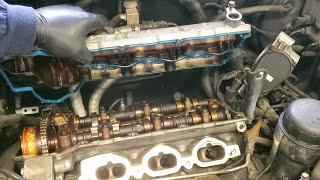
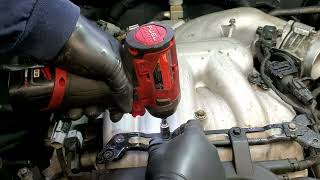
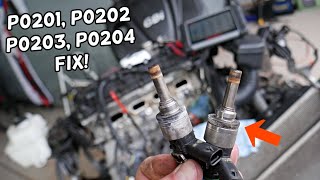
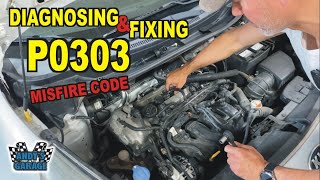
Typical fix: Replace the faulty fuel injector. 🎬 Watch: A quick overview of diagnosing P0203 codes on this model. Since accessing the rear bank requires removing the intake manifold, many owners and technicians choose to replace all three rear injectors (1, 3, 5) and the upper intake gaskets at the same time to avoid future labor costs. 🎬 Watch: Detailed walkthrough of fuel rail and intake manifold removal.
Est. part cost: $50-$150 - Damaged Wiring or Connector 🟡 Medium Probability The wiring harness and connector sit on top of a hot engine, and heat cycles can make the plastic and wires brittle over time. The locking tab on the connector can break, or the terminals can lose tension, leading to a poor connection. Rodents can also chew on the soy-based wiring insulation used in many modern vehicles.
How to confirm: Visually inspect the wiring and connector for cylinder #3. Look for any signs of melting, corrosion, or broken wires. Wiggle the connector while the engine is running to see if it affects the idle. Use a 'noid light' to confirm if the PCM is sending a pulse signal to the connector. If the light flashes, the wiring and PCM driver are likely good, pointing to the injector.
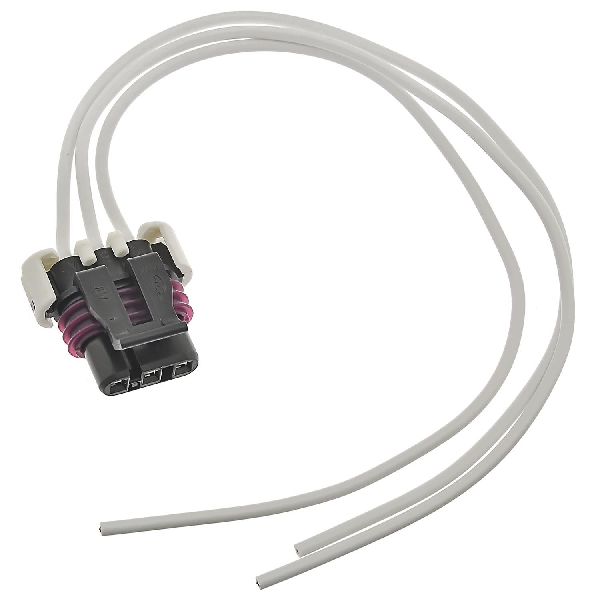
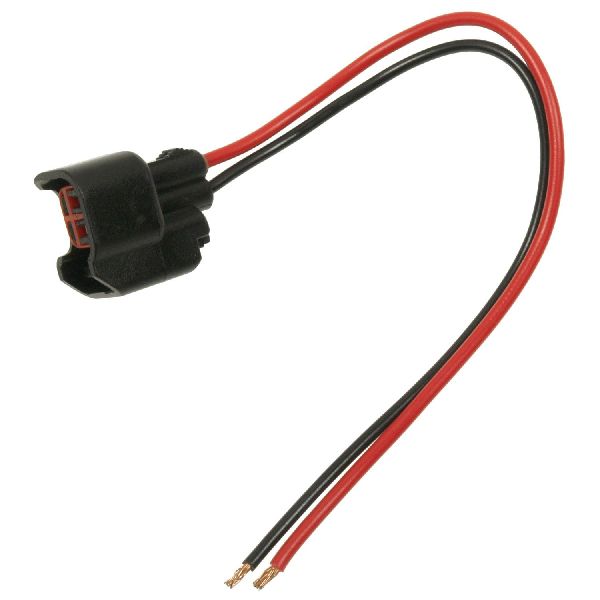
Typical fix: If the connector is damaged, it can be replaced with a new pigtail. If the wiring is broken, the damaged section needs to be repaired and properly insulated.
Est. part cost: $10-$30
Rare But Worth Checking
- Powertrain Control Module (PCM) Failure: This is the least likely cause. The internal driver circuit for the injector can fail, but all other possibilities should be exhausted before condemning the PCM. A PCM replacement requires programming specific to your vehicle's VIN.
Diagnosis Steps
- Confirm the code with an OBD-II scanner. Note any other codes present, especially P0303.
- Visually inspect the fuel injector #3 connector and its wiring harness. Check for loose connections, corrosion, or obvious damage like rodent chew marks.
- With the engine running, carefully wiggle the connector for injector #3 to see if it causes any change in the engine's idle.
- Disconnect the injector and plug in a 'noid light'. Start the engine. The noid light should flash, indicating the PCM is sending a signal. If it doesn't flash, the problem is in the wiring or the PCM. If it does flash, the injector is likely faulty.
- To confirm a bad injector, disconnect the battery and the injector connector. Measure its resistance with a multimeter. Compare the reading to the other injectors or to manufacturer specifications (typically 12-16 Ohms). A reading of infinity (OL) or zero indicates a failed injector.
- As a final confirmation, swap the cylinder #3 injector with an injector from an easily accessible front cylinder (e.g., cylinder #2). This requires removing the intake manifold. Clear the codes and run the engine. If the code changes to P0202, the injector is faulty. If P0203 returns, the problem is in the wiring or PCM.
- If all tests point away from the injector, carefully inspect the wiring harness from the injector back to the PCM for any breaks or shorts. If the wiring is good, the PCM may be the issue, which is a rare but possible failure.
Parts You'll Likely Need
- Fuel Injector
(OEM #35310-3C000 (for 3.3L Lambda V6) or 35310-23600 (for 2.7L Mu V6))— This is the most common failure point for a P0203 code. The internal coil windings can break, causing an open circuit.
Trusted brands: Hyundai Genuine (Delphi), Bosch, Standard Motor Products
OEM price range: $110-$200
Aftermarket price range: $50-$150 - Upper Intake Manifold Gasket Set
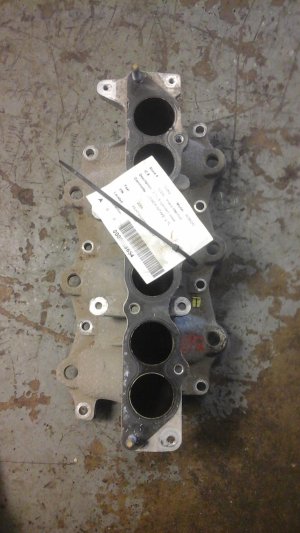
(OEM #28411-3E001 (for 2.7L Mu V6) or 29215-3C000 (for 3.3L Lambda V6))— The intake manifold must be removed to access the rear fuel injectors. The gaskets are one-time use and must be replaced to prevent vacuum leaks.
Trusted brands: Fel-Pro, Mahle, Hyundai Genuine Parts
OEM price range: $40-$60
Aftermarket price range: $20-$40
Related Codes That Often Appear With This One
- P0303 — P0303 is a 'Cylinder 3 Misfire' code. Since the P0203 code indicates a problem preventing the cylinder 3 injector from firing, that cylinder will not be contributing power, which the PCM will detect as a misfire.
- P0300 — This is a 'Random/Multiple Cylinder Misfire' code. Sometimes, the effects of a single dead cylinder can be misinterpreted by the PCM, or there may be an underlying issue affecting more than one cylinder.
- P0301, P0305 — If a vacuum leak is created after reinstalling the intake manifold (e.g., from a pinched gasket), it could cause misfires on other cylinders on the same bank (Bank 1: cylinders 1, 3, 5).
Platform-Specific Known Issues
- Intake Manifold Removal Required: To access injector #3 on the rear cylinder bank, the entire upper intake manifold plenum must be removed. 🎬 See this step-by-step guide for removing the intake plenum. This involves disconnecting multiple vacuum lines, electrical connectors, and the throttle body. It is critical to replace the intake manifold gaskets during reassembly to prevent vacuum leaks, which can cause new misfire codes.
Mechanic-Grade Diagnostic Values
- Fuel Injector Coil Resistance — expected: 13.8-15.2 Ohms for most models. Some 3.3L V6 injectors may be slightly lower, around 12 Ohms.. Failure: A reading of OL (Open Loop/infinity) or near zero Ohms indicates a failed injector coil.
- Injector Control Wire Voltage (Key On, Engine Off, Injector Connected) — expected: ~12V (Battery Voltage). Failure: A reading of 0V could indicate an open in the power supply wire to the injector.
- Injector Control Wire Voltage (Engine Cranking/Running) — expected: A flashing noid light or a square wave pattern on an oscilloscope, indicating the PCM is pulsing the ground.. Failure: A steady light or constant voltage indicates the PCM is not pulsing the injector, pointing to a wiring or PCM driver issue.
- Injector Closing Voltage Spike (on Oscilloscope) — expected: A brief spike of approximately 50-60 volts as the magnetic field in the injector coil collapses.. Failure: Absence of this spike when the injector is commanded off confirms a circuit or injector coil problem.
Scan Tool Commands That Help
- Hyundai GDS (Global Diagnostic System) or equivalent advanced scanner: Active Test / Actuation Test — This function allows a technician to command the #3 fuel injector to fire independently of the engine running. If the injector clicks when commanded, it confirms the injector coil and wiring are likely functional, pointing towards a potential PCM logic issue or intermittent fault.
- G-Scan / Advanced Aftermarket Scanners: Injector Quantity Comparison / Power Balance Test — This test sequentially disables one injector at a time while monitoring the drop in engine RPM. If disabling cylinder #3 causes no change in RPM, it confirms that cylinder was not contributing power, validating the P0203 fault.
Wiring & Ground Locations
- Injector Power Feed Wire — At the fuel injector connector for cylinder #3.. This wire supplies constant 12V power with the key on. For the 2.7L Mu V6, this wire is typically PINK. For the 3.3L Lambda V6, this wire is typically ORANGE. The other wire in the connector is the control wire pulsed by the PCM. Knowing the power wire color is crucial for correct testing.
- Injector Control Wire — At the fuel injector connector, running back to the PCM.. This is the wire the PCM pulses to ground to fire the injector. An open or short on this wire is a direct cause of P0203. On a 2.7L, it is the wire that is NOT pink; on a 3.3L, it is the wire that is NOT orange.
- BCM (Body Control Module) — Located under the driver's side of the dashboard, often behind the interior fuse box.. While not directly controlling the injectors, the BCM is a central hub for vehicle electronics. In rare cases of widespread electrical issues, knowing its location for inspection of connectors and grounds can be useful context, though it is not a primary diagnostic point for P0203.
OEM Part Supersession History
35310-3E100 (Incorrect PN from Pass 2)→35310-23600— Correction. 35310-23600 is the correct part number for the 2.7L 'Mu' V6 engine used in the 2007-2009 Santa Fe.
Heads up: The previously listed part number 35310-3E100 is for a different application. Part 35310-3C000 for the 3.3L V6 is not interchangeable with the 2.7L V6 injector.
Model Year Variations Within This Range
- 2007-2009: These pre-facelift models were available with the 2.7L Mu V6 and 3.3L Lambda V6 engines, which this guide primarily covers.
- 2010-2012: For the 2010 model year facelift, the V6 engine options were changed. The 2.7L and 3.3L were replaced by a new 3.5L Lambda II V6 (and a 2.4L I4). While the P0203 code is fundamentally the same, part numbers for the fuel injector (35310-3C400) and intake gaskets will be different for the 3.5L engine.
Diagnostic Flowchart
Other Known Issues on This Vehicle
Issues unrelated to this code that are worth knowing about as an owner of this generation:
- Faulty Fuel Level Sensor 🟠 Medium — Very common, typically occurs around 85,000-100,000 miles. Causes inaccurate fuel gauge readings and can trigger a check engine light. (Ref: No official recall, but a widely known issue. Repair involves replacing one or both sending units in the fuel tank, which requires removing the rear seats.)
- Leaking Valve Cover Gaskets 🟠 Medium — Common oil leak source, especially on the 2.7L V6. Oil drips onto the alternator or exhaust, causing a burning smell or alternator failure.
- Crankshaft Position Sensor Failure 🔴 High — A known failure point that can cause the engine to stall while driving or fail to start.
- Leaking Oil Pressure Switch 🔴 High — The switch, located under the intake manifold, can leak oil into the engine valley. This is often misdiagnosed as a rear main seal leak. In severe cases, oil can wick through the wiring harness to the ECU.
- Automatic Transmission Shift Problems 🟠 Medium — Owners report issues like harsh shifting, hesitation, or abnormal RPM fluctuation between gears.
Used vs. New Parts: Buying Guide for This Vehicle
When a used part is the smart pick: A used wiring harness pigtail from a junkyard is a smart choice if only the plastic connector is broken. It is much cheaper than replacing a larger section of the harness. Used fuel injectors are generally not recommended due to the risk of them being clogged or having a high amount of wear, but can be a last resort for budget repairs.
Donor-vehicle mileage cap: roughly under 80000 miles for the part to have meaningful remaining life.
What to inspect on the donor part:
- For a wiring pigtail: Ensure the plastic is not brittle, the locking tab is intact, and there's no visible corrosion on the metal pins.
- For a used injector: Look for a clean nozzle tip with no carbon buildup. Avoid injectors from engines that show signs of sludge or poor maintenance.
OEM-only on this vehicle (don't cheap out):
- Upper Intake Manifold Gaskets: These are single-use crush gaskets and must always be replaced with new ones to prevent vacuum leaks. Aftermarket is acceptable, but they must be new.
- Powertrain Control Module (PCM): Due to VIN-specific programming requirements, a new or professionally refurbished and programmed unit is the only reliable option.
Aftermarket brands forum-validated for this vehicle:
- Bosch
- Standard Motor Products (SMP)
- Fel-Pro (for gaskets)
- Mahle (for gaskets)
Brands owners have reported issues with on this vehicle:
- Unbranded, no-name injectors from online marketplaces often have high failure rates, inconsistent flow rates, and may not meet OEM specifications, causing persistent performance issues.
Real Owner Stories
Aggregated from forums and TSBs cited above. Mileages and costs reflect what owners reported in those sources.
2007-2012 Hyundai Santa Fe 2.7L V6
Symptoms: Rough idle and acceleration problems with a cylinder 3 misfire.
What fixed it: The discussion confirmed these symptoms are common for P0203; the standard fix involves diagnosing the injector circuit or replacing the injector.
Source hint: reddit.com/r/MechanicAdvice
Hyundai Santa Fe V6 (Motor Swap)
Symptoms: Persistent P0203 code after a motor swap despite consistent voltage (10.xx V) and resistance (15.8x Ohms) across all injectors.
What fixed it: The issue was attributed to a bad ground or a faulty PCM driver, as the injector and wiring tested within normal parameters.
Source hint: Hyundai-Aftermarket.org - 'p0203 obd2 code'
Related OBD-II Codes
Frequently Asked Questions
Where is cylinder #3 located on my 2.7L or 3.3L Santa Fe engine?
What is the correct resistance for a fuel injector on a 2007-2012 Santa Fe?
Should I replace all the injectors if only P0203 is showing?
Can I use a used wiring connector to fix this code?
Why is my Santa Fe shaking and the Check Engine Light flashing?
Is there a specific part number for the fuel injectors in my Santa Fe?
Helpful Videos
Used OEM Parts in Stock



New Aftermarket Parts Available


The information in this article is provided for general reference and educational purposes only. Vehicle specifications, procedures, and part compatibility can vary by production date, trim level, and region. Always consult your vehicle's factory service manual and verify part numbers before purchasing or performing repairs. Safety-critical components such as airbags, seat belts, and braking systems should be installed by a qualified professional.
- Hyundai Santa Fe:
- 🎬 Helpful Videos
- 🛍️ Shop This Part
- What's Unique About the 2007-2012 Hyundai Santa Fe
- Symptoms You May Notice
- Most Likely Causes
- Rare But Worth Checking
- Diagnosis Steps
- Parts You'll Likely Need
- Related Codes That Often Appear With This One
- Platform-Specific Known Issues
- Mechanic-Grade Diagnostic Values
- Scan Tool Commands That Help
- Wiring & Ground Locations
- OEM Part Supersession History
- Model Year Variations Within This Range
- Diagnostic Flowchart
- Other Known Issues on This Vehicle
- Used vs. New Parts: Buying Guide for This Vehicle
- Real Owner Stories
- 2007-2012 Hyundai Santa Fe 2.7L V6
- Hyundai Santa Fe V6 (Motor Swap)
- Related OBD-II Codes
- Frequently Asked Questions
- 🎟️ Get 5% Off