

P0192 on 2010-2019 Ford Taurus 3.5L EcoBoost: Fuel Rail Pressure Sensor Circuit Low Causes and Fixes
For the 2010-2019 Ford Taurus with the 3.5L EcoBoost engine, code P0192 most often indicates a failed Fuel Rail Pressure (FRP) sensor or a problem with its wiring. This is an electrical fault code, not a confirmation of low fuel pressure. The sensor is the most common point of failure, followed closely by heat-damaged wiring at the connector.
- P0192 is an electrical fault code for the high-pressure fuel rail sensor circuit; it does not automatically mean your fuel pump is bad.
- The most likely cause on a 3.5L EcoBoost Taurus is a failed Fuel Rail Pressure (FRP) sensor.
- Before replacing any parts, inspect the sensor's wiring and connector for heat damage, which is common in this engine bay.
- Check if your vehicle is affected by Ford Safety Recall 16S31 for the Fuel Pump Control Module, as this can cause similar stalling symptoms.
- Always use a high-quality OEM (Motorcraft) or reputable aftermarket sensor for this repair to ensure compatibility and longevity.
What's Unique About the 2010-2019 Ford Taurus
The 3.5L EcoBoost engine uses a Gasoline Direct Injection (GDI) system, which features both a low-pressure fuel pump in the tank and a high-pressure fuel pump (HPFP) driven by the engine. Code P0192 specifically relates to the high-pressure side's Fuel Rail Pressure (FRP) sensor. Unlike on some other Ford EcoBoost platforms where wiring chafe is the primary culprit, on the Taurus and related F-150s with this engine, the FRP sensor itself is a very common failure point, along with heat-damaged wiring right at the connector. The sensor is located in a high-heat area at the back of the engine, making both the sensor and its connector susceptible to failure.
Symptoms You May Notice
- Check Engine Light is on
- Engine is hard to start or requires long cranking time
- Engine stalls, sometimes without warning
- Hesitation or stumbling during acceleration
- Reduced engine power or 'limp mode'
- Rough idle
- No throttle response after a hard start
- Replacing the in-tank low-pressure fuel pump. P0192 points to an issue with the high-pressure side's sensor circuit, not necessarily a lack of fuel supply from the tank.
- Replacing the High-Pressure Fuel Pump (HPFP) before diagnosing the sensor and wiring. The sensor is a far more common and less expensive failure point for this specific code.
Most Likely Causes
- Faulty Fuel Rail Pressure (FRP) Sensor 🔴 High Probability The FRP sensor is a common failure item on the 3.5L EcoBoost engine. It is subjected to high pressure and temperature cycles, leading to internal failure. The sensor is located in a difficult-to-access, high-heat area which contributes to its failure rate.
How to confirm: With a scan tool, observe the Fuel Rail Pressure reading with the key on, engine off. If it reads an abnormally low or zero value, the sensor is likely bad. Test the sensor's wiring for 5V reference, ground, and signal continuity before condemning the sensor. An internal failure of the sensor can also manifest as raw fuel in its vacuum hose.
Typical fix: Replace the Fuel Rail Pressure sensor. It is highly recommended to use an OEM Motorcraft part (CM-5250) to avoid compatibility issues.
Est. part cost: $65-$150 - Damaged FRP Sensor Wiring or Connector 🟡 Medium Probability The wiring and connector for the FRP sensor are located in a high-heat area at the back of the engine, which can cause the wires to become brittle and break or the connector to fail over time. This is a well-documented issue on the platform.
How to confirm: Visually inspect the wiring harness leading to the FRP sensor for any signs of chafing, melting, or broken wires, especially right at the connector. Perform a wiggle test on the harness while monitoring the FRP voltage on a scan tool. A broken signal wire is a common finding.
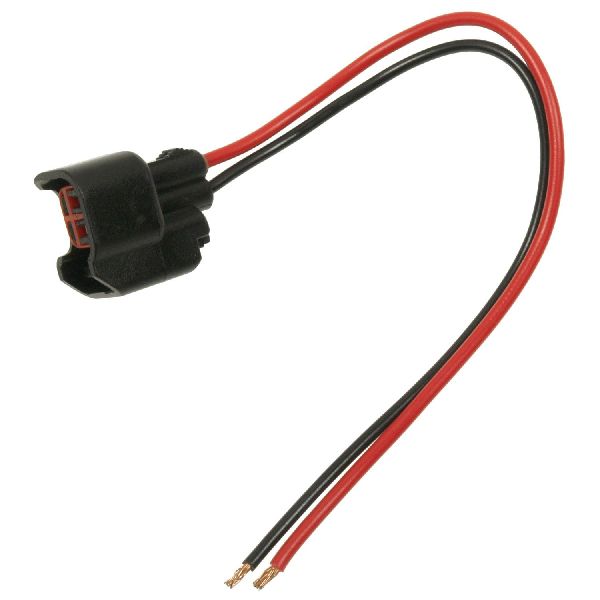
Typical fix: Repair the damaged section of the wire or replace the connector pigtail. The Motorcraft pigtail part number is often WPT-1253. Ensure the repaired harness is protected with heat-resistant tape.
Est. part cost: $15-$40 - Failing Fuel Pump Control Module (FPCM) ⚪ Low Probability Ford issued Safety Recall 16S31 for a faulty Fuel Pump Control Module on 2013-2015 Taurus models with the 3.5L EcoBoost engine. This module can fail, causing a stall or no-start condition, which may or may not be accompanied by P0192.
How to confirm: Check your vehicle's VIN against Ford's recall database for Safety Recall 16S31 (NHTSA Recall 16V-621). If the recall applies and has not been performed, this is a likely cause. Diagnosis involves checking power and communication to the module, which is located behind the rear seat back.
Typical fix: The dealer will inspect and, if necessary, replace the Fuel Pump Control Module free of charge under the recall.
Est. part cost: $0 (if covered by recall)
Rare But Worth Checking
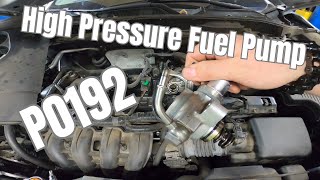
- Failing High-Pressure Fuel Pump (HPFP): While P0192 is an electrical circuit code, a failing HPFP can sometimes cause erratic pressure that may contribute to the code. A failing HPFP seal can also leak fuel into the engine oil. This is a much more expensive repair and should only be considered after the sensor and wiring have been ruled out.
- Powertrain Control Module (PCM) Fault: This is extremely rare. The PCM is the last component to suspect after all other possibilities, including wiring, sensors, and mechanical fuel system components, have been thoroughly tested and eliminated.
Diagnosis Steps
- Connect an OBD-II scanner and check for any other stored codes. Address any other codes first, especially those related to the camshaft or fuel pump control module.
- Monitor the live data for the Fuel Rail Pressure (FRP) sensor. With the Key On, Engine Off (KOEO), the pressure should read a plausible, steady value. A reading of 0 PSI or an extremely low, unchanging value points to a sensor or wiring issue.
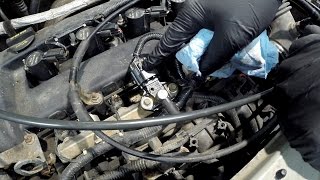
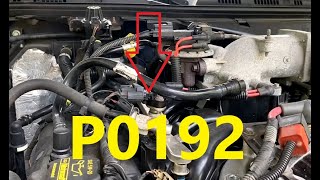
- Visually inspect the FRP sensor's wiring harness and connector. The sensor is located on the high-pressure fuel rail, at the rear of the engine. Look for any signs of heat damage, chafing, or broken wires.
- If the wiring appears intact, perform a wiggle test on the harness while monitoring the FRP voltage to see if the reading fluctuates.
- Using a multimeter, disconnect the sensor and test the connector for a 5-volt reference signal, a good ground, and continuity on the signal wire back to the PCM.
- If the wiring and connector test good, the Fuel Rail Pressure sensor itself is the most likely culprit and should be replaced.
- If the sensor and wiring are confirmed to be good, further diagnosis of the low and high-pressure fuel pumps and the Fuel Pump Control Module is required. Check if Safety Recall 16S31 applies to your vehicle.
Parts You'll Likely Need
- Fuel Rail Pressure Sensor
(OEM #CM-5250 / BU5Z-9F972-B)— This is the most common component to fail and trigger a P0192 code on the 3.5L EcoBoost engine.
Trusted brands: Motorcraft, Bosch
OEM price range: $65-$100
Aftermarket price range: $50-$90 - Fuel Rail Pressure Sensor Connector Pigtail
(OEM #WPT-1253)— If the wiring is damaged right at the sensor due to heat or vibration, replacing the connector pigtail is the proper repair.
Trusted brands: Motorcraft, Dorman
OEM price range: $25-$40
Aftermarket price range: $15-$30
Related Codes That Often Appear With This One
- P0087 — This code means 'Fuel Rail/System Pressure - Too Low'. It can appear alongside P0192 if there is a genuine lack of fuel pressure from a failing pump, in addition to or causing the sensor circuit fault.
- P0193 — This code for 'Fuel Rail Pressure Sensor Circuit High Input' can appear intermittently with P0192 if the sensor is failing erratically or there is a loose connection causing the voltage signal to fluctuate wildly.
Technical Service Bulletins (TSBs) & Recalls
- Recall 16S31 / NHTSA 16V-621 - Fuel Pump Control Module Inspection and Repair for certain 2013-2015 Taurus models with 3.5L EcoBoost engines.
Platform-Specific Known Issues
- Safety Recall 16S31: Affects some 2013-2015 Ford Taurus models with the 3.5L EcoBoost engine. A failing Fuel Pump Control Module can cause the engine to stall or not start. Owners should check if their VIN is affected.
- Real Owner Experience: Broken Wire at Connector: A common owner-reported failure is not the sensor itself, but the signal wire breaking from heat and vibration right at the back of the connector. This requires a pigtail replacement or careful wire repair.
Mechanic-Grade Diagnostic Values
- FRP Sensor Signal Voltage (KOEO) — expected: > 0.5V. Failure: Voltage below 0.5V, and especially below 0.05V, triggers the P0192 code.
- Low-Pressure Fuel System (supplying HPFP) — expected: 40-65 PSI at idle.. Failure: Pressure consistently below 40 PSI indicates a problem with the in-tank pump or FPCM.
- High-Pressure Fuel System (Scan Tool PID 'FRP') — expected: ~500 PSI during cranking, up to 2,150+ PSI under load. Should closely track the 'FRP_DES' (Desired) PID.. Failure: Actual pressure ('FRP') lags desired pressure ('FRP_DES') by more than 200 PSI, or the reading is stuck/erratic.
- FRP Sensor Circuit Resistance — expected: Less than 5.0 ohms on the signal and reference voltage circuits between the PCM and sensor connectors.. Failure: Resistance greater than 5.0 ohms indicates an open or high-resistance wire.
- FRP Sensor Circuit Short to Ground Test — expected: Greater than 10,000 ohms between the FRP signal pin and the Signal Return (ground) pin at the PCM connector.. Failure: Resistance less than 10,000 ohms indicates a short circuit.
Scan Tool Commands That Help
- Ford IDS / FORScan: Monitor PIDs: 'FRP' (Actual Fuel Rail Pressure) and 'FRP_DES' (Desired Fuel Rail Pressure). — This is the primary diagnostic step to determine if the high-pressure fuel system is meeting the PCM's commanded pressure. A significant deviation points towards a sensor, pump, or leak issue.
- Ford IDS: Service Function: FP (MODE) PID Activation — This bidirectional control allows the technician to manually command the fuel pump on (with engine off) to check for maximum system pressure and perform leak-down tests.
- Ford IDS: Service Function: Relative Injector Flow Test — This test helps identify leaking or underperforming fuel injectors that could cause a drop in rail pressure, which might be misinterpreted as a sensor or pump fault.
Wiring & Ground Locations
- FRP Sensor Connector — On the high-pressure fuel rail, at the rear of the engine near the firewall, under the intake manifold.. This 3-pin connector and its associated wiring are in a high-heat area and are a common failure point due to brittle wires and heat damage, causing a 'Circuit Low' condition.
- PCM Connector C175B — At the Powertrain Control Module (PCM), located in the engine compartment.. The FRP sensor wires terminate here. Pushed-out or corroded pins at this connector can be a rare but difficult-to-diagnose cause of P0192 after the sensor and its pigtail have been checked.
- Ground G104 / G105 — Located on the right side of the engine compartment.. These are primary engine bay ground points. A loose or corroded ground here can cause unstable voltage references for multiple sensors, including the FRP sensor, leading to erratic readings and codes.
Real Owner Repair Stories
- ScannerDanner Forum User (2014 Ford Fusion 2.0L EcoBoost (platform-mate with similar electronics)) — Long crank to start, poor acceleration, code P0087 (often related to FRP sensor issues).
❌ Tried (didn't work) Replaced low-pressure fuel sensor, Replaced high-pressure fuel sensor (FRP), Installed a used high-pressure fuel pump (HPFP)
✅ What actually fixed it The root cause was two pushed-out connector pins at the main Powertrain Control Module (PCM) socket (C175B). Reseating the pins properly resolved all symptoms and codes. - F-150 Forum User / YouTube Video (2011 Ford F-150 3.5L EcoBoost) — Check Engine Light with code P0192.
❌ Tried (didn't work) Initial diagnosis pointed to the sensor itself.
✅ What actually fixed it A close inspection revealed a broken signal wire right at the back of the FRP sensor connector, caused by heat and vibration. Replacing the connector pigtail was the correct repair. - YouTube channel ZB Auto Repair (2013 Ford F-150 3.5L EcoBoost) — Hard start, rough run, code P0087 (Fuel Rail Pressure Too Low).
❌ Tried (didn't work) Ruled out injectors and low-pressure pump issues.
✅ What actually fixed it After removing the High-Pressure Fuel Pump (HPFP), a visual inspection showed its internal return spring was broken and compressed compared to a new unit. This confirmed a mechanical failure of the pump. Replacing the HPFP and its tappet follower fixed the issue.
"I Checked Everything" — The Actual Cause
- A smoke test for vacuum leaks would come back clean, and standard wiring checks at the sensor might show no issue, but the actual cause could be pushed-out pins at the PCM connector (C175B). This fault interrupts the circuit far from the sensor itself and is often missed because technicians focus on the engine-side harness which is more prone to heat damage.
OEM Part Supersession History
BU5Z-9F972-A, CM-5226→BU5Z-9F972-B (Service Part #: CM-5250)— Standard part revision and consolidation.
Heads up: An additional interchange part number is BU5A-9F972-CA. All these numbers refer to the same high-pressure rail sensor and should be compatible.
Model Year Variations Within This Range
- 2010-2012: These early models of the 3.5L EcoBoost used a direct injection fuel system supplied by Hitachi.
- 2013-2016: Ford switched to a Bosch direct injection fuel system. This change coincided with the FPCM recall (16S31) which applies to 2013-2015 models. Parts like the HPFP and potentially the sensor may differ between Hitachi and Bosch systems.
Diagnostic Flowchart
Other Known Issues on This Vehicle
Issues unrelated to this code that are worth knowing about as an owner of this generation:
- Internal Water Pump Failure 🔴 High — Common on engines over 80,000 miles. As a wear item, failure is expected, but the internal design makes it catastrophic. The pump is driven by the timing chain, and when its seal fails, it leaks coolant directly into the engine oil, leading to rapid engine damage if not caught immediately.
- Power Transfer Unit (PTU) Failure (AWD Models) 🔴 High — Very common, with failures reported from 40,000 to 100,000+ miles. The unit is located next to hot exhaust components, causing its 'lifetime' fluid to break down from heat. Symptoms include a burning gear oil/propane smell, grinding/whining noises, and eventual loss of AWD. (Ref: TSB 19-2017 (for fluid leak))
- Timing Chain Stretch and Phaser Rattle 🟠 Medium — Common on the first-generation (2010-2015) engines. The primary symptom is a loud rattle from the front of the engine for 2-5 seconds on a cold start. If ignored, a stretched chain can lead to timing correlation codes like P0016 and potential engine damage. (Ref: TSB 15-0131)
- Intake Valve Carbon Buildup 🟠 Medium — A known issue for all first-generation direct-injection engines, typically becoming noticeable after 60,000-80,000 miles. Symptoms include gradual power loss, rough idle, and misfires. Requires manual cleaning (e.g., walnut blasting) as there is no fuel washing over the intake valves.
Used vs. New Parts: Buying Guide for This Vehicle
When a used part is the smart pick: A used wiring connector pigtail can be a good option if it is sourced from a low-mileage, non-corroded vehicle. Ensure the wires are still flexible and not brittle.
Donor-vehicle mileage cap: roughly under 60000 miles for the part to have meaningful remaining life.
What to inspect on the donor part:
- For wiring, check for wire flexibility and absence of cracks in the insulation.
- Inspect plastic connectors for cracks, brittleness, or signs of melting.
- Ensure locking tabs on connectors are intact.
- Verify there is no corrosion on the electrical pins.
OEM-only on this vehicle (don't cheap out):
- Fuel Rail Pressure Sensor (FRP)
- High-Pressure Fuel Pump (HPFP)
Aftermarket brands forum-validated for this vehicle:
- Bosch (OEM supplier for 2013+ models)
Brands owners have reported issues with on this vehicle:
- Unbranded, low-cost electronic sensors from online marketplaces are frequently reported to fail quickly or provide inaccurate readings.
Real Owner Stories
Aggregated from forums and TSBs cited above. Mileages and costs reflect what owners reported in those sources.
2013-2015 Ford Taurus 3.5L EcoBoost
Symptoms: Engine stalls or results in a no-start condition.
What fixed it: The dealer inspected and replaced the Fuel Pump Control Module under Safety Recall 16S31.
Cost: $0-$0
Source hint: Recall 16S31 / NHTSA 16V-621
2010-2019 Ford Taurus 3.5L EcoBoost
Symptoms: P0192 code triggered by a broken signal wire at the back of the sensor connector due to heat and vibration.
What fixed it: Replacement of the connector pigtail (Motorcraft WPT-1253) or careful wire repair.
Source hint: vehicle_specific_issues: Real Owner Experience: Broken Wire at Connector
2011-2016 Ford F-150 3.5L EcoBoost
Symptoms: P0192 code and fuel delivery issues on the same 1st generation 3.5L EcoBoost engine platform.
What fixed it: Replacing the Fuel Rail Pressure sensor with Motorcraft part CM-5250 or repairing the pigtail connector.
Source hint: f150forum.com
2010-2019 Ford Taurus 3.5L EcoBoost
Symptoms: No-start condition and fuel delivery issues.
What fixed it: Traced to fuel delivery issues including the fuel pump control module.
Source hint: shoforum.com thread titled 'Fuel Pump Issue?'
Related OBD-II Codes
Frequently Asked Questions
Is there a recall for the fuel system on my 2013-2015 Ford Taurus 3.5L EcoBoost?
What specific replacement part should I use for the Fuel Rail Pressure sensor on my Taurus?
My Taurus has a P0192 and won't start; could it be the wiring instead of the sensor?
Can a bad Fuel Rail Pressure sensor cause my engine to stall while driving?
Where is the Fuel Rail Pressure (FRP) sensor located on the 3.5L EcoBoost V6?
How can I tell if the Fuel Pump Control Module is the cause of my P0192 code?
Helpful Videos
We Have This Part in Stock


The information in this article is provided for general reference and educational purposes only. Vehicle specifications, procedures, and part compatibility can vary by production date, trim level, and region. Always consult your vehicle's factory service manual and verify part numbers before purchasing or performing repairs. Safety-critical components such as airbags, seat belts, and braking systems should be installed by a qualified professional.
- Ford Taurus:
- 🎬 Helpful Videos
- 🛍️ Shop This Part
- What's Unique About the 2010-2019 Ford Taurus
- Symptoms You May Notice
- Most Likely Causes
- Rare But Worth Checking
- Diagnosis Steps
- Parts You'll Likely Need
- Related Codes That Often Appear With This One
- Technical Service Bulletins (TSBs) & Recalls
- Platform-Specific Known Issues
- Mechanic-Grade Diagnostic Values
- Scan Tool Commands That Help
- Wiring & Ground Locations
- Real Owner Repair Stories
- "I Checked Everything" — The Actual Cause
- OEM Part Supersession History
- Model Year Variations Within This Range
- Diagnostic Flowchart
- Other Known Issues on This Vehicle
- Used vs. New Parts: Buying Guide for This Vehicle
- Real Owner Stories
- 2013-2015 Ford Taurus 3.5L EcoBoost
- 2010-2019 Ford Taurus 3.5L EcoBoost
- 2011-2016 Ford F-150 3.5L EcoBoost
- 2010-2019 Ford Taurus 3.5L EcoBoost
- Related OBD-II Codes
- Frequently Asked Questions
- 🎟️ Get 5% Off