

P0175 on 2006-2012 Mitsubishi Eclipse 3.8L V6: System Too Rich Bank 2 Causes and Fixes
This code means Bank 2 of your engine is getting too much fuel. The most common causes are a failing front oxygen sensor (A/F sensor) on Bank 2 or a leaking fuel injector. Expect to pay $50-$150 for a new sensor or $50-$120 per injector, plus labor. Accessing these parts on the front bank (Bank 2) can be challenging.
- P0175 means Bank 2 (front cylinder bank) is running rich.
- Start your diagnosis by checking live fuel trim data with an OBD-II scanner.
- The most probable causes are a bad upstream O2 sensor on Bank 2 or a leaking fuel injector.
- If you also have a P0172 code for Bank 1, the problem is likely a shared component like the MAF sensor.
- Do not ignore this code, as it can lead to costly catalytic converter damage over time.
What's Unique About the 2006-2012 Mitsubishi Eclipse
The 2006-2012 Eclipse uses the 6G75 V6, an engine shared with other Mitsubishi models like the Galant and Endeavor. For this P0175 code, the causes are generally typical for modern V6 engines. However, accessing the Bank 2 (front) fuel injectors and the upstream oxygen sensor can be more involved due to the transverse engine layout. The intake plenum often needs to be removed to service the fuel rail and injectors, and the Bank 2 upstream O2 sensor is tucked near the firewall, making some repairs more labor-intensive than on other vehicles.
Symptoms You May Notice
- Poor fuel economy.
- Rough or unstable idle.
- Strong smell of gasoline from the exhaust.
- Black smoke from the tailpipe, especially under acceleration.
- Hesitation or lack of power during acceleration.
- Engine misfires, which may feel like a stumble or jerking, and can trigger codes like P0300, P0302, P0304, P0306.
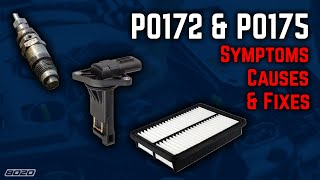
- Illuminated Check Engine Light. 🎬 Watch: A breakdown of P0172 and P0175 symptoms and fixes.
- Replacing the downstream (post-catalyst) O2 sensor instead of the upstream (pre-catalyst) sensor. The upstream sensor (Sensor 1) is the primary input for fuel trim adjustments.
- Replacing parts without confirming the failure. For example, replacing O2 sensors when the real problem is a leaking injector or a dirty MAF sensor.
Most Likely Causes
- Faulty Bank 2 Upstream Oxygen Sensor (Air/Fuel Ratio Sensor) 🔴 High Probability Oxygen sensors are wear items that degrade over time. A lazy or biased sensor can send incorrect rich readings to the PCM, causing it to reduce fuel when it isn't necessary.
How to confirm: Use an OBD-II scanner to monitor the live data for the Bank 2, Sensor 1 voltage. A healthy sensor should fluctuate rapidly between approximately 0.1 and 0.9 volts. A sensor that is stuck high (e.g., above 0.8V) or responds very slowly is likely faulty.
Typical fix: Replace the Bank 2, Sensor 1 (upstream) oxygen sensor. This sensor is located on the front exhaust manifold, near the radiator.
Est. part cost: $50-$150 - Leaking or Stuck-Open Fuel Injector(s) 🟡 Medium Probability Injectors can fail internally or become clogged, allowing more fuel than commanded to enter a cylinder. This is a common failure point on many port-injected engines as they age.
How to confirm: Perform a fuel pressure leak-down test; if pressure drops quickly after the engine is off, an injector may be leaking. You can also pull the spark plugs on Bank 2 (cylinders 2, 4, 6) and look for one that is black, sooty, and smells of raw fuel, indicating a rich condition in that specific cylinder.
Typical fix: Replace the faulty fuel injector(s). It is often recommended to replace all injectors on that bank (or all six) at the same time for balanced flow and to prevent future failures.
Est. part cost: $50-$120 per injector - Dirty or Faulty Mass Airflow (MAF) Sensor 🟡 Medium Probability If the MAF sensor is dirty (especially from over-oiled aftermarket air filters) or failing, it can under-report the amount of air entering the engine. The PCM then calculates an incorrect (too rich) fuel mixture for both banks. This will usually trigger a P0172 (Bank 1 Rich) code as well.
How to confirm: Inspect the MAF sensor element for dirt or debris. You can try cleaning it with a dedicated MAF sensor cleaner. Monitor MAF sensor readings with a scan tool to see if they are plausible for the engine RPM and load.
Typical fix: Clean the MAF sensor with a dedicated spray cleaner. If cleaning doesn't work, replace the sensor.
Est. part cost: $20 (cleaner) or $70-$200 (new sensor) - High Fuel Pressure ⚪ Low Probability A failing fuel pressure regulator can cause system-wide high fuel pressure, forcing too much fuel through the injectors on both banks. This would typically set both P0175 and P0172 codes.
How to confirm: Connect a fuel pressure gauge to the fuel rail and check the pressure at idle. Compare the readings to the manufacturer's specifications (typically 40-60 psi). If pressure is too high, the regulator is a likely suspect.
Typical fix: Replace the fuel pressure regulator.
Est. part cost: $40-$100
Rare But Worth Checking
- Faulty Engine Coolant Temperature (ECT) Sensor: If the ECT sensor is stuck reading very cold, the PCM will command a richer fuel mixture, similar to a cold-start enrichment, even when the engine is warm. This can cause a P0175, often alongside a P0172.
- Leaking EVAP Purge Solenoid: A purge solenoid stuck open can allow un-metered fuel vapors from the charcoal canister to be drawn into the intake manifold, creating a rich condition that can affect one or both banks.
- Exhaust Leak Before O2 Sensor: An exhaust leak between the cylinder head and the upstream O2 sensor can draw in outside air. This fresh air causes the O2 sensor to read a false lean condition, prompting the PCM to add excessive fuel, which results in an actual rich condition and a P0175 code.
Diagnosis Steps
- Use an OBD-II scanner to confirm the P0175 code and check for any other related codes, like P0172 or misfire codes.
- Observe live data on the scanner, paying close attention to Short-Term Fuel Trim (STFT) and Long-Term Fuel Trim (LTFT) for both Bank 1 and Bank 2. For P0175, you will see highly negative numbers for Bank 2 (e.g., -15% or more) as the PCM tries to subtract fuel.
- If both banks are rich (P0172 & P0175 are both present), investigate components common to both, like the MAF sensor (check for dirt) and fuel pressure (perform a pressure test).
- If only Bank 2 is rich, focus on bank-specific components. Inspect the Bank 2 upstream O2 sensor's live data. It should switch rapidly. If it's stuck high or is slow to respond, it's a primary suspect.
- Inspect the spark plugs on Bank 2 (cylinders 2, 4, 6). A plug that is black and sooty compared to the others points to a problem in that specific cylinder, most likely a leaking injector.
- Perform a fuel pressure test to rule out a faulty fuel pressure regulator. A leak-down test can help identify a leaking injector if pressure drops after shutdown.
- Conduct a visual inspection of the exhaust manifold on Bank 2 for any signs of cracks or gasket leaks before the O2 sensor.
- Check for less common causes like a faulty ECT sensor by verifying its reading on the scan tool matches the actual engine temperature.
Parts You'll Likely Need
- Air/Fuel Ratio Sensor (Bank 2, Sensor 1)
(OEM #1588A141)— This is the primary sensor that detects the rich condition and is a common failure item. Replacing a faulty sensor restores accurate feedback to the PCM.
Trusted brands: Denso, Bosch, NGK/NTK
OEM price range: $150-$400
Aftermarket price range: $50-$150 - Fuel Injector
(OEM #MR578968)— A leaking or stuck-open injector is a direct cause of too much fuel entering a cylinder. Replacement is the only reliable fix for a mechanically failed injector.
Trusted brands: Standard Motor Products, GB Remanufacturing, OEM Mitsubishi
OEM price range: $200-$300
Aftermarket price range: $50-$120 - Mass Airflow (MAF) Sensor — If the code is accompanied by P0172 (Bank 1 Rich), a faulty MAF sensor is a likely cause affecting the entire engine. Often, it only needs cleaning.
Trusted brands: Denso, Hitachi
OEM price range: $150-$250
Aftermarket price range: $70-$200
Related Codes That Often Appear With This One
- P0172 — System Too Rich (Bank 1). If both P0172 and P0175 are present, the cause is likely a component common to both banks, such as the MAF sensor, fuel pressure regulator, or ECT sensor.
- P0300, P0302, P0304, P0306 — Misfire codes for Bank 2 cylinders (P0302, P0304, P0306) or random misfires (P0300). An excessively rich mixture can foul spark plugs and cause incomplete combustion, leading to misfires on the affected bank.
Platform-Specific Known Issues
- Access to the Bank 2 (front) upstream O2 sensor can be tight, but is generally manageable from the top of the engine bay.
- Servicing the fuel injectors on the 6G75 engine requires removal of the upper intake manifold plenum, which adds significant labor time to the repair.
Mechanic-Grade Diagnostic Values
- Fuel Pressure at Idle — expected: Approx. 270 kPa (38 psi). Failure: Significantly higher or lower pressure indicates a fuel delivery problem.
- Fuel Pressure at Idle (Vacuum hose to regulator disconnected) — expected: 330 - 350 kPa (47 - 50 psi). Failure: Pressure not rising to this range can indicate a faulty fuel pressure regulator.
- Fuel Injector Resistance — expected: Approx. 11-15 Ohms at 68°F/20°C. Failure: A reading significantly outside this range, or an open/short circuit, indicates a failed injector coil.
- Long Term Fuel Trim (LTFT) for Bank 2 — expected: Within +/- 10%. Failure: A reading of -20% or more negative indicates the PCM is subtracting a large amount of fuel to compensate for a rich condition, triggering the code.
Scan Tool Commands That Help
- Mitsubishi MUT-III or advanced bidirectional scanner: EVAP Purge Solenoid Activation Test — If P0175 is accompanied by EVAP codes (P0442, P0455) or if a stuck-open purge solenoid is suspected. This command allows you to manually cycle the solenoid to check its function while monitoring fuel trims or using a noid light to confirm the electrical signal.
- Mitsubishi MUT-III or advanced bidirectional scanner: Fuel Pump Activation — During a fuel pressure test, this command allows you to run the fuel pump without starting the engine, making it easier and safer to check for leaks at the gauge connections before proceeding.
Wiring & Ground Locations
- Engine Compartment Grounds — Multiple points: On the firewall behind the ECU assembly, on both the driver and passenger side strut towers, a strap near the main motor mount, and a heavy wire off the side of the front valve cover.. Poor grounds can cause erratic voltage signals from critical sensors like the O2 sensor, MAF sensor, and ECT sensor, leading to incorrect fuel calculations by the PCM. Cleaning these points is a crucial, often-overlooked first step in diagnosing electrical issues.
- ETACS ECU — The Electronic Time and Alarm Control System (ETACS) ECU is attached to the back of the interior fuse box under the driver's side dash.. While not a direct cause, this unit integrates with many vehicle systems. Knowing its location is important for advanced electrical diagnosis if multiple unrelated codes are present with P0175.
OEM Part Supersession History
Unknown→1588A141— Standard part evolution and updates.
Heads up: Part number 1588A141 is listed for a wide range of Mitsubishi vehicles, including the Eclipse, Lancer, and Outlander from 2008 onwards. It may have superseded earlier part numbers for the 2006-2007 models. Always verify fitment with VIN.1588A183→1588A141— Part consolidation/update.
Heads up: Some aftermarket suppliers list 1588A183 as being replaced by 1588A141. They appear to be interchangeable for many applications.
Model Year Variations Within This Range
- 2006-2012: The 6G75 3.8L V6 engine in the Eclipse GT features the Mitsubishi Innovative Valve-timing Electronic Control (MIVEC) system, which was not present on all earlier 6G75 engines in other platforms. This system adjusts intake valve timing and lift around 4000 RPM to optimize power. While not a direct cause of P0175 at idle, issues with the MIVEC system's oil control solenoids could potentially affect performance and fuel consumption at higher RPMs.
Diagnostic Flowchart
Other Known Issues on This Vehicle
Issues unrelated to this code that are worth knowing about as an owner of this generation:
- Clear Coat / Paint Failure 🟠 Medium — Very common, especially on darker colors and cars exposed to high UV/sunlight. Peeling and fading often starts on the hood, roof, and bumpers after 5-10 years.
- Timing Belt Replacement Interval 🔴 High — This is a critical maintenance item, not a failure. The 6G75 is an interference engine, and a snapped belt will cause catastrophic engine damage. The recommended replacement interval is every 60,000 miles.
- Cracked Dashboard 🟡 Low — Commonly reported issue where the dashboard material becomes brittle from sun exposure and develops cracks, particularly in warmer climates.
- Valve Cover Gasket Oil Leaks 🟠 Medium — The valve cover gaskets, particularly on the V6, are known to degrade over time and cause oil leaks onto the exhaust manifolds.
- Automatic Transmission Issues 🟠 Medium — Some owners report issues like slipping, hard shifts, or hesitation, especially if transmission fluid changes are neglected.
- Main Bearing Bolt Stretch (Modified Engines) 🔴 High — A rare but documented issue primarily in modified (boosted) 6G75 engines where the center main bearing bolts can stretch, leading to bearing failure. Not a concern for stock vehicles.
Used vs. New Parts: Buying Guide for This Vehicle
When a used part is the smart pick: Used parts can be a cost-effective option for major mechanical components that are not typical wear items, such as the intake manifold or fuel rail, provided they are from a low-mileage, accident-free donor vehicle.
Donor-vehicle mileage cap: roughly under 80000 miles for the part to have meaningful remaining life.
What to inspect on the donor part:
- For fuel injectors, ask if they can be tested for flow and spray pattern before purchase.
- When buying an intake manifold, inspect carefully for any cracks, especially around mounting points and vacuum ports.
- Check for signs of heavy oil residue or sludge inside any used engine component, as this can indicate poor maintenance of the donor vehicle.
OEM-only on this vehicle (don't cheap out):
- Mass Airflow (MAF) Sensor: While some aftermarket brands work, many owners report issues with incorrect readings, making a genuine Mitsubishi or original Denso/Hitachi sensor a safer bet to avoid repeat diagnostics.
Aftermarket brands forum-validated for this vehicle:
- Denso and NTK (NGK) are the original equipment manufacturers for Mitsubishi's oxygen sensors and are highly recommended for reliable performance.
- For fuel injectors, remanufactured sets from reputable companies like GB Remanufacturing are a viable alternative to expensive OEM parts.
Brands owners have reported issues with on this vehicle:
- Avoid unbranded, generic 'no-name' oxygen sensors and fuel injectors from online marketplaces. These parts often have high failure rates and may not meet the precise specifications required by the PCM, leading to persistent codes and drivability issues.
Real Owner Stories
Aggregated from forums and TSBs cited above. Mileages and costs reflect what owners reported in those sources.
2006 Mitsubishi Eclipse GT 3.8L V6
Symptoms: The owner was identifying O2 sensor locations to troubleshoot codes and noted the front bank (Bank 2) was the primary area of concern.
What fixed it: Replacement of the Bank 2 upstream O2 sensor located near the radiator.
Source hint: youtube.com: Video titled 'O2 sensor locations for a 2006 Eclipse GT 3.8L V6' by user 'Choo1me'
Mitsubishi Eclipse 4th Gen 3.8L V6
Symptoms: Owners on the forum reported rich condition codes P0172 and P0175 occurring frequently.
What fixed it: Cleaning the MAF sensor or replacing faulty A/F sensors and leaking fuel injectors.
Source hint: club4g.org: Multiple discussions on this forum for the 4th Generation Eclipse
Related OBD-II Codes
Frequently Asked Questions
Where is the Bank 2 upstream oxygen sensor located on my 3.8L V6 Eclipse?
Why is my Eclipse GT showing both P0175 and P0172 at the same time?
Is it difficult to replace the fuel injectors on the 6G75 engine to fix this code?
Could an aftermarket air filter be causing my P0175 code?
How can I tell if a specific cylinder on Bank 2 is causing the rich condition?
Does the Mitsubishi Galant or Endeavor share this P0175 issue with the Eclipse?
Helpful Videos
Used OEM Parts in Stock


New Aftermarket Parts Available


The information in this article is provided for general reference and educational purposes only. Vehicle specifications, procedures, and part compatibility can vary by production date, trim level, and region. Always consult your vehicle's factory service manual and verify part numbers before purchasing or performing repairs. Safety-critical components such as airbags, seat belts, and braking systems should be installed by a qualified professional.
- Mitsubishi Eclipse:
- 🎬 Helpful Videos
- 🛍️ Shop This Part
- What's Unique About the 2006-2012 Mitsubishi Eclipse
- Symptoms You May Notice
- Most Likely Causes
- Rare But Worth Checking
- Diagnosis Steps
- Parts You'll Likely Need
- Related Codes That Often Appear With This One
- Platform-Specific Known Issues
- Mechanic-Grade Diagnostic Values
- Scan Tool Commands That Help
- Wiring & Ground Locations
- OEM Part Supersession History
- Model Year Variations Within This Range
- Diagnostic Flowchart
- Other Known Issues on This Vehicle
- Used vs. New Parts: Buying Guide for This Vehicle
- Real Owner Stories
- 2006 Mitsubishi Eclipse GT 3.8L V6
- Mitsubishi Eclipse 4th Gen 3.8L V6
- Related OBD-II Codes
- Frequently Asked Questions
- 🎟️ Get 5% Off