

P0132 on 2001-2008 Audi A4 1.8T & 2.0T: O2 Sensor High Voltage Causes and Fixes
On a 2001-2008 Audi A4, code P0132 is most often caused by a failed upstream (pre-cat) oxygen sensor. However, it can also be triggered by vacuum leaks from a cracked PCV hose system or fuel system issues causing a rich condition. Before replacing the sensor, inspect the vacuum system thoroughly. Expect to pay $70-$150 for a quality aftermarket sensor (Bosch, Denso) and $150-$250 for an OEM part. DIY difficulty is 2/5, requiring an O2 sensor socket.
- P0132 means the upstream O2 sensor is detecting a rich fuel mixture.
- Before replacing the O2 sensor, always check for vacuum leaks, especially from the PCV system, as this is a very common issue on the 1.8T and 2.0T engines.
- Use a quality, direct-fit replacement O2 sensor from a reputable brand like Bosch or Denso; avoid universal-fit sensors.
- If you also have a P0172 code, the problem is almost certainly a vacuum leak or fuel system issue, not the O2 sensor itself.
- Ignoring this code can lead to significantly reduced fuel mileage and potential damage to your catalytic converter.
What's Unique About the 2001-2008 Audi A4
On the B6 and B7 generation Audi A4s with the 1.8T and 2.0T engines, the P0132 code is common due to the aging of components. While the O2 sensor itself is a frequent failure point, these turbocharged engines are notorious for developing vacuum leaks from a complex web of plastic and rubber hoses in the PCV (Positive Crankcase Ventilation) system. Specific failure points include the 'pancake' pressure control valve (PCV), the suction jet pump, and various plastic breather hoses that become brittle. A leak here introduces unmetered air, causing the ECU to overcompensate by adding fuel, which in turn makes the O2 sensor correctly report a high voltage (rich condition). Owners often mistakenly replace the sensor multiple times without addressing the root cause, which is the vacuum leak.
Generation note: This guide covers the B6 (2001-2005) and B7 (2005.5-2008) generations of the Audi A4. The B6 primarily used the 1.8T engine, while the B7 used the 2.0T (FSI) engine. The causes and diagnostic principles for P0132 are very similar for both, as they both rely on a similar upstream wideband O2 sensor and are prone to vacuum leaks and PCV system failures. The 2.0T adds the complexity of a high-pressure fuel system, where a failing HPFP can also be a cause.
Symptoms You May Notice
- Check Engine Light is on
- Reduced fuel economy
- Rough or unstable idle
- Engine hesitation or stumbling during acceleration
- Black smoke from the exhaust, especially on cold starts
- Strong smell of unburnt fuel from the exhaust
- Replacing the O2 sensor without checking for underlying issues like vacuum leaks or high fuel pressure. The new sensor will also read high if the engine is truly running rich, causing the P0132 code to return.
- Using a cheap, universal O2 sensor that requires splicing wires. These can have incorrect resistance, slow response times, or improper heating elements, leading to persistent codes or new ones. It is highly recommended to use a direct-fit sensor from an OEM supplier like Bosch.
- Mistaking a symptom for the cause. The P0132 code means the sensor is *reporting* high voltage, which can be because it has failed *or* because it is accurately reporting a rich condition caused by something else.
Most Likely Causes
- Failed Upstream Oxygen Sensor (Bank 1, Sensor 1) 🔴 High Probability Oxygen sensors are wear items with a typical lifespan of 60,000 to 100,000 miles. On these engines, they are exposed to high heat from the turbocharger, accelerating wear. Contamination from oil or coolant leaks can also cause premature failure.
How to confirm: Use an OBD-II scanner (like VCDS for VW/Audi) to monitor live data for the Bank 1, Sensor 1 voltage. A healthy sensor's voltage will fluctuate rapidly. If the voltage is stuck high (e.g., >0.9V) and doesn't change, the sensor is likely bad. This test should be done after confirming there are no vacuum leaks or fuel pressure issues.
Typical fix: Replace the upstream oxygen sensor. It is located on the exhaust manifold or turbo outlet, accessible from the top of the engine bay. An O2 sensor socket is required. Soaking the threads with penetrating oil beforehand is highly recommended.
Est. part cost: $70-$250 - Vacuum Leak (PCV System) 🔴 High Probability The 1.8T and 2.0T engines have notoriously brittle PCV systems. Hoses made of plastic and rubber crack with age and heat cycles, causing unmetered air to enter the intake system, which the ECU compensates for by adding excess fuel.
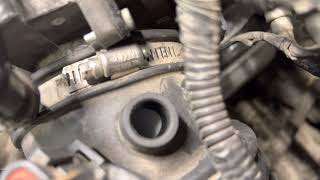
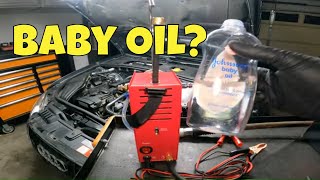
How to confirm: Visually inspect all vacuum lines and PCV hoses, especially the main breather hose running from the valve cover, the suction jet pump (a black plastic 'Y' or 'T' fitting), and the PCV valve itself. A professional smoke test is the most reliable method to find small or hidden leaks. 🎬 See how to perform a professional smoke test for leaks.
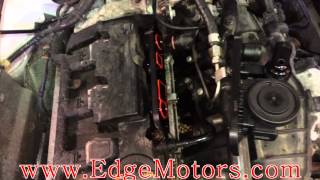
Typical fix: Replace the cracked or broken vacuum hose(s). 🎬 Watch: Step-by-step guide to replacing the PCV valve and hoses. It is often recommended to replace the entire PCV breather hose assembly as a kit, since if one hose has failed, others are likely to fail soon.
Est. part cost: $40-$200 - Wiring or Connector Issue ⚪ Low Probability The O2 sensor wiring harness is routed near the hot exhaust manifold and turbocharger. Over time, the protective loom can degrade, allowing wires to melt or chafe against the engine, causing a short circuit that results in a constant high voltage signal.
How to confirm: Visually inspect the entire wiring harness from the O2 sensor to its connection point on the firewall. Look for any signs of melting, chafing, or corrosion at the connector pins. Use a multimeter to check for continuity and for shorts between the signal wire and the power or ground wires.
Typical fix: Repair the damaged section of the wiring harness using heat-shrink butt connectors or by soldering. Replace the connector if it is corroded or damaged. Secure the harness away from heat sources with zip ties.
Est. part cost: $10-$50 - Rich Fueling Condition (Fuel System) ⚪ Low Probability On the 2.0T FSI engine, wear on the cam follower for the high-pressure fuel pump (HPFP) can cause erratic fuel pressure. Additionally, leaking fuel injectors can stick open, dumping excess fuel into a cylinder and causing a rich condition.
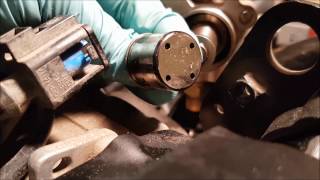
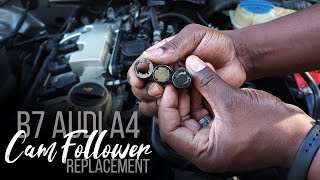
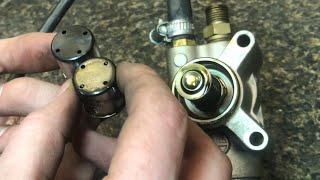
How to confirm: Check for other trouble codes, especially P0172 (System Too Rich). Use a scan tool to check fuel trim values; highly negative numbers confirm a rich condition. Test fuel pressure at the rail. For the 2.0T, inspect the HPFP cam follower for wear—a known failure item. 🎬 Watch: How to inspect and replace the 2.0T cam follower.
Typical fix: Replace the faulty fuel injector(s) or the fuel pressure regulator. On 2.0T engines, replace the HPFP cam follower and potentially the HPFP itself if damaged.
Est. part cost: $60-$500
Rare But Worth Checking
- Faulty Engine Control Module (ECM): This is very rare. The ECM should only be considered after all other possibilities, including sensors, wiring, and mechanical issues, have been thoroughly ruled out. A PCM self-test can sometimes identify internal faults.
- Exhaust Leak Before the O2 Sensor: A crack in the exhaust manifold or a bad turbo-to-manifold gasket can draw in outside air. This fresh air fools the O2 sensor into thinking the engine is lean, causing the ECM to add more fuel, which paradoxically results in a rich condition and a P0132 code.
- Contaminated or Faulty Mass Airflow (MAF) Sensor: A dirty or failing MAF sensor can under-report the amount of air entering the engine, causing the ECM to calculate an incorrect (rich) fuel mixture. Cleaning the MAF sensor with a dedicated cleaner is a simple first step.
Diagnosis Steps
- Scan for any other stored trouble codes. Address codes like P0172 (System Rich) or misfire codes first, as they indicate an underlying problem.
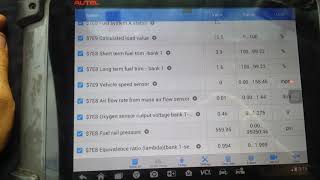
- Use a VCDS/VAG-COM or capable scan tool to view live data. Check Short Term and Long Term Fuel Trims in Measuring Block 032. Large negative values (e.g., -10% or more) confirm the engine is running rich.
- Observe the voltage for Bank 1 Sensor 1. If it is stuck high (above 0.9V) and not fluctuating, the issue is present.
- Perform a thorough visual inspection of all vacuum lines and the PCV system. Pay close attention to the PCV valve, suction jet pump, and all plastic breather hoses for cracks, breaks, or loose connections. A smoke test is the most effective way to find hidden leaks.
- Inspect the O2 sensor wiring harness and connector for any signs of melting, chafing, or corrosion, especially where it runs near the turbo and exhaust manifold.
- If no vacuum leaks or wiring issues are found, test the fuel pressure to ensure it is within the manufacturer's specifications. For 2.0T engines, this is a good time to inspect the HPFP cam follower for wear.
- If all other systems check out, the upstream O2 sensor is the most likely culprit and should be replaced with a quality OEM or equivalent part.
Parts You'll Likely Need
- Upstream Oxygen Sensor (Bank 1, Sensor 1)
(OEM #06B906265D (1.8T) / 06F906262R (2.0T))— This is the most common part to fail and directly cause the P0132 code when no other issues are present. Bosch is the OEM supplier.
Trusted brands: Bosch (e.g., 17098 for 1.8T, 17351 for 2.0T)
Related Codes That Often Appear With This One
- P0172 — P0172 means 'System Too Rich (Bank 1)'. This code directly confirms the condition that P0132 is detecting. Seeing both together strongly points towards a fuel delivery or vacuum leak issue rather than just a sensor fault.
- P0135 — P0135 indicates a fault in the 'O2 Sensor Heater Circuit (Bank 1, Sensor 1)'. Since the heater and signal circuits are part of the same physical component, seeing both codes together strongly suggests the O2 sensor itself has failed internally.
- P0300, P0301, P0302... — These are misfire codes. A rich condition can foul spark plugs and cause misfires. If you see misfire codes alongside P0132, it's another sign that the engine is running excessively rich.
Technical Service Bulletins (TSBs) & Recalls
- While no specific TSB directly addresses only P0132, several VW/Audi TSBs exist for diagnosing rich running conditions (P0172) and evaporative emissions leaks (P0455, P0456), which can be related causes. For example, TSB 2010668/10 for 2.0T engines discusses diagnosing oil consumption which can contaminate O2 sensors.
Platform-Specific Known Issues
- 1.8T PCV System Complexity: The 1.8T engine's PCV system is a maze of plastic pipes, rubber hoses, and check valves. The main culprits for leaks are the 'L' shaped hose off the valve cover, the 'T' shaped hose at the block breather, and the suction jet pump. These parts become extremely brittle from heat and oil exposure and will crack, causing significant vacuum leaks that are a primary cause of P0132.
- 2.0T FSI Cam Follower Wear: The EA113 2.0T FSI engine has a known issue with rapid wear of the flat tappet cam follower that drives the high-pressure fuel pump (HPFP). As it wears, it can perforate, leading to improper fuel pump actuation, low fuel pressure, and eventually damage to the camshaft and HPFP. While this often causes lean codes, erratic fueling can also lead to rich conditions and P0132. It is considered a routine maintenance item to inspect and replace every 20-30k miles.
Mechanic-Grade Diagnostic Values
- Upstream O2 Sensor (Wideband) Voltage — expected: Rapidly fluctuating between 0.1V and 4.5V under varying load.. Failure: Stuck high, typically above 0.9V, and does not respond to changes in engine RPM.
- O2 Sensor Heater Circuit Resistance — expected: 2-20 Ohms. Failure: An open circuit (infinite resistance) reading on a multimeter between the heater pins indicates a defective heater element.
- Low-Pressure Fuel System Pressure — expected: 50-70 PSI. Failure: Pressure below this range indicates a weak in-tank fuel pump, which can affect the high-pressure system.
- High-Pressure Fuel System Rail Pressure (2.0T FSI at idle) — expected: Approximately 550 PSI (around 38 bar). Failure: Significantly lower pressure, or pressure that bleeds off immediately after shutdown, can indicate a failing HPFP or leaking injector. Pressure rising after shutdown can also indicate an issue.
- Long Term Fuel Trim (VCDS Measuring Block 032) — expected: Close to 0%, ideally within +/- 5%. Failure: Large negative values, such as -25% or more, confirm the ECU is compensating for a severe rich condition.
Scan Tool Commands That Help
- VCDS (VAG-COM): Throttle Body Adaptation - Basic Settings Group 060 — After cleaning the throttle body or addressing significant vacuum leaks, performing a TBA resets the throttle plate's learned idle and off-idle positions, which is crucial for stable idle after fixing a rich condition.
- VCDS (VAG-COM): Clear DTCs and Reset Fuel Trims — After replacing a component like an O2 sensor or fuel injector, clearing the codes will also reset the long-term fuel trims (Block 032). This forces the ECU to relearn the fuel mixture from a baseline, which is necessary to verify the fix. Some systems may require a short drive cycle for the ECU to adapt.
Wiring & Ground Locations
- Engine Block to Chassis Ground Strap — On the B6 A4, the main engine-to-chassis ground cable is located on the passenger side, connecting from the engine mount area to the front frame rail, just behind the secondary air pump.. A corroded or loose main engine ground can create a voltage offset, causing sensor readings, including the O2 sensor, to be skewed. The ECU may interpret this as a high voltage signal from the sensor, triggering P0132. Verifying this ground is clean and tight is a critical step before replacing sensors.
- G12 - ECM Ground — Located at the center of the firewall in the engine bay.. This is a primary ground point for the Engine Control Module (ECM). A poor connection here can cause a wide range of erratic engine behavior and sensor faults, including incorrect O2 sensor voltage interpretation.
- G43 / G44 - Kick Panel Grounds — G43 is behind the passenger side kick panel, and G44 is behind the driver's side kick panel.. These ground points are critical for various control modules, including the Body Control Module and instrument cluster. While not a direct cause, water ingress or corrosion at these interior grounds can cause bizarre electrical issues that may indirectly affect engine management systems.
Real Owner Repair Stories
- Audi-Sport.net forum user (Audi A4 2.0 TFSI B8 (similar principle applies to B7)) — Misfiring, rough idle, white smoke, strong smell of unburnt fuel, fuel contaminating the engine oil, and fuel trims at -25% (short term) and -40% (long term).
❌ Tried (didn't work) New Spark plugs, New coil packs, New air filter, New oil and filter
✅ What actually fixed it The user's symptoms were consistent with a stuck-open fuel injector. Another user in the same thread confirmed they had identical symptoms (shuddering, loss of power, white smoke) which were resolved by replacing a fuel injector that was stuck open. - Ross-Tech Forums user (2010 Audi A4 2.0T) — Persistent 'System too Rich at Idle' codes (P2188, related to P0132), and gasoline smell in the oil.
❌ Tried (didn't work) Replaced EVAP (N80) purge valve, Replaced HPFP cam follower and seal, Oil change
✅ What actually fixed it The user ultimately replaced the High Pressure Fuel Pump (HPFP) and used an injector cleaner. After 250 miles, the fuel trims returned to normal and the rich code did not return. The underlying cause was likely the failing HPFP leaking fuel into the crankcase.
"I Checked Everything" — The Actual Cause
- On 2.0T FSI engines, a car can pass a smoke test (indicating no vacuum leaks) but still have a severe rich condition. The hidden cause is often a failing High-Pressure Fuel Pump (HPFP) whose internal seals have failed, allowing raw fuel to leak directly into the crankcase and mix with the engine oil. This fuel-contaminated oil then gets circulated through the PCV system as vapor, creating a rich mixture that the O2 sensor correctly reports, leading to P0132/P0172 codes. Mechanics often miss this because they focus on vacuum leaks and don't check for fuel in the oil.
OEM Part Supersession History
06B906265D→This part number has multiple supersessions and equivalents from OEM suppliers. Key aftermarket replacements include Bosch 0 258 007 351 and Delphi ES10921-12B1.— Standard part evolution for improved reliability and material changes.
Heads up: This is a 5-wire wideband sensor. Using a cheaper 4-wire narrowband sensor will not work and will cause persistent codes. Always use a direct-fit, 5-wire sensor from a reputable brand.06F906262R (for 2.0T)→Has been superseded by part numbers including 06F906262AC, 06F906262L, and 06J906262AA.— Revisions to improve sensor longevity and response time.
Heads up: These are all 5-wire wideband sensors. Ensure the cable length and connector match the specific vehicle, as different models and years had slight variations in harness routing. For example, some aftermarket versions have a 570mm cable while others have a 725mm cable.
Model Year Variations Within This Range
- 2001-2008: The 1.8T engines fall into two main block types: the '058' block (early B6, e.g., AWM) with an external water pump and the '06A' block (later B6, e.g., AMB) with an internal, timing-belt-driven water pump. While the P0132 diagnosis is similar, accessory and component locations differ slightly.
- 2005.5-2008: The B7 A4 introduced the 2.0T FSI engine, which came in several variants. US-spec models are typically BPG or BWT. These engines have different compression ratios and torque curves (e.g., BPG at 10.5:1, BWE at 10.3:1). While diagnostically similar for P0132, the BPG/BWT are known for HPFP cam follower wear, a primary cause of fuel issues not present on the 1.8T.
Diagnostic Flowchart
Real Owner Stories
Aggregated from forums and TSBs cited above. Mileages and costs reflect what owners reported in those sources.
B6 Audi A4 1.8T
Symptoms: Triggered P0132 and P0172 codes.
What fixed it: Replaced the O2 sensor and fixed a massive vacuum leak at the suction jet pump.
Source hint: Audizine thread titled 'P0132 and P0172 - My diagnostic journey'
B7 Audi A4 2.0T
Symptoms: Experienced a rough idle along with P0132 and P0172 codes. Replacing the O2 sensor initially did not resolve the issue.
What fixed it: Performed an injector leak-down test and found a faulty fuel injector. Replacing the injector resolved the rich-running codes.
Source hint: AudiWorld thread titled 'B7 A4 2.0T P0132, P0172, rough idle SOLVED'
Related OBD-II Codes
Frequently Asked Questions
Is there a specific TSB for my 2.0T engine that relates to the P0132 code?
I have a 2.0T FSI engine. Could my high-pressure fuel pump (HPFP) cause a P0132?
What should I check first on my 1.8T before replacing the O2 sensor?
How can I test the O2 sensor using VCDS on my Audi A4?
Where is the upstream oxygen sensor located on the 1.8T and 2.0T engines?
Why does the O2 sensor wiring harness fail on these Audi engines?
Helpful Videos



Used OEM Parts in Stock
New Aftermarket Parts Available


The information in this article is provided for general reference and educational purposes only. Vehicle specifications, procedures, and part compatibility can vary by production date, trim level, and region. Always consult your vehicle's factory service manual and verify part numbers before purchasing or performing repairs. Safety-critical components such as airbags, seat belts, and braking systems should be installed by a qualified professional.
- Audi A4:
- 🎬 Helpful Videos
- 🛍️ Shop This Part
- What's Unique About the 2001-2008 Audi A4
- Symptoms You May Notice
- Most Likely Causes
- Rare But Worth Checking
- Diagnosis Steps
- Parts You'll Likely Need
- Related Codes That Often Appear With This One
- Technical Service Bulletins (TSBs) & Recalls
- Platform-Specific Known Issues
- Mechanic-Grade Diagnostic Values
- Scan Tool Commands That Help
- Wiring & Ground Locations
- Real Owner Repair Stories
- "I Checked Everything" — The Actual Cause
- OEM Part Supersession History
- Model Year Variations Within This Range
- Diagnostic Flowchart
- Real Owner Stories
- B6 Audi A4 1.8T
- B7 Audi A4 2.0T
- Related OBD-II Codes
- Frequently Asked Questions
- 🎟️ Get 5% Off