

P0128 on 2011-2016 Scion tC: Coolant Temperature Below Normal Causes and Fixes
On a 2011-2016 Scion tC, code P0128 almost always means the engine thermostat is stuck open and needs to be replaced. This is a common, inexpensive fix, with parts costing around $20-$80. The thermostat is a known wear item on the 2AR-FE engine and its platform mates.
- P0128 on a 2011-2016 Scion tC means the engine is running too cool.
- The most probable cause, by far, is a thermostat that is stuck in the open position.
- Confirm the failure by monitoring live coolant temperature data with an OBD-II scanner; the engine should reach ~180-195°F.
- Replacing the thermostat and its separate gasket is a common, DIY-friendly repair. Use an OEM (Toyota/Aisin) part for best results.
- Always bleed the cooling system properly after the repair to prevent the code from returning.
What's Unique About the 2011-2016 Scion tC
The 2.5L 2AR-FE engine in the second-generation Scion tC is known for its reliability, and the cooling system is straightforward. Code P0128 on this platform is not typically associated with complex electronic issues or software glitches, which can be the case on other modern vehicles. The cause is almost always a mechanical failure of the thermostat, a common wear-and-tear item designed to fail in the open position. Aisin, an original equipment manufacturer for Toyota/Scion, is a trusted brand for this part. The thermostat is located next to the alternator, making access a bit tight but manageable for a DIY repair.
Symptoms You May Notice
- Check Engine Light is on
- Engine temperature gauge on the dashboard reads lower than normal or takes a very long time to warm up
- Temperature gauge may drop towards 'Cold' when driving at highway speeds as airflow increases cooling.
- Heater may not blow hot air or is only lukewarm, as it relies on hot engine coolant.
- Noticeable decrease in fuel economy because the engine stays in the richer 'warm-up' fuel map.
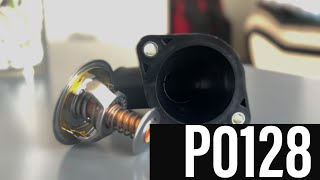
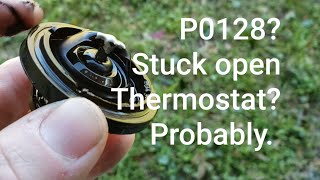
- Replacing the ECT sensor when the thermostat is the actual problem. The symptoms of a stuck-open thermostat (slow to warm up, temp drop at speed) are very distinct and should be confirmed with live data before 🎬 Watch a mechanic diagnose P0128 using live data. replacing parts.
- Not properly bleeding the cooling system after a repair. Trapped air can cause erratic temperature readings and may lead to the code returning.
Most Likely Causes
- Engine thermostat stuck open 🔴 High Probability The thermostat is a mechanical part with a spring and wax pellet that is designed to fail in the open position to prevent overheating. This is the most common cause for P0128 on virtually all vehicles, including the Scion tC and its platform mates with the 2AR-FE engine.
How to confirm: Use an OBD-II scanner with live data to monitor the Engine Coolant Temperature (ECT). Start the car cold and watch the temperature rise. If it climbs very slowly and struggles to get above 160-170°F, or if it drops significantly at highway speeds, the thermostat is stuck open.
Typical fix: Replace the engine thermostat and the corresponding gasket. The gasket is often sold separately, so ensure you purchase it. It's also a good time to top off or replace the engine coolant with Toyota Super Long Life Coolant.
Est. part cost: $20-$80 - Low engine coolant level 🟡 Medium Probability Coolant can be lost over time due to small, undetected leaks or evaporation. If the level is low, the coolant temperature sensor may be exposed to an air pocket, giving an inaccurate reading to the ECM.
How to confirm: Visually inspect the coolant level in the overflow reservoir when the engine is cool. It should be between the 'MIN' and 'MAX' lines. Also, remove the radiator cap (only when the engine is completely cool) to ensure the radiator is full.
Typical fix: Find and repair any leaks, then refill the cooling system with Toyota Super Long Life Coolant (pink) and properly bleed the air out of the system.
Est. part cost: $20-$40 for coolant - Faulty Engine Coolant Temperature (ECT) Sensor ⚪ Low Probability While reliable, the ECT sensor can fail electronically, sending incorrect temperature readings to the ECM. This is less common than a mechanical thermostat failure. A faulty sensor often triggers other codes like P0117 (low input) or P0118 (high input) in addition to P0128.
How to confirm: Watch the live data on an OBD-II scanner. If the temperature reading is erratic (e.g., jumping from -40°F to 250°F instantly) or doesn't change at all as the engine warms up, the sensor is likely bad. You can also test the sensor's resistance with a multimeter; at 68°F (20°C), it should be between 2,000-3,000 ohms.
Typical fix: Replace the engine coolant temperature sensor. It is a simple screw-in part.
Est. part cost: $25-$70
Rare But Worth Checking
- Cooling fan running constantly: If the radiator fan is stuck on, it can over-cool the engine, especially in cold weather or at low speeds. This is usually caused by a failed fan relay or a short in the wiring, and is very uncommon on this platform.
- Aftermarket thermostat failure: Some owners have reported getting the P0128 code again shortly after replacing the thermostat with a non-OEM part. Using a genuine Toyota/Aisin thermostat is highly recommended to avoid premature failure.
Diagnosis Steps
- Check for other DTCs. If codes like P0117 or P0118 are present, suspect the ECT sensor. If only P0128 is present, proceed.
- Visually inspect the coolant level in the reservoir and radiator (only when the engine is completely cold). Top off if necessary.
- Connect an OBD-II scanner and monitor the Engine Coolant Temperature live data.
- Start the engine from cold and observe the temperature reading. It should rise steadily to approximately 180-195°F (82-90°C) and stabilize.
- If the temperature rises very slowly, never reaches the target range, or drops significantly when driving at highway speeds, the thermostat is stuck open and must be replaced. This is the most likely scenario.
- If the temperature reading is erratic, nonsensical, or doesn't move, the ECT sensor or its wiring is the likely culprit. Test the sensor with a multimeter if possible.
- Check if the cooling fans are running constantly, even with a cold engine. If so, diagnose the fan control circuit (relay, wiring).
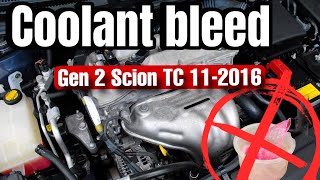
- After any repair involving draining coolant, ensure the system is properly bled. Park the car on an incline (nose up), turn the heater to full hot, and let the engine run with the radiator cap off (using a spill-free funnel is recommended) until all air bubbles are purged. 🎬 Watch this guide on how to bleed the cooling system.
Parts You'll Likely Need
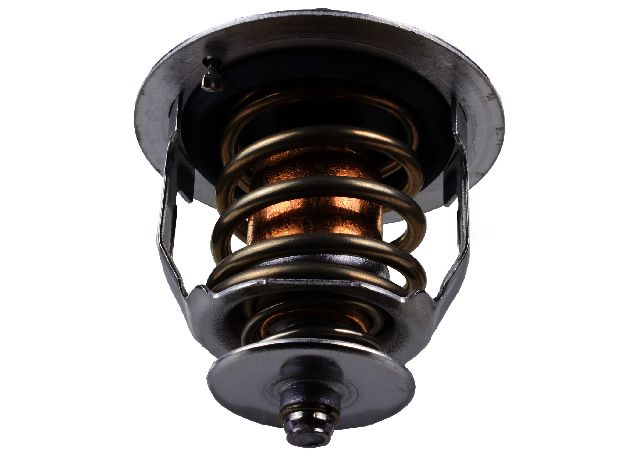
- Engine Coolant Thermostat and Gasket
(OEM #90916-A3003 (replaces 90916-03129, 90916-03084))— This is the most common failure part for code P0128. The thermostat physically sticks open, preventing the engine from reaching operating temperature. The gasket must be replaced as well and is often sold separately.
Trusted brands: Toyota (OEM), Aisin
OEM price range: $25-$50
Aftermarket price range: $15-$35 - Engine Coolant Temperature Sensor
(OEM #89422-33030)— A less common but possible cause. It can fail and send incorrect temperature data to the computer. Recommended to use OEM (Denso) for reliability.
Trusted brands: Denso (OEM), NTK
OEM price range: $50-$70
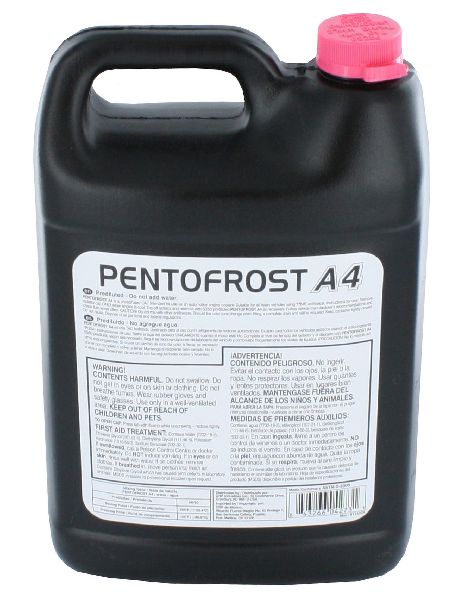
Aftermarket price range: $25-$50 - Toyota Super Long Life 50/50 Pre-Diluted Coolant
(OEM #00272-SLLC2)— The cooling system must be refilled with the correct type of coolant after replacing the thermostat or sensor to prevent corrosion and ensure proper performance.
Trusted brands: Toyota OEM, Aisin, Pentofrost A4
OEM price range: $25-$35 per gallon
Aftermarket price range: $20-$30 per gallon
Technical Service Bulletins (TSBs) & Recalls
- No TSBs were found specifically for the P0128 code on the 2011-2016 Scion tC. A general Toyota TSB exists for 'non-electric water pump leak inspection' (T-SB-0032-20), but it is not directly related to the P0128 cause.
Platform-Specific Known Issues
- The thermostat gasket/seal is not included with the thermostat and must be purchased separately. Forgetting this will cause a coolant leak.
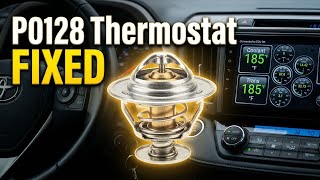
- Access to the thermostat housing, located near the alternator, is tight. Some owners find it easier to remove the alternator 🎬 See this walkthrough for replacing the thermostat. for better access, though it is not strictly required.
Mechanic-Grade Diagnostic Values
- Engine Coolant Temperature (ECT) Sensor Resistance — expected: Approximately 2,200-3,000 Ω at 20°C (68°F) and 250-350 Ω at 80°C (176°F).. Failure: Readings outside of the expected range for a given temperature, or an open/short circuit reading.
- ECT Sensor Voltage (Signal Wire to Ground) — expected: Approximately 3.0-3.5V on a cold start (~20°C/68°F), dropping to around 1.0-1.3V at normal operating temperature (~80°C/176°F).. Failure: Voltage that is stuck high (indicating constant cold) or low, or voltage that does not change smoothly as the engine warms up.
- Thermostat Jiggle Valve Orientation — expected: The jiggle valve (a small pin/valve on the thermostat flange) must be installed in the 'up' or 12 o'clock position.. Failure: Incorrect orientation can trap air in the cooling system, leading to improper coolant flow and potentially causing the P0128 code to return after replacement.
Wiring & Ground Locations
- Engine Coolant Temperature Sensor (ECT) — Screwed into the cylinder head or coolant outlet housing, near the thermostat housing.. This is the primary sensor providing the data that triggers the P0128 code. Its wiring integrity is crucial. A wiring diagram for the 2AR-FE shows the ECT sensor (THW) signal wire and ground wire (ETHW) connect directly to the ECM.
- ECM Pins THW and ETHW — At the Engine Control Module (ECM) connector. For the 2AR-FE, the THW (Temperature Hot Water) signal is pin 65 and the sensor ground ETHW is pin 64 on one of the main ECM connectors.. For advanced diagnosis, a technician can test for resistance and voltage directly at the ECM pins to rule out any wiring harness issues between the sensor and the computer. This confirms if the fault is with the sensor, the wiring, or the ECM itself.
- Engine Block Ground — There are multiple ground points on the engine block and cylinder head where various harnesses connect to the chassis ground. A primary ground strap typically connects the engine block to the chassis near the battery.. A poor engine ground can cause erratic sensor readings for multiple components, including the ECT sensor. While less common for an isolated P0128, it's a foundational check for any electrical diagnosis.
Real Owner Repair Stories
- Reddit r/MechanicAdvice user (2012 Honda Civic (similar logic applies)) — P0128 code returned even after replacing the thermostat and ECT sensor.
❌ Tried (didn't work) Replaced thermostat, Replaced ECT sensor
✅ What actually fixed it The user discovered their cooling fans were running constantly, even immediately after a cold start. This over-cooling prevented the engine from reaching operating temperature, triggering the P0128. The root cause was likely a faulty fan relay or wiring, not the thermostat. - Car Talk Community Forum user (Unspecified vehicle) — Check engine light with P0128 returned immediately after a mechanic replaced the thermostat.
❌ Tried (didn't work) Thermostat replacement
✅ What actually fixed it The discussion pointed to two likely causes for the immediate return of the code: 1) The mechanic installed a faulty new thermostat (bad out of the box), or 2) The mechanic used a thermostat with the wrong temperature rating. The freeze frame data showed the engine temperature was only 160°F after 7 minutes of highway driving, confirming it was not warming up properly.
OEM Part Supersession History
90916-03084, 90916-03129→90916-A3003— Standard part evolution and consolidation by Toyota.
Heads up: The new part number 90916-A3003 is the correct and current replacement for the specified Scion tC and is widely cross-compatible with many Toyota 2.4L and 2.5L engines. No incompatibility issues are noted.
Diagnostic Flowchart
Real Owner Stories
Aggregated from forums and TSBs cited above. Mileages and costs reflect what owners reported in those sources.
2010 to 2016 Scion tC
Symptoms: Check Engine Light with code P0128, stating the coolant temperature was not reaching the operating temperatures.
What fixed it: Replaced the engine thermostat and thermostat seal. Also required draining and refilling with 50/50 Asian antifreeze coolant.
Source hint: YouTube comment - YL's Mechanic
Scion tC / Toyota 2AR-FE
Symptoms: Getting code P0128 again 2 months after changing the thermostat.
What fixed it: Replacing the faulty aftermarket part with an OEM or high-quality replacement thermostat.
Source hint: Reddit r/MechanicAdvice - 'getting code p0128 again 2 months after changing thermostat'
Scion tC / Toyota 2AR-FE
Symptoms: Check engine light came on reading code P0128 right after getting the coolant thermostat replaced.
What fixed it: Diagnosing and addressing either a faulty new part or an installation error, such as trapped air in the cooling system.
Source hint: Reddit r/Cartalk - 'I got my coolant thermostat replaced recently... and right after my check engine light came on... it read code P0128'
Related OBD-II Codes
Frequently Asked Questions
Is there a specific TSB for the P0128 code on my 2011-2016 Scion tC?
I'm replacing the thermostat on my 2.5L 2AR-FE engine. Does the new thermostat come with the required gasket?
Where is the thermostat located on the 2011-2016 Scion tC, and is it hard to replace?
What type of coolant should I use when refilling my Scion tC after a thermostat replacement?
How do I properly bleed the cooling system on my Scion tC after replacing the thermostat?
Why did my P0128 code come back immediately after replacing the thermostat?
Helpful Videos
Used OEM Parts in Stock

New Aftermarket Parts Available


The information in this article is provided for general reference and educational purposes only. Vehicle specifications, procedures, and part compatibility can vary by production date, trim level, and region. Always consult your vehicle's factory service manual and verify part numbers before purchasing or performing repairs. Safety-critical components such as airbags, seat belts, and braking systems should be installed by a qualified professional.
- Scion tC:
- 🎬 Helpful Videos
- 🛍️ Shop This Part
- What's Unique About the 2011-2016 Scion tC
- Symptoms You May Notice
- Most Likely Causes
- Rare But Worth Checking
- Diagnosis Steps
- Parts You'll Likely Need
- Technical Service Bulletins (TSBs) & Recalls
- Platform-Specific Known Issues
- Mechanic-Grade Diagnostic Values
- Wiring & Ground Locations
- Real Owner Repair Stories
- OEM Part Supersession History
- Diagnostic Flowchart
- Real Owner Stories
- 2010 to 2016 Scion tC
- Scion tC / Toyota 2AR-FE
- Scion tC / Toyota 2AR-FE
- Related OBD-II Codes
- Frequently Asked Questions
- 🎟️ Get 5% Off