

P0128 on 2006-2011 Kia Optima: Coolant Temperature Below Normal, Causes and Fixes
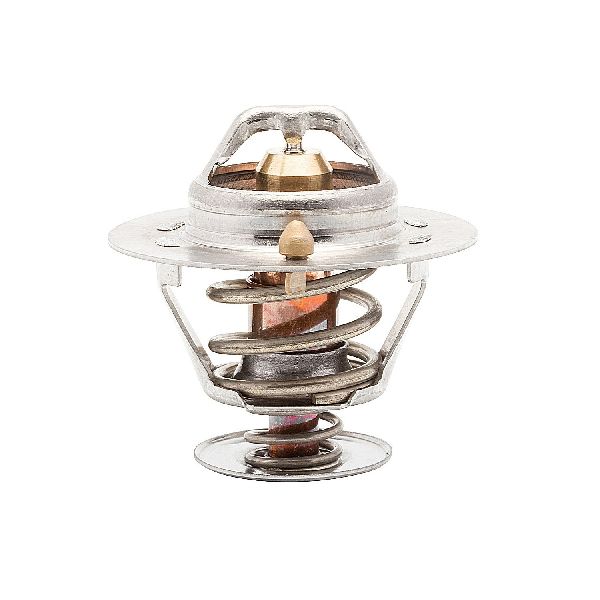
For the 2006-2011 Kia Optima, code P0128 almost always means the engine thermostat is stuck open and needs to be replaced. This is a common failure part that prevents the engine from warming up properly. Expect to pay $20-$60 for an aftermarket part or $40-$90 for an OEM thermostat assembly. Before replacing, verify your engine type as parts differ significantly.
- P0128 on a 2006-2011 Optima is overwhelmingly caused by a bad thermostat stuck open.
- Before buying parts, verify your engine (2.4L, 2.7L, or 2.4L GDI) as the thermostat part is different between them.
- Always check your coolant level first, as a low level can trigger this code.
- When replacing the thermostat, it is critical to properly bleed the cooling system to remove air pockets.
- Be aware of major unrelated issues on this platform, such as engine failure on 2011+ GDI models and clock spring failure on 2006-2008 models.
What's Unique About the 2006-2011 Kia Optima
The 2006-2011 Kia Optima spans two distinct generations, the MG (2006-2010) and the TF (2011), which feature different engines. The earlier MG generation uses 2.4L four-cylinder (Theta) and 2.7L V6 (Mu) engines with traditional, standalone thermostats. The 2011 TF generation introduced the newer 2.4L GDI (Theta II) engine, which uses a complete thermostat and integrated housing assembly. While the cause of P0128 is almost always the same (a stuck-open thermostat), it's crucial to buy the correct part for your specific model year and engine, as they are not interchangeable.
Generation note: This range covers two generations: - 2nd Gen (MG, 2006-2010): Equipped with a 2.4L 'Theta' inline-4 or a 2.7L 'Mu' V6 engine. These typically use a standalone thermostat that fits into the engine block or a small housing. - 3rd Gen (TF, 2011): Equipped with a new 2.4L GDI 'Theta II' inline-4 or a 2.0L Turbo GDI. These models use an integrated thermostat and housing assembly, which is replaced as a single unit.
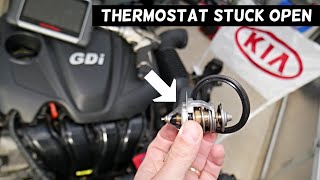
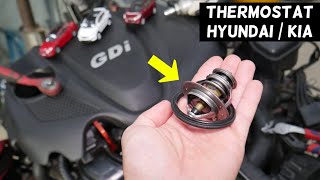
🎬 See this replacement walkthrough for the 2.4L GDI engine housing.Symptoms You May Notice
- Check Engine Light is on
- Engine temperature gauge on the dashboard reads lower than normal, often stuck at 1/4 or below, or takes a very long time to reach the middle
- Heater and defroster blow lukewarm or cool air, even after the engine has been running for a while 🎬 Watch: See how a stuck thermostat affects your heater and gauge.
- Noticeable decrease in fuel economy
- Engine temperature drops at highway speeds as increased airflow over-cools the engine
- Replacing the ECT sensor when the thermostat is actually the problem. The sensor is often correctly reporting a low temperature because the thermostat is stuck open, and replacing it will not fix the issue.
Most Likely Causes
- Thermostat Stuck Open 🔴 High Probability Thermostats are wear-and-tear items designed to fail in the open position as a failsafe against overheating. This is the most common reason for P0128 on virtually all vehicles, including the Optima.
How to confirm: After starting the engine from cold, feel the upper radiator hose. It should stay cool for several minutes (5-10 min). If it starts warming up gradually almost immediately, the thermostat is stuck open, allowing coolant to circulate prematurely. Alternatively, use an OBD-II scanner to monitor live data; if the coolant temperature struggles to exceed 170-180°F, the thermostat is the likely culprit.
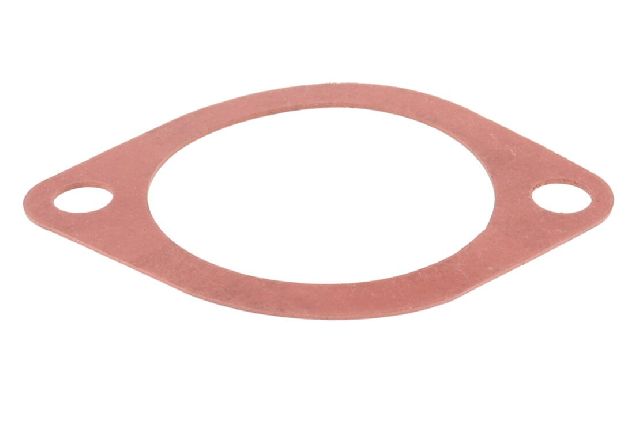
Typical fix: Replace the thermostat and its gasket or the entire thermostat housing assembly, depending on the engine. This requires draining some coolant, unbolting the housing (usually found where the upper radiator hose meets the engine), swapping the part, then refilling and bleeding the cooling system of any air pockets.
Est. part cost: $20-$90 - Low Engine Coolant Level 🟡 Medium Probability Leaks in the cooling system from hoses, the radiator, or water pump can cause the coolant level to drop. If the level is low enough, an air pocket can form around the Engine Coolant Temperature (ECT) sensor, causing it to send inaccurate low-temperature readings to the ECU.
How to confirm: Visually inspect the coolant reservoir and the radiator (when the engine is completely cool). If the level is below the 'MIN' line, it needs to be topped off. Also, check for visible signs of green or pink coolant leaks under the car, around hoses, or at the water pump.
Typical fix: Find and repair the source of any leak. Top off the cooling system with the correct type of coolant (Kia-specific green or blue-green coolant is recommended). Bleed the system thoroughly to remove all air pockets.
Est. part cost: $15-$30 for coolant - Faulty Engine Coolant Temperature (ECT) Sensor ⚪ Low Probability
How to confirm: Use an OBD-II scanner to monitor the live coolant temperature data. If the reading is erratic, jumps around, or stays at a very low, illogical temperature (e.g., -40°F) even after the engine has run, the sensor or its wiring is likely faulty. A good test is to compare the ECT reading to the Intake Air Temperature (IAT) sensor reading on a cold engine; they should be within a few degrees of each other.
Typical fix: Replace the ECT sensor. It's typically a small, inexpensive brass sensor threaded into the engine block, cylinder head, or thermostat housing.
Est. part cost: $15-$40
Rare But Worth Checking
- Cooling Fan Running Constantly: If the electric cooling fan is stuck on due to a failed relay or fan control module, it will continuously cool the radiator, preventing the engine from warming up properly, especially in cold weather or during short trips. You would likely hear the fan running as soon as the car is started, which is abnormal.
- ECU Software Glitch: While no specific TSB was found for this exact model range, other Kia/Hyundai vehicles have had TSBs issued for P0128 where overly sensitive ECU logic was the cause. One forum mentioned a TSB where using coolant with a concentration higher than 50/50 could confuse the ECU's logic and trigger the code. This should be considered only after all mechanical causes are ruled out.
Diagnosis Steps
- Check for other stored trouble codes with an OBD-II scanner.
- With the engine completely cold, check the coolant level in the overflow reservoir and radiator. Ensure it is full.
- Start the engine from cold. Feel the upper radiator hose. It should remain cool to the touch for at least 5-10 minutes of idling. If it warms up gradually along with the engine, the thermostat is stuck open and is the most likely culprit.
- If the hose stays cold and then gets hot suddenly (correct operation), use a scanner to monitor the ECT sensor data. Does the temperature rise steadily to ~180-200°F and stabilize? If it stays low (e.g., below 170°F) or drops at highway speeds, the thermostat is failing.
- If the ECT data on the scanner is illogical (e.g., -40°F) or doesn't change, compare it to the IAT sensor on a cold engine. If they are not similar, the ECT sensor or its wiring is faulty.
- Listen for the radiator fan. It should not be running when the engine is cold. If it is, diagnose the fan control circuit (relay, fan switch).
- If all mechanical checks pass, verify the coolant concentration is a 50/50 mix. As a last resort, check with a Kia dealer for any potential ECU software updates related to P0128 logic.
Parts You'll Likely Need
- Engine Coolant Thermostat (or Assembly)
(OEM #2.7L V6 (2006-2010): 25500-35540 | 2.4L I4 (2006-2010): 25500-2G000 | 2.4L GDI I4 (2011): 25600-2G500)— This is the most common failure part that causes code P0128 by sticking in the open position.
Trusted brands: Genuine Kia, Mahle, Stant, Motorad
OEM price range: $40-$90
Aftermarket price range: $20-$60 - Engine Coolant / Antifreeze — You will lose coolant when replacing the thermostat and will need to top off and bleed the system. Using the correct OEM-spec Asian Phosphate-based (green or blue-green) coolant is recommended.
Trusted brands: Peak OET Asian Green, Pentofrost A2, Zerex Asian Vehicle Green
OEM price range: $25-$35 per gallon
Aftermarket price range: $15-$25 per gallon
Technical Service Bulletins (TSBs) & Recalls
- While no specific TSB for the Optima was found, a general Kia/Hyundai TSB has been discussed in forums (BobIsTheOilGuy) suggesting that incorrect coolant concentration (over 50% antifreeze) can trigger a P0128 code due to sensitive ECU logic.
Platform-Specific Known Issues
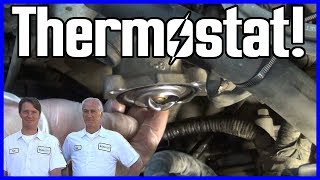
- On the 2.7L V6 engine, the thermostat is located on the driver's side of the engine block and can be somewhat difficult to access without removing other components. 🎬 Watch: Step-by-step thermostat replacement guide for the 2.7L V6 engine.
- For the 2011 2.4L GDI engine, the part is an entire housing assembly, not just the thermostat itself, which makes it a more expensive but straightforward replacement.
Mechanic-Grade Diagnostic Values
- Engine Coolant Temperature (ECT) Sensor Resistance — expected: At 20°C (68°F): 2.0-3.0 kΩ. At 90°C (194°F): 225-300 Ω.. Failure: Resistance is significantly outside the expected range for a given temperature, or shows an open/infinite reading.
- Engine Coolant Temperature (ECT) Sensor Signal Voltage (at sensor connector, key on, engine off) — expected: Approximately 2.0V-3.0V on a cold engine (e.g., 20°C / 68°F), decreasing to approximately 0.5V on a fully warmed-up engine.. Failure: Voltage is stuck high (near 5V), stuck low (near 0V), or does not change as the engine warms up.
- ECT vs. IAT Sensor Comparison (cold engine) — expected: The Engine Coolant Temperature (ECT) and Intake Air Temperature (IAT) readings on a scan tool should be within 5°F (3°C) of each other after the vehicle has been off overnight.. Failure: A significant difference between the two readings points to a faulty ECT sensor.
Scan Tool Commands That Help
- Kia GDS (Global Diagnostic System): Guided Troubleshooting Procedures / Vehicle S/W Management — The OEM GDS tool provides guided diagnostic steps for specific codes like P0128. It also allows for 'Resetting adaptive values' under the 'Vehicle S/W Management' menu, which can be useful after a repair to clear learned values, although it's not typically required for a simple thermostat replacement.
Wiring & Ground Locations
- ECT Sensor Connector — On the 2.4L Theta II engine (2009+), the ECT sensor is located on the passenger side of the cylinder head, near the thermostat housing. For the 2.7L V6, it is typically on the thermostat housing where the upper radiator hose connects.. The connector and its wiring are a potential point of failure. A corroded or damaged connector can cause erratic or incorrect temperature readings, mimicking a failed sensor and leading to a P0128 or related codes (P0117/P0118).
Real Owner Repair Stories
- Reddit r/AskMechanics (2017 Kia Optima 2.4L (Note: Newer model but same engine family and code logic)) — Check engine light with code P0128.
❌ Tried (didn't work) The thermostat housing was replaced a month prior when the code first appeared.
✅ What actually fixed it The code returned a month after thermostat replacement. The user was advised by the community that this could be due to a faulty aftermarket thermostat or remaining air in the cooling system that was not properly bled, indicating the importance of using a quality part and performing the bleed procedure correctly.
OEM Part Supersession History
25600-2G400→25600-2G500— Material improvement. The 25600-2G500 housing is made from a reinforced, fiber-infused polymer to resist warping and stress fractures common in the earlier design.25500-2B001, 25500-2B400→25500-2B000— Part consolidation and revision.
Heads up: These part numbers are often associated with the 1.6L Gamma engine but are sometimes cross-referenced. Always verify by VIN.
Model Year Variations Within This Range
- 2006-2010: These models (MG generation) use a standalone, traditional thermostat for both the 2.4L I4 and 2.7L V6 engines. The part is just the metal thermostat and a gasket.
- 2011: The 2011 model (TF generation) with the 2.4L GDI engine uses a complete thermostat and integrated housing assembly (PN 25600-2G500). The entire plastic and metal unit is replaced, which is more expensive but less prone to leaking at the housing seam.
Diagnostic Flowchart
Other Known Issues on This Vehicle
Issues unrelated to this code that are worth knowing about as an owner of this generation:
- Theta II Engine Failure (2011+ models) 🔴 High — Widespread issue affecting 2.0L and 2.4L GDI engines, often occurring under 100,000 miles. Caused by manufacturing debris leading to connecting rod bearing failure. (Ref: Multiple recalls (e.g., NHTSA 17V-224) and a class-action lawsuit settlement provide extended warranties and potential engine replacements for affected vehicles.)
- Clock Spring Failure (2006-2008 models) 🔴 High — Common failure due to wear over time, causing the driver's airbag light to illuminate and disabling the airbag. (Ref: Kia Safety Recall Campaign SC094 was issued to replace the clock spring assembly and provide a lifetime warranty on the part for affected vehicles.)
- Weak Alternator (Multiple Years) 🟠 Medium — Affects various model years including 2006, 2008, and 2009-2011, leading to insufficient battery charging, starting problems, and frequent battery drain. (Ref: Kia released an upgraded alternator part to address the issue, but it is not a formal recall.)
- Faulty Door Latches 🟡 Low — A common annoyance where door latches fail, preventing the door from being opened from the inside or outside.
Used vs. New Parts: Buying Guide for This Vehicle
When a used part is the smart pick: For this repair, using a used part is strongly discouraged. The thermostat is an inexpensive wear-and-tear item. The labor cost to replace it far outweighs the savings of a used part with an unknown remaining lifespan.
What to inspect on the donor part:
- Not applicable as used thermostats are not recommended. Even testing a used thermostat by boiling it is not a reliable indicator of its future performance or reaction time.
OEM-only on this vehicle (don't cheap out):
- While not strictly 'OEM-only', using a cheap, no-name aftermarket thermostat is a significant risk. Many forum and mechanic reports cite premature failure of low-quality aftermarket thermostats, causing the code to return. Sticking to the OEM part or a reputable aftermarket brand is a wise investment.
Aftermarket brands forum-validated for this vehicle:
- Stant
- Gates
- Mahle
- Motorad
- Beck/Arnley
Brands owners have reported issues with on this vehicle:
- Unbranded, 'white box' parts from online marketplaces should be avoided due to inconsistent quality and high failure rates reported by users.
Real Owner Stories
Aggregated from forums and TSBs cited above. Mileages and costs reflect what owners reported in those sources.
2011 Kia Optima 2.4L GDI
Symptoms: The P0128 code appeared and the repair required replacing the entire housing assembly rather than just a single thermostat valve.
What fixed it: Replacement of the entire thermostat housing assembly.
Source hint: vehicle_specific_issues
Kia Forte 2.4L (Platform Mate)
Symptoms: Received a P0128 code immediately following a coolant change.
What fixed it: Adjusting the coolant mixture ratio, as incorrect concentrations can confuse the ECU logic.
Source hint: BobIsTheOilGuy.com thread title: 'P0128 Coolant code on the Forte 2.4L'
2006-2010 Kia Optima 2.7L V6
Symptoms: Check engine light for P0128; the thermostat was found to be the primary cause, though it was difficult to access on the driver's side of the block.
What fixed it: Replacement of the thermostat (Part number 25500-35540).
Source hint: kia-forums.com and platform_mates (Kia Rondo/Optima 2.7L)
Related OBD-II Codes
Frequently Asked Questions
Is there a TSB for the P0128 code on my Kia Optima regarding coolant concentration?
I have a 2011 Optima with the 2.4L GDI engine; can I just replace the thermostat?
Where is the thermostat located on the 2.7L V6 engine?
What type of coolant should I use to top off my Optima to avoid sensor issues?
Could my P0128 code be related to the Theta II engine recalls?
My airbag light is on at the same time as my Check Engine Light; are they related?
Helpful Videos
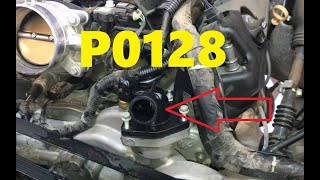
![How to Fix P0128 Engine Code in 3 Minutes [2 DIY Methods / Only $7.34]](https://img.youtube.com/vi/AfDXh4cko84/mqdefault.jpg)

We Have This Part in Stock



The information in this article is provided for general reference and educational purposes only. Vehicle specifications, procedures, and part compatibility can vary by production date, trim level, and region. Always consult your vehicle's factory service manual and verify part numbers before purchasing or performing repairs. Safety-critical components such as airbags, seat belts, and braking systems should be installed by a qualified professional.
- Kia Optima:
- 🎬 Helpful Videos
- 🛍️ Shop This Part
- What's Unique About the 2006-2011 Kia Optima
- Symptoms You May Notice
- Most Likely Causes
- Rare But Worth Checking
- Diagnosis Steps
- Parts You'll Likely Need
- Technical Service Bulletins (TSBs) & Recalls
- Platform-Specific Known Issues
- Mechanic-Grade Diagnostic Values
- Scan Tool Commands That Help
- Wiring & Ground Locations
- Real Owner Repair Stories
- OEM Part Supersession History
- Model Year Variations Within This Range
- Diagnostic Flowchart
- Other Known Issues on This Vehicle
- Used vs. New Parts: Buying Guide for This Vehicle
- Real Owner Stories
- 2011 Kia Optima 2.4L GDI
- Kia Forte 2.4L (Platform Mate)
- 2006-2010 Kia Optima 2.7L V6
- Related OBD-II Codes
- Frequently Asked Questions
- 🎟️ Get 5% Off