

P0128 on 2011-2024 Dodge Durango 3.6L: Coolant Temperature Below Normal Causes and Fixes
On a 2011-2024 Dodge Durango with the 3.6L V6, code P0128 is almost always caused by a thermostat that is stuck open. This is a well-documented, high-frequency failure on the Pentastar engine family. The most reliable fix is to replace the entire thermostat housing assembly, which includes a new thermostat and sensor. The OEM Mopar part number has been superseded multiple times, with 05184570AK being a common replacement for earlier models. Expect the part to cost between $60 and $110.
- P0128 on your Durango 3.6L means the engine is running too cool.
- The most likely cause, by far, is a thermostat that is stuck open.
- The standard, most effective repair is to replace the entire thermostat housing assembly, which includes a new thermostat and sensor.
- Always check your coolant level first, as low coolant can also trigger this code.
- After replacing the thermostat, it is essential to properly bleed all air from the cooling system to prevent overheating.
What's Unique About the 2011-2024 Dodge Durango

The P0128 code is an extremely common issue across the entire 3.6L Pentastar engine family, which includes this Durango. The plastic thermostat housing assembly is a known weak point and is the primary culprit, often failing by sticking in the open position. While a faulty sensor or low coolant can cause this code on any vehicle, on this specific platform, the thermostat assembly itself is the most probable cause by a wide margin, with some mechanics reporting it as the cause over 95% of the time. For some newer models, specific Technical Service Bulletins (TSBs) like #9100287 have been issued for this exact problem.
Symptoms You May Notice
- Check Engine Light is on.
- Engine temperature gauge on the dashboard reads lower than normal (e.g., stuck at the 1/4 mark) or takes a very long time to move.
- Heater may not blow hot air or takes longer than usual to warm up.
- Noticeable decrease in fuel economy.
- Engine may seem to run for a long time before reaching operating temperature.
- Remote start feature may be disabled.
- Replacing only the ECT sensor when the thermostat is the actual problem. Since the recommended repair is to replace the entire housing which includes the sensor, this mistake is less common, but it can happen if someone tries to save money by replacing only the sensor.
- Assuming a major engine issue when it's a simple thermostat fault. Due to the high frequency of this specific failure, P0128 on a Pentastar V6 should be treated as a thermostat issue until proven otherwise.
Most Likely Causes

- Thermostat Stuck Open 🔴 High Probability The original equipment thermostat assembly is made of plastic and is a well-documented failure point on the 3.6L Pentastar engine. It commonly fails by sticking in the open position, allowing coolant to circulate continuously and preventing the engine from warming up properly. This is the cause in the vast majority of P0128 cases on this platform.
How to confirm: After the engine has been running for 10-15 minutes, the temperature gauge will still be low. A scan tool will show the coolant temperature struggling to get above 170-180°F, when it should be stable around 203°F. You can also feel the upper radiator hose; if it becomes warm shortly after a cold start, coolant is flowing prematurely, indicating a stuck-open thermostat.
Typical fix: Replace the entire thermostat housing assembly. 🎬 Watch: Step-by-step 3.6L Durango thermostat replacement walkthrough This part typically includes the thermostat, the housing, a new seal, and a new engine coolant temperature (ECT) sensor. Using an OEM Mopar part is highly recommended by many technicians, as some aftermarket thermostats have been reported to fail closed, causing overheating. An aluminum aftermarket housing (like Dorman 902-3035HP) is available, which solves the plastic cracking issue, but some users report issues with the included aftermarket thermostat component and recommend swapping in an OEM thermostat.
Est. part cost: $60-$110 - Low Engine Coolant 🟡 Medium Probability While not specific to the Durango, leaks can develop over time. The plastic thermostat housing itself can develop hairline cracks, as can the separate plastic coolant crossover pipe it attaches to.
How to confirm: Visually inspect the coolant reservoir tank when the engine is cold. If the level is below the 'MIN' or 'ADD' line, it is low. Check for visible leaks around hoses, the radiator, water pump, and especially the thermostat housing itself.
Typical fix: Top off the coolant with the correct type (Mopar OAT 50/50 Pre-Diluted coolant is specified). If the level drops again, you must find and repair the leak. A cooling system pressure test can help locate hard-to-find leaks.
Est. part cost: $25-$40 for coolant - Faulty Engine Coolant Temperature (ECT) Sensor ⚪ Low Probability While the sensor can fail, it's far less common than the thermostat failing. The recommended repair is to replace the entire thermostat housing assembly, which almost always includes a new sensor, making individual replacement unnecessary in most cases.
How to confirm: With a cold engine (left overnight), use a scan tool to compare the ECT sensor reading with the Intake Air Temperature (IAT) sensor reading. They should be within a few degrees of each other. If the ECT reading is illogical (e.g., -40°F on a warm day), the sensor is bad.
Typical fix: Replace the ECT sensor. On the 3.6L Pentastar, it is located on the thermostat housing. However, the best practice is to replace the entire housing assembly.
Est. part cost: $20-$50
Rare But Worth Checking
- PCM Software Update Needed: In some instances, particularly on earlier models, the parameters for triggering the P0128 code were too sensitive. A dealer may find a Technical Service Bulletin (TSB) that calls for a software update to the Powertrain Control Module (PCM) to correct the 'Thermostat Rationality' logic. This is much less common than a mechanical failure.
- Cooling Fan Stuck On: If a fan relay fails or there's a wiring short, the electric cooling fans might run continuously from the moment the car is started. This constant airflow over the radiator can prevent the engine from warming up efficiently, especially in cold weather or at highway speeds, triggering a P0128.
Diagnosis Steps

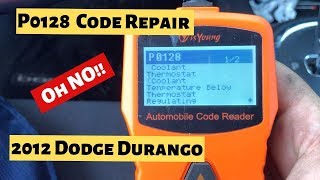
- Check for a Check Engine Light and use an OBD-II scanner to confirm P0128 is the stored code.
- With the engine cold, check the coolant level in the reservoir. Top off if necessary with the correct Mopar OAT coolant.
- Start the engine and monitor the temperature gauge on the dashboard. Observe if it stays below the normal halfway mark or takes more than 5-10 minutes to get there.
- (Recommended) Use a scan tool to monitor the live data for the Engine Coolant Temperature (ECT). After 15-20 minutes of driving, the temperature should be stable around 203°F. If it's stuck around 160-180°F or drops at highway speeds, the thermostat is almost certainly stuck open.
- To definitively rule out a bad sensor, let the vehicle sit overnight. Before starting it, use a scan tool to compare the ECT and Intake Air Temp (IAT) readings. They should be within a few degrees of each other. If not, the ECT sensor may be faulty.
- Check if the cooling fans are running constantly, even with a cold engine. If so, investigate the fan relay and wiring.
- Based on the extremely high probability, if the coolant level is correct and the sensor reads logically when cold, proceed with replacing the thermostat housing assembly.
Parts You'll Likely Need

- Thermostat Housing Assembly
(OEM #05184570AK (supersedes 5184570AG, 5184570AH, 5184570AI, 5184570AJ))— This is the most common failure point for code P0128 on the 3.6L Pentastar engine. The assembly includes the thermostat, housing, seal, and ECT sensor, addressing the most likely causes in one repair.
Trusted brands: Mopar (OEM), Mahle, Dorman (Plastic and Aluminum versions available), Gates
OEM price range: $80-$120
Aftermarket price range: $50-$90 - Engine Coolant/Antifreeze
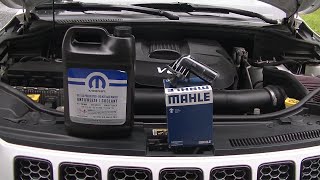
(OEM #Mopar 68163848AB (10 Year/150,000 Mile OAT))— You will lose coolant when replacing the thermostat and will need to refill and bleed the system. 🎬 Watch: How to properly bleed the Pentastar V6 cooling system The 3.6L Pentastar requires a specific OAT (Organic Additive Technology) coolant. Using the wrong type can cause damage.
Trusted brands: Mopar OAT 50/50 Pre-Diluted, PEAK OET North American Vehicles Purple 50/50
OEM price range: $25-$40 per gallon
Aftermarket price range: $20-$30 per gallon
Technical Service Bulletins (TSBs) & Recalls
- TSB #9100287: Mentioned for newer (2022-2024) 3.6L models, specifically addressing the P0128 code and pointing to a known issue with the thermostat assembly.
- TSB #S2118000009: Confirms the P0128 code definition for customer complaints on 2020 models.
- TSB #18-034-14: While not directly for P0128, this TSB addresses a separate issue with the oil pressure sensor on many of the same vehicles, including the Durango. It's an example of other known electronic issues on this platform.
Platform-Specific Known Issues
- The plastic thermostat housing on the 3.6L Pentastar is a known weak point that not only causes the P0128 code when it sticks open but can also develop coolant leaks from hairline cracks over time.
- Properly bleeding the cooling system after the repair is critical. The 3.6L engine has a small bleeder screw (often 8mm or 10mm hex) on the thermostat housing to help remove air pockets. Failure to bleed the system can lead to trapped air, causing erratic temperature readings or overheating, even with a new thermostat.
- Some owners opt for an aftermarket aluminum thermostat housing (e.g., Dorman 902-3035HP) to prevent future cracking of the plastic, but there are mixed reviews on the quality of the included aftermarket thermostat component.
Mechanic-Grade Diagnostic Values
- ECT Sensor Resistance vs. Temperature — expected: Approximately 2000-3000Ω at 20°C (68°F) and 200-300Ω at 90°C (194°F).. Failure: Resistance readings that are significantly outside this range for a given temperature indicate a faulty sensor.
- ECT Sensor Signal Voltage (Key On, Engine Off, Cold) — expected: Approximately 2.0V to 3.5V, depending on ambient temperature.. Failure: A voltage reading near 5.0V suggests an open circuit, while a reading near 0V suggests a short to ground.
- ECT Sensor Signal Voltage (Engine at Operating Temp) — expected: Approximately 0.5V.. Failure: A voltage that remains high (e.g., over 1.25V) when the engine should be hot can indicate a sensor that is not reading temperature changes correctly.
- PCM Logic for setting P0128 — expected: The PCM expects the ECT sensor to read above a threshold like 160°F within about 15 minutes of startup and not drop below that threshold during operation.. Failure: If the temperature rise is too slow or drops below the threshold after warming up (common at highway speeds with a stuck-open thermostat), the code is set.
Scan Tool Commands That Help
- wiTECH / Professional Bidirectional Scanner: Cooling Fan Actuation Test — To test the functionality of the cooling fan relay and motor independently. This helps rule out a 'cooling fan stuck on' scenario by confirming the PCM has control over the fan.
- wiTECH / Professional Bidirectional Scanner: Live Data Graphing (ECT, IAT, Ambient Temp) — Used during a cold soak test. Graphing all temperature sensors simultaneously before startup should show them reading within a few degrees of each other. This is the primary method to validate ECT sensor rationality before condemning the thermostat.
Wiring & Ground Locations
- ECT Sensor Connector — On the thermostat housing assembly, located at the front of the engine near the driver's side cylinder head.. This is the primary connection point for testing. The connector and its wiring can be damaged or corroded, causing faulty readings even if the sensor itself is good. The PCM supplies a 5V reference and a sensor ground through this connector.
- ECT Signal Circuit (K2) — This wire runs from the ECT sensor connector to the C2 connector at the Powertrain Control Module (PCM).. A short to ground or an open/high resistance on this circuit will cause incorrect temperature readings and can set codes P0117 (short) or P0118 (open), but can sometimes contribute to P0128 issues if the fault is intermittent. A service manual specifies checking for resistance below 5.0 Ohms on this circuit.
- Sensor Ground Circuit (K900) — This wire provides the ground reference for the ECT and other sensors, running from the sensor connector back to the PCM.. A poor ground connection on this circuit will skew the voltage reading for the ECT sensor, leading the PCM to calculate an incorrect temperature. This can be a hidden cause of temperature rationality codes.
- G904 / G905 / G907a — These are primary engine ground points. For the 3.6L, G907a is located on the lower right front of the engine compartment.. While not directly for the sensor circuit (which is grounded through the PCM), a poor main engine ground can cause a host of electrical issues and noise that can affect sensor readings. Ensuring these main grounds are clean and tight is a good practice during any electrical diagnosis.
Real Owner Repair Stories
- YouTube user comment (2015 Chrysler Town & Country (shares 3.6L Pentastar)) — Check Engine Light with code P0128.
❌ Tried (didn't work) Initial diagnosis pointed to thermostat.
✅ What actually fixed it Replacing the thermostat housing assembly resolved the code. The user noted the importance of clearing the code with a scanner after the repair and driving for a while to confirm the fix. - YouTube video by 'MotorCity Mechanic' (Various Chrysler/Dodge/Jeep with 3.6L Pentastar) — P0128 - Thermostat Rationality code.
❌ Tried (didn't work) The video advises against replacing just the internal thermostat component and recommends against some aftermarket housings due to quality concerns.
✅ What actually fixed it The definitive fix in over 90% of cases is replacing the entire Mopar thermostat housing assembly. The video shows a failed unit stuck in the open position and also highlights how the plastic housings can develop hairline cracks and leak, providing a second reason to replace the whole assembly.
OEM Part Supersession History
5184570AG, 5184570AH, 5184570AI, 5184570AJ→05184570AK— Part revision by the manufacturer to address failure modes, likely improving the durability of the thermostat mechanism or the plastic housing.
Heads up: All previous versions are superseded by 05184570AK, which is the correct current replacement part for a wide range of 3.6L Pentastar applications.4893926AD, 4893926AF, 4893926AG→04893926AH— Part revision for later model year Pentastar engines (e.g., in Jeep JL/JT).
Heads up: While for the same engine family, different vehicle platforms (like the newer Wranglers/Gladiators) may use a slightly different housing. It is critical to verify the correct part number for the specific vehicle VIN, though 05184570AK is the most common for the Durango.
Model Year Variations Within This Range
- 2011-2012 vs 2013-2024: The specified coolant type changed. Early models (approx. 2011-2012) used a HOAT (Hybrid Organic Additive Technology) coolant. Later models (approx. 2013+) switched to a 10-year/150,000-mile OAT (Organic Additive Technology) coolant. The two types are not compatible and should not be mixed, as mixing can cause the coolant to gel and lead to cooling system damage.
Diagnostic Flowchart
Real Owner Stories
Aggregated from forums and TSBs cited above. Mileages and costs reflect what owners reported in those sources.
2011 Dodge Durango V6 — 134500 miles
Symptoms: Check Engine Light came on with a P0128 code.
What fixed it: A local repair shop confirmed the thermostat was opening too soon and replaced it.
Cost: $150
Source hint: DodgeForum.com - Thread 'Check Engine Light - P0128'
2014 Dodge Durango 3.6L
Symptoms: Triggered a P0128 code and noticed the oil temperature would only reach 160°F while driving on the highway.
What fixed it: Replaced the thermostat assembly with an OEM part, noting the job was very simple.
Source hint: BobIsTheOilGuy.com - Forum User Experience
Chrysler 300 3.6L V6
Symptoms: Experienced a P0128 code after the thermostat included with an aftermarket aluminum housing failed.
What fixed it: Kept the Dorman aluminum housing but installed a genuine Mopar thermostat into it for best results.
Source hint: Reddit r/Chrysler300 - 'Dorman Aluminum Thermostat Housing for the 3.6L V6 - Code P0128'
Related OBD-II Codes
Frequently Asked Questions
Is there a specific TSB for the P0128 code on newer Dodge Durangos?
Should I upgrade to an aluminum thermostat housing on my 3.6L Pentastar?
Why did my remote start stop working when the Check Engine Light came on?
Do I need to replace the Engine Coolant Temperature (ECT) sensor to fix P0128?
How do I properly bleed the cooling system on the 3.6L V6 after replacing the thermostat?
What temperature should my Durango's coolant reach when fully warmed up?
Helpful Videos
We Have This Part in Stock


The information in this article is provided for general reference and educational purposes only. Vehicle specifications, procedures, and part compatibility can vary by production date, trim level, and region. Always consult your vehicle's factory service manual and verify part numbers before purchasing or performing repairs. Safety-critical components such as airbags, seat belts, and braking systems should be installed by a qualified professional.
- Dodge Durango:
- 🎬 Helpful Videos
- 🛍️ Shop This Part
- What's Unique About the 2011-2024 Dodge Durango
- Symptoms You May Notice
- Most Likely Causes
- Rare But Worth Checking
- Diagnosis Steps
- Parts You'll Likely Need
- Technical Service Bulletins (TSBs) & Recalls
- Platform-Specific Known Issues
- Mechanic-Grade Diagnostic Values
- Scan Tool Commands That Help
- Wiring & Ground Locations
- Real Owner Repair Stories
- OEM Part Supersession History
- Model Year Variations Within This Range
- Diagnostic Flowchart
- Real Owner Stories
- 2011 Dodge Durango V6 — 134500 miles
- 2014 Dodge Durango 3.6L
- Chrysler 300 3.6L V6
- Related OBD-II Codes
- Frequently Asked Questions
- 🎟️ Get 5% Off