

P0126 on 2018-2023 Kia Stinger 3.3T: Insufficient Coolant Temp Causes and Fixes
On the 3.3T Stinger, code P0126 is most often caused by a faulty electronically controlled thermostat that is stuck open. This is a difficult part to replace. Before replacing parts, ensure the coolant is full and properly bled, especially if the vehicle recently had the SC300 turbo oil line recall service performed, as improper bleeding by technicians is a known issue leading to air pockets in the system.
- P0126 on the Stinger 3.3T almost always points to a thermostat that is stuck open.
- Before assuming a part has failed, check the coolant level and ask if the vehicle recently had the SC300 recall service; an air pocket in the system could be the true cause.
- Replacing the thermostat is a difficult, labor-intensive job not recommended for novice DIYers due to poor access.
- Always use the correct pink/red long-life coolant specified by Kia when refilling the system.
What's Unique About the 2018-2023 Kia Stinger
The Lambda II 3.3L Twin-Turbo V6 in the Stinger uses a sophisticated, electronically controlled thermostat for precise temperature management, unlike simpler mechanical thermostats in many other vehicles. This entire assembly, which includes the housing and electronic controls, is the primary failure point. Additionally, many of these vehicles were subject to a recall (SC300) that required partial draining of the cooling system. A Kia dealer technician noted that the Stinger's cooling system is particularly difficult to bleed correctly, and improper refilling by technicians has led to air pockets, causing subsequent cooling system problems for some owners.
Symptoms You May Notice
- Check Engine Light is on
- Temperature gauge on the dashboard reads lower than normal or fluctuates
- Heater blows lukewarm air or does not get hot
- Reduced fuel economy
- Engine may idle roughly during the warm-up period
- A fuel smell from the exhaust due to rich running conditions
- Replacing the ECT sensor when the thermostat is actually the problem. It is more common for the thermostat to fail than the sensor.
Most Likely Causes
- Faulty Electronically Controlled Thermostat 🔴 High Probability The thermostat is the most common cause for this code across all vehicles (~80% likelihood), and the Stinger's electronically controlled unit adds a layer of complexity that can fail. It typically fails in the 'open' position, over-cooling the engine. This is a known issue on the 3.3T Lambda II platform.
How to confirm: Use an OBD-II scanner with live data to monitor the Engine Coolant Temperature (ECT) sensor reading. If the engine fails to reach ~195°F after 15-20 minutes of driving, or the temperature drops significantly at highway speeds, the thermostat is likely stuck open. Also scan for more specific codes like P0597 or P0598, which point directly to a failure in the thermostat's electronic heater circuit.
Typical fix: Replacement of the entire thermostat control assembly (Part No. 25600-3L260). This is a labor-intensive repair.
Est. part cost: $150-$410 - Low Engine Coolant Level / Air in System 🟡 Medium Probability Many Stingers underwent the SC300 recall service, which involved draining coolant. Improper bleeding procedures at the dealership have been reported by owners, leading to air pockets in the cooling system. An air pocket can get trapped at the thermostat, preventing it from opening correctly or preventing hot coolant from reaching the sensor, causing a false low reading or overheating.
How to confirm: Check the coolant reservoir and radiator (when the engine is cold) to ensure the level is correct. Listen for gurgling sounds from the dashboard area. Check for heat from the cabin vents; a lack of heat, especially on one side, can indicate an airlock. A special funnel kit is recommended for proper bleeding.
Typical fix: Top off the coolant with the correct type (Kia specifies a pink/red long-life coolant) and properly bleed the cooling system to remove all air pockets. This may require elevating the front of the vehicle and using a vacuum-fill tool for best results.
Est. part cost: $20-$40 for coolant - Faulty Engine Coolant Temperature (ECT) Sensor ⚪ Low Probability
How to confirm: With a cold engine, the ECT sensor reading on a scan tool should be very close to the ambient air temperature. If the reading is erratic or nonsensical (e.g., -40°F), the sensor or its wiring is likely faulty. It is much more common for the thermostat to fail than the sensor.
Typical fix: Replace the ECT sensor and its connector if corroded.
Est. part cost: $20-$60
Diagnosis Steps
- Check for other Diagnostic Trouble Codes (DTCs) with an OBD-II scanner. Look specifically for P0597 or P0598, which directly implicate the electronic thermostat.
- Verify the engine coolant level in the reservoir and radiator (only when the engine is completely cool).
- If the coolant is low, top it off with Kia-specified pink long-life coolant and inspect the system for visible leaks.
- Use a scan tool to monitor live data from the Engine Coolant Temperature (ECT) sensor. Start the cold engine and watch the temperature rise.
- The temperature should climb steadily to around 195-210°F and stabilize. If it climbs very slowly, never reaches operating temperature, or drops significantly at highway speeds, the thermostat is almost certainly stuck open.
- If the temperature reading is erratic or illogical from the start (e.g., reads 250°F on a cold engine), suspect a faulty ECT sensor or wiring.
- If the vehicle recently had the SC300 recall performed, be highly suspicious of air in the system. A Reddit user advises warming the car up post-service and checking for heat on both driver and passenger sides to check for air in the system before leaving the dealership.
- To properly bleed the system, elevate the front of the car, use a spill-free funnel on the radiator, and run the engine with the heat on high, squeezing the upper radiator hose to help purge air bubbles. A vacuum lift tool is the professional method.
Parts You'll Likely Need
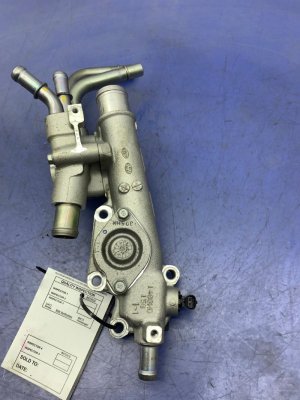
- Thermostat Control Assembly
(OEM #25600-3L260)— This is the most common cause of P0126. It is the complete electronically controlled thermostat unit. It fails in the open position, preventing the engine from warming up.
Trusted brands: Kia Genuine
OEM price range: $400-$410
Aftermarket price range: $150-$250 - Thermostat Assembly
(OEM #25500-3L200)— This part number refers to the mechanical thermostat component itself, which is included within the larger 'Thermostat Control Assembly' (25600-3L260). For a complete repair of the common electronic failure, 25600-3L260 is the required part. This part alone will not fix the electronic control issue.
Trusted brands: Kia Genuine
OEM price range: $150-$160
Aftermarket price range: $80-$120 - Engine Coolant Temperature (ECT) Sensor
(OEM #39220-38020)— A less common but possible cause. It can send incorrect temperature readings to the ECU if it fails.
Trusted brands: Kia Genuine, BOGAP, NRF
OEM price range: $30-$50
Aftermarket price range: $15-$40
Related Codes That Often Appear With This One
- P0128 — P0128 (Coolant Temperature Below Thermostat Regulating Temperature) is a very similar code and is often caused by the exact same issues, primarily a stuck-open thermostat.
- P0125 — P0125 (Insufficient Coolant Temperature for Closed Loop Fuel Control) is another related code that points to the engine not warming up properly, often due to the same thermostat failure.
- P0597 — This code for 'Thermostat Heater Control Circuit/Open' points directly to an electrical failure within the electronic thermostat assembly, confirming it as the root cause.
- P0598 — This code for 'Thermostat Heater Control Circuit High' indicates a short or other electrical fault in the thermostat's control circuit, strongly suggesting the thermostat assembly needs replacement.
Technical Service Bulletins (TSBs) & Recalls
- While not for P0126 directly, Safety Recall SC300 is highly relevant. It addresses a potential oil leak from the left-hand turbocharger oil feed pipe. The repair requires draining coolant, and post-repair issues are a known problem if the system isn't bled correctly.
Platform-Specific Known Issues
- Improper cooling system bleeding after the SC300 turbo oil feed line recall service can introduce air pockets, leading to erratic temperature readings and potential overheating.
- A Kia technician on Reddit confirmed the SC300 recall requires draining coolant and that bleeding the system on a Stinger is 'ass to bleed', highlighting the difficulty and likelihood of technician error.
Mechanic-Grade Diagnostic Values
- Engine Coolant Temperature (ECT) Sensor Resistance (Cold Engine) — expected: ~2000Ω - 3000Ω at 20°C (68°F). Failure: Resistance significantly outside this range at a known ambient temperature.
- Engine Coolant Temperature (ECT) Sensor Resistance (Warm Engine) — expected: ~200Ω - 300Ω at 90°C (194°F). Failure: Resistance that does not drop to this range as the engine warms up.
- Engine Coolant Temperature (ECT) Sensor Signal Voltage (Cold Engine, KOEO) — expected: ~2.0V - 3.5V. Failure: A voltage of 0V, 5V, or a value significantly outside the expected range.
- Engine Coolant Temperature (ECT) Sensor Signal Voltage (Warm Engine) — expected: ~0.5V. Failure: Voltage remains high and does not decrease as the engine reaches operating temperature.
Hidden / Shadow Codes Worth Checking
- P0597: Thermostat Heater Control Circuit/Open. This is not a shadow code but a highly specific standard DTC that directly indicates an open circuit in the electronic thermostat's heating element, which is the primary failure mode. (see via Standard OBD-II scanner. Often appears with P0126 or P0128.)
- P0598: Thermostat Heater Control Circuit High. This is a standard DTC indicating a high voltage or short in the thermostat's control circuit. (see via Standard OBD-II scanner. Often appears with P0126 or P0128.)
Scan Tool Commands That Help
- Kia GDS (Global Diagnostic System) or KDS (Kia Diagnostic System): Actuation Test — The OEM scan tool has an 'Actuation Test' menu that allows technicians to command specific components to turn on or off. While not explicitly documented in search results, it is highly probable that a test exists to activate the electronic thermostat's heater circuit. A technician could use this to verify if the thermostat responds to a command from the scan tool, helping to isolate a faulty thermostat from a wiring or ECU problem.
- Kia GDS (Global Diagnostic System): DTC Guide / Shop Manual — When a DTC like P0126 is pulled, the GDS tool provides an integrated guide with step-by-step diagnostic procedures, component locations, wiring diagrams, and expected electrical specifications directly on the tool, which is invaluable for diagnosis.
Wiring & Ground Locations
- ECT Sensor Connector — The Engine Coolant Temperature (ECT) sensor is typically located on the engine block or cylinder head, often near the thermostat housing. It is a 3-pin rectangular connector.. A loose or corroded connector at the ECT sensor can cause erratic or incorrect temperature readings, leading to a false P0126 code.
- Thermostat Control Assembly Connector — The electronic thermostat is located at the back of the engine, near the firewall, making access difficult. It has a two-wire electrical connector that controls the internal heating element.. This connector provides power and control to the electronic portion of the thermostat. Damage to this connector or its wiring is a primary cause of codes P0597 and P0598, which often accompany P0126.
- Battery Location — The battery is located in the trunk, under the spare tire cover.. When performing electrical tests or disconnecting power for a repair, technicians need to know the battery is not in the engine bay.
Real Owner Repair Stories
- Reddit user in r/kiastinger (Kia Stinger GT1, 72,000 miles) — Check Engine Light
✅ What actually fixed it Owner scanned the car and found codes P0597, P0598, and P0128. Another user confirmed having the same codes and the fix was a full thermostat replacement, which was covered under warranty. - Facebook Kia Stinger Owners Group post (2022 Kia Stinger GT1, 64,000 miles) — Check Engine Light, engine took a very long time to reach operating temperature.
✅ What actually fixed it The owner had the thermostat replaced at a dealership for a total cost of $1,066. Another owner with a 2022 GT1 had the same part replaced under warranty at 34,000 miles, confirming the part can fail at low mileage. - Reddit user in r/StingerGT (2022 Kia Stinger GT2) — Repetitive overheating issues.
❌ Tried (didn't work) Replacing the thermostat and a coolant pipe.
✅ What actually fixed it This is a cautionary tale. The owner was on their fourth thermostat replacement in a few months, with the dealer suggesting a potential lemon law buyback if the issue persisted. This indicates that sometimes a simple thermostat swap doesn't resolve the root cause, which could be persistent air pockets from improper bleeding or a bad batch of parts.
OEM Part Supersession History
25600-3L260→25600-3L260— No supersession found. The original part number appears to be the current and only part number for the complete assembly.
Model Year Variations Within This Range
- 2022-2023: The 2022 facelift introduced a minor 3hp increase for the 3.3T V6 from a new variable exhaust system. This change does not affect the cooling system or the diagnosis for code P0126.
Diagnostic Flowchart
Other Known Issues on This Vehicle
Issues unrelated to this code that are worth knowing about as an owner of this generation:
- Warped Brake Rotors / Pulsating Brakes 🟠 Medium — Very common, often appearing within 15,000-25,000 miles. Many owners report the issue recurring even after rotor replacement.
- Interior Rattles (Hatch/Trunk Area) 🟡 Low — Commonly reported, especially on earlier 2018-2019 models. Can be intermittent and difficult to resolve.
- Failing Oil Pressure Sensor 🟠 Medium — A known issue on the Lambda II engine, typically occurring at higher mileage (60k+ miles).
- Thin/Easily Chipped Paint 🟡 Low — Frequently mentioned by owners as a point of frustration. The Sunset Yellow color had a specific recall for peeling/flaking. (Ref: Recall for Sunset Yellow paint specifically.)
- Carbon Buildup on Intake Valves 🟠 Medium — Inherent to all Gasoline Direct Injection (GDI) engines, including the 3.3T. Becomes a factor at higher mileage (60k-100k miles), potentially causing misfires and reduced performance if not cleaned.
Used vs. New Parts: Buying Guide for This Vehicle
When a used part is the smart pick: For this specific repair, using a used part is NOT recommended. The primary failure is the electronic thermostat assembly, which has shown to fail at relatively low mileage (e.g., 34,000 miles). The labor cost and complexity of the job are high, making the risk of installing a used part with an unknown lifespan a poor economic choice.
What to inspect on the donor part:
- Not applicable as used parts are not recommended.
OEM-only on this vehicle (don't cheap out):
- Thermostat Control Assembly (25600-3L260). Given the critical nature of the electronic control and documented failures, a genuine Kia/Hyundai OEM part is the safest choice to ensure compatibility and longevity.
Aftermarket brands forum-validated for this vehicle:
- No specific aftermarket brands have been consistently validated as reliable in forum discussions for the complete electronic thermostat assembly. While brands like AISIN may be reputable, the lack of community feedback for this specific, complex part on this vehicle makes OEM the preferred choice.
Brands owners have reported issues with on this vehicle:
- Unnamed, low-cost parts from online marketplaces should be avoided. The risk of premature failure and repeating the difficult labor process is too high.
Real Owner Stories
Aggregated from forums and TSBs cited above. Mileages and costs reflect what owners reported in those sources.
2018-2023 Kia Stinger 3.3T
Symptoms: Owner experienced coolant smells, leaks, or overheating immediately after having the SC300 recall performed.
What fixed it: Properly bleeding the cooling system to remove air pockets introduced during the recall service.
Source hint: r/kiastinger on Reddit: Multiple threads discuss owners experiencing coolant smells, leaks, or overheating immediately after having the SC300 recall performed
2018-2023 Kia Stinger 3.3T
Symptoms: Vehicle would overheat but showed no signs of a physical leak; described a 'ridiculous burping process' to try and clear the system.
What fixed it: Removing an air bubble that was likely stuck at the thermostat.
Source hint: stingerforum.org: A user in thread 'overheat but no leak' describes the 'ridiculous burping process'
2018-2023 Kia Stinger 3.3T
Symptoms: A dealer technician noted that the cooling system is 'ass to bleed' and frequently results in issues after the SC300 recall service.
What fixed it: Ensuring the cooling system is properly bled after the SC300 turbo oil feed line repair which requires draining coolant.
Source hint: r/StingerGT on Reddit: In a thread about the SC300 recall, a user identifying as a dealer tech states the recall 'sucks' and confirms it requires draining coolant
Related OBD-II Codes
Frequently Asked Questions
I just had the SC300 recall for the turbo oil feed line performed on my Stinger and now I have a P0126 code. Are they related?
My Stinger's heater is only blowing lukewarm air and the temp gauge is fluctuating. What part do I likely need?
Is there a specific coolant I should use for my 3.3T Lambda II engine to avoid issues?
How can I tell if my P0126 is a bad sensor or a stuck thermostat using a scan tool?
I heard the Stinger is hard to 'burp' after a coolant change. Is there a recommended method?
We Have This Part in Stock


The information in this article is provided for general reference and educational purposes only. Vehicle specifications, procedures, and part compatibility can vary by production date, trim level, and region. Always consult your vehicle's factory service manual and verify part numbers before purchasing or performing repairs. Safety-critical components such as airbags, seat belts, and braking systems should be installed by a qualified professional.
- Kia Stinger:
- 🛍️ Shop This Part
- What's Unique About the 2018-2023 Kia Stinger
- Symptoms You May Notice
- Most Likely Causes
- Diagnosis Steps
- Parts You'll Likely Need
- Related Codes That Often Appear With This One
- Technical Service Bulletins (TSBs) & Recalls
- Platform-Specific Known Issues
- Mechanic-Grade Diagnostic Values
- Hidden / Shadow Codes Worth Checking
- Scan Tool Commands That Help
- Wiring & Ground Locations
- Real Owner Repair Stories
- OEM Part Supersession History
- Model Year Variations Within This Range
- Diagnostic Flowchart
- Other Known Issues on This Vehicle
- Used vs. New Parts: Buying Guide for This Vehicle
- Real Owner Stories
- 2018-2023 Kia Stinger 3.3T
- 2018-2023 Kia Stinger 3.3T
- 2018-2023 Kia Stinger 3.3T
- Related OBD-II Codes
- Frequently Asked Questions
- 🎟️ Get 5% Off