

OBD-II Code P0597: Thermostat Heater Control Circuit/Open
The Ultimate Guide to Diagnosing and Fixing P0597
- Code P0597 indicates a complete electrical break (open circuit) in the engine's thermostat heater control system.
- Replacing the entire thermostat assembly fixes this code 80% of the time, as the internal heating element frequently burns out.
- Always test the thermostat connector for 11-14V of power and a solid ground before buying parts to rule out a $20 wiring fix.
- Driving with an active P0597 code risks severe engine overheating and blown head gaskets, which cost upwards of $2,500 to repair.
- General Motors 1.4L and 1.8L engines frequently trigger this code due to cracked plastic thermostat housings; upgrade to an all-aluminum housing for a permanent fix.
- BMW, Mini, Kia, and Hyundai owners should call a dealership with their VIN before paying for repairs, as many models have active 10-year/120,000-mile warranty extensions for this exact failure.
What Does P0597 Mean?

The Powertrain Control Module (PCM) detected an open circuit in the engine's thermostat heater control system. Modern cars use an integrated heater to open the thermostat faster and more precisely than traditional mechanical versions, improving fuel economy and reducing emissions. Code P0597 means the electrical signal from the computer is not reaching this heater—similar to a cut wire or a burned-out light bulb—preventing the PCM from managing engine temperature.
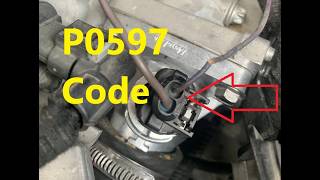
🎬 Watch: A quick breakdown of what code P0597 means.Technical definition: The official SAE/OBD-II definition is "Thermostat Heater Control Circuit/Open". This indicates the Powertrain Control Module (PCM) detected a complete loss of continuity in the electrical circuit for the electronically controlled thermostat heater. The PCM sets this code when it commands the heater circuit 'on' but detects zero voltage or no current draw for a specified period.
Can I Drive With P0597?
Yes, But With Caution. You can physically drive the vehicle, but we strongly advise against it. If the thermostat fails in the closed position, the engine will rapidly overheat, causing catastrophic damage like a warped cylinder head or blown head gasket—repairs exceeding $2,500. If it fails open, the engine won't reach optimal temperature, leading to poor fuel economy, increased emissions, and constant cooling fan operation.
Common Causes

- Faulty Thermostat Assembly (Very Common) — The internal heating element within the thermostat assembly burns out like a light bulb, creating an open circuit. The entire thermostat unit, typically integrated into a plastic or metal housing, requires replacement.
- Corroded Connector or Damaged Wiring (Common) — The electrical connector at the thermostat or its wiring becomes corroded, loose, or broken due to engine vibration and heat. A frequent source of this corrosion is a coolant leak directly from the thermostat housing. Loose female pins within the connector also cause intermittent open circuits.
- Low Engine Coolant Level (Less Common) — If the coolant level drops too low due to a leak, the thermostat heater is exposed to air pockets. This causes the heating element to overheat and burn out, creating an open circuit.
- Coolant Wicking into Wiring Harness (Less Common) — On specific vehicles (particularly GM models), a failed thermostat seal forces coolant past the connector's weather pack. The coolant 'wicks' up the copper wire inside the insulation, causing corrosion and open circuits deep inside the main wiring harness.
- Faulty Engine Coolant Temperature (ECT) Sensor (Rare) — The PCM uses the ECT sensor to verify thermostat heater operation. If the ECT sensor provides incorrect data, the PCM falsely concludes the heater circuit is open. This is usually accompanied by other ECT-related codes.
- Blown Fuse or Faulty Relay (Rare) — A blown fuse cuts power to the thermostat heater circuit and sets P0597. This usually points to an underlying short circuit, which sets codes P0598 or P0599.
- Faulty Powertrain Control Module (PCM) (Very Rare) — The internal driver circuit within the engine's computer that sends voltage to the thermostat heater fails. Suspect this only after exhaustively testing the wiring and thermostat.
Symptoms

- Check Engine Light On — This is the first and often the only symptom the driver notices.
- Cooling Fans Run Constantly — The PCM runs the radiator fans at full speed continuously as a failsafe to prevent overheating, even when the engine is cold.
- Abnormal Temperature Gauge Reading — The gauge shows the engine running much colder than normal, taking a long time to warm up, or running dangerously hot.
- Slow Engine Warm-Up and Poor Heater Performance — The engine takes significantly longer to reach operating temperature, causing the cabin heater to blow lukewarm air in cold weather.
- Remote Start Disabled — The factory software automatically disables the remote start feature whenever a Check Engine Light is active to prevent engine damage.
- Rough Idle and Excessive Exhaust Smoke — During the extended warm-up period, the richer fuel mixture causes a rough idle and visible white or black exhaust smoke.
- Reduced Fuel Economy (also visible on scanner) — An engine running below optimal temperature remains in a 'rich' fuel state, burning fuel inefficiently and dropping MPG.
Diagnostic Flowchart
Tap your situation to follow the diagnostic path that matches what you're seeing on this code.
Common Fixes & Costs
- Replace Thermostat Assembly — Parts: $50-$250, Labor: $150-$450, ~1.8 hr book time (Intermediate)
- Clean, Repair, or Replace Thermostat Connector/Pigtail — Parts: $15-$40, Labor: $100-$200, ~0.8 hr book time (DIY)
- Find and Repair Coolant Leak — Parts: $20-$500, Labor: $150-$600, ~2.0 hr book time (Intermediate)
- Repair Damaged Wiring in Harness — Parts: $5-$20, Labor: $100-$300, ~1.5 hr book time (Intermediate)
- Replace Powertrain Control Module (PCM) — Parts: $500-$1200, Labor: $150-$300, ~1.5 hr book time (Professional)
Used vs. New Parts: Buying Guide
When a used part is worth it: Buying a used thermostat assembly is strongly NOT recommended. The internal electronic heater is a wear-and-tear item with a finite life. A used part carries a high risk of failing shortly after installation.
Donor-vehicle mileage cap: roughly under 20000 miles for the part to have meaningful remaining life.
Donor quality checklist:
- Avoid parts from vehicles with high mileage or unknown history.
- Never use a part from a vehicle scrapped due to overheating, as the plastic housing warps.
- Verify the part number exactly; electronic components are specific to model years and software versions.
Decision logic:
- If The part is an integrated electronic thermostat assembly. → Always buy new. The cost of repeat labor ($150-$450) far outweighs any savings from a used part.
- If The vehicle is a model with a known plastic housing cracking issue (e.g., GM 1.4L). → Buy a new, upgraded all-metal aftermarket housing for a permanent solution.
- If Budget is extremely tight and the vehicle has very high mileage. → A used part is a last resort, but understand it is a high-risk gamble that provides only a temporary fix.
Warranty tradeoff: Used parts from a salvage yard typically offer a 30-90 day warranty on the part only, not labor. New aftermarket parts usually come with a 1-year to limited lifetime warranty. New OEM parts offer a 1-2 year warranty.
Worst-case if a used part fails: $200-$500 if a used part fails after installation, primarily due to the cost of repeating the labor.
What Happens If You Wait — Timeline
- 0-1 month: Code P0597 sets, Check Engine Light turns on. If thermostat fails open, engine takes longer to warm up, and cabin heater is weak. Remote start is disabled. (MPG impact: 5-15%% · Added cost: $0-$50 in wasted fuel.)
- 1-3 months: Engine consistently runs too cool, leading to a permanent rich fuel condition. Cooling fans run constantly as a failsafe, causing premature wear on the fan motor. MPG loss is significant. (MPG impact: 10-20%% · Added cost: $50-$150 in wasted fuel, plus increased wear on fan assembly ($300-600 part).)
- 3-6 months: Prolonged rich condition fouls spark plugs and damages the catalytic converter with unburnt fuel. If stuck closed, a severe overheating event becomes highly likely. (MPG impact: 15-25%% · Added cost: $500-$2,500 (Risk of catalytic converter replacement or cooling fan replacement becomes high).)
- 6+ months: Catastrophic failure is imminent. A thermostat failing closed causes severe overheating, leading to a warped cylinder head or blown head gasket. This is a terminal event for many engines. (MPG impact: N/A (Vehicle likely undrivable)% · Added cost: $2,500-$5,000+ (Cost of head gasket repair or used engine replacement).)
Cost of Not Fixing It
- 0-1 Month: Noticeable 10-20% drop in fuel economy due to the engine running too cool and in a rich fuel state. Poor cabin heater performance in cold weather. (Added cost: $20-$60 per month in extra fuel costs.)
- 1-6 Months: Prolonged rich fuel condition causes carbon buildup and damages the catalytic converter. Constant fan operation causes premature wear on cooling fan motors. (Added cost: $500-$2800 (Catalytic converter or cooling fan assembly replacement).)
- 6+ Months: High risk of catastrophic engine damage if the thermostat fails in the closed position, causing rapid overheating and a warped cylinder head. (Added cost: $2500-$4000+ (Cylinder head repair or engine replacement).)
Diagnosis Steps

- Scan for All Trouble Codes
Use an OBD-II scanner to confirm P0597 and look for related codes. Codes like P0598 (short to ground), P0599 (short to power), P0128 (engine too cool), or P0119 (ECT sensor fault) provide critical diagnostic direction.
Tools: OBD-II Scanner (Beginner) - Visually Inspect the Thermostat Wiring and Connector
Locate the thermostat housing. Inspect the electrical connector for green/white corrosion, moisture from leaks, or backed-out pins. Follow the wiring harness to check for breaks, fraying, or heat damage.
Tools: Flashlight (Beginner) - Check Engine Coolant Level and Condition
With the engine completely cool, check the coolant level in the reservoir. A low level indicates a leak that causes thermostat failure. Inspect the coolant for signs of contamination.
Tools: Flashlight, Rag (Beginner) - Check for Blown Fuses
Consult your owner's manual to locate the fuse for the thermostat heater circuit. Pull the fuse and inspect the filament for a break.
Tools: Fuse puller or needle-nose pliers (Beginner) - Test Thermostat Heater Resistance
Disconnect the thermostat's electrical connector. Set a multimeter to Ohms (Ω) and touch the probes to the two pins on the thermostat. A reading of 'OL' (infinite resistance) confirms a burned-out heater. A good heater typically reads between 5 and 15 Ohms.
Tools: Multimeter, vehicle-specific repair manual (Intermediate) - Test for Voltage and Ground at the Connector
With the ignition on and engine running, set a multimeter to DC Volts. Probe the terminals on the wiring harness side. One pin must have a ground connection (less than 0.1V) and the other must receive 11-14V. Missing voltage or ground isolates the problem to the wiring or PCM.
Tools: Multimeter (Advanced) - Pro Tip: Active Test with Bi-Directional Scan Tool
Navigate to the active test menu for the thermostat heater on a professional scan tool. Command the circuit 'On' and 'Off' while monitoring live data for 'Heater Voltage' (11-14V) and 'Heater Current' (0.5-2.0A). This definitively tests the entire control side of the circuit.
Tools: Bi-directional OBD-II Scan Tool (Advanced) - Pro Tip: Check for Coolant Wicking
If the connector shows moisture, disconnect it and inspect the wire seals. Cut back a small piece of wire insulation an inch away from the connector to see if moisture or corrosion is present inside the copper strands, indicating a compromised harness.
Tools: Flashlight, utility knife (Advanced) - Advanced: Monitor Live Data PIDs
Monitor the 'Engine Coolant Temperature' (ECT) PID on a cold start. The ECT should rise steadily to 195-220°F (90-104°C). If the ECT hovers around 160-170°F, the thermostat is stuck open.
Tools: OBD-II Scan Tool (with Live Data) (Advanced)
When This Code Triggers (Freeze-Frame Conditions)
- Engine Coolant Temp: 160-195°F (71-90°C) (During engine warm-up phase when the PCM expects to see a rapid temperature increase.)
- RPM: 1500-2500 (Steady cruise or light acceleration, when the PCM actively manages engine temperature.)
- Engine Load: 25-50% (The PCM commands the heater on during moderate load to optimize engine temperature for efficiency.)
- Vehicle Speed: 30-60 mph (48-97 km/h) (The code sets during city or highway driving after the engine runs long enough for the diagnostic monitor to execute.)
Related Codes
- P0598 — Means "Thermostat Heater Control Circuit Low," indicating a short to ground. This is the opposite of P0597; electricity flows directly to ground due to a frayed wire touching the engine block.
- P0599 — Means "Thermostat Heater Control Circuit High," indicating a short to power. This happens if the control wire chafes against a voltage-carrying wire, often blowing the circuit's fuse.
- P0128 — Means "Coolant Temperature Below Thermostat Regulating Temperature." P0597 points to the electrical cause (open heater circuit), while P0128 confirms the mechanical result (thermostat stuck open).
- P0119 — Means "Engine Coolant Temperature Sensor 1 Circuit Intermittent." Seeing this with P0597 suggests a faulty ECT sensor is giving the PCM implausible data, rather than a true thermostat failure.
Climate & Environmental Factors
- Cold Climates: Symptoms are highly pronounced. An engine with a thermostat stuck open takes excessively long to warm up, leading to freezing cabin temperatures and a massive drop in fuel economy.
- High Humidity / Road Salt: Accelerates corrosion at the thermostat's electrical connector, especially if a minor coolant leak is present. Moisture, electricity, and coolant create an ideal environment for pin degradation.
- Hot Climates: If the thermostat fails in a closed position, the engine is at a severe risk of overheating rapidly in hot weather, leading to catastrophic engine damage.
How to Talk to a Mechanic About This Code
Say this: "I have an engine code P0597 for the thermostat heater circuit. Before replacing the thermostat, I'd like you to perform a circuit test. Please check for voltage and ground at the connector and measure the resistance of the heater element itself."
This signals that you understand the common misdiagnosis of replacing the part without checking the wiring first. It directs the mechanic to perform a proper diagnosis, saving you money if the problem is a simple wiring issue.
Avoid saying:
- My check engine light is on.
- Just replace the thermostat.
- I think my car is overheating.
Questions to ask before authorizing the repair:
- What was the resistance reading across the thermostat's heater pins? Was it open?
- Did you confirm there is battery voltage and a good ground at the harness connector when the heater is commanded on?
- If the connector is corroded, have you found the source of the coolant leak that caused it?
- Is the recommended repair to fix a wiring issue or to replace the entire thermostat assembly?
Where to Take It: Dealer vs Independent vs Chain
- Dealer:
Recommended first stop ONLY if you own a BMW, Mini, or newer Kia/Hyundai to check for warranty coverage. Otherwise, use for a second opinion on complex cases.
Best for: Vehicles under warranty (BMW, Mini, Kia, Hyundai have known warranty extensions/TSBs for this issue)., Complex electrical diagnostics if an independent shop cannot find the fault., When you want an OEM part and a manufacturer-backed warranty on the repair.
Downsides: Highest labor rates and part costs, often 1.5-2x more than an independent shop., May be quick to replace the entire assembly without thoroughly checking for cheaper wiring fixes. (Typical cost: +75% vs. baseline) - Independent Shop:
Best fit for most P0597 repairs. This is a very common code, and a competent independent shop will have diagnosed and repaired it many times.
Best for: Out-of-warranty vehicles, especially common ones like the Chevy Cruze or Ford Focus., Cost-conscious owners, as they have lower labor rates and are willing to use high-quality aftermarket parts., Installing upgraded parts, like the all-metal thermostat housing for GM vehicles.
Downsides: Quality varies greatly; ensure the shop has good reviews and ASE-certified technicians., May lack the expensive, manufacturer-specific diagnostic tools to trace the most complex wiring faults. (Typical cost: +0% vs. baseline) - Chain Shop:
AVOID for P0597 diagnosis and repair. The risk of misdiagnosis and unnecessary parts replacement is high.
Best for: Simple, unrelated maintenance like oil changes and tire rotations.
Downsides: Technician skill and diagnostic equipment are very limited., High pressure to sell parts leads to misdiagnosis; they are more likely to replace the thermostat without performing necessary circuit tests. (Typical cost: -10% vs. baseline)
When to Walk Away From the Repair
If the estimated repair cost for P0597 exceeds 40-50% of your car's private-party market value, pause and consider your options. This is especially true if the car has other known issues.
- Car worth $4000, fix is $450: Fix it. This repair cost is well below the threshold and is critical for engine health.
- Car worth $8000, fix is $1200: Fix it, but get a second opinion. A $1200 quote (likely from a dealer) could be done for $700-$800 at a good independent shop.
- Car worth $2500, fix is $900: Borderline. If the car is otherwise reliable, the repair is worth it to keep it running safely. If it needs other expensive repairs, consider selling it.
What Scan Tool You Need for This Code
Minimum: A basic OBD-II code reader to confirm P0597 and a digital multimeter. The multimeter is essential for testing resistance on the thermostat and voltage/ground on the connector.
A simple $20 code reader only tells you the code is present. It cannot help you determine if the fault is the thermostat itself or the wiring. Without a multimeter, you are just guessing.
Budget: BlueDriver Pro (~$100) — Reads and clears the code, provides freeze-frame data, and allows you to view live data for Engine Coolant Temperature (ECT) to see if the engine is warming up properly. Paired with a multimeter, this is a strong DIY setup.
Mid-range: Innova 5610 or Foxwell NT series (~$300) — Includes bi-directional control. This is a game-changer for P0597, allowing you to command the thermostat heater 'on' and 'off' directly from the scan tool to prove the PCM and wiring work.
Professional: Autel MaxiCOM MK808 / Launch X431 Series (~$450-700) — Provides full professional-level bi-directional control, offers wiring diagrams on the tool, and has advanced data graphing capabilities to make diagnosing intermittent wiring issues easier.
How to Clear the Code After You Fix It
- Use an OBD-II scan tool to clear the P0597 code from the PCM's memory.
- Ensure the fuel tank is between 30% and 70% full for EVAP monitor testing.
- Perform a complete OBD-II drive cycle to allow the vehicle's readiness monitors to run and complete.
Drive cycle (~30 minutes): From a cold start (engine coolant below 122°F/50°C), idle the engine for 2-3 minutes. Drive in mixed city traffic, including several slow stops. Accelerate to a steady highway speed of 55-60 mph for at least 5 minutes. Allow the vehicle to coast down to 20 mph without braking. Let the vehicle cool down completely overnight and repeat if necessary.
Readiness monitors affected: Catalyst Monitor, Evaporative (EVAP) System Monitor, O2 Sensor Monitor, O2 Sensor Heater Monitor
Before emissions retest: drive at least 100 miles to fully set monitors.
Watch out for:
- Clearing the code with a scanner without performing a drive cycle leaves readiness monitors incomplete, causing an automatic emissions test failure.
- The code returns immediately if the root cause (bad thermostat, broken wire) was not correctly repaired.
- Failing to let the engine cool down sufficiently before starting the drive cycle prevents certain monitors from running.
Will This Fail Emissions / State Inspection?
Yes — this code typically fails an OBD-II emissions inspection.
- California: An active Check Engine Light for P0597 is an automatic smog check failure. All required readiness monitors must be 'Complete'. After repair, a full drive cycle is mandatory before re-testing.
- New York: The NYS DMV inspection includes an OBD-II scan. Any active diagnostic trouble code, including P0597, results in an emissions failure.
- Texas: In the 17 counties requiring emissions testing, a vehicle with an illuminated Check Engine Light for P0597 fails the OBD portion of the inspection.
Most Commonly Affected Vehicles
- Chevrolet Cruze, Sonic, Aveo, Malibu, Equinox (esp. 1.4L & 1.8L Ecotec) (2011-2018) — Extremely common. The plastic thermostat housing cracks, causing leaks that corrode the connector. Coolant often wicks through the wiring harness. Upgraded metal housings are the best permanent solution.
- BMW 1, 3, 5 Series, X1, X3, X5 (esp. with N20/N26/N52/N55 engines) (2006-2017) — BMW extensively uses electronically controlled thermostats, and failures are rampant. Always check for 10-year/120,000-mile warranty extensions before paying for repairs.
- Mini Cooper, Countryman (2007-2016) — Sharing engineering with BMW, Minis are highly susceptible to thermostat heater circuit failures and housing leaks.
- Audi / Volkswagen A3, A4, A6, Q3, Q5 / Golf, Jetta, Passat, Tiguan (2008-2017) — Persistent wiring issues often remain even after the thermostat housing is replaced, making a thorough circuit test crucial before swapping parts.
- GMC Terrain (2011-2017) — Shares the problematic 1.4L/1.8L Ecotec engines and cracking plastic thermostat housings with the Chevrolet Equinox and Cruze.
- Kia / Hyundai Telluride, Palisade, Stinger, Genesis G70 (2019-2023) — Newer models use a complex 'Coolant Control Valve' known to fail and trigger P0597. Check for Technical Service Bulletins (TSBs) like SC223 for free replacements.
- Ford Focus, Mondeo, Kuga, Transit (2010-2016) — Prevalent in Ford models utilizing electronically controlled thermostats to meet strict emissions targets.
- Mercedes-Benz C-Class, E-Class, GLK, Sprinter (2009-2016) — Mercedes models equipped with precision temperature control thermostats frequently experience P0597 due to internal heater burnout.
Manufacturer-Specific Notes
- General Motors (Chevrolet, Buick, GMC): The OEM plastic thermostat housings on 1.4L and 1.8L Ecotec engines become brittle, crack, and leak coolant onto the connector. Install an aftermarket all-aluminum housing to fix this design flaw permanently.
- BMW / Mini: BMW issued multiple warranty extensions for the engine coolant thermostat. For N20/N26 engines, Service Information Bulletin SI B01 01 16 extends coverage to 10 years/120,000 miles. Always check your VIN with a dealer.
- Kia / Hyundai: The component is called a 'Coolant Control Valve Assembly'. It is a complex, expensive part with active recalls and TSBs (like campaign SC223). Check with a dealer for free replacement coverage.
- Volkswagen / Audi: Technicians frequently replace the thermostat only to have the P0597 code return. This indicates the actual problem is a break or high resistance in the wiring harness between the PCM and the thermostat.
Real Owner Stories
2014 Chevy Cruze 1.8L at 90k miles
Check Engine Light came on. Owner noted a very slow coolant leak for the past 6 months. After clearing the code, it returned within 10 minutes of driving.
What they tried:
- Cleared the code with a scanner.
- Unplugged and re-plugged the thermostat connector.
Outcome: The problem was a classic failure of the thermostat assembly, exacerbated by the long-term slow leak from the plastic housing. The owner replaced the entire thermostat and housing assembly.
Lesson: On GM products like the Cruze, a slow coolant leak and a P0597 code are almost always linked. Don't just fix the code; fix the leak by replacing the entire housing with an upgraded metal version.
2012 BMW 328i (F30) at 70k miles
Check Engine Light appeared with code P0597. Owner was aware of a potential extended warranty for the thermostat.
What they tried:
- Called the dealership to inquire about warranty coverage before authorizing a paid diagnosis.
- Persisted when the service advisor initially pushed for a standard diagnostic fee.
Outcome: The repair was covered for free under a SULEV (Super Ultra Low Emission Vehicle) warranty extension. The dealer replaced the thermostat assembly at no cost to the owner.
Lesson: For BMW and Mini owners, always check for warranty extensions or recalls related to the thermostat before paying for a P0597 repair. A phone call with your VIN saves over $1,000.
2014 Chevy Cruze - Misdiagnosis Story
P0597 code appeared. Owner replaced the thermostat and housing assembly, cleared the code, but the Check Engine Light returned immediately.
What they tried:
- Replaced the thermostat and housing.
- Cleared the code with an OBD-II reader.
Outcome: The code remained, indicating the problem was not the thermostat itself. The issue was a corroded connector pin that required a $20 replacement pigtail.
Lesson: If you replace a part and the code comes back instantly, you misdiagnosed the problem or installed a faulty part. Always test the circuit (wiring, connector, voltage) before replacing components.
MINI Cooper - Intermittent Code
P0597 code appeared intermittently. The only symptom was that the remote start would not work when the light was on.
What they tried:
- Initially lived with the issue, clearing the code as needed.
Outcome: Eventually replaced the thermostat housing assembly, which permanently resolved the intermittent code. The issue was a failing heating element on the verge of complete burnout.
Lesson: An intermittent P0597 points to a failing electrical component, like a loose connector pin or a breaking heater element wire. It will eventually become a hard fault.
How to Prevent This Code From Triggering
- Perform regular cooling system flushes. (Every 30,000 to 50,000 miles or 3-5 years.) — Removes old, acidic coolant and contaminants that cause corrosion. Fresh coolant contains anti-corrosion additives that protect the thermostat housing and electrical components.
- Use the correct type of coolant for your vehicle. (Every time coolant is added or changed.) — Using the wrong coolant accelerates corrosion and damages plastic components, leading to leaks that destroy the thermostat's electrical connector. Always use the manufacturer-specified fluid.
- Apply dielectric grease to the thermostat connector seal. (During any service involving the thermostat or its connector.) — Dielectric grease is a non-conductive, silicone-based grease that seals out moisture, dirt, and road salt, preventing corrosion on the electrical pins.
- Periodically inspect the thermostat housing and wiring. (During every oil change.) — A quick visual inspection catches early signs of a coolant leak (stains, wetness) around the thermostat housing before it damages the electrical connector.
Frequently Asked Questions
What are the most common mistakes when diagnosing P0597?
The biggest mistake is immediately replacing the thermostat assembly without testing the circuit. Mechanics often spend hundreds on a new thermostat only to find the code returns because the actual problem was a broken wire or corroded connector pin. Always test for voltage and ground first.
My Check Engine Light for P0597 turns on and off. What does that mean?
An intermittent light usually points to a borderline electrical connection, like a loose connector pin or a frayed wire that loses contact during engine vibration. While the light may turn off temporarily, the underlying problem still exists and requires diagnosis. It will eventually become a permanent fault.
Can a bad coolant temperature sensor cause P0597?
Yes, though it is less common. The PCM relies on the Engine Coolant Temperature (ECT) sensor to confirm if the engine is warming up as expected. If the ECT sensor sends incorrect signals, the PCM misinterprets this as a heater circuit failure and logs P0597.
What happens if I don't fix code P0597?
Ignoring P0597 leads to poor fuel economy, high emissions, and constant cooling fan operation. If the thermostat fails in the closed position, the engine will overheat, causing catastrophic damage like a blown head gasket that costs thousands to repair.
Why did my remote start stop working with code P0597?
Most modern vehicles disable the remote start system whenever there is an active Check Engine Light. The computer does this to prevent a potentially damaging situation from worsening while the vehicle is unattended. Once you repair and clear the P0597 code, remote start will function again.
Why is my radiator fan always running with this code?
When the computer loses control of the thermostat heater, it enters a failsafe mode. It commands the radiator cooling fans to run at full speed continuously to prevent the engine from overheating.
Can I replace the thermostat myself to fix P0597?
Yes, replacing a thermostat is a manageable DIY job for someone with moderate mechanical skill. The process involves draining the cooling system, swapping the part, and properly bleeding the air from the system afterward to prevent air pockets. Always ensure the engine is completely cold before starting.
How much does it cost to fix code P0597?
Replacing the thermostat assembly typically costs between $200 and $450 at an independent shop for common vehicles like a Chevy Cruze. For luxury brands like BMW or Audi, the same job costs $700 to over $1,200. If the issue is just a corroded wire, repairs average $100 to $200.
Key Takeaways
- Code P0597 indicates a complete electrical break (open circuit) in the engine's thermostat heater control system.
- Replacing the entire thermostat assembly fixes this code 80% of the time, as the internal heating element frequently burns out.
- Always test the thermostat connector for 11-14V of power and a solid ground before buying parts to rule out a $20 wiring fix.
- Driving with an active P0597 code risks severe engine overheating and blown head gaskets, which cost upwards of $2,500 to repair.
- General Motors 1.4L and 1.8L engines frequently trigger this code due to cracked plastic thermostat housings; upgrade to an all-aluminum housing for a permanent fix.
- BMW, Mini, Kia, and Hyundai owners should call a dealership with their VIN before paying for repairs, as many models have active 10-year/120,000-mile warranty extensions for this exact failure.
Helpful Videos

The information in this article is provided for general reference and educational purposes only. Vehicle specifications, procedures, and part compatibility can vary by production date, trim level, and region. Always consult your vehicle's factory service manual and verify part numbers before purchasing or performing repairs. Safety-critical components such as airbags, seat belts, and braking systems should be installed by a qualified professional.
- 🎬 Helpful Videos
- What Does P0597 Mean?
- Can I Drive With P0597?
- Common Causes
- Symptoms
- Diagnostic Flowchart
- Common Fixes & Costs
- Used vs. New Parts: Buying Guide
- What Happens If You Wait — Timeline
- Cost of Not Fixing It
- Diagnosis Steps
- When This Code Triggers (Freeze-Frame Conditions)
- Related Codes
- Climate & Environmental Factors
- How to Talk to a Mechanic About This Code
- Where to Take It: Dealer vs Independent vs Chain
- When to Walk Away From the Repair
- What Scan Tool You Need for This Code
- How to Clear the Code After You Fix It
- Will This Fail Emissions / State Inspection?
- Most Commonly Affected Vehicles
- Manufacturer-Specific Notes
- Real Owner Stories
- 2014 Chevy Cruze 1.8L at 90k miles
- 2012 BMW 328i (F30) at 70k miles
- 2014 Chevy Cruze - Misdiagnosis Story
- MINI Cooper - Intermittent Code
- How to Prevent This Code From Triggering
- Frequently Asked Questions
- What are the most common mistakes when diagnosing P0597?
- My Check Engine Light for P0597 turns on and off. What does that mean?
- Can a bad coolant temperature sensor cause P0597?
- What happens if I don't fix code P0597?
- Why did my remote start stop working with code P0597?
- Why is my radiator fan always running with this code?
- Can I replace the thermostat myself to fix P0597?
- How much does it cost to fix code P0597?
- Key Takeaways
- 🎟️ Get 5% Off