

P0122 on 1998-2002 Saab 9-3: Throttle Position Sensor Low Voltage Causes and Fixes
On a 1998-2002 Saab 9-3, P0122 indicates a low voltage signal from the throttle position sensor (TPS). For 2000-2002 models with the Trionic 7 engine management system, this almost always means the entire electronic throttle body has failed and needs replacement. On 1998-1999 models with the Trionic 5 system, you can replace the sensor separately.
- P0122 on a 1998-2002 Saab 9-3 means the throttle position sensor signal is too low.
- Determine if your car is a 1998-99 model (Trionic 5, separate sensor) or a 2000-02 model (Trionic 7, integrated throttle body).
- For Trionic 7 cars, the entire electronic throttle body is the most likely culprit and requires replacement.
- For Trionic 5 cars, the separate TPS is the likely failure point and can be replaced on its own.
- Always inspect wiring and connectors for damage before replacing expensive components.
What's Unique About the 1998-2002 Saab 9-3
The 1998-2002 Saab 9-3 spans a major engine management transition. 1998 and most 1999 models use the Trionic 5 (T5) system with a traditional throttle cable and a separate, replaceable TPS. Later models, from model year 2000 onwards (and in the 1999 Viggen), use the Trionic 7 (T7) system with a fully electronic throttle body (ETB). On these T7 cars, the throttle position sensors are integrated into the throttle body assembly and are not sold as a separate part. This means a sensor failure requires replacing the entire, more expensive, throttle body unit, which is a very common and well-documented failure point for these vehicles.
Symptoms You May Notice
- Check Engine Light is on
- Vehicle enters 'Limp Home Mode' (drastically reduced power and acceleration)
- Poor, delayed, or no throttle response
- High or erratic idle speed
- Engine stalling
- A/C compressor may not engage
- Cruise control is disabled
- Replacing only the accelerator pedal position sensor (APPS) without checking the throttle body itself. The APPS is on the pedal, the TPS is on the throttle body.
- Replacing the ECM when the fault lies in the wiring or the throttle body.
- Assuming a dirty throttle body is the cause. While cleaning is good maintenance, it rarely fixes an electrical circuit fault code like P0122, which indicates a signal problem, not a mechanical restriction.
Most Likely Causes
- Internal Failure of Electronic Throttle Body (Trionic 7 models) 🔴 High Probability This is a widely documented failure point on Saabs with the Trionic 7 system (2000-2002 9-3 and 1998-2010 9-5). The internal electronics and non-contact sensor components wear out, leading to erratic or no signal. Remanufactured units are common, often identified by a yellow label, but quality can vary.
How to confirm: Use a scan tool to monitor TPS voltage. If the voltage is stuck at a very low value (e.g., <0.2V) and does not change when the accelerator is pressed, and the wiring is confirmed to be good, the throttle body is faulty. The two internal sensors should also have a combined reading of ~5V at any given time.
Typical fix: Replace the entire throttle body assembly. A new gasket is required. Some owners report needing a software update or adaptation reset via a Saab Tech II tool after replacement to prevent erroneous codes from returning, though this is not always necessary.
Est. part cost: $150-$450 - Faulty Throttle Position Sensor (TPS) (Trionic 5 models) 🔴 High Probability On earlier models (approx. 1998-1999) where the TPS is a separate component, it is a common wear item. The internal resistive strip wears out from the physical contact of the wiper, creating dead spots or a complete loss of signal.
How to confirm: Disconnect the sensor and test its resistance with a multimeter while manually operating it. The resistance should change smoothly. Alternatively, monitor voltage with a scan tool; it should sweep smoothly from ~0.5V to ~4.5V with no dropouts as the throttle is opened.
Typical fix: Replace the throttle position sensor. It is typically held on by two screws.
Est. part cost: $40-$120 - Wiring Harness or Connector Damage 🟡 Medium Probability The wiring harness leading to the throttle body is in the engine bay and subject to heat, vibration, and oil contamination. Wires can chafe against brackets or the cylinder head, and pins within the connector can corrode or lose tension over time, causing an intermittent or permanent low signal.
How to confirm: Visually inspect the wiring for breaks, chafing, or melted sections, especially where it routes near sharp edges. Unplug the connector at the throttle body and check for corrosion, moisture, or bent/loose pins. Use a multimeter to check for continuity on the signal and ground wires and for a short to ground on the signal wire.
Typical fix: Repair the damaged section of wiring or replace the connector pigtail.
Est. part cost: $10-$50
Rare But Worth Checking
- Faulty Engine Control Module (ECM): This is very uncommon. The ECM should only be suspected after all other possibilities, including the throttle body and wiring, have been exhaustively tested and ruled out. A faulty ECM is the least likely cause.
Diagnosis Steps
- Connect an OBD-II scanner and confirm P0122 is the active code. Note any other codes present, especially P1230, P1251, or P0123.
- Use the scanner's live data function to monitor the 'Throttle Position' or 'TPS Voltage' PID.
- With the key on and engine off, observe the reading. It should be low but not zero (e.g., ~0.5V). For P0122, you will likely see a reading below 0.28V. 🎬 See this guide on diagnosing P0122 and testing sensor voltage.
- Slowly press the accelerator to the floor. The voltage should increase smoothly and linearly to around 4.5V. Watch for any dropouts, spikes, or flat spots.
- If the voltage is stuck low or does not respond, proceed to the throttle body. Visually inspect the wiring harness for any signs of chafing, melting, or damage.
- Unplug the connector at the throttle body. Inspect the pins on both the harness side and the throttle body side for corrosion, moisture, or damage.
- Using a multimeter and a wiring diagram for your specific model year (T5 vs T7), check for a 5V reference and a good ground at the connector with the key on.
- If power and ground are present, the fault is highly likely within the throttle body (on 2000-02 models) or the TPS itself (on 1998-99 models).
- If power or ground is missing, trace the corresponding wire back toward the ECM to find the open or short circuit. Pay close attention to areas where the harness bends or is secured to the engine/chassis.
Parts You'll Likely Need
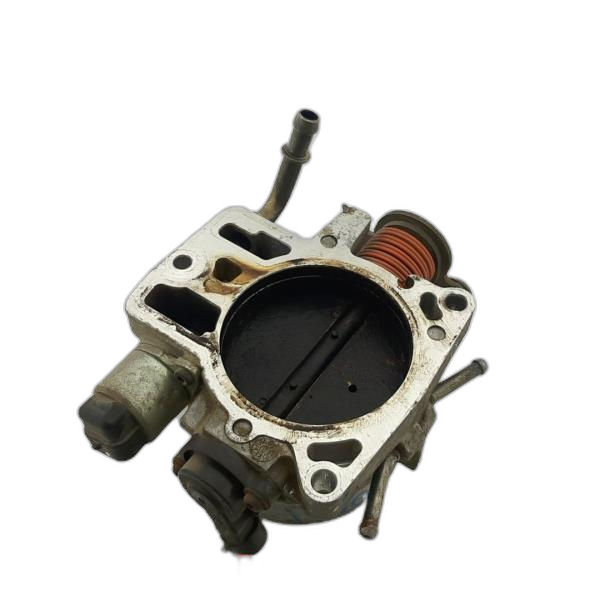
- Electronic Throttle Body Assembly
(OEM #9191352, 55560399 (supersedes 9191352))— For 2000-2002 models (Trionic 7), the TPS is integrated. This entire unit is the most common failure point causing P0122. The part number 93176028 cited in pass 1 is for the later 9-3 Sport Sedan (2003+) and is incorrect for this vehicle.
Trusted brands: Bosch (OEM), Cardone (Remanufactured)
OEM price range: $350-$500
Aftermarket price range: $150-$300 - Throttle Position Sensor
(OEM #9181538, Bosch 0280122014)— For 1998-1999 models (Trionic 5) where the sensor is a separate part, this is the component that fails.
Trusted brands: Bosch, Facet, Replacement AP
OEM price range: $80-$120
Aftermarket price range: $40-$70
Related Codes That Often Appear With This One
- P1230 — This is another Saab-specific code related to throttle/pedal position sensor signals not being in the expected range, often appearing with other throttle body faults.
- P1251 — Indicates a stuck throttle valve, which can be caused by the same failing throttle body that triggers P0122.
- P0123 — This code is for 'TPS Circuit High Input', the opposite of P0122. Seeing them intermittently together can point to a very erratic sensor or a wiring short.
- P1261 — A general throttle valve malfunction code, frequently stored alongside other throttle body electrical faults on these Saabs.
Platform-Specific Known Issues
- Temporary Limp Home Mode Reset: On Trionic 7 models, the mechanical 'Limp Home Mode' can often be temporarily reset without tools. By removing the plastic cover on the side of the throttle body, you can access a spring-loaded cogged wheel. Manually rotating this wheel back until it 'pops' will re-engage the electronic control. 🎬 Watch: How to manually reset Limp Home Mode on your Saab. This is a temporary fix to restore driveability to get home or to a shop; the fault code will remain and the mode will re-engage if the underlying electrical fault is not corrected.
- Owner Repair Story: A user on SaabTechTalk.net with a 2002 Aero reported experiencing Limp Home Mode twice over 30,000 miles. Both times, a simple reset with a Tech II scanner by an independent specialist cleared the issue for thousands of miles, costing significantly less than the £400 quoted for immediate replacement by another shop. This highlights that while the throttle body may be failing, an electronic reset can sometimes postpone a costly replacement.
Mechanic-Grade Diagnostic Values
- Trionic 7 Throttle Position Sensors 1 and 2 Voltage Sum — expected: Approximately 5V at all times (Key On, Engine Off or Running).. Failure: A sum that deviates significantly from 5V indicates a fault in one or both internal sensors or their circuits.
- Trionic 7 Throttle Position Sensor 1 Voltage (Signal) — expected: Approximately 0.5V at closed throttle, sweeping smoothly up to ~4.5V at wide-open throttle.. Failure: A voltage reading consistently below 0.28V triggers code P0122. Any dropouts or non-linear response during the sweep test indicates a failing sensor.
- Trionic 5 Throttle Position Sensor Resistance — expected: Resistance between the ground and signal pins should change smoothly and continuously as the sensor is rotated. Total resistance between the 5V and ground pins should be constant, typically in the range of 1.3k to 10k Ohms.. Failure: Sudden jumps, dead spots (infinite resistance), or no change in resistance indicates the internal resistive track is worn out.
- Alternator AC Ripple Voltage — expected: Less than 0.5V AC (500mV AC) measured at the alternator output post with the engine running.. Failure: AC voltage exceeding 0.5V indicates failing alternator diodes, which can introduce electrical noise into the system and cause sensor reading errors for sensitive components like the TPS.
Scan Tool Commands That Help
- Saab Tech II: Reset Adaptation / Throttle Adaptation — This function should be used after replacing the electronic throttle body on Trionic 7 models. It forces the ECM to relearn the new throttle body's closed and wide-open positions and operational range. While the car may run without it, performing this adaptation ensures optimal performance and can prevent other throttle-related codes from appearing.
Wiring & Ground Locations
- G7A / G7B — On the side of the intake manifold, near cylinder 4.. This is a primary grounding point for the engine management system on Trionic 5 and 7 cars. Corrosion or a loose connection at this point can create a floating ground, causing erratic voltage readings for multiple sensors, including the throttle position sensor, leading to a P0122 code.
- Throttle Body Connector (Trionic 7) — An 8-pin connector directly on the electronic throttle body assembly.. This is the single connection point for both internal TPS sensors, the throttle motor, and their power/ground feeds. The pins are prone to corrosion and losing tension. Specifically checking for 5V reference, ground, and signal continuity at this connector is a critical diagnostic step.
Real Owner Repair Stories
- SaabCentral Forums user (2001 Saab 9-3 (Trionic 7)) — Intermittent Limp Home Mode, Check Engine Light with P0122 and P1230.
❌ Tried (didn't work) Clearing codes (they would return within a day), Performing the manual limp-home reset (temporary fix only)
✅ What actually fixed it The owner unplugged the 8-pin connector at the throttle body, sprayed both the male and female sides thoroughly with electrical contact cleaner, let it dry, and applied a small amount of dielectric grease before reconnecting. The codes did not return, indicating the fault was a poor connection/corrosion at the connector, not a failed throttle body. - Saabnet.com Forums user (1999 Saab 9-3 (Trionic 5)) — Engine hesitating badly on acceleration, high idle, P0122 stored.
❌ Tried (didn't work) Cleaning the throttle body plate
✅ What actually fixed it The owner tested the separate TPS with a multimeter and found the resistance jumped erratically instead of sweeping smoothly. Replacing the individual Bosch TPS (Part No. 0280122014) and adjusting it to the correct idle voltage solved the problem completely.
OEM Part Supersession History
9191352→55560399— Standard part revision and update by the manufacturer (Bosch/Saab).
Heads up: These parts are fully interchangeable for the specified Trionic 7 vehicles. The later part number is the current replacement.
Model Year Variations Within This Range
- 1999: The 1999 model year is a crossover period. Standard 9-3 models typically use the Trionic 5 system (B204 engine) with a separate TPS. However, the high-performance 1999 Viggen model uses the Trionic 7 system (B235R engine) with the integrated electronic throttle body. It is crucial to visually identify the system (cable-actuated throttle vs. fully electronic) or confirm the engine code before ordering parts for a 1999 model. A quick visual cue is the Direct Ignition Cassette: T5 cars have a red top, while T7 cars have a black top.
Diagnostic Flowchart
Other Known Issues on This Vehicle
Issues unrelated to this code that are worth knowing about as an owner of this generation:
- Saab Information Display (SID) Pixel Failure 🟡 Low — Extremely common. Most original displays fail over time due to a faulty ribbon cable.
- Engine Oil Sludge (B205/B235 Engines) 🔴 High — Common, especially on 2000-2002 models if oil changes are neglected or incorrect oil is used. Can lead to catastrophic engine failure. (Ref: Saab issued recommendations for a PCV (Positive Crankcase Ventilation) system update (kit #55561200) to help mitigate this.)
- Bulkhead Connector Water Ingress 🟠 Medium — Occurs frequently. The main electrical connector on the firewall (bulkhead) has a poor seal, allowing water to enter and cause a wide range of difficult-to-diagnose electrical gremlins.
- Direct Ignition Cassette (DIC) Failure 🟠 Medium — Common failure item. The DIC (the red or black cassette that sits atop the engine) fails, causing misfires, poor running, and stalling. It is considered a routine replacement item every 60-100k miles.
- Convertible Top Hydraulic/Mechanical Failures 🟠 Medium — Common on convertible models. Hydraulic leaks, sensor failures, and mechanical latch problems can render the power top inoperable.
Used vs. New Parts: Buying Guide for This Vehicle
When a used part is the smart pick: For Trionic 5 models (1998-1999), a used TPS is a reasonable, low-cost option as it's a simple sensor. For Trionic 7 models (2000-2002), a used Electronic Throttle Body (ETB) is a significant gamble. It's only recommended as a cheap, temporary fix if you can verify it came from a low-mileage, running vehicle.
Donor-vehicle mileage cap: roughly under 100000 miles for the part to have meaningful remaining life.
What to inspect on the donor part:
- For a T7 ETB, inspect the 8-pin connector for any signs of green/white corrosion or bent pins.
- Check the throttle plate for excessive carbon buildup, which might suggest a poorly maintained donor engine.
- Ask the seller if the part is original Bosch or a remanufactured unit (often marked with a yellow sticker). Original Bosch units, even used, are often more reliable than cheap remans.
- Ensure the mechanical spring return feels smooth and isn't seized.
OEM-only on this vehicle (don't cheap out):
- Electronic Throttle Body (Trionic 7): While expensive, a new OEM Bosch unit or a high-quality remanufactured unit from a specialist (e.g., Xemodex) that replaces the original potentiometers with contactless Hall effect sensors is the most reliable long-term solution. Cheap, unbranded aftermarket ETBs have a very high failure rate.
Aftermarket brands forum-validated for this vehicle:
- Bosch (OEM for both T5 sensor and T7 throttle body)
Brands owners have reported issues with on this vehicle:
- Unbranded, no-name electronic throttle bodies from online marketplaces like eBay and Amazon. These are frequently reported as being dead-on-arrival or failing within a few months.
Real Owner Stories
Aggregated from forums and TSBs cited above. Mileages and costs reflect what owners reported in those sources.
2002 Saab 9-3 Aero
Symptoms: Vehicle entered Limp Home Mode.
What fixed it: A simple reset with a Tech II scanner cleared the issue and postponed the need for a replacement part for thousands of miles.
Source hint: SaabTechTalk.net thread 'Throttle Bodies' (2011)
Related OBD-II Codes
Frequently Asked Questions
What is the difference between the P0122 fault on a 1999 versus a 2001 Saab 9-3?
My 9-3 is stuck in 'Limp Home Mode'. Can I reset it myself to get to a shop?
I replaced the throttle body on my 2002 9-3, but the Check Engine Light came back. What went wrong?
Is this throttle body failure issue also common on the Saab 9-5?
My mechanic quoted me for a new throttle body, but I heard a simple reset might work. Is that possible?
How can I confirm my throttle body is the problem before buying a new one?
Helpful Videos

We Have This Part in Stock


The information in this article is provided for general reference and educational purposes only. Vehicle specifications, procedures, and part compatibility can vary by production date, trim level, and region. Always consult your vehicle's factory service manual and verify part numbers before purchasing or performing repairs. Safety-critical components such as airbags, seat belts, and braking systems should be installed by a qualified professional.
- Saab 9-3:
- 🎬 Helpful Videos
- 🛍️ Shop This Part
- What's Unique About the 1998-2002 Saab 9-3
- Symptoms You May Notice
- Most Likely Causes
- Rare But Worth Checking
- Diagnosis Steps
- Parts You'll Likely Need
- Related Codes That Often Appear With This One
- Platform-Specific Known Issues
- Mechanic-Grade Diagnostic Values
- Scan Tool Commands That Help
- Wiring & Ground Locations
- Real Owner Repair Stories
- OEM Part Supersession History
- Model Year Variations Within This Range
- Diagnostic Flowchart
- Other Known Issues on This Vehicle
- Used vs. New Parts: Buying Guide for This Vehicle
- Real Owner Stories
- 2002 Saab 9-3 Aero
- Related OBD-II Codes
- Frequently Asked Questions
- 🎟️ Get 5% Off