

P0121 on 2007-2017 Volkswagen Tiguan: Throttle Position Sensor Causes and Fixes
On a 2007-2017 VW Tiguan, code P0121 is almost always caused by heavy carbon buildup inside the throttle body, physically restricting the throttle plate. A thorough cleaning often fixes it for under $20 in materials. If cleaning doesn't work, or if the code returns, the entire throttle body assembly needs replacement as the sensor is integrated. In some cases, a wiring issue near the throttle body connector is to blame.
- P0121 on a Tiguan almost always points to a problem with the throttle body, not the accelerator pedal.
- Before buying any parts, remove and thoroughly clean the throttle body. This resolves the code in a majority of cases for minimal cost.
- A Throttle Body Adaptation (TBA) with a proper scan tool like VCDS is mandatory after cleaning or replacing the part.
- If cleaning does not provide a permanent fix, the issue is likely a failing throttle body assembly or a wiring problem as described in VW TSB 2018652.
What's Unique About the 2007-2017 Volkswagen Tiguan

The first-generation Tiguan, particularly models with the 2.0L TDI diesel and 2.0T TSI gasoline engines, is prone to significant carbon accumulation in the intake system. This is a known characteristic of many direct-injection (TSI) and diesel (TDI) engines, where crankcase vapors and EGR gases cause a sticky buildup on intake components that aren't washed by fuel. This buildup can physically restrict the throttle plate's movement, causing it to stick or respond slowly. The ECM correctly identifies this mechanical issue as a sensor performance problem, making a thorough cleaning the most common and effective first step, rather than immediate part replacement.
Symptoms You May Notice
- Check Engine Light is on
- EPC (Electronic Power Control) warning light may be illuminated
- Vehicle enters 'limp mode' with drastically reduced engine power
- Poor or hesitant acceleration
- Rough or unstable idle
- Engine may stall when coming to a stop
- Failure of the automatic Start/Stop system, where the engine won't restart after stopping.
- No response from the accelerator pedal
- Replacing the accelerator pedal sensor. P0121 on this platform almost always refers to 🎬 Watch: Why P0121 usually means a dirty throttle body, not the pedal. the throttle body at the engine, not the pedal inside the car. While a pedal issue can throw similar codes, P0121 is specifically linked to the throttle body's G69 sensor.
- Assuming the throttle body must be replaced without first attempting a thorough cleaning. Many owners and shops fix this code with just a cleaning, which is an inexpensive first step.
Most Likely Causes

- Dirty Throttle Body 🔴 High Probability Both the TDI (diesel) and TSI (direct injection gasoline) engines recirculate exhaust gases and crankcase vapors, which leads to a sticky, carbon-like buildup inside the intake manifold and throttle body, restricting movement. This is especially true for vehicles used for many short trips.
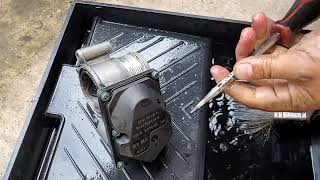
How to confirm: Remove the intake pipe connected to the throttle body. Visually inspect the throttle plate and the inside of the housing for a thick, black, tar-like substance. 🎬 Watch: Step-by-step guide to cleaning a carbon-fouled Tiguan throttle valve. The plate may feel sticky or difficult to move by hand.
Typical fix: Remove the throttle body from the vehicle (typically 3x T30 Torx bolts) and clean it thoroughly with dedicated throttle body cleaner and a soft brush/rag. Do not spray cleaner into the electronic connector. Also, clean the connecting intake pipe.
Est. part cost: $10-$25 for cleaner and a new gasket. - Failed Throttle Body Assembly 🟡 Medium Probability If cleaning does not resolve the issue, or the code returns after a short period, the internal electronic sensor or the motor that actuates the throttle plate has likely failed. The sensors are integrated into the assembly and cannot be replaced separately on this vehicle.
How to confirm: The code P0121 returns shortly after a thorough cleaning. A diagnostic scan tool (like VCDS) may show erratic voltage readings from the throttle position sensor that do not correspond to pedal input, or the adaptation procedure fails.
Typical fix: Replace the entire throttle body assembly. A Throttle Body Adaptation (TBA) procedure is required after installation using a compatible scan tool.
Est. part cost: $150-$500 - Wiring or Connector Issue ⚪ Low Probability The wiring harness to the throttle body can experience high resistance due to vibration and heat. VW has issued a Technical Service Bulletin (TSB 2018652 / 01-16-12) for this issue on related 2.0T engines, which involves repairing the wires near the connector.
How to confirm: Inspect the wiring harness and 6-pin connector going to the throttle body for any signs of damage, corrosion, or loose pins. With a scan tool, monitor TPS voltage while wiggling the harness; any jumps or dropouts indicate a wiring fault. A multimeter can be used to check for proper voltage and ground at the connector per the factory repair manual.
Typical fix: Repair the damaged section of the harness using a wire repair kit (do not use solder per VW TSB) or clean/replace the connector. The TSB specifies a procedure for crimping and heat-shrinking new wire sections.
Est. part cost: $20-$75 for a wiring repair kit.
Rare But Worth Checking
- Failed Engine Control Module (ECM): In very rare cases, the fault can be internal to the ECM itself. This should only be considered after all other possibilities (throttle body, wiring) have been exhaustively ruled out by a professional.
Diagnosis Steps

- Scan for Codes: Confirm P0121 is the primary code. Note any other codes that are present, such as P0221, P0122, or P0638, as they reinforce a throttle body issue.
- Visual Inspection: Check the wiring and 6-pin connector at the throttle body for obvious damage, corrosion, or chafing. Wiggle the connector and harness to see if it affects engine idle (if running).
- Inspect for Carbon Buildup: Remove the main intake hose from the throttle body. Use a light to inspect the throttle plate and housing for heavy carbon deposits. This is the most likely cause.
- Clean the Throttle Body: If dirty, disconnect the battery. Remove the throttle body (typically held by 3-4 T30 Torx bolts). Clean it thoroughly off the vehicle using a dedicated throttle body cleaner and a non-abrasive cloth or brush. Manually move the plate to clean all surfaces. Do not spray cleaner directly into the electronic components.
- Reinstall and Adapt: Reinstall the throttle body with a new gasket. Reconnect the battery. A Throttle Body Adaptation (TBA) is mandatory. This must be done with a compatible scan tool like VCDS or OBDeleven. Go to Engine (01) -> Basic Settings (04) -> Group 060 and activate. You will hear the throttle body cycle. A manual 'key on, wait 3 minutes' procedure is sometimes suggested online but is not the official or reliable method for these cars. 🎬 See how to perform a throttle body adaptation using VCDS.
- Test Drive: Clear the codes and test drive the vehicle. If the code does not return, the problem is solved.
- Check Sensor Readings (Advanced): If the code returns, use a scan tool to monitor the throttle position sensor voltage (MVB 062 on VCDS). If the readings are erratic, jumpy, or do not change smoothly as the pedal is pressed, the throttle body assembly has likely failed internally.
- Test Wiring Harness: If the code persists and sensor readings are erratic, perform the wiring checks outlined in VW TSB 2018652. This involves checking for high resistance in the wires between the ECM and the throttle body connector.
- Replace Throttle Body: If all other steps fail, replace the entire throttle body assembly and perform the TBA again.
Parts You'll Likely Need
- Throttle Body Assembly
(OEM #06F133062T)— This is the required part if cleaning fails, as the sensors are integrated and not sold separately. Common supersessions include 06F133062Q, 06F133062J, and 06F133062AG. Always verify with VIN.
Trusted brands: Bosch, VDO, Pierburg, Genuine Volkswagen
OEM price range: $450-$760
Aftermarket price range: $150-$350 - Throttle Body Gasket/Seal
(OEM #06F133073D)— This seal should always be replaced whenever the throttle body is removed for cleaning or replacement to prevent vacuum leaks.
Trusted brands: Elring, Victor Reinz, Genuine Volkswagen
OEM price range: $15-$25
Aftermarket price range: $5-$15
Related Codes That Often Appear With This One
- P0122 — This code indicates 'Throttle Position Sensor Signal Too Low', which can be caused by the same carbon buildup or wiring issues.
- P0221 — This code relates to the second throttle position sensor ('B' circuit). Since the throttle body has redundant sensors for safety, a problem affecting the throttle plate's movement can cause faults on both circuits.
- P0638 — Indicates 'Throttle Actuator Control Range/Performance'. This code often accompanies P0121 as it points to a general problem with the throttle body's ability to achieve the commanded position, which could be due to carbon restriction or a failing motor.
Technical Service Bulletins (TSBs) & Recalls
- VW TSB 2018652 (also referenced as 01-16-12 or 01-09-04): Addresses MIL on with P0121 and other throttle codes due to contact resistance in the wiring harness. It provides a procedure for repairing the wires near the throttle body connector. This TSB is critical if cleaning/replacing the throttle body does not solve the problem.
Platform-Specific Known Issues
- TDI vs TSI Engines: While both engine types are prone to this issue, the carbon buildup in the 2.0 TDI (diesel) can be particularly thick and stubborn due to the nature of diesel EGR systems. The fix (cleaning) is identical for both.
- Recurrence After Cleaning: Some owners report the P0121 code returning weeks or months after a cleaning. This often indicates the internal electronic potentiometers are failing and can no longer be compensated for by cleaning. In these cases, replacement of the throttle body assembly is the only permanent solution.
Mechanic-Grade Diagnostic Values
- VCDS Engine (01) -> Measuring Blocks (08) -> Group 062, Field 1 — expected: Should show a smooth percentage increase from ~12-16% at idle to ~85-90% at wide-open throttle (WOT) as accelerator is pressed.. Failure: Readings are erratic, jumpy, or do not correspond smoothly with pedal movement. This indicates a failing sensor (G187).
- VCDS Engine (01) -> Measuring Blocks (08) -> Group 062, Field 2 — expected: Should show a smooth percentage decrease from ~85-90% at idle to ~12-16% at WOT. This is the inverse reading of the primary sensor.. Failure: Readings are erratic or do not move inversely to Field 1. This indicates a failing sensor (G188).
- VCDS Engine (01) -> Measuring Blocks (08) -> Group 003, Field 1 — expected: At idle, with a warm engine and no accessories on, the throttle valve angle should be stable, typically between 1.0% and 5.0%.. Failure: The value fluctuates wildly at idle or is significantly higher than 5%, indicating the ECU is struggling to maintain a stable idle due to a sticking throttle plate or bad sensor.
- Battery Voltage — expected: At least 11.5V with key on, engine off.. Failure: Voltage below 11.5V can cause various electronic faults, including failed throttle body adaptations.
Scan Tool Commands That Help
- VCDS (VAG-COM): Engine (01) -> Basic Settings (04) -> Group 060 -> Go! — This is the mandatory Throttle Body Adaptation (TBA) procedure. It must be performed after cleaning, reinstalling, or replacing the throttle body to allow the ECU to relearn the sensor's end stops. Failure to perform this step will likely result in an erratic idle and the P0121 code returning.
Wiring & Ground Locations

- T6ae (Throttle Body Connector) — The 6-pin electrical connector on the throttle body assembly itself, located at the front of the engine.. This is the primary connection point. TSB 2018652 addresses high resistance in the wires leading to this connector, which can mimic a failed throttle body.
- Ground Point 12 — In the engine compartment, on the left side frame rail near the headlight.. This is a major ground point for the engine harness. A corroded or loose connection here can cause intermittent and difficult-to-diagnose electronic issues, including sensor performance codes.
- Ground Point 640 — A ground connection located in the left side of the engine compartment.. This is another key ground for engine electronics. Verifying it is clean and tight is a crucial step when diagnosing persistent electronic faults after parts have been replaced.
Real Owner Repair Stories
- Andrew Fixes (YouTube/Blog) (2012 VW Tiguan 2.0 TDI DSG 4Motion with ~83,000 miles) — P0121 code found during a scan for an unrelated issue. No check engine light was on yet, but the owner suspected it was imminent.
❌ Tried (didn't work) Directly proceeded to the most likely cause.
✅ What actually fixed it The throttle body was removed and found to be extremely caked with carbon. A thorough cleaning with Wynn's EGR cleaner and a new gasket resolved the code. The owner also reported significantly improved throttle response and fuel economy after the cleaning. - Ross-Tech Forums User (2013 VW Tiguan 2.0 TDI) — P0121 code, plus failure of the start/stop system (engine would not restart automatically in traffic).
❌ Tried (didn't work) A shop cleaned the heavily caked throttle body, which fixed the code and the start/stop issue temporarily.
✅ What actually fixed it The code returned after two months. The temporary fix from cleaning, followed by the code's return, strongly indicated that the electronic sensors within the throttle body assembly were failing. The final fix required replacing the entire throttle body assembly. - Reddit user on r/MechanicAdvice (2009 VW Tiguan) — P0121 'Throttle/ Pedal Position Sensor' error code.
❌ Tried (didn't work) The user first cleared the code.
✅ What actually fixed it The user inspected the throttle body and found it to be surprisingly clean. They wiped it down anyway, reinstalled it, and the code did not return. The user speculated that simply unplugging and reconnecting the electrical connector may have resolved a poor connection, rather than the cleaning itself.
"I Checked Everything" — The Actual Cause
- A smoke test is not applicable for this electronic/mechanical fault. The equivalent pattern is 'Cleaning the throttle body didn't work'. In these cases, the root cause is almost always either a failing electronic sensor inside the sealed throttle body unit (requiring replacement) or high resistance in the wiring harness as described in VW TSB 2018652. Technicians may replace a perfectly good throttle body if they don't perform the resistance checks on the harness first.
OEM Part Supersession History
06F133062J, 06F133062Q→06F133062T, 06F133062AG— Minor revisions to internal components, materials, or sensor tolerances by the manufacturer.
Heads up: These part numbers are generally cross-compatible for the 2.0TSI engine within this generation. However, always confirm the latest part number with a VIN at a dealership.1J0973713 (Throttle Body Connector Housing)→4H0973713 (Connector Housing), 000979025E (Repair Wires)— To resolve issues with high contact resistance as detailed in TSB 2018652.
Heads up: The TSB requires splicing in new wires and the updated connector housing; the old housing should not be reused.
Model Year Variations Within This Range
- 2007-2009 (approx.): Early Tiguans used the EA888 Gen 1 2.0T engine. While susceptible to P0121, this generation is also known for issues like excessive oil consumption due to piston ring design and a less robust PCV system.
- 2009-2017 (approx.): Later Tiguans in this range used the EA888 Gen 2 2.0T engine. This generation had a more significant and well-documented issue with timing chain tensioner failure, which is a critical maintenance item to be aware of on these vehicles. The carbon buildup leading to P0121 remains a common problem.
Diagnostic Flowchart
Used vs. New Parts: Buying Guide for This Vehicle
When a used part is the smart pick: A used throttle body can be a cost-effective way to diagnose the problem. If installing a used part and performing the adaptation resolves the code, it confirms the original unit's electronics have failed. However, due to the electronic components being a common failure point, a used part is a gamble for long-term reliability.
Donor-vehicle mileage cap: roughly under 60000 miles for the part to have meaningful remaining life.
What to inspect on the donor part:
- Check the throttle plate and bore for scoring or damage; some carbon is expected and can be cleaned.
- Ensure the electrical connector pins are straight, clean, and free of corrosion.
- Ask for the donor vehicle's mileage. A lower-mileage part has a better chance of having healthy internal electronics.
- Avoid parts from vehicles with known electrical issues or flood damage.
OEM-only on this vehicle (don't cheap out):
- While the throttle body itself has good aftermarket options, the specific wire repair kit for TSB 2018652 should be sourced from VW or an OEM supplier to ensure correct wire gauge and connector quality.
Aftermarket brands forum-validated for this vehicle:
- Bosch (often the original OEM supplier)
- VDO
- Pierburg
Brands owners have reported issues with on this vehicle:
- Unbranded, no-name parts from online marketplaces are a significant risk. They often have poorly calibrated internal sensors that can fail adaptation or cause erratic performance, even when new.
Real Owner Stories
Aggregated from forums and TSBs cited above. Mileages and costs reflect what owners reported in those sources.
2013 VW Tiguan TDI
Symptoms: The P0121 code returned after cleaning the throttle body, and the automatic Start/Stop system was also failing.
What fixed it: Cleaning the throttle body only provided a temporary fix, indicating a deeper issue with the assembly.
Source hint: Ross-Tech Forums - 2013 VW Tiguan P0121/EGR Problems
2012 VW Tiguan 2.0 TDI
Symptoms: Check Engine Light and EPC light were on, and the vehicle entered 'limp mode' with drastically reduced engine power.
What fixed it: The issue was resolved by removing the throttle body (using a T30 Torx bit) and thoroughly cleaning the heavy carbon buildup from the throttle plate and housing.
Source hint: AndrewFixes.com - P0121 VW Tiguan 2.0 TDi - Throttle Valve Cleaning
Volkswagen Tiguan
Symptoms: The P0121 code would return weeks or months after the throttle body was cleaned.
What fixed it: The only permanent solution was the complete replacement of the throttle body assembly, as the internal electronic potentiometers were failing.
Source hint: vehicle_specific_issues section: Recurrence After Cleaning
Related OBD-II Codes
Frequently Asked Questions
I cleaned the throttle body on my Tiguan, but the P0121 code came back. What should I do next?
Is there a TSB for the P0121 code on my 2.0T Tiguan?
Do I need a special tool to reset the computer after cleaning or replacing the throttle body?
My Tiguan is a TDI diesel. Is the P0121 fix different than for the TSI gas engine?
My automatic Start/Stop system isn't working and I have a P0121 code. Are these problems related?
The TSB for my Tiguan says to repair the wiring. Can I just solder the broken wire?
Helpful Videos

We Have This Part in Stock


The information in this article is provided for general reference and educational purposes only. Vehicle specifications, procedures, and part compatibility can vary by production date, trim level, and region. Always consult your vehicle's factory service manual and verify part numbers before purchasing or performing repairs. Safety-critical components such as airbags, seat belts, and braking systems should be installed by a qualified professional.
- Volkswagen Tiguan:
- 🎬 Helpful Videos
- 🛍️ Shop This Part
- What's Unique About the 2007-2017 Volkswagen Tiguan
- Symptoms You May Notice
- Most Likely Causes
- Rare But Worth Checking
- Diagnosis Steps
- Parts You'll Likely Need
- Related Codes That Often Appear With This One
- Technical Service Bulletins (TSBs) & Recalls
- Platform-Specific Known Issues
- Mechanic-Grade Diagnostic Values
- Scan Tool Commands That Help
- Wiring & Ground Locations
- Real Owner Repair Stories
- "I Checked Everything" — The Actual Cause
- OEM Part Supersession History
- Model Year Variations Within This Range
- Diagnostic Flowchart
- Used vs. New Parts: Buying Guide for This Vehicle
- Real Owner Stories
- 2013 VW Tiguan TDI
- 2012 VW Tiguan 2.0 TDI
- Volkswagen Tiguan
- Related OBD-II Codes
- Frequently Asked Questions
- 🎟️ Get 5% Off