

P0121 on 2010-2012 Audi A3 1.2 TSI: Throttle Body Causes and Fixes
For the Audi A3 with a 1.2 TSI engine (CBZB), code P0121 almost always points to an issue with the Magneti Marelli throttle body. The most common and cheapest first step is to thoroughly clean the throttle body of carbon buildup, which can restrict the throttle plate's movement. If cleaning fails, the entire throttle body assembly likely needs replacement, followed by a mandatory software adaptation using a tool like VCDS.
- P0121 on an A3 1.2 TSI is a throttle body problem, not a pedal sensor problem.
- The first and most likely fix is to remove and thoroughly clean the throttle body of carbon buildup.
- A Throttle Body Adaptation (TBA) with a diagnostic tool like VCDS is mandatory after cleaning or replacing the part.
- If cleaning fails, the entire throttle body assembly must be replaced; the sensors are integrated and cannot be bought separately.
- Driving with this fault is risky due to the potential for sudden power loss or stalling.
What's Unique About the 2003-2012 Audi A3

The Audi A3 8P generation with the 1.2 TSI engine (engine code CBZB, typically 2010-2012 models) uses a specific Magneti Marelli electronic throttle body (Part No. 03F133062B) that is a known common failure point across the entire VAG lineup, including VW, Skoda, and Seat models with the same engine. Unlike some vehicles where the sensor is a separate part, on this engine, the entire throttle body assembly is the component that needs to be addressed. This code is frequently seen with other throttle-related faults like P0221 (referring to the secondary sensor G188), P0222, and P0638, all pointing back to this specific component.
Generation note: The 2003-2012 year range covers the entire second generation (8P) of the Audi A3. However, the 1.2 TSI engine (engine code CBZB) was only offered in the later facelifted models, approximately from 2010 to 2012. This guide is specific to those models with the 1.2 TSI engine, but the same issue affects other VAG vehicles with this engine.
Symptoms You May Notice
- Check Engine Light and/or EPC (Electronic Power Control) light is on.
- Vehicle enters 'limp mode' with significantly reduced engine power.
- Hesitation or sluggish acceleration.
- Engine runs rough or has an unstable idle.
- Engine stalls, especially at low speeds.
- No response or delayed response from the accelerator pedal.
- Car shakes or judders, especially when holding a steady speed.
- Black smoke from the exhaust during acceleration.
- Replacing the accelerator pedal position sensor. While the code definition can include 'Pedal Position Sensor', on this platform, P0121 is almost always related to the throttle body at the engine, not the pedal in the cabin.
Most Likely Causes

- Dirty Throttle Body 🔴 High Probability Direct injection engines like the 1.2 TSI are prone to carbon and oil vapor buildup in the intake system from the EGR and PCV systems. This grime can form a sticky ring around the throttle plate, restricting its movement and causing its actual position to differ from what the ECM expects, triggering a range/performance fault.
How to confirm: Remove the intake hose connected to the throttle body and visually inspect for a thick layer of black carbon soot around the throttle plate and bore. The plate may feel sticky or slow to move when pushed manually (with the ignition off).
Typical fix: Remove the throttle body and clean it thoroughly with a dedicated throttle body cleaner and a soft cloth or brush until all carbon is removed. 🎬 Watch: How to clean and repair a VAG throttle body. Pay special attention to the edges of the plate and the bore. A throttle body adaptation must be performed after reinstallation using a diagnostic tool.
Est. part cost: $10-$20 - Faulty Throttle Body Assembly 🟡 Medium Probability The Magneti Marelli throttle bodies (03F133062B) used on this engine are a known failure point; the internal electronic sensors or the plastic gears for the motor can wear out or fail over time, leading to implausible signals. A common internal failure point is the breaking of thin wires connecting the external plug to the internal circuit board. 🎬 Watch: How to repair the internal wiring for free.
How to confirm: If a thorough cleaning and adaptation does not resolve the code and symptoms, the throttle body itself is the likely culprit. A diagnostic tool can be used to monitor the voltage output from sensors G69 and G188; erratic or non-linear readings during throttle operation confirm internal failure. If the sensor values in VCDS measuring block 062 do not change at all when pressing the accelerator (with key on, engine off), it points to an internal electronic failure.
Typical fix: Replace the entire throttle body assembly. This is a direct bolt-on replacement. A throttle body adaptation is required after installation for the ECM to learn the new sensor's positions.
Est. part cost: $100-$250 - Wiring or Connector Issue ⚪ Low Probability Engine vibrations and heat can cause wires to fray or the pins in the 6-pin connector to develop high resistance or become loose over time. There is an Audi TSB (01-09-04 or 2018652) for other engines that addresses this exact issue by repairing the wiring terminals at the throttle body connector, indicating it's a known VAG problem area.
How to confirm: Visually inspect the wiring harness and the 6-pin connector going to the throttle body for any signs of damage, corrosion, or loose connections. Wiggle the connector with the engine running to see if it affects the idle or triggers the fault.
Typical fix: Repair the damaged section of wire or replace the connector terminals. The TSB suggests using specific wiring repair kits. Cleaning corroded pins with contact cleaner may also work as a temporary fix.
Est. part cost: $5-$50
Rare But Worth Checking
- Faulty Engine Control Module (ECM): This is very rare. The ECM should only be considered after all other possibilities, including the throttle body and wiring, have been exhaustively tested and ruled out. Sometimes an ECM software update is available from the dealer which can address sensitivity to this fault, especially in cold weather.
Diagnosis Steps

- Scan the ECM for fault codes to confirm P0121 and check for any other related codes like P0221, P0222, or P0638.
- Disconnect the negative battery terminal to ensure safety.
- Remove the air intake ducting to access the throttle body, which is located at the front of the engine.
- Disconnect the 6-pin electrical connector and inspect it for corrosion, moisture, or damaged pins.
- Remove the four bolts holding the throttle body to the intake manifold.
- Thoroughly clean the throttle plate and bore using a dedicated throttle body cleaner and a soft, non-abrasive cloth until all black carbon is removed. Do not spray cleaner directly into the electronic components.
- Reinstall the clean throttle body and reconnect all hoses and the electrical connector.
- Reconnect the battery.
- Perform a Throttle Body Adaptation (TBA). This is a critical step. Using a tool like VCDS, go to Engine -> Basic Settings -> Group 060 and activate. You will hear the throttle body cycle as it relearns its end stops. This procedure requires the engine to be off, ignition on, battery voltage >11.5V, and coolant temp between 5-95°C.
- Clear all fault codes and start the engine. Go for a test drive to see if the symptoms and fault code return.
- If the code returns after a proper cleaning and adaptation, the throttle body assembly is faulty and needs to be replaced with a new unit (e.g., part 03F133062B).
Parts You'll Likely Need

- Throttle Body Assembly
(OEM #03F133062B)— This is the primary cause of code P0121 if cleaning does not work. The internal sensors are not sold separately. This part is shared across many VW, Seat, and Skoda models with the 1.2 TSI engine.
Trusted brands: VDO (OEM), Bosch, Magneti Marelli (Original Manufacturer), Vemo, Metzger
OEM price range: $200-$350
Aftermarket price range: $90-$180 - Throttle Body Cleaner — Required for the most common and first-step fix: cleaning the existing throttle body of performance-inhibiting carbon buildup.
Trusted brands: CRC, Liqui Moly, WD-40 Specialist
Aftermarket price range: $10-$20 - Throttle Body Gasket/Seal
(OEM #03F133073)— It is best practice to replace the gasket between the throttle body and the intake manifold to prevent vacuum leaks after removal and reinstallation. Some new throttle bodies may not include it.
Trusted brands: Elring, Victor Reinz, Genuine VW/Audi
OEM price range: $10-$15
Aftermarket price range: $5-$10
Related Codes That Often Appear With This One
- P0221 — This code refers to the 'B' circuit (Sensor G188) of the throttle position sensor. Since the throttle body has two redundant sensors for safety, a fault in one (P0121) often triggers a corresponding implausibility fault in the other.
- P0638 — This code indicates a fault with the throttle actuator control. It is often set alongside P0121 because the ECM cannot control the throttle plate correctly if it's receiving implausible position data from the sensors.
- P0222 — This code means the signal from the secondary throttle position sensor (G188) is too weak or low. It frequently appears with P0121 when the entire throttle body unit is failing electronically.
Technical Service Bulletins (TSBs) & Recalls
- Audi TSB 01-09-04 / 2018652: While not for the 1.2 TSI specifically, this TSB for other VW/Audi engines with FSI/TFSI technology recommends a wiring repair at the throttle body connector to resolve P0121, indicating a known wiring vulnerability in this area.
Platform-Specific Known Issues
- Intermittent Fault After Clearing: Many owners report that after clearing the P0121 code, the car may drive fine for a short period (e.g., a few miles) before the EPC light and symptoms return, especially after the engine warms up. This intermittent behavior strongly points to a component at the edge of its operating tolerance, such as a dirty or failing throttle body, rather than a hard electrical failure.
Mechanic-Grade Diagnostic Values
- VCDS Measuring Block 062, Field 1 (Throttle Valve Sensor 1, G187/G69) — expected: Should be low at rest (5-15%) and increase smoothly towards 90-95% as the accelerator is pressed (Key On, Engine Off).. Failure: Values are frozen, jump erratically, or do not change when the pedal is pressed.
- VCDS Measuring Block 062, Field 2 (Throttle Valve Sensor 2, G188) — expected: Should be high at rest (80-95%) and decrease smoothly towards 5-15% as the accelerator is pressed. It should move opposite to Sensor 1.. Failure: Values are frozen, jump erratically, or do not change when the pedal is pressed.
- Throttle Position Sensor Signal Voltage (at sensor connector) — expected: Approximately 0.5V - 0.7V at idle (throttle closed) and increasing smoothly to ~4.5V at wide-open throttle.. Failure: Voltage is outside the expected range, shows sudden spikes or dropouts, or doesn't change with throttle movement.
- 5V Reference Voltage (at sensor connector) — expected: A constant ~5V with the ignition on.. Failure: Voltage is significantly lower than 5V or is absent, indicating a wiring issue or a fault in the ECM.
Scan Tool Commands That Help
- VCDS (VAG-COM): Basic Settings - Group 060 (Throttle Body Adaptation) — This is a mandatory procedure after cleaning or replacing the throttle body. It allows the ECM to relearn the closed, open, and partial-load positions of the new or cleaned throttle plate. Failure to perform this step will likely cause the P0121 code to return immediately.
- VCDS (VAG-COM): Measuring Blocks - Group 062 (Throttle Sensor Live Data) — Used during diagnosis to observe the real-time percentage readings of the two internal throttle position sensors (G69 and G188). Graphing these values is the best way to spot glitches, freezes, or non-linear responses that confirm an electronic failure within the throttle body.
Wiring & Ground Locations
- Throttle Body Connector (T6k) — A 6-pin electrical connector plugged directly into the throttle body assembly at the front of the engine.. This is the single point of connection for the throttle motor and both position sensors. Corrosion, loose pins, or wire damage right at the connector are common causes of intermittent P0121 faults.
- ECM Ground Point — On the left-hand side of the engine bay, near the strut tower, there is a primary grounding stud where multiple brown wires are attached. The ECM is one of the components grounded here.. A poor ground connection at this point can cause floating voltages and erratic signals for all engine sensors, including the throttle position sensors, leading to a range of performance codes like P0121.
Real Owner Repair Stories
- YouTube channel Southside_Streetcars (VW Polo with 1.2 TSI engine (same CBZB engine and throttle body as the Audi A3)) — EPC light on, car going into limp mode, fault codes for the throttle body.
❌ Tried (didn't work) Swapping with a known-good throttle body confirmed the original unit was faulty.
✅ What actually fixed it The owner opened the sealed electronic side cover of the Magneti Marelli throttle body and found that four thin wires connecting the main plug to the internal circuit board had broken off. He re-soldered the broken wires, sealed the unit, and reinstalled it, which permanently fixed the fault codes and drivability issues. - BRISKODA forum user (2012 Skoda Fabia 1.2 TSI (CBZB engine)) — EPC warning light, car enters limp-home mode, fault code P334B (related to turbo actuator position sensor).
❌ Tried (didn't work) Initial diagnosis pointed towards throttle issues due to limp mode.
✅ What actually fixed it The actual cause was a known issue with the turbo wastegate actuator. The fix, per a technical service bulletin, was to fit a 2mm shim between the wastegate actuator and the turbo body, followed by an ECU software update to calibrate the new actuator position. This highlights that limp mode can be caused by non-throttle components.
OEM Part Supersession History
03F133062→03F133062B, 03F133062C— Likely internal revisions to improve the reliability of the electronic components that were a common failure point.
Heads up: Part numbers 03F133062B and 03F133062C are generally interchangeable for this application.
Diagnostic Flowchart
Used vs. New Parts: Buying Guide for This Vehicle
When a used part is the smart pick: A used throttle body is a high-risk, budget-only option for this specific repair. Given that the electronic sensors and internal wiring are the known primary failure points, a used part from a donor vehicle carries a significant risk of having the same fault or failing shortly after installation. It should only be considered if the cost of a new part is prohibitive and the donor part can be tested or comes with a warranty.
Donor-vehicle mileage cap: roughly under 80000 miles for the part to have meaningful remaining life.
What to inspect on the donor part:
- Check for minimal carbon buildup inside the throttle bore; excessive grime may suggest a poorly maintained engine.
- Inspect the 6-pin connector for any signs of corrosion, bent pins, or cracks in the plastic housing.
- If possible, ask the seller if the part was tested or if the donor car had any EPC light or running issues.
- Avoid parts that show signs of having been opened or tampered with (e.g., pry marks on the black plastic cover).
Aftermarket brands forum-validated for this vehicle:
- Magneti Marelli (this is the Original Manufacturer)
- VDO (often an OEM supplier for VAG)
- Bosch
Brands owners have reported issues with on this vehicle:
- Unbranded, no-name parts from online marketplaces should be avoided. They often have lower quality electronic components that can fail prematurely or not calibrate correctly during the adaptation procedure.
Real Owner Stories
Aggregated from forums and TSBs cited above. Mileages and costs reflect what owners reported in those sources.
Skoda Fabia 1.2 TSI
Symptoms: The EPC light came on and the car went into limp mode. The cause was excessive gunk from the EGR system clogging the throttle body.
What fixed it: The throttle body assembly had to be replaced entirely, as the buildup had likely damaged the internal plastic gears over time.
Source hint: BRISKODA.net
Seat Ibiza 1.2 TSI
Symptoms: The car threw multiple codes (P0121, P0221, P2101) and entered limp mode with reduced power.
What fixed it: A thorough cleaning of the throttle body and bore, followed by a throttle body adaptation, resolved all codes and symptoms.
Source hint: SEATCupra.net
Audi A3 1.2 TSI
Symptoms: The car would shake and judder when trying to hold a steady speed. Wiggling the electrical connector on the throttle body would cause the idle to fluctuate.
What fixed it: The pins in the 6-pin connector were corroded. Cleaning the pins with electrical contact cleaner restored a solid connection and fixed the issue.
Source hint: Audi TSB 01-09-04 / 2018652
Audi A3 1.2 TSI
Symptoms: After clearing the P0121 code, the car would drive normally for a few miles, but the EPC light and limp mode would always return once the engine fully warmed up.
What fixed it: This intermittent fault was caused by a dirty throttle body at the edge of its operating tolerance. A full cleaning and adaptation procedure provided a permanent fix.
Source hint: vehicle_specific_issues
Related OBD-II Codes
Frequently Asked Questions
I cleaned my A3's throttle body, but the P0121 code and EPC light came back. What did I miss?
Is the P0121 throttle body issue common on other cars besides the Audi A3?
My car is in 'limp mode' with the EPC light on. Is it safe to drive?
I heard there's a TSB for a wiring issue causing P0121. Does it apply to my 1.2 TSI?
What is the part number for the throttle body on my 1.2 TSI A3 and what should it cost?
My car drives fine for a few miles after I clear the code, then the EPC light comes back. What does that mean?
Helpful Videos



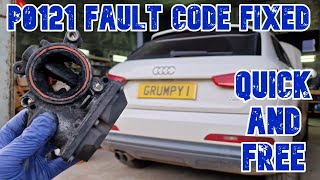
We Have This Part in Stock


The information in this article is provided for general reference and educational purposes only. Vehicle specifications, procedures, and part compatibility can vary by production date, trim level, and region. Always consult your vehicle's factory service manual and verify part numbers before purchasing or performing repairs. Safety-critical components such as airbags, seat belts, and braking systems should be installed by a qualified professional.
- Audi A3:
- 🎬 Helpful Videos
- 🛍️ Shop This Part
- What's Unique About the 2003-2012 Audi A3
- Symptoms You May Notice
- Most Likely Causes
- Rare But Worth Checking
- Diagnosis Steps
- Parts You'll Likely Need
- Related Codes That Often Appear With This One
- Technical Service Bulletins (TSBs) & Recalls
- Platform-Specific Known Issues
- Mechanic-Grade Diagnostic Values
- Scan Tool Commands That Help
- Wiring & Ground Locations
- Real Owner Repair Stories
- OEM Part Supersession History
- Diagnostic Flowchart
- Used vs. New Parts: Buying Guide for This Vehicle
- Real Owner Stories
- Skoda Fabia 1.2 TSI
- Seat Ibiza 1.2 TSI
- Audi A3 1.2 TSI
- Audi A3 1.2 TSI
- Related OBD-II Codes
- Frequently Asked Questions
- 🎟️ Get 5% Off