

P0118 on 2018-2025 Mazda CX-5: Engine Coolant Temp Sensor Causes and Fixes
P0118 on your CX-5 almost always means the Engine Coolant Temperature (ECT) sensor has failed or its wiring is damaged. This is an electrical fault, not the common thermostat issue. The PCM sees a high voltage/open circuit, thinks the engine is at -40°F, and enriches the fuel mixture. Expect to pay $60-$90 for an OEM sensor and 1-2 hours of labor due to difficult access on the cylinder head.
- P0118 is an electrical fault, most likely a bad Engine Coolant Temperature (ECT) sensor or its wiring.
- Do not confuse this code with the very common mechanical thermostat failure (P0126) on the same vehicle.
- Diagnosis involves checking live scan tool data and testing the sensor's resistance with a multimeter.
- The sensor is located on the cylinder head and can be difficult to access, requiring 1-2 hours of labor.
- Using a genuine OEM Mazda sensor (SH01-18-840) is highly recommended to ensure a lasting repair.
What's Unique About the 2018-2025 Mazda CX-5
On the 2018-2025 Mazda CX-5, this code is often confused with a much more common platform issue: a failing thermostat within the Coolant Control Valve, which triggers code P0126 and has an extended warranty (SSPD8). It is critical to understand that P0118 is an *electrical circuit* problem (bad sensor, bad wiring), while P0126 is a *mechanical* problem (stuck thermostat). While symptoms can overlap (e.g., constant fan operation), the diagnostic paths are completely different. Do not replace the thermostat for a P0118 code unless P0126 is also present and diagnosed separately.
Symptoms You May Notice
- Check Engine Light is on
- Engine is difficult to start, especially when cold
- Rough or unstable idle
- Noticeably reduced fuel economy
- Black smoke from the exhaust, especially on startup
- Cooling fans run constantly, even when the engine is cold
- Temperature gauge on the dashboard may drop to its lowest reading or not move at all
- Engine may hesitate until it warms up
- Replacing the thermostat. A very common issue on these CX-5s is a stuck-open thermostat, which sets a P0126 code and has an extended warranty (SSPD8). However, a P0118 code points specifically to an electrical fault in the ECT sensor circuit (open circuit/high voltage), not a mechanical thermostat problem.
Most Likely Causes
- Failed Engine Coolant Temperature (ECT) Sensor 🔴 High Probability The sensor is a common failure point across many vehicles as it ages. It contains a Negative Temperature Coefficient (NTC) thermistor that can fail internally, creating an open circuit which the PCM reads as maximum high voltage.
How to confirm: With the engine cold, use a scan tool to read live data. If the ECT sensor shows an extremely low temperature (e.g., -40°F) while the ambient and intake air temperatures are much higher, the sensor or its circuit is faulty. You can also test the sensor's internal resistance with a multimeter. Per Mazda service data, it should be approximately 2.45 kΩ at 20°C (68°F) and 0.318 kΩ at 80°C (176°F). An open circuit (infinite resistance) confirms failure.
Typical fix: Replace the Engine Coolant Temperature sensor.
Est. part cost: $60-$90 - Damaged Wiring or Connector 🟡 Medium Probability The wiring harness is subject to engine heat and vibration, which can cause wires to become brittle and break over time. Rodent damage is also a known possibility, with owners finding wires chewed right at the sensor connector.
How to confirm: Visually inspect the wiring leading to the ECT sensor for any signs of breaks, chafing, or corrosion at the connector pins. Perform a 'wiggle test' on the harness while watching live data on a scan tool; if the temperature reading flickers, it indicates a wiring issue. If wires are broken, you will need to repair them with a new pigtail connector and heat-shrink butt connectors.
Typical fix: Repair the broken wire or replace the connector pigtail.
Est. part cost: $15-$30
Rare But Worth Checking
- Faulty Powertrain Control Module (PCM): This is extremely rare. The PCM should only be considered after the sensor and its entire circuit (power, ground, and signal wires) have been thoroughly tested and confirmed to be in perfect working order.
Diagnosis Steps
- Verify the P0118 code with an OBD-II scanner. Note any other codes present.
- Access the 'Live Data' stream on your scanner. With a cold engine, compare the Engine Coolant Temperature (ECT) reading to the Intake Air Temperature (IAT) and Ambient Air Temperature. If IAT and Ambient are 70°F and ECT reads -40°F, you have confirmed the fault lies with the ECT circuit.
- Turn the engine off. Locate the ECT sensor. On SKYACTIV engines, it is screwed into the cylinder head. Access requires disconnecting the battery, removing the engine cover, and potentially other components like the air intake box.
- Inspect the sensor's electrical connector and wiring for visible damage, corrosion, or loose pins. Check for rodent damage, which is a known issue.
- Disconnect the sensor. Check for 5-volt reference and a good ground at the connector terminals using a multimeter. If either is missing, you have a wiring problem to trace back to the PCM.
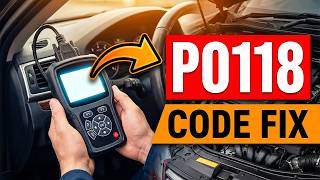
- If the wiring is good, test the sensor itself. Measure the resistance across the two pins of the sensor. A P0118 code is usually caused by an open circuit, so you will likely see infinite resistance (OL). Compare your reading to specifications: approx. 2.45 kΩ at 20°C (68°F). If the resistance is infinite or far from spec, the sensor is bad. 🎬 See how to test and fix a P0118 code step-by-step
- If replacing the sensor, you must partially drain the engine coolant first. Be prepared to top off and bleed the system afterward.
- If the sensor and wiring test good, the fault may be intermittent or, in very rare cases, with the PCM itself.
Parts You'll Likely Need
- Engine Coolant Temperature Sensor
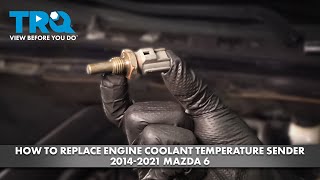
(OEM #SH01-18-840)— This is the most common cause for a P0118 code, as the internal thermistor fails and creates an open circuit. This part number is used across many Mazda models. 🎬 Watch: How to replace the coolant temperature sensor on a Mazda
Trusted brands: Mazda (OEM), NGK/NTK, Denso
OEM price range: $60-$90
Aftermarket price range: $25-$50
Technical Service Bulletins (TSBs) & Recalls
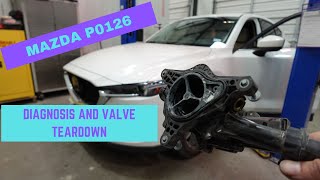
- SSPD8 / TSB 01-005/24 - While not for P0118, this extended warranty and associated TSB for code P0126 (Insufficient Coolant Temperature) is a critical piece of related information for anyone diagnosing cooling system issues on this vehicle. The TSB outlines the repair for the stuck thermostat. 🎬 Watch this Mazda P0126 diagnosis and coolant control valve teardown video
Platform-Specific Known Issues
- Warranty Extension for P0126: Mazda has issued a Special Service Program (SSPD8) that extends the warranty for a failing thermostat (part of the Coolant Control Valve) to 15 years or 150,000 miles for many 2018-2025 CX-5s. This issue causes code P0126, not P0118, but the symptoms can be similar (slow engine warm-up, fluctuating temp gauge). It is crucial to diagnose the code correctly before replacing parts. The latest fix involves replacing the thermostat with a 'dummy plug' and a PCM software update.
Mechanic-Grade Diagnostic Values
- ECT Sensor Resistance (ECT1 & ECT2) — expected: Approx. 2.45 kΩ at 20°C (68°F) and approx. 0.318 kΩ at 80°C (176°F).. Failure: Infinite resistance (Open Loop) is the most common failure for P0118. Any reading significantly outside the expected range for a given temperature indicates a faulty sensor.
- ECT Sensor Signal Voltage vs. Temperature — expected: Voltage should correspond to temperature: 4.84V ≈ -40°C, 3.10V ≈ 20°C, 2.17V ≈ 40°C, 0.87V ≈ 80°C, 0.55V ≈ 100°C.. Failure: A reading stuck near 5V (typically 4.8V or higher) indicates an open circuit, triggering P0118.
- ECT Sensor Connector Voltage (KOEO) — expected: With sensor disconnected, one pin should show ~5V (reference from PCM) and the other should show near 0V (ground).. Failure: Missing 5V reference or ground indicates a wiring issue between the connector and the PCM. Voltage on both pins or 12V on the reference pin indicates a short circuit.
Scan Tool Commands That Help
- Mazda Modular Diagnostic System (M-MDS): Datalogger - Live Data PID Comparison — During a cold soak (engine off overnight), use the M-MDS to compare the PIDs for 'ECT' (Engine Coolant Temp 1), 'ECT2_V' (Engine Coolant Temp 2 Voltage), and 'AMB_TEMP' (Ambient Air Temp). All three should read nearly identically. A significant deviation in the ECT reading points directly to a fault in that sensor's circuit.
Wiring & Ground Locations
- Engine/Transmission Ground Strap — A primary ground strap connects from the negative battery terminal to a bracket on top of the transmission housing.. A loose or corroded main ground can cause floating voltages and erratic sensor readings across the engine, including for the ECT sensor. While not a direct cause of a specific P0118 open circuit, it should be checked for any electrical fault diagnosis.
- Chassis Ground Point — On the first-generation CX-5 (similar architecture), a ground wire bundle is located below the battery tray, attaching to the chassis near the driver's side engine mount bracket.. The ECT sensor's ground path eventually leads back to the PCM, which relies on clean chassis and engine grounds. A user on a forum found this ground dangling after a previous repair, which can cause unpredictable electrical issues.
Real Owner Repair Stories
- Mazdaspeeds.org user 'Sleepy_Pat' (Mazdaspeed (similar engine management principles)) — Engine revving on its own, coolant temp reading negative for a split second, traction control light on, codes P0126 & P0118.
❌ Tried (didn't work) The user had previously replaced the ECT sensor but the problem persisted and was intermittent.
✅ What actually fixed it The user discovered the replacement ECT sensor they had installed was not a genuine OEM part. After installing a new, genuine OEM Mazda ECT sensor, all codes (including P0118) and symptoms were resolved. They noted a visible physical difference between the aftermarket and OEM sensors. - Mazdas247 forum user 'Jmaz' (2014 CX-5 Touring) — P011A code (for ECT2), dashboard says overheating, scan tool shows 250°F.
❌ Tried (didn't work) An initial replacement of the ECT sensor did not fix the problem.
✅ What actually fixed it The first replacement sensor was also defective. A second, good quality (implied OEM) sensor resolved the issue. Another user in the thread commented, 'It's best to use OEM factory sensors... the aftermarket sensors can be a crapshoot.'
OEM Part Supersession History
SH01-18-840→SH01-18-840— No supersession found for this model range.
Heads up: The key issue is not supersession but incompatibility with non-OEM parts. Multiple owner reports confirm that aftermarket sensors, even when new, can fail to resolve the P0118 code. Sticking with the genuine Mazda part is critical for this repair.
Model Year Variations Within This Range
- 2018-2025: The Mazda CX-5 received a mid-cycle refresh for the 2022 model year, which included revised styling, standard AWD, and suspension tuning. However, the core 2.5L and 2.5L Turbo engines were retained, and there is no evidence that the ECT sensor (part SH01-18-840) or the diagnostic procedure for P0118 was changed.
Diagnostic Flowchart
Other Known Issues on This Vehicle
Issues unrelated to this code that are worth knowing about as an owner of this generation:
- Cracked Cylinder Head (2.5L NA & Turbo) 🔴 High — A known issue affecting 2018-2021 models. Non-turbo engines with cylinder deactivation may leak oil externally. Turbo engines may develop coolant leaks near the exhaust manifold. (Ref: TSB SA-031-21 (for NA oil leak), Warranty Extension for 2.5T models (10yr/120k miles).)
- Failing Coolant Control Valve Thermostat (P0126) 🟠 Medium — Very common on non-turbo 2018-2025 models. The internal failsafe thermostat sticks open, preventing the engine from warming up properly. (Ref: SSPD8 (Warranty Extension to 15 years/150,000 miles), TSB 01-005/24 (Repair Procedure).)
- Infotainment 'Ghost Touch' 🟡 Low — Common on 2017-2020 models. The touchscreen registers phantom inputs, causing random menu selections and calls. Many owners disable the touchscreen by disconnecting a ribbon cable. (Ref: SSPB6 (for Mazda3, but not officially for CX-5, though the issue is identical).)
- Poor Paint Quality 🟡 Low — Widespread owner complaint, especially regarding Mazda's 'Soul Red Crystal' color. The paint is reported to be thin and chips very easily from road debris.
- Failing Power Folding Side Mirrors 🟡 Low — Reported by some owners where the power-folding mechanism fails, often on the passenger side, due to moisture intrusion and corrosion. (Ref: A TSB exists that details the replacement of faulty parts and adding moisture protection.)
Used vs. New Parts: Buying Guide for This Vehicle
When a used part is the smart pick: Never. The ECT sensor is a low-cost wear item. The labor to replace it is significant enough that installing a used sensor with unknown remaining life is a poor economic choice. The risk of getting a part that is already failing is high.
What to inspect on the donor part:
- Not applicable as used parts are not recommended.
OEM-only on this vehicle (don't cheap out):
- Engine Coolant Temperature Sensor (ECT)
Aftermarket brands forum-validated for this vehicle:
- Denso
- NGK/NTK
Brands owners have reported issues with on this vehicle:
- Unbranded or generic 'white-box' parts. Forum reports strongly indicate that using anything other than the genuine Mazda part or a direct OEM equivalent (like Denso) is likely to result in the code returning.
Real Owner Stories
Aggregated from forums and TSBs cited above. Mileages and costs reflect what owners reported in those sources.
2018-2025 Mazda CX-5 SKYACTIV-G
Symptoms: The owner found the P0118 code triggered because rodents had chewed the wires directly off the Engine Coolant Temperature (ECT) sensor connector.
What fixed it: The repair required splicing in a new pigtail connector with heat-shrink butt connectors to restore the circuit.
Source hint: YouTube - 'Engine Coolant Temperature Sensor Connector Repair and Replace #P0118 #diy'
2018-2025 Mazda CX-5 2.5L Non-Turbo
Symptoms: Slow engine warm-up and a fluctuating temperature gauge; symptoms similar to cooling system failure but specifically throwing code P0126.
What fixed it: Replacing the thermostat with a 'dummy plug' and performing a PCM software update as part of the permanent fix.
Source hint: Reddit r/CX5 - 'SSPD8 Warranty Extension/P0126 - Coolant Control Valve (CCV) - New Permanent Fix'
Related OBD-II Codes
Frequently Asked Questions
My 2018 CX-5 has a temperature gauge that won't move and a P0118 code; is this covered by the SSPD8 warranty extension?
Where is the ECT sensor located on my SKYACTIV-G engine?
What resistance should I see when testing the Mazda CX-5 ECT sensor with a multimeter?
I found chewed wires near my coolant sensor; is this a known issue for the CX-5?
Does the P0118 code affect other Mazda models with the 2.5L engine?
Why are my cooling fans running constantly even though I just started the car cold?
Helpful Videos
Used OEM Parts in Stock

New Aftermarket Parts Available


The information in this article is provided for general reference and educational purposes only. Vehicle specifications, procedures, and part compatibility can vary by production date, trim level, and region. Always consult your vehicle's factory service manual and verify part numbers before purchasing or performing repairs. Safety-critical components such as airbags, seat belts, and braking systems should be installed by a qualified professional.
- Mazda CX-5:
- 🎬 Helpful Videos
- 🛍️ Shop This Part
- What's Unique About the 2018-2025 Mazda CX-5
- Symptoms You May Notice
- Most Likely Causes
- Rare But Worth Checking
- Diagnosis Steps
- Parts You'll Likely Need
- Technical Service Bulletins (TSBs) & Recalls
- Platform-Specific Known Issues
- Mechanic-Grade Diagnostic Values
- Scan Tool Commands That Help
- Wiring & Ground Locations
- Real Owner Repair Stories
- OEM Part Supersession History
- Model Year Variations Within This Range
- Diagnostic Flowchart
- Other Known Issues on This Vehicle
- Used vs. New Parts: Buying Guide for This Vehicle
- Real Owner Stories
- 2018-2025 Mazda CX-5 SKYACTIV-G
- 2018-2025 Mazda CX-5 2.5L Non-Turbo
- Related OBD-II Codes
- Frequently Asked Questions
- 🎟️ Get 5% Off