

P0116 on 2017-2019 Ford Fusion: ECT Sensor Range/Performance Issues Explained
On a 2017-2019 Ford Fusion, code P0116 is most often caused by a faulty Engine Coolant Temperature (ECT) sensor or a poor connection at the sensor. This is a known issue highlighted in Ford Technical Service Bulletins, especially on the 2.7L EcoBoost engine where a loose connector is common. Expect to pay around $20-$50 for a new sensor (Motorcraft part FT4Z-12A648-B for many models), which is a relatively easy DIY fix for most engines.
- First, check that the ECT sensor's electrical connector is plugged in securely. This is a known issue from Ford TSBs.
- If the connector is secure, the most likely cause is a faulty ECT sensor itself, which is an inexpensive and relatively easy part to replace.
- Use a scan tool to watch the coolant temperature in real-time. On a cold start, it should match the air temperature. If it's an illogical number, the sensor is bad.
- If the engine takes a very long time to warm up on the gauge, and you also have a P0128 code, suspect a stuck-open thermostat.
What's Unique About the 2017-2019 Ford FUSION
For this generation of Ford Fusion and other contemporary Ford models, issues with the ECT sensor and its connector are well-documented. Ford has issued multiple Technical Service Bulletins (TSBs) that directly link code P0116 to a faulty ECT sensor or, more specifically, a connector that isn't fully seated. TSBs SSM 47791 and 46906 are particularly notable for the 2.7L EcoBoost engine (Fusion Sport), identifying a poorly seated connector or damaged wiring as a primary cause. This indicates a higher-than-average probability that the issue lies with the sensor or its immediate connection, rather than a more complex cooling system problem.
🎬 See these two quick DIY methods for fixing Ford P0116 codes.Diagnostic Flowchart
Tap your situation to follow the diagnostic path that matches what you're seeing on this vehicle.
Symptoms You May Notice
- Check Engine Light is on
- Engine temperature gauge reading is incorrect (stuck on cold, hot, or fluctuates wildly)
- "Engine Coolant Over Temperature" warning on the dash
- Cooling fans run continuously, even when the engine is cold
- Reduced fuel economy
- Rough idle or poor engine performance
- Difficulty starting the engine
- Heater not blowing warm air
- Dark or black exhaust smoke
- Replacing the thermostat when the ECT sensor is the actual problem.
- Replacing the PCM when the issue is simple wiring damage or a bad sensor.
- Replacing the Cylinder Head Temperature (CHT) sensor instead of the Engine Coolant Temperature (ECT) sensor. While they work together, P0116 specifically relates to the ECT circuit.
Most Likely Causes
- Faulty Engine Coolant Temperature (ECT) Sensor 🔴 High Probability As cited in Ford TSB SSM 48991, the sensor itself is a primary suspect for this code on 2017-2019 Fusions, particularly those with the 2.7L engine. The sensor is a common failure point across many Ford platforms.
How to confirm: Use a scan tool to monitor live ECT data. If the reading is stuck, erratic, or doesn't match the actual engine temperature (e.g., reads -40°F or 250°F on a cold engine), the sensor is likely bad. You can also test the sensor's resistance with a multimeter; at 68°F (20°C), it should be between 2,000 and 3,000 ohms.
Typical fix: Replace the Engine Coolant Temperature sensor. For the 2.7L engine, TSB SSM 48991 recommends replacing the sensor and the knock sensor harness at the same time.
Est. part cost: $20-$50 - Poor Connection at ECT Sensor 🔴 High Probability Ford TSBs SSM 47791 and SSM 46906 specifically mention that the ECT sensor connector not being fully seated can cause this code on 2017-2019 Fusions with the 2.7L engine. This is a critical first check for Fusion Sport owners.
How to confirm: Visually inspect the sensor's electrical connector. Check for corrosion, pushed-out pins, or a loose fit. Unplug and reseat the connector firmly, ensuring it 'clicks' into place. The TSB for the 2.7L engine notes to check wiring between connectors C1016 and C1168.
Typical fix: Clean the connector terminals and ensure it is securely plugged in. Apply dielectric grease to protect the connection. If the connector or pigtail is damaged, it may need to be replaced.
Est. part cost: $5-$15 - Low Engine Coolant Level 🟡 Medium Probability
How to confirm: With the engine cold, check the coolant level in the expansion tank. If it is low, the sensor may be exposed to air pockets, causing inaccurate readings.
Typical fix: Top off the coolant with the correct type specified for your vehicle (Motorcraft Orange or Yellow, depending on build date) and bleed the system of any air.
Est. part cost: $20-$40 - Stuck-Open Thermostat 🟡 Medium Probability
How to confirm: If the engine takes an unusually long time to warm up, or the temperature gauge never reaches the middle, the thermostat may be stuck open. This can trigger a P0116 because the PCM sees the engine isn't warming up at the expected rate. This is often accompanied by code P0128.
Typical fix: Replace the engine thermostat and gasket. This is a common repair documented in forums and videos for the Fusion.
Est. part cost: $30-$70 - Damaged Wiring Harness ⚪ Low Probability
How to confirm: Visually inspect the wires leading to the ECT sensor for any signs of breaks, chafing, or melting. Use a multimeter to check for continuity between the connector and the PCM. TSB SSM 47791 specifically points to potential wiring damage between connectors C1016 and C1168 on 2.7L models.
Typical fix: Repair or replace the damaged section of the wiring harness. In a Reddit thread, one owner described fixing a similar issue by repairing a snapped cable.
Est. part cost: $10-$500
Rare But Worth Checking
- Air in the Cooling System: Air pockets trapped near the ECT sensor can cause erratic temperature readings. This often happens after the cooling system has been serviced (like a thermostat or water pump replacement) and not properly bled. A Reddit user reported getting P0116 and P0128 codes after a thermostat replacement, suggesting a possible air pocket issue.
- Faulty Powertrain Control Module (PCM): This is extremely rare and should only be considered after all other possibilities have been exhaustively ruled out. Sometimes a PCM software update is required to fix logic errors, as seen in other Ford TSBs for similar issues.
Diagnosis Steps
- Check for other stored trouble codes that may provide more context.
- With the engine cold, check the coolant level and condition in the reservoir. Ensure it is at the 'MAX' line.
- Using an OBD-II scanner, view the live data for the Engine Coolant Temperature (ECT). On a cold engine, this reading should be very close to the Intake Air Temperature (IAT) and ambient outside temperature.
- Start the engine and continue to monitor the ECT reading. It should climb steadily and smoothly as the engine warms up.
- If the reading is irrational (e.g., -40°F, 280°F on a cold engine) or jumps around erratically, the problem is likely the sensor or its wiring.
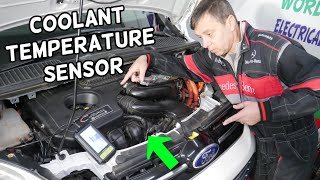
- Turn off the engine. Locate the ECT sensor. On the 1.5L, it's under the air intake system. On the 2.5L, it's on the thermostat housing. On the 2.0L Hybrid, it's between ignition coils 3 and 4. On the 2.7L, it is under the intake manifold. Inspect the sensor's connector for looseness, damage, or corrosion. TSBs specifically call out poorly seated connectors on the 2.7L model.
- If the connector looks good, unplug it. The scan tool reading should change to a default high or low value (e.g., -40°F). If it doesn't change, there may be a wiring issue between the connector and the PCM.
- If the sensor, connector, and wiring appear fine, but the engine takes a very long time to warm up, the thermostat is the most likely cause.
Parts You'll Likely Need
- Engine Coolant Temperature (ECT) Sensor
(OEM #Motorcraft FT4Z-12A648-B (replaces DY-1298, FT4Z-12A648-A))— This is the most common failure point for code P0116, as confirmed by Ford's own service bulletins.
Trusted brands: Motorcraft, Bosch, Delphi, Duralast (SU13812)
OEM price range: $30-$60
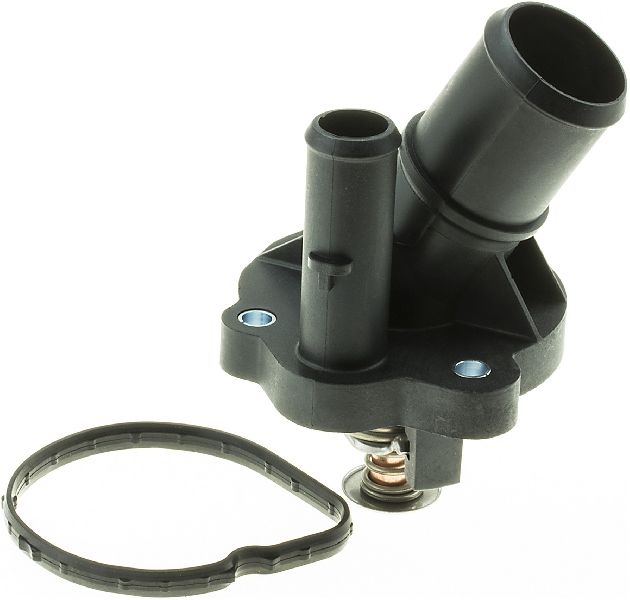
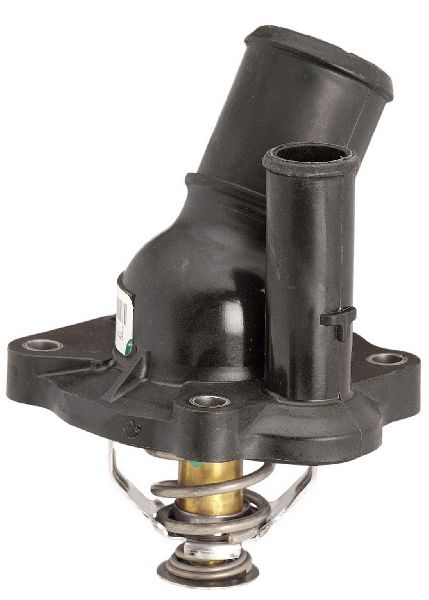
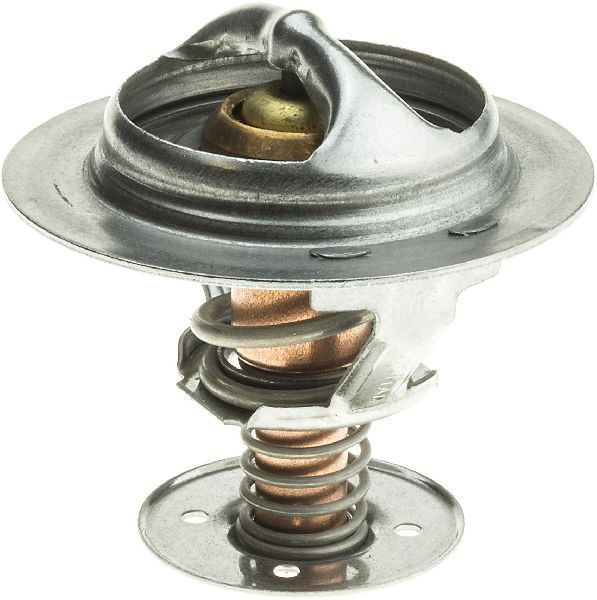
Aftermarket price range: $20-$40 - Engine Coolant Thermostat — If the sensor is working but the engine warms up too slowly, a stuck-open thermostat is the next most likely cause.
Trusted brands: Motorcraft, Stant, Gates
OEM price range: $40-$80
Aftermarket price range: $30-$70
Related Codes That Often Appear With This One
- P0117 — Indicates ECT Sensor Circuit Low Input, often pointing to a short in the circuit. It is listed in the same TSBs as P0116.
- P0118 — Indicates ECT Sensor Circuit High Input, often pointing to an open circuit or unplugged sensor. It is listed in the same TSBs as P0116.
- P0128 — Indicates Coolant Thermostat Rationality. This code is often set alongside P0116 if the engine is not reaching operating temperature quickly enough, strongly suggesting a stuck-open thermostat.
- P0217 — Indicates an Engine Overtemperature Condition, which can be triggered by a faulty ECT sensor reading high, even if the engine isn't actually overheating. It is listed in the same TSBs as P0116.
Technical Service Bulletins (TSBs) & Recalls
- SSM 48991: Notes that P0116 can be caused by a faulty ECT sensor or its shared harness with the knock sensor on 2.7L engines.
- SSM 47791: Points to an improperly seated ECT sensor connector or damaged wiring as a cause for P0116 on 2.7L engines.
- SSM 46906: An earlier version of SSM 47791, also identifying a poorly seated ECT sensor connector as a potential cause for P0116 on the 2.7L.
Platform-Specific Known Issues
- TSB SSM 48991: States that 2017-2019 Fusions with the 2.7L EcoBoost engine may exhibit an illuminated MIL with DTC P0116 (among others). It suggests this may be due to the engine coolant temperature (ECT) sensor or the knock sensor wiring harness, and recommends replacing both.
- TSB SSM 47791 & 46906: For 2017-2019 Fusions with the 2.7L engine, these bulletins warn that P0116 can be caused by an ECT sensor connector that is not fully seated or has damaged wiring between connectors C1016 and C1168.
Mechanic-Grade Diagnostic Values
- ECT Sensor Resistance — expected: Approximately 2,000 - 3,000 Ohms at 68°F (20°C). Resistance decreases as temperature increases.. Failure: A reading outside this range, or an open/infinite resistance, indicates a faulty sensor.
- ECT Sensor Signal Voltage (Cold Engine) — expected: Approximately 2.0V to 3.0V on a cold engine (e.g., 70°F). Should be close to the IAT sensor reading.. Failure: A reading near 5V may indicate an open circuit, while a reading near 0V suggests a short to ground. An irrational value like -40°F on the scan tool points to an open circuit.
- ECT Sensor Signal Voltage (Warm Engine) — expected: Should decrease smoothly to around 0.5V as the engine reaches operating temperature (approx. 200°F).. Failure: Voltage that jumps erratically, does not decrease, or decreases too slowly (indicating a stuck thermostat).
- ECT Sensor Reference Voltage (KOEO) — expected: The PCM supplies a 5-volt reference signal to the sensor circuit.. Failure: Measuring significantly more (e.g., 12V) or less than 5V on the reference wire at the unplugged connector points to a wiring or PCM issue.
Wiring & Ground Locations
- C1016 and C1168 — On 2.7L EcoBoost models, these are inline harness connectors for the wiring that goes to the ECT sensor.. TSBs SSM 47791 and 46906 specifically identify the wiring between these two connectors as a potential location for damage or poor connections that can cause a P0116 code.
- ECT Sensor Connector — Directly on the Engine Coolant Temperature sensor. Location varies by engine (e.g., under the intake manifold on the 2.7L).. TSBs specifically call out that this connector may not be fully seated, especially on the 2.7L engine, leading to an intermittent or open circuit and triggering P0116.
Model Year Variations Within This Range
- 2017-2019: Ford began transitioning from Motorcraft Orange Coolant (WSS-M97B44-D) to Motorcraft Yellow Coolant (WSS-M97B57-A2). The new yellow coolant is backward-compatible and can be mixed with or used to replace the orange coolant. If a full flush is not performed, the remaining orange coolant will cause the new yellow coolant to appear orange.
Helpful Videos

![How to Fix P0116 Engine Code in 3 Minutes [2 DIY Methods / Only $7.31]](https://img.youtube.com/vi/lEaB_7q1xKI/mqdefault.jpg)
![How to Fix FORD P0116 Engine Code in 3 Minutes [2 DIY Methods / Only $7.31]](https://img.youtube.com/vi/2qFbXSeKGqU/mqdefault.jpg)

Used OEM Parts in Stock


New Aftermarket Parts Available


The information in this article is provided for general reference and educational purposes only. Vehicle specifications, procedures, and part compatibility can vary by production date, trim level, and region. Always consult your vehicle's factory service manual and verify part numbers before purchasing or performing repairs. Safety-critical components such as airbags, seat belts, and braking systems should be installed by a qualified professional.
- Ford FUSION:
- 🎬 Helpful Videos
- 🛍️ Shop This Part
- What's Unique About the 2017-2019 Ford FUSION
- Diagnostic Flowchart
- Symptoms You May Notice
- Most Likely Causes
- Rare But Worth Checking
- Diagnosis Steps
- Parts You'll Likely Need
- Related Codes That Often Appear With This One
- Technical Service Bulletins (TSBs) & Recalls
- Platform-Specific Known Issues
- Mechanic-Grade Diagnostic Values
- Wiring & Ground Locations
- Model Year Variations Within This Range
- 🎟️ Get 5% Off