

P0108 on 2011-2018 Volkswagen Jetta 2.5L: MAP Sensor Circuit High Causes and Fixes
On the Jetta 2.5L, code P0108 is most often caused by a MAP sensor that has been contaminated with oil due to a failed PCV valve diaphragm. The fix is to replace both the MAP sensor and the PCV valve diaphragm (or the entire PCV assembly), which is a relatively low-cost DIY repair. It is critical to clean the oil out of the intake manifold port where the sensor sits to prevent immediate re-contamination of the new sensor.
- P0108 on a Jetta 2.5L is almost always caused by an oil-fouled MAP sensor.
- The oil contamination is a direct result of a failed PCV valve diaphragm, a very common issue on this engine.
- To fix the problem permanently, you must replace both the MAP sensor and the PCV valve diaphragm, and clean the oil out of the intake manifold.
- Be careful not to mix up the MAP sensor (part number starts with '03C') with the identical-looking SAI pressure sensor (part number starts with '07C').
What's Unique About the 2011-2018 Volkswagen Jetta

The 2.5L inline-five engine (engine codes CBTA, CBUA) in the Mk6 Jetta has a well-documented design characteristic that makes it prone to this code. The PCV (Positive Crankcase Ventilation) valve diaphragm is a known high-failure item. When it tears, it creates a massive vacuum leak and allows engine oil to be drawn into the intake manifold. Because the MAP sensor is positioned at a low point on the manifold, this oil pools around the sensor, contaminating and damaging it, leading to signal faults like P0108. This PCV failure is the root cause so often that replacing only the sensor is usually a temporary fix at best.
Generation note: The 2011-2018 Volkswagen Jetta is a single generation (Mk6). However, the 2.5L engine was only offered in the Jetta from model years 2011 through 2014, after which it was replaced by smaller turbocharged engines. This guide is specific to the 2.5L models from 2011-2014, but the same engine and issue are found in other VW models from the same era.
Symptoms You May Notice
- Check Engine Light is on
- Rough or unstable idle, sometimes called 'hunting' idle.
- Poor fuel economy
- Hesitation or lack of power during acceleration
- Black smoke from the exhaust
- Engine may stall intermittently
- Loud whistling or sucking noise from the engine bay, caused by the torn PCV diaphragm.
- On some 2.5L engines, the Secondary Air Injection (SAI) pressure sensor is physically identical to the MAP sensor and uses the same connector. They can be accidentally swapped during service. The MAP sensor part number typically starts with '03C' (e.g., 03C906051F), while the SAI sensor starts with '07C' (e.g., 07C906051). Installing the wrong sensor will cause persistent codes.
Most Likely Causes

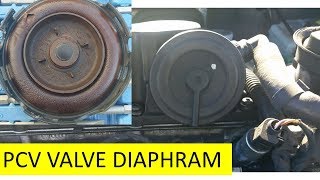
- Failed PCV Valve Diaphragm Causing MAP Sensor Oil Contamination 🔴 High Probability The PCV diaphragm on the 2.5L engine is a known failure point made of rubber that becomes brittle and tears over time. Its failure allows oil into the intake manifold, which pools directly where the MAP sensor is located, causing it to fail.
How to confirm: With the engine running, try to remove the oil filler cap. If there is extreme suction holding it down, the PCV diaphragm is torn. You may also hear a loud whistling sound. Visually, remove the MAP sensor from the intake manifold. If the tip of the sensor is wet with engine oil, the PCV valve has failed.
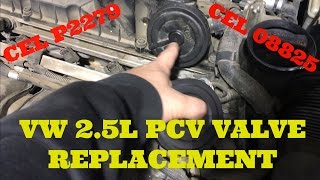
Typical fix: Replace the PCV valve diaphragm (available as a standalone part, e.g., Dorman 917-064 🎬 See how to replace just the PCV diaphragm yourself.) and the oil-fouled MAP sensor. It is also critical to clean any pooled oil out of the intake manifold port where the sensor sits.
Est. part cost: $40-$80 - Faulty MAP Sensor 🟡 Medium Probability The sensor itself can fail, but it's most often a symptom of the PCV issue described above. If the sensor fails on its own without oil contamination, it is less common.
How to confirm: With the sensor connector unplugged and Key On Engine Off, test the signal wire with a multimeter. If the code P0108 disappears and is replaced by a low voltage code (like P0107), the sensor itself is likely shorted internally. If the high voltage remains on the signal wire with the sensor disconnected, the problem is in the wiring.
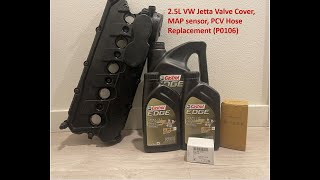
Typical fix: Replace the MAP sensor. It is held in by a single Torx screw and is accessible after removing the engine cover/airbox. 🎬 Watch this full walkthrough for replacing the valve cover and sensor. The correct OEM part number is 03C906051F.
Est. part cost: $30-$120 - Wiring Harness Short to Power ⚪ Low Probability Wiring harnesses can chafe over time, but there isn't a widely documented specific chafe point for this circuit on this vehicle. A YouTube video noted a case where wires near the MAP sensor had their insulation fail and were touching.
How to confirm: Disconnect the MAP sensor and the ECU. Use a multimeter to check for continuity between the signal wire and the 5V reference wire or a known 12V power source. There should be no continuity.
Typical fix: Locate the short in the harness, which may be caused by chafing or heat damage, and repair the damaged wire.
Est. part cost: $5-$50
Rare But Worth Checking
- Faulty Engine Control Module (ECU): This is very rare. The ECU should only be considered after all other possibilities, including the sensor, PCV system, and wiring, have been definitively ruled out.
- Loose Intake Manifold Bolts: On the 2.5L engine, the intake manifold bolts can sometimes loosen over time, creating a vacuum leak that can trigger MAP-related codes like P0106. While less likely to cause a 'High Input' code like P0108, it's a known issue on the platform worth checking.
- Clogged Catalytic Converter: A severely restricted catalytic converter can cause excessive backpressure in the engine, which can lead to an abnormally high pressure reading in the intake manifold, potentially triggering a P0108 code.
Diagnosis Steps

- Scan for any other fault codes that may provide additional clues.
- With the engine running at idle, listen for a loud whistling or sucking sound from the top of the engine, indicating a torn PCV diaphragm.
- Perform the 'oil cap test': With the engine running, try to remove the oil filler cap. If it is held on by strong vacuum, the PCV diaphragm has failed.
- Remove the engine cover/airbox assembly to access the intake manifold.
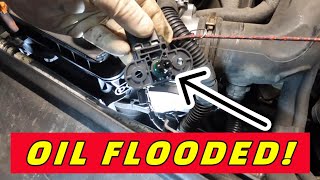
- Locate the MAP sensor. On the 2.5L, it is plugged into the intake manifold, behind the throttle body. 🎬 Watch a quick guide on locating and swapping the MAP sensor.
- Disconnect the electrical connector and remove the single Torx screw holding the sensor in place.
- Inspect the tip of the sensor for engine oil. If oil is present, the PCV valve is faulty and is the root cause. Also inspect the manifold port for pooled oil.
- If the sensor is dry, inspect the wiring harness and connector for any signs of damage, corrosion, or loose pins.
- With the key on and engine off, use a multimeter to test the disconnected harness connector. You should find a 5-volt reference wire, a ground wire, and a signal wire (which should read low voltage with the sensor disconnected).
- If voltage on the signal wire is high (5V or more) with the sensor unplugged, there is a short to power in the wiring harness that must be traced.
- If the wiring checks out and the sensor is dry, the sensor itself has likely failed internally.
Parts You'll Likely Need

- Manifold Absolute Pressure (MAP) Sensor
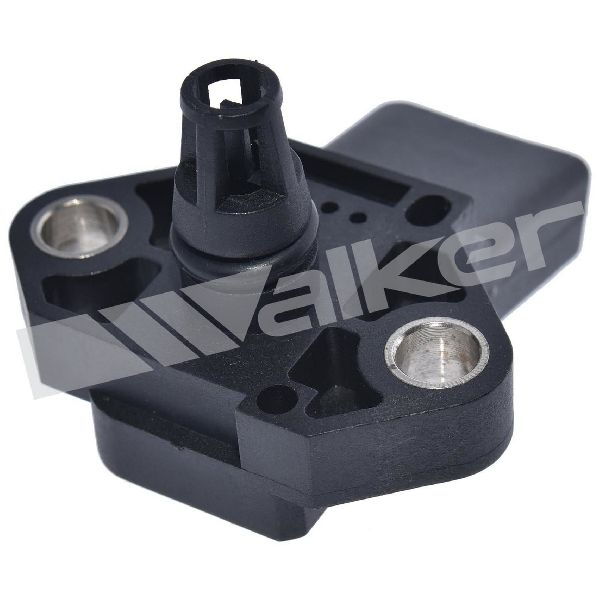
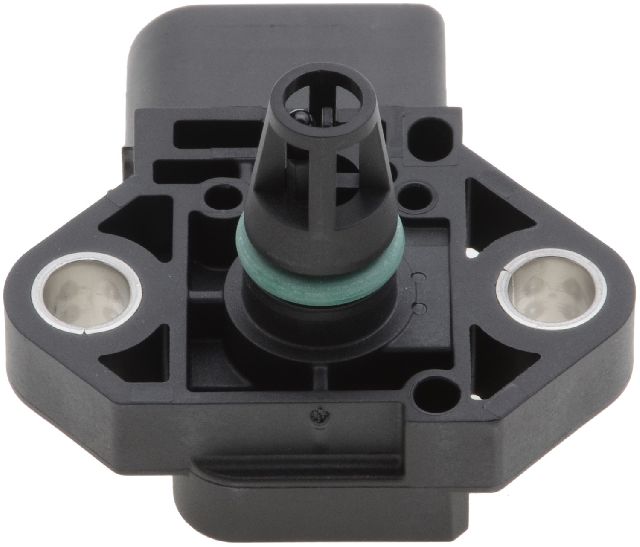
(OEM #03C906051F)— This is the sensor that directly reports the pressure reading. It is the most common part to fail, usually due to oil contamination from the PCV system. This part number is confirmed by multiple OEM parts suppliers and cross-references.
Trusted brands: Bosch (0261230234), Standard Motor Products, VEMO
OEM price range: $70-$120
Aftermarket price range: $25-$70 - PCV Valve Diaphragm Repair Kit
(OEM #07K103469F (Full PCV Assembly))— This is the most frequent root cause of MAP sensor failure on the 2.5L engine. The diaphragm tears, causing a vacuum leak and oil consumption. VW typically sells the entire PCV valve assembly, but aftermarket kits allow for replacing just the failed diaphragm.
Trusted brands: Dorman (917-064), URO Parts, RKX Tech
OEM price range: $150-$250 (for full assembly)
Aftermarket price range: $15-$40 (for diaphragm kit)
Related Codes That Often Appear With This One
- P0106 — P0106 ('MAP Sensor Implausible Signal') is extremely common with the same root causes. Often, a failing sensor will trigger P0106 before it fails completely and triggers P0108. A TSB was issued for P0106 recommending a software update.
- P0113 — P0113 ('Intake Air Temperature Sensor Circuit High') can appear alongside P0108. On these engines, the IAT is integrated into the MAP sensor. A user on Reddit reported this exact issue after replacing a MAP sensor with a slightly different part number, suggesting an internal fault or incompatibility in the replacement sensor affecting both circuits.
- P2187 — P2187 ('System Too Lean at Idle') is another common code caused by the torn PCV diaphragm. The tear creates a large, unmetered vacuum leak, which the engine computer sees as a lean condition at idle.
Technical Service Bulletins (TSBs) & Recalls
- TSB 01-14-23 / TPI 2034012: Addresses P0106 on 2011-2014 2.5L engines (CBTA, CBUA) by updating ECU software due to over-sensitivity. Also covers P0507 and P050A.
Platform-Specific Known Issues
- A Technical Service Bulletin (TSB 01-14-23 / TPI 2034012) exists for the related code P0106 on 2011-2014 models with the 2.5L engine. It states the monitoring strategy for the MAP sensor may be too sensitive and recommends an ECU software update as the fix. The TSB explicitly states NOT to replace the MAP sensor or throttle body for this code until the software update is performed. While this TSB doesn't specifically name P0108, it addresses the same system and may be relevant if no physical faults (like oil contamination) are found.
Mechanic-Grade Diagnostic Values
- MAP Sensor 5V Reference Wire Voltage — expected: ~5.0 Volts DC with Key On, Engine Off (KOEO), measured at the sensor connector.. Failure: A reading of 0V indicates an open in the power wire from the ECU or a faulty ECU. A reading significantly less than 5V indicates high resistance in the circuit.
- MAP Sensor Signal Wire Voltage (KOEO) — expected: ~4.5 - 5.0 Volts DC, reflecting atmospheric pressure.. Failure: A low voltage reading with the engine off could indicate a sensor or wiring issue, though this is not the typical failure for P0108.
- MAP Sensor Signal Wire Voltage (Engine Idling) — expected: 1.0 - 2.0 Volts DC. The voltage should drop immediately from the KOEO reading upon starting the engine.. Failure: If the voltage remains high (near KOEO value, >4.5V) while the engine is running, it confirms the 'Circuit High' condition of P0108. This points to a bad sensor, a wiring short to power, or a complete lack of vacuum to the sensor.
- MAP Sensor Ground Wire Check — expected: Near battery voltage (~12.6V) when measuring between the positive battery terminal and the ground pin at the sensor connector. Alternatively, less than 0.5 Ohms of resistance between the ground pin and a known good chassis ground.. Failure: Low or no voltage in the first test, or high resistance in the second test, indicates a poor ground connection, which can cause erratic sensor readings.
- VCDS Live Data at Idle (Scan Tool) — expected: Absolute pressure reading around 300 mBar (or 30 kPa).. Failure: A reading stuck at or near atmospheric pressure (~1000 mBar or 100 kPa) while the engine is running and creating vacuum is a definitive sign of a fault. A reading of 255 kPa is often a default value indicating an out-of-bounds measurement.
Hidden / Shadow Codes Worth Checking
- 16492: This is the VAG-specific fault code that corresponds to the generic OBD-II code P0108. It will be displayed by VW-specific scan tools like VCDS. (see via VCDS (VAG-COM) or other professional European vehicle scan tools.)
Scan Tool Commands That Help
- VCDS (VAG-COM): Basic Settings - Group 060 (Throttle Body Adaptation) — After replacing the MAP sensor, cleaning the throttle body, or clearing major engine faults like P0106/P0108, it is good practice to perform a throttle body adaptation. This resets the throttle plate's learned idle and off-idle positions, which can be affected by incorrect MAP sensor readings. A video for the related P0106 code demonstrates this procedure.
Wiring & Ground Locations
- G71 — The MAP sensor itself is identified as component G71 in VW wiring diagrams. It is located on the intake manifold, behind the throttle body.. Knowing the component identifier helps in locating the correct sensor and its wiring in official service manuals and diagrams.
- Ground Point 15 — On the cylinder head.. The cylinder head is a primary grounding location for many engine sensors. A loose or corroded ground at this point could potentially affect the MAP sensor's circuit, as sensor grounds are often bundled together.
- Ground Point 652 — Main ground strap between the transmission and engine block/chassis.. This is a critical engine ground. While a failure here would likely cause numerous other codes and issues, ensuring it is clean and tight is a fundamental step in diagnosing any electrical fault.
Real Owner Repair Stories
- Ross-Tech Forums user (2011 VW Golf Mk6 (shares 2.5L engine and platform)) — Check Engine Light with P0108 - Signal too High - Intermittent.
❌ Tried (didn't work) Using a cheap OBD scanner provided little help.
✅ What actually fixed it Cleaning the throttle body and MAP sensor due to oil blow-by made the CEL go away, but only temporarily. The code returned after about 200 miles. This strongly implies the root cause (the source of the oil, i.e., the PCV system) was not addressed, leading to re-contamination of the sensor.
OEM Part Supersession History
07K103469F, 07K103469D→07K103469L— Standard part evolution and revision by the manufacturer.
Heads up: When ordering the full PCV/valve cover assembly, 07K103469L is the current part number to use. The older numbers have been superseded.03C906051→03C906051F— Part revision.
Heads up: While 03C906051F is the commonly cited part, vendors note that due to numerous factory supersessions, the part number on a replacement may not match the original. It is crucial to verify fitment by VIN. The Bosch equivalent is 0261230234.
Model Year Variations Within This Range
- 2011-2014: The 2.5L engine was available with two primary codes in this Jetta: CBTA and CBUA. The main difference is that the CBUA is a SULEV (Super Ultra-Low Emission Vehicle) version, primarily for states with California emissions standards, and features additional emissions components, including more O2 sensors. While the P0108 fault is identical between them, be aware of the engine code when ordering any related emissions parts or consulting wiring diagrams.
Diagnostic Flowchart
Real Owner Stories
Aggregated from forums and TSBs cited above. Mileages and costs reflect what owners reported in those sources.
Volkswagen 2.5L (Engine Code CBT)
Symptoms: Triggered a check engine light whenever accelerating more than gently. Freeze frame data showed code P0106 (Implausible Signal - Intermittent) at 1010 mbar manifold pressure.
What fixed it: Not specified in the original post, but owner was seeking diagnostic help for the implausible signal reading under acceleration.
Source hint: VWvortex
2012 Volkswagen Jetta SE 2.5L
Symptoms: Check engine light illuminated with codes related to the MAP sensor.
What fixed it: Identified the PCV valve as the root cause after discovering the MAP sensor was fouled with engine oil.
Source hint: Reddit r/Volkswagen - 2012 Jetta SE, 2.5L codes
2012 Volkswagen Jetta 2.5L
Symptoms: Check engine light on with a P0106 MAP sensor code.
What fixed it: Replaced the MAP sensor and performed a throttle body cleaning and adaptation.
Source hint: YouTube - MattsAPlusCarCare
Volkswagen 2.5L
Symptoms: Persistent MAP sensor codes due to incorrect sensor installation.
What fixed it: Swapped the physically identical MAP sensor (part number 03C) and SAI sensor (part number 07C) back to their correct locations after they had been mixed up.
Source hint: Ross-Tech Wiki / YouTube - German Auto Tech
Related OBD-II Codes
Frequently Asked Questions
Does TSB 01-14-23 apply to my P0108 code on the 2.5L Jetta?
Why is there a loud whistling noise coming from my 2.5L engine?
How do I test if my PCV valve diaphragm has failed?
What is the correct part number for the MAP sensor on the 2.5L Jetta?
Can I just replace the PCV diaphragm instead of the whole valve cover?
I found oil on my MAP sensor. Should I just replace the sensor?
Helpful Videos
We Have This Part in Stock

The information in this article is provided for general reference and educational purposes only. Vehicle specifications, procedures, and part compatibility can vary by production date, trim level, and region. Always consult your vehicle's factory service manual and verify part numbers before purchasing or performing repairs. Safety-critical components such as airbags, seat belts, and braking systems should be installed by a qualified professional.
- Volkswagen Jetta:
- 🎬 Helpful Videos
- 🛍️ Shop This Part
- What's Unique About the 2011-2018 Volkswagen Jetta
- Symptoms You May Notice
- Most Likely Causes
- Rare But Worth Checking
- Diagnosis Steps
- Parts You'll Likely Need
- Related Codes That Often Appear With This One
- Technical Service Bulletins (TSBs) & Recalls
- Platform-Specific Known Issues
- Mechanic-Grade Diagnostic Values
- Hidden / Shadow Codes Worth Checking
- Scan Tool Commands That Help
- Wiring & Ground Locations
- Real Owner Repair Stories
- OEM Part Supersession History
- Model Year Variations Within This Range
- Diagnostic Flowchart
- Real Owner Stories
- Volkswagen 2.5L (Engine Code CBT)
- 2012 Volkswagen Jetta SE 2.5L
- 2012 Volkswagen Jetta 2.5L
- Volkswagen 2.5L
- Related OBD-II Codes
- Frequently Asked Questions
- 🎟️ Get 5% Off