

P0108 on 2007-2021 Mitsubishi Outlander: MAP Sensor Circuit High Causes and Fixes
For a 2007-2021 Mitsubishi Outlander, code P0108 almost always points to a failed Manifold Absolute Pressure (MAP) sensor or a wiring issue. Replacing the sensor is the most common fix and is a straightforward DIY job.
- P0108 on a Mitsubishi Outlander means the MAP sensor circuit is reporting an abnormally high voltage, typically over 4.6V.
- The most likely cause is a failed MAP sensor, which is a simple part to replace.
- Before replacing the sensor, check its connector and wiring for obvious damage, corrosion, or a short to power.
- Ensure you purchase the correct MAP sensor for your engine (2.4L or 3.0L), as they use different parts.
- This is a DIY-friendly repair that can be completed with basic tools in under 30 minutes.
What's Unique About the 2007-2021 Mitsubishi Outlander
On the Mitsubishi Outlander, the P0108 code is a very direct fault related to the MAP sensor circuit. Unlike some vehicles where vacuum leaks can indirectly cause this specific code, Mitsubishi's diagnostic logic points squarely at a sensor or electrical fault. The primary difference owners need to be aware of is the different MAP sensor part numbers used for the 2.4L 4-cylinder engine versus the 3.0L V6 engine.
Generation note: This range covers the second generation (2007-2012) and the third generation (2013-2021) of the Mitsubishi Outlander. The primary cause, a faulty MAP sensor, is common to both. However, the specific OEM part number for the MAP sensor differs depending on the engine (2.4L vs. 3.0L), not necessarily the generation.
Symptoms You May Notice
- Check Engine Light is on
- Rough or unstable idle
- Hesitation or sluggish acceleration
- Reduced fuel economy
- Engine may stall intermittently, especially when stopping or at low RPMs
- Black smoke from the exhaust, indicating a rich fuel condition
- Replacing the throttle body when it is just dirty.
- Assuming a vacuum leak is the cause. While vacuum leaks can cause performance issues, they typically set other codes (like lean condition codes P0171/P0174) and are not the primary cause for a 'circuit high' fault on this vehicle.
Most Likely Causes
- Failed Manifold Absolute Pressure (MAP) Sensor 🔴 High Probability Sensors can fail over time due to heat cycles and internal component degradation. This is the most common resolution reported by owners.
How to confirm: With the key on and engine off, use a scan tool to compare the MAP sensor reading to the Barometric Pressure (BARO) reading. They should be nearly identical. If the MAP reading is stuck high, the sensor has failed. You can also test the sensor's output voltage; if it's stuck high (near 5V) regardless of vacuum, it's faulty.
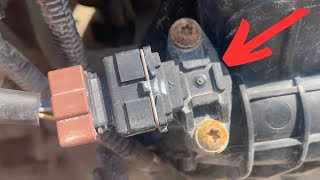
Typical fix: Replace the MAP sensor. On the 2.4L engine, it is located on the intake manifold and is easily accessible. 🎬 Watch: 2.4L MAP sensor location and replacement walkthrough On the 3.0L V6, it is also on the intake manifold, though access may be slightly tighter.
Est. part cost: $80-$250 - Wiring or Connector Issue 🟡 Medium Probability Engine vibration and heat can cause wiring to fray or connectors to become loose or corroded over time, especially at the pigtail connecting to the sensor.
How to confirm: Inspect the wiring harness and connector (B-117 or B-124 depending on model year) leading to the MAP sensor for any signs of damage, corrosion, or loose pins. With the connector unplugged and key on, check for a 5-volt reference and a good ground at the connector terminals using a multimeter.
Typical fix: Repair the damaged section of the wiring harness or clean/replace the sensor connector pigtail.
Est. part cost: $5-$50
Rare But Worth Checking
- Faulty Powertrain Control Module (PCM/ECM): This is the least likely cause. All other possibilities, especially the sensor and its wiring, must be exhaustively ruled out before considering PCM replacement, as it is expensive and requires programming.
- Clogged Catalytic Converter: A severely restricted exhaust can cause intake manifold pressure to be abnormally high, potentially triggering a P0108 code. This would usually be accompanied by other symptoms like a severe loss of power and possibly other codes.
Diagnosis Steps
- Connect an OBD-II scanner and confirm P0108 is the primary code. Note the freeze frame data to see engine conditions when the fault occurred.
- With the Key On, Engine Off (KOEO), view live data. The MAP sensor pressure/voltage should be close to the Barometric Pressure (BARO) reading.
- If the MAP reading is stuck high (e.g., voltage is stuck near 4.6V-5V), the sensor or its circuit is faulty.
- Visually inspect the MAP sensor's electrical connector (e.g., B-117 or B-124) and wiring for any visible damage, corrosion, or loose connections.
- Disconnect the sensor. With the key on, use a multimeter to test the connector terminals. You should find a 5V reference wire (from ECM pin 44), a ground wire (from ECM pin 46), and a signal wire (to ECM pin 45).
- If the 5V reference or ground is missing, the problem is in the wiring between the connector and the ECM.
- If power and ground are good, and the signal wire is not shorted to power, the MAP sensor itself has almost certainly failed.
- Replace the MAP sensor, clear the code, and perform a test drive to confirm the fix.
Parts You'll Likely Need
- Manifold Absolute Pressure (MAP) Sensor (2.4L Engine)
(OEM #1865A139)— This is the most common failure point for code P0108 on Outlanders with the 2.4L 4-cylinder engine.
Trusted brands: Mitsubishi Genuine, Denso, Bosch, Standard Motor Products
OEM price range: $200-$250
Aftermarket price range: $80-$150 - Manifold Absolute Pressure (MAP) Sensor (3.0L Engine)
(OEM #1865A148)— This is the correct sensor for Outlanders equipped with the 3.0L V6 engine, which is the most common failure for this code.
Trusted brands: Mitsubishi Genuine, Denso, Bosch
OEM price range: $200-$250
Aftermarket price range: $80-$150
Technical Service Bulletins (TSBs) & Recalls
- TSB-13-13-003: While not directly for P0108, this TSB was issued for 2009-2010 Outlanders with the 3.0L engine to correct diagrams for the knock sensor in the service manual. It shows that Mitsubishi does issue bulletins to correct service information.
- No specific TSB for P0108 on the Outlander was found during research, reinforcing that the issue is typically a straightforward component failure rather than a systemic design flaw requiring a special procedure.
Platform-Specific Known Issues
- Repeat Failures After Replacement: In a forum thread (not for an Outlander, but relevant to the code), a user reported having the P0108 code return even after a dealer replaced the MAP sensor. The dealer suspected a batch of bad sensors, indicating that part quality, even from OEM sources, can sometimes be an issue. If the code returns immediately after replacement, this is a possibility to consider after re-checking wiring.
Mechanic-Grade Diagnostic Values
- MAP Sensor Live Data (KOEO - Key On, Engine Off) — expected: Should match barometric pressure. At sea level: ~101 kPa (29.8 in. Hg). At 1,200m (3,937 ft): ~88 kPa (26.0 in. Hg).. Failure: A reading stuck high, near 4.6V or higher, indicates a circuit high fault.
- MAP Sensor Live Data (Engine Idling, Warmed Up) — expected: 28.3 - 41.7 kPa (8.36 - 12.31 in. Hg).. Failure: A reading that does not change with engine RPM or remains high at idle.
- MAP Sensor Ground Circuit Voltage (Backprobed at Connector) — expected: 0.5 volts or less.. Failure: Voltage significantly higher than 0.5V indicates a poor ground connection.
- MAP Sensor Ground Wire Resistance to Chassis Ground — expected: Continuity (2 ohms or less).. Failure: High resistance or an open circuit (OL) indicates a break in the ground wire.
Scan Tool Commands That Help
- Mitsubishi M.U.T.-III / M.U.T.-III SE: Data List, Item 8: Manifold Absolute Pressure Sensor — This is the primary function used to view live data from the MAP sensor to check its readings at KOEO, idle, and under load to determine if it is functioning correctly.
- Mitsubishi M.U.T.-III / M.U.T.-III SE: Erase DTC — Used after the repair is completed to clear the P0108 code from the ECM's memory before performing a test drive.
Wiring & Ground Locations
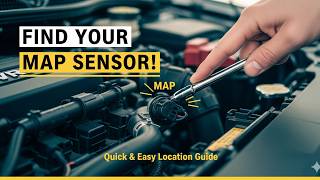
- MAP Sensor Connector (e.g., B-117, B-124, B-14) — Directly on the Manifold Absolute Pressure sensor, which is mounted on the intake manifold. 🎬 See this quick guide to finding your MAP sensor. This is the primary point of failure for wiring issues. Inspect for corrosion, backed-out pins, or damage to the connector body or pigtail.
- ECM Connector (e.g., B-108, B-26) — At the Engine Control Module (ECM), location varies by model year but is typically in the engine bay or under the dashboard.. This is the termination point for the MAP sensor circuit. A poor connection here can mimic a sensor or wiring failure. The MAP sensor signal, power, and ground wires terminate here (e.g., pins 44, 45, 46).
Model Year Variations Within This Range
- 2007-2021: The specific connector designator for the MAP sensor and ECM can vary. For example, service manuals may refer to the MAP sensor connector as B-117, B-124, or B-14, and the ECM connector as B-108 or B-26, depending on the specific model year and engine combination.
- 2007-2021: The pinout for the MAP sensor can vary slightly in numbering between service manuals (e.g., power on pin 1 vs pin 3), but the function remains a 3-wire setup with 5V reference, signal, and ground. Always verify wire colors or use a multimeter to confirm function before probing.
Diagnostic Flowchart
Other Known Issues on This Vehicle
Issues unrelated to this code that are worth knowing about as an owner of this generation:
- CVT Transmission Failure/Issues 🔴 High — Widespread concern across multiple model years. Problems like shuddering, hesitation, whining, and complete failure can occur, sometimes before 50,000 miles. (Ref: TSB 20-23-001REV has been issued for transmission problems.)
- Premature Brake Wear 🟠 Medium — Commonly reported, especially on 2018 models. Owners report needing to replace pads and rotors much sooner than expected, often attributed to the quality of OEM brake pads.
- Paint Chipping 🟡 Low — Frequently mentioned by owners, the exterior paint, particularly on the hood, is prone to chipping easily.
- Faulty Engine/Cooling Relays 🔴 High — Some 2015-2017 models were recalled for defective engine control, valve lift, and radiator fan relays, which could lead to stalling or overheating. (Ref: NHTSA Recall for 2015-2017 models.)
- Lower Control Arm Bushing Wear 🟠 Medium — Primarily affects the 2nd generation (2007-2013). Worn bushings lead to squeaking or rattling noises over bumps and can cause premature tire wear due to alignment issues.
- TPMS Sensor Battery Failure 🟡 Low — On some models, particularly around 2014, the batteries inside the TPMS sensors can drain prematurely, causing the TPMS warning light to illuminate. (Ref: Service Campaign SC-13-003 was issued for some 2014 models to replace the sensors.)
Used vs. New Parts: Buying Guide for This Vehicle
When a used part is the smart pick: For a simple electronic sensor like a MAP sensor, a used OEM part from a low-mileage, reputable salvage yard can be a cost-effective alternative to a new aftermarket part, as OEM electronics often have better calibration and longevity. However, given the relatively low cost of new aftermarket parts, many owners opt for new for the warranty and peace of mind.
Donor-vehicle mileage cap: roughly under 75000 miles for the part to have meaningful remaining life.
What to inspect on the donor part:
- Check for a clean donor vehicle without signs of flood or fire damage.
- Inspect the connector pins on the used sensor for any corrosion or damage.
- Ensure the plastic housing is not cracked or showing signs of extreme heat stress.
- Ask for the VIN of the donor vehicle to verify its mileage and year.
OEM-only on this vehicle (don't cheap out):
- Powertrain Control Module (PCM/ECM)
Aftermarket brands forum-validated for this vehicle:
- Denso (often the OEM supplier)
- Bosch
- Standard Motor Products (SMP)
- NTK
Brands owners have reported issues with on this vehicle:
- Unnamed, no-brand sensors from online marketplaces should be avoided. Forum discussions often show that while extremely cheap, these parts have a high failure rate and can be poorly calibrated, causing performance issues even if they clear the code initially.
Real Owner Stories
Aggregated from forums and TSBs cited above. Mileages and costs reflect what owners reported in those sources.
Mitsubishi Outlander (General)
Symptoms: The code returned even after a dealer replaced the MAP sensor. The dealer suspected a batch of bad sensors might be the cause.
What fixed it: Re-checking wiring and considering the possibility of a faulty replacement part (bad batch of sensors).
Source hint: vehicle_specific_issues titled 'Repeat Failures After Replacement'
Mitsubishi Outlander (General)
Symptoms: Loss of power; the sensor was reporting an out-of-range value.
What fixed it: Diagnosis revealed the code can be triggered by the sensor itself or an actual engine problem like a plugged exhaust causing high manifold pressure.
Source hint: Car Talk Community - 'P0108 Loss of Power'
Related OBD-II Codes
Frequently Asked Questions
Is there a specific TSB for the P0108 code on my 2009-2010 Mitsubishi Outlander 3.0L?
Where is the MAP sensor located on my Outlander's 2.4L engine?
I just replaced my MAP sensor but the P0108 code came back immediately. What should I check next?
Can a transmission issue be related to my P0108 code symptoms?
My 2016 Outlander is stalling; could this be related to a recall instead of the MAP sensor?
What should the MAP sensor voltage read on my Outlander when the engine is off?
Helpful Videos
We Have This Part in Stock



The information in this article is provided for general reference and educational purposes only. Vehicle specifications, procedures, and part compatibility can vary by production date, trim level, and region. Always consult your vehicle's factory service manual and verify part numbers before purchasing or performing repairs. Safety-critical components such as airbags, seat belts, and braking systems should be installed by a qualified professional.
- Mitsubishi Outlander:
- 🎬 Helpful Videos
- 🛍️ Shop This Part
- What's Unique About the 2007-2021 Mitsubishi Outlander
- Symptoms You May Notice
- Most Likely Causes
- Rare But Worth Checking
- Diagnosis Steps
- Parts You'll Likely Need
- Technical Service Bulletins (TSBs) & Recalls
- Platform-Specific Known Issues
- Mechanic-Grade Diagnostic Values
- Scan Tool Commands That Help
- Wiring & Ground Locations
- Model Year Variations Within This Range
- Diagnostic Flowchart
- Other Known Issues on This Vehicle
- Used vs. New Parts: Buying Guide for This Vehicle
- Real Owner Stories
- Mitsubishi Outlander (General)
- Mitsubishi Outlander (General)
- Related OBD-II Codes
- Frequently Asked Questions
- 🎟️ Get 5% Off