

P0108 on 2012-2018 Chevrolet Sonic 1.8L: MAP Sensor Circuit High Causes and Fixes
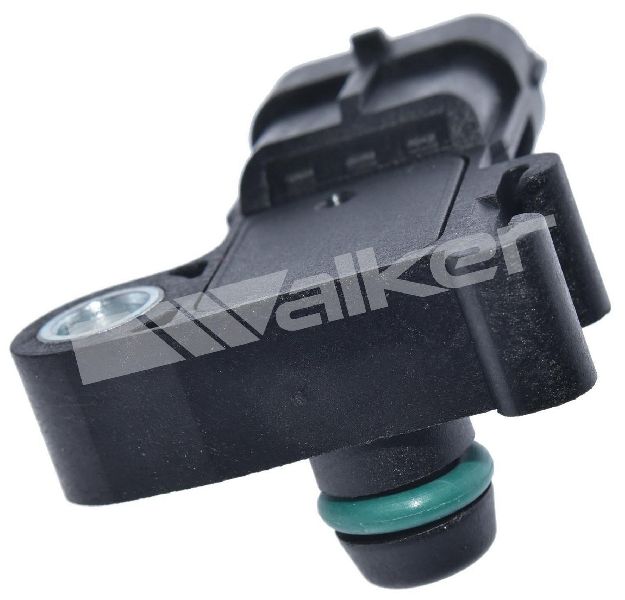
This code almost always means the Manifold Absolute Pressure (MAP) sensor has failed and is stuck sending a high voltage signal. Replacing the sensor is a simple, 15-minute DIY job with a single bolt, and the part costs between $25 for an aftermarket brand and $60 for an OEM ACDelco part.
- P0108 on a 1.8L Sonic is almost certainly a bad MAP sensor.
- Diagnosis is fast: if your scan tool shows MAP voltage is stuck near 5V at idle, the sensor has failed.
- This is an excellent DIY repair for beginners. The sensor is easy to access on the back of the intake manifold and is held by only one T30 Torx bolt.
- Do not immediately suspect a vacuum leak for this specific 'circuit high' code; focus on the sensor and its wiring first.
What's Unique About the 2012-2018 Chevrolet Sonic
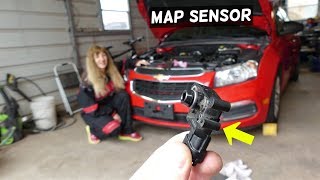
On the 1.8L engine used in the Sonic and Chevrolet Cruze, the P0108 code is overwhelmingly caused by a simple failure of the MAP sensor itself rather than complex wiring or vacuum issues. The sensor is conveniently located on the back of the intake manifold, 🎬 See exactly where the sensor is located on your engine. making it an unusually easy part to access and replace compared to many other vehicles. This makes it a very common and straightforward DIY repair for Sonic owners.
Symptoms You May Notice
- Check Engine Light is on
- Rough or unstable idle
- Hesitation or stumbling during acceleration
- Poor fuel economy
- Engine may stall when coming to a stop
- Black smoke from the exhaust in some cases
- Hard starting
- Replacing the throttle body or other sensors without first testing the MAP sensor's voltage output.
- Assuming a vacuum leak is the cause. While vacuum leaks are common on many cars, for the P0108 'circuit high' code, an electrical fault in the sensor or wiring is far more likely than a physical leak. Vacuum leaks typically set P0106 (range/performance) codes.
Most Likely Causes
- Faulty Manifold Absolute Pressure (MAP) Sensor 🔴 High Probability The sensor is a common failure point due to age and heat cycles. It fails internally, causing the signal circuit to short to its internal 5-volt reference, resulting in a constant high voltage output. This is a well-documented issue on the 1.8L Ecotec engine family.
How to confirm: With a scan tool, observe the MAP sensor voltage at idle. If the voltage is stuck high (at or near 5 volts) and does not decrease as the engine runs, the sensor is bad. At idle, a healthy sensor should read between 1.0 and 1.8 volts.
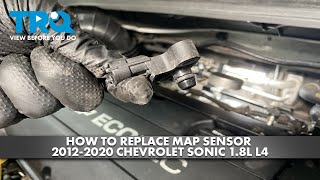
Typical fix: Replace the MAP sensor. It is held to the intake manifold by a single T30 Torx bolt. 🎬 Watch this quick walkthrough on replacing the Sonic MAP sensor. Pro-tip: Lightly lubricate the O-ring on the new sensor with clean engine oil before installation to ensure a good seal and prevent damage.
Est. part cost: $25-$60 - Damaged Wiring or Connector ⚪ Low Probability
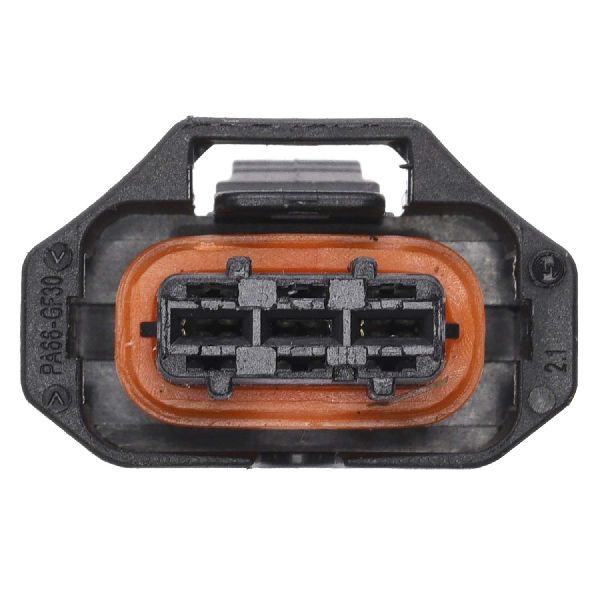
How to confirm: Visually inspect the MAP sensor's wiring harness and connector for any signs of damage, corrosion, or loose pins. Check for rodent damage, as chewed wires can cause a short to power. With the connector unplugged and key on, use a multimeter to verify you have a 5-volt reference and a good ground at the connector.
Typical fix: Repair the damaged section of the wiring harness or clean/replace the connector pigtail.
Est. part cost: $10-$30
Rare But Worth Checking
- Clogged Catalytic Converter: A severely restricted exhaust can cause pressure to build in the intake, leading to a higher-than-normal MAP sensor reading. This would be accompanied by a significant loss of engine power, especially at higher RPMs, and likely other exhaust-related codes.
- Faulty Engine Control Module (ECM): In very rare instances, the fault can be internal to the ECM's circuitry. This should only be considered after the sensor and wiring have been definitively ruled out as the cause. Sometimes a cluster of unrelated sensor codes can point to an ECM or reference voltage issue.
Diagnosis Steps
- Connect an OBD-II scanner to confirm the P0108 code is present and check for any other codes.
- With the scanner, view the live data for the MAP sensor. With the Key On, Engine Off (KOEO), the voltage should be high, around 4.5-5.0V, reflecting atmospheric pressure.
- Start the engine. At idle, the MAP sensor voltage should drop to between 1.0V and 1.8V due to engine vacuum.
- If the voltage remains stuck high (above 4.4V) while the engine is idling, the MAP sensor is defective and needs to be replaced.
- If the voltage reading is erratic or seems incorrect, turn the engine off. Disconnect the sensor and inspect the electrical connector and wiring for corrosion, damage, bent pins, or loose wires.
- If the wiring looks good, use a multimeter to test the connector (with it unplugged from the sensor and key on). Verify the presence of a 5V reference wire (4.8V-5.2V) and a good ground wire (less than 0.10V).
- Before installing the new sensor, ensure the old O-ring came out with the old sensor. Lightly lubricate the new O-ring with clean engine oil.
- If the sensor and wiring test good, the issue may be a severe exhaust restriction or, rarely, a faulty ECM.
Parts You'll Likely Need
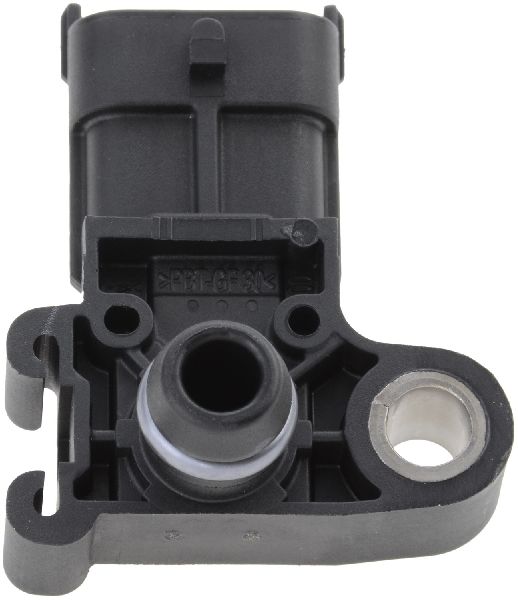
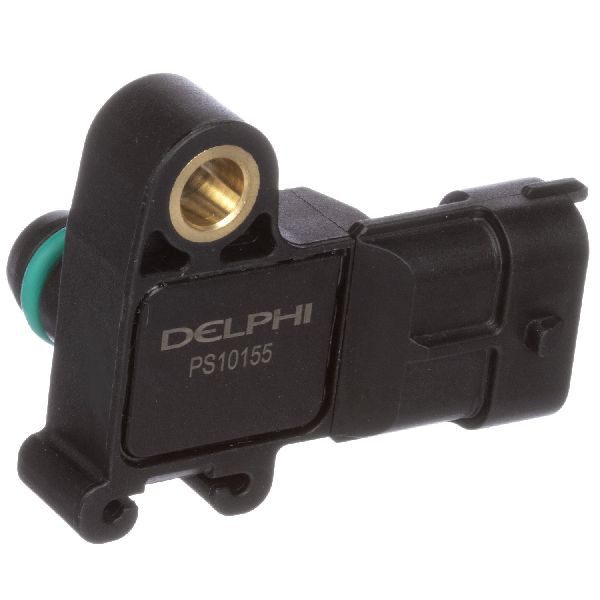
- Manifold Absolute Pressure (MAP) Sensor
(OEM #55567257)— This is the most common failure point for code P0108 on this engine. The sensor fails internally, causing a persistent high voltage signal.
Trusted brands: ACDelco, Standard Motor Products, Bosch, Delphi
OEM price range: $50-$70
Aftermarket price range: $25-$45
Technical Service Bulletins (TSBs) & Recalls
- While no specific TSB for P0108 on the 1.8L Sonic was found, a related bulletin for the 1.4L engine (TSB 12-06-04-004B) addresses a P0107 code caused by a poor terminal connection at the ECM. This serves as a reminder that wiring issues, though rare for this specific P0108 fault, can occur anywhere in the circuit.
- A manufacturer service bulletin for other Chevrolet models, TSB Bulletin #N212330660, notes that customers may notice the service engine soon lamp illuminate with DTCs P0106 and P0108 present as active or stored in history, requiring a MAP sensor replacement.
- Similarly, TSB Bulletin #PIP5787A describes instances where the check engine light is illuminated and technicians may find P0108 (Manifold Absolute Pressure Sensor Circuit High) along with P0106 or P00C7 codes during inspection.
Platform-Specific Known Issues
- Ice Formation in Extreme Cold: While not specific to the Sonic, GM has issued a TSB for other vehicles noting that in freezing temperatures, ice can form on the MAP sensor port, causing temporary performance issues and codes like P0106. The issue may resolve itself once the engine warms up. This is less likely to cause a P0108 'circuit high' fault but is worth noting in cold climates.
Mechanic-Grade Diagnostic Values
- MAP Sensor 5V Reference Wire Voltage — expected: 4.8V - 5.2V DC with key on, engine off, measured at the sensor connector.. Failure: Voltage below 4.8V or above 5.2V indicates a problem with the ECM or wiring, not necessarily the sensor.
- MAP Sensor Ground Wire Voltage Drop — expected: Less than 100 millivolts (0.10V) DC.. Failure: A reading higher than 0.10V indicates high resistance in the ground circuit, which can cause an artificially high signal voltage and trigger P0108.
- MAP Sensor Signal Voltage vs. Applied Vacuum — expected: With the sensor off the car but connected electrically, voltage should be ~4.5V at 0 inHg (atmospheric pressure) and should drop smoothly towards ~1.0V as vacuum is increased to ~21 inHg with a hand pump.. Failure: No change in voltage, or jerky/erratic voltage changes as vacuum is applied, confirms a bad sensor. 🎬 Watch: How to test and replace a faulty MAP sensor.
Scan Tool Commands That Help
- GDS2 (GM Dealer Tool): Module Diagnostics > ECM > Data Display — This is not a bidirectional command but the primary function used by technicians to monitor the live MAP sensor voltage (and pressure) data to see if it is stuck high, which is the main diagnostic step.
Wiring & Ground Locations
- MAP Sensor Connector (at sensor) — On the back of the plastic intake manifold, center-right.. This is the primary point of failure (the sensor itself) and the first place to test for 5V reference, ground, and signal.
- ECM Connector X1 Pins (at ECM) — The Engine Control Module is located on the left side of the engine compartment, near the strut tower.. Based on wiring diagrams for the 1.8L engine, the MAP sensor circuit corresponds to these pins: Pin 8 (Signal), Pin 25 (5V Reference), and Pin 5 (Low Reference/Ground). Testing here can rule out a wiring break between the sensor and the ECM.
- G104 / G107 — Lower right rear of the engine block.. This is a critical ground point for the ECM. A loose or corroded connection here can cause a variety of sensor codes, including P0108, due to an unstable ground reference.
- G105 — Left front of the engine compartment, near the underhood fuse block.. This is another primary ground for the ECM. A poor connection here was noted in a GM bulletin for other issues as a source of intermittent electrical problems.
OEM Part Supersession History
12592525→55567257— Standard part update and consolidation by GM.
Heads up: While some vendor sites state this part requires programming, this is generally for other applications (e.g., 1.4L Turbo where it also functions as a boost pressure sensor) and is not required for the 1.8L engine in the Sonic.
Diagnostic Flowchart
Real Owner Stories
Aggregated from forums and TSBs cited above. Mileages and costs reflect what owners reported in those sources.
Chevrolet Cruze 1.8L
Symptoms: Experienced rough idle, stalling symptoms, and a P0108 code.
What fixed it: Replaced the MAP sensor with ACDelco part 213-4760, which served as the definitive fix.
Source hint: cruzetalk.com
Chevrolet Sonic 1.8L
Symptoms: Experienced engine performance issues and related check engine codes.
What fixed it: Replaced the MAP sensor as a simple DIY repair.
Source hint: sonicownersforum.com
2018 Chevrolet Cruze
Symptoms: Had a cluster of sensor codes simultaneously, including P0108, P0107, and camshaft sensor codes.
What fixed it: Diagnosed as a wiring or ECM reference voltage problem rather than a single failed MAP sensor.
Source hint: reddit.com/r/cruze
Related OBD-II Codes
Frequently Asked Questions
Is there a specific TSB for the P0108 code on my 2012-2018 1.8L Sonic?
What is the exact part number for the replacement MAP sensor on the 1.8L LUW/LWE engine?
My Sonic is stalling at stops and has a rough idle with the P0108 code. Is this normal?
I live in a cold climate. Could freezing temperatures cause the P0108 code on my Sonic?
How do I test the MAP sensor on my 2012-2018 Sonic 1.8L?
What tools do I need to replace the MAP sensor on my 1.8L Sonic?
Helpful Videos

We Have This Part in Stock


The information in this article is provided for general reference and educational purposes only. Vehicle specifications, procedures, and part compatibility can vary by production date, trim level, and region. Always consult your vehicle's factory service manual and verify part numbers before purchasing or performing repairs. Safety-critical components such as airbags, seat belts, and braking systems should be installed by a qualified professional.
- Chevrolet Sonic:
- 🎬 Helpful Videos
- 🛍️ Shop This Part
- What's Unique About the 2012-2018 Chevrolet Sonic
- Symptoms You May Notice
- Most Likely Causes
- Rare But Worth Checking
- Diagnosis Steps
- Parts You'll Likely Need
- Technical Service Bulletins (TSBs) & Recalls
- Platform-Specific Known Issues
- Mechanic-Grade Diagnostic Values
- Scan Tool Commands That Help
- Wiring & Ground Locations
- OEM Part Supersession History
- Diagnostic Flowchart
- Real Owner Stories
- Chevrolet Cruze 1.8L
- Chevrolet Sonic 1.8L
- 2018 Chevrolet Cruze
- Related OBD-II Codes
- Frequently Asked Questions
- 🎟️ Get 5% Off