

P0107 on 2011-2015 Kia Optima 2.4L GDI: MAP Sensor Circuit Low Causes and Fixes
On a 2011-2015 Kia Optima with the 2.4L GDI engine, code P0107 is almost always caused by a faulty Manifold Absolute Pressure (MAP) sensor. It's a simple, 15-minute DIY fix with the part costing $25-$60 for an aftermarket replacement or $70-$105 for an OEM sensor. Before replacing, always perform a 'tug test' on the wiring at the connector, as a broken wire is a common secondary cause.
- P0107 on your 2011-2015 Optima almost always points to a bad MAP sensor.
- The repair is very DIY-friendly, requires only a 10mm socket, and takes less than 15 minutes.
- Before buying a new sensor, always perform a quick visual inspection and 'tug test' on the wiring at the connector for any obvious damage.
- When replacing the sensor, check for oil in the intake manifold port, as this could indicate a failing PCV valve that should also be replaced.
- Using a genuine Kia/Hyundai sensor or a reputable aftermarket brand like Bosch or Delphi is recommended to avoid premature failure.
What's Unique About the 2011-2015 Kia Optima
The 2011-2015 Optima uses the Theta II GDI engine, which has a couple of quirks related to this code. The MAP sensor itself is a very common failure item. Additionally, the Positive Crankcase Ventilation (PCV) system on these engines can allow oil vapor into the intake manifold, which can contaminate and foul the MAP sensor, causing it to fail and trigger a P0107 code. While the sensor is the primary culprit, checking for oil residue in the intake port when you remove the old sensor is a key platform-specific diagnostic step. It's also critical to be aware that this engine platform is subject to a major recall (SC147) for catastrophic rod bearing failure; other engine codes should be diagnosed with this in mind.
Symptoms You May Notice
- Check Engine Light is on
- Rough or unstable idle
- Engine hesitation or poor acceleration
- Reduced fuel economy
- Engine stalling, especially when coming to a stop
- Engine running rich or lean
- Black smoke from the exhaust
- Replacing the throttle body. The symptoms of a bad MAP sensor (rough idle, stalling) can sometimes be mistaken for a throttle body issue, but P0107 specifically points to the MAP sensor circuit.
Most Likely Causes
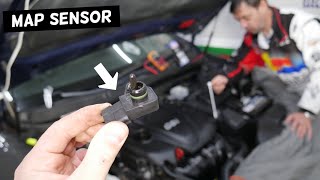
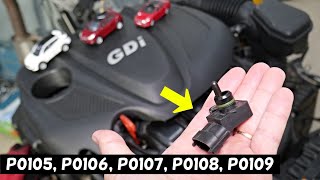
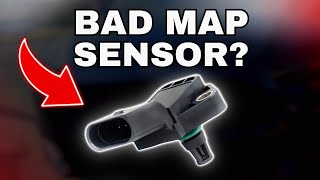
- Faulty Manifold Absolute Pressure (MAP) Sensor 🔴 High Probability This is the most common failure point for P0107 on this platform. The sensor's internal electronics fail from constant heat cycles and engine vibration, or from oil contamination.
How to confirm: With the key on and engine off, use a scan tool to check live data. A voltage reading below 0.5V points to a faulty sensor or circuit. The sensor is located on top of the intake manifold and is easy to access.
Typical fix: Replace the MAP sensor. It is held in place by a single 10mm bolt. Ensure the old O-ring is removed with the old sensor.
Est. part cost: $25-$105 - Damaged Wiring or Loose Connector 🟡 Medium Probability The wiring harness in the engine bay is exposed to heat and vibration, which can make wires brittle and cause them to break over time, often right at the connector. On some related platforms, the harness clip can break, allowing wires to fall into the radiator fan.
How to confirm: Visually inspect the MAP sensor's three-wire connector for corrosion, damage, or loose pins. Perform a gentle 'tug test' on each wire at the back of the connector to see if one pulls out. A real-world example from an owner on optimaforums.com with a 2012 Optima EX 2.4L found a broken wire was the true cause of P0107 and P0106 codes, even after a new sensor didn't fix it.
Typical fix: If a wire is broken, repair the damaged section or install a new pigtail connector. Clean any corrosion from the terminals.
Est. part cost: $10-$30 - Oil Contamination from PCV System ⚪ Low Probability A failing or stuck-open PCV valve can allow excessive oil into the intake manifold, fouling the MAP sensor. This is a known issue on some higher-mileage Theta II GDI engines which are prone to oil consumption.
How to confirm: When you remove the MAP sensor, inspect its tip and the port in the intake manifold for significant oil residue. The sensor may be visibly coated in oil.
Typical fix: Clean the oil from the intake manifold port and replace the MAP sensor. It is also highly recommended to replace the PCV valve to prevent the new sensor from failing for the same reason.
Est. part cost: $10-$25 for a PCV valve
Rare But Worth Checking
- Major Vacuum Leak: While more likely to cause a P0106 performance code, a very large vacuum leak (e.g., a disconnected brake booster hose) can sometimes cause the MAP sensor reading to be abnormally low, triggering P0107.
- Faulty Powertrain Control Module (PCM): This is very rare. The PCM should only be considered a potential cause after the MAP sensor, its wiring, and all other possible causes have been definitively ruled out.
Diagnosis Steps
- Connect an OBD-II scanner to confirm P0107 is the active code and check for any other codes, paying special attention to P0106 or P1326.
- Visually inspect the MAP sensor, which is located on top of the intake manifold, for any obvious damage.
- Inspect the MAP sensor's electrical connector and wiring harness. Look for loose connections, corrosion, or damaged/brittle wires. Perform a gentle 'tug test' on the wires at the back of the connector.
- With the ignition on but the engine off (KOEO), unplug the sensor's connector. Use a multimeter to test the terminals in the harness-side connector. You should find one wire with a 5-volt reference signal, one with a good ground (near 0 volts), and the signal wire.
- If the 5V reference or ground is missing, there is a wiring issue or a problem with the PCM. If they are present, the issue is likely the sensor itself.
- If you have a scan tool with live data, observe the MAP sensor voltage with the key on and engine off (KOEO). It should be high (around 4.5V-5.0V depending on altitude). At a warm idle, it should drop to 1.0-1.5V. If the voltage is stuck below 0.5V, the sensor or its signal circuit is faulty.
- If all wiring tests pass, remove the single 10mm bolt and replace the MAP sensor. Inspect the old sensor's tip for oil fouling.
- After replacement, clear the codes with the scanner and start the vehicle to ensure the Check Engine Light does not return.
Parts You'll Likely Need
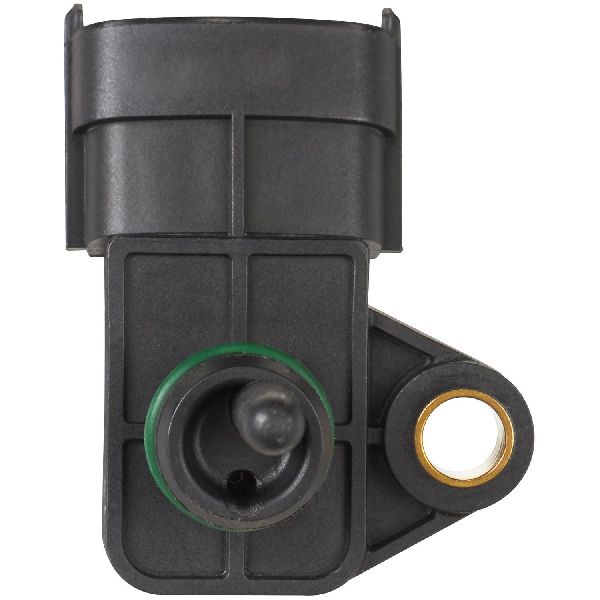
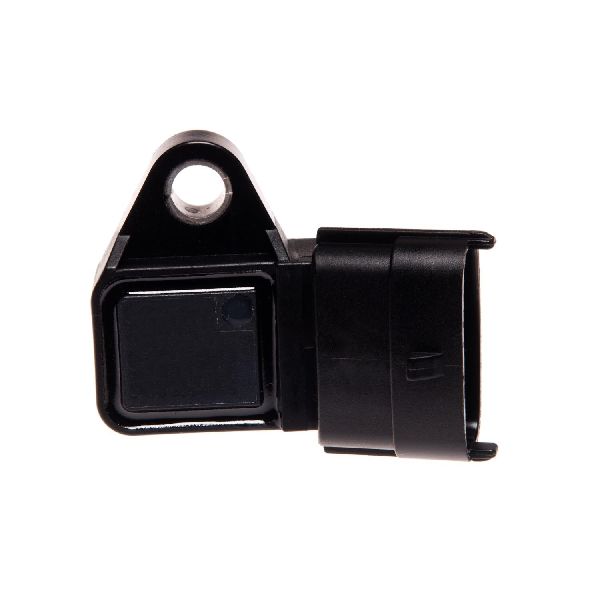
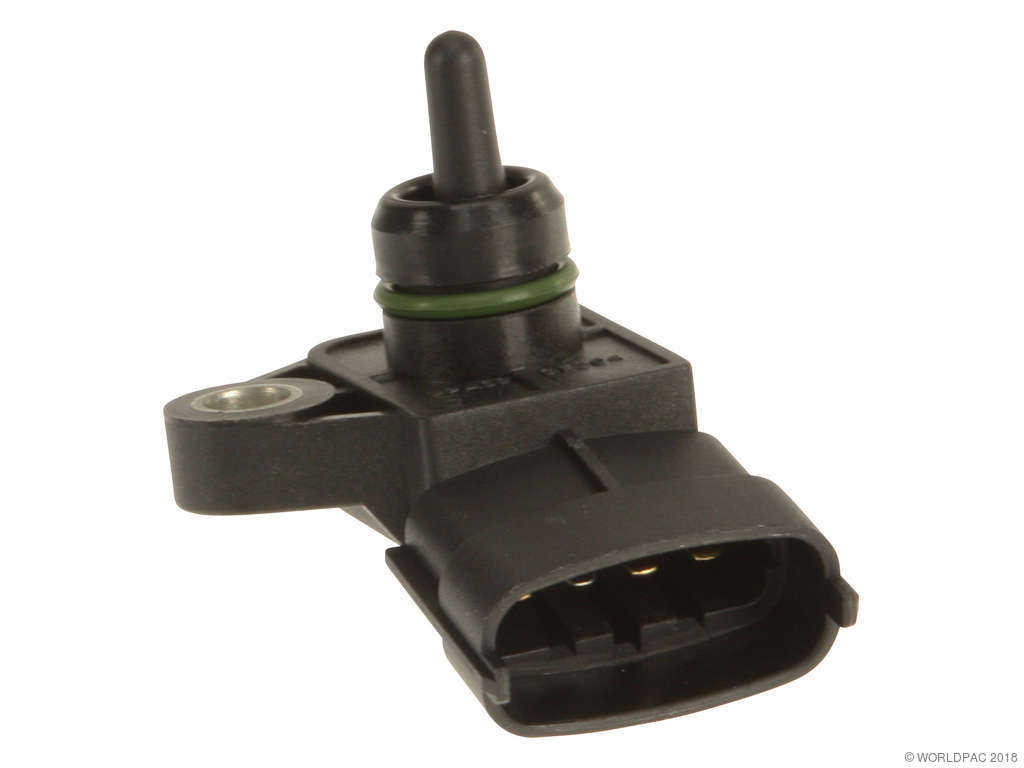
- Manifold Absolute Pressure (MAP) Sensor
(OEM #39300-2G000 (or 39300-2B000); superseded by 39300-84400)— This is the most common component to fail and cause code P0107 on this vehicle. The original part number was often 39300-2G000, which has since been updated by Kia/Hyundai to 39300-84400.
Trusted brands: Genuine Hyundai/Kia, Bosch, Delphi, NGK/NTK, Duralast
OEM price range: $70-$105
Aftermarket price range: $25-$60
Related Codes That Often Appear With This One
- P0106 — This code for 'MAP Sensor Range/Performance' can appear if the sensor's signal is erratic, not just low. It's common to see both codes when a wiring issue is present.
- P0108 — This code for 'MAP Sensor Circuit High' can appear alongside P0107 if the sensor is failing erratically or if there's an intermittent wiring short.
- P1326 — This code for the Knock Sensor Detection System is a major red flag on this engine. It indicates potential rod bearing failure. If you see P1326 with P0107, you should stop driving and investigate the engine's mechanical health immediately under the extended lifetime warranty.
Technical Service Bulletins (TSBs) & Recalls
- TSB CHA060 / CHA072 / CS1604: While not for P0107, these bulletins address the common steering coupler degradation issue. Symptoms like clunking noises can occur, and it's a well-known problem for this platform.
- TSB ENG222: Outlines the official procedure for dealers to test for excessive oil consumption, a common precursor to more severe engine issues on the Theta II GDI.
Platform-Specific Known Issues
- The Theta II 2.4L GDI engine is subject to a recall and lifetime warranty extension for potential connecting rod bearing failure (NHTSA Campaign 17V224000 / Kia Recall SC147). While P0107 is unrelated, the TSB for the engine inspection notes that other DTCs (like P0107) should be diagnosed and repaired first. The presence of a P1326 code is a direct indicator of this issue.
Mechanic-Grade Diagnostic Values
- MAP Sensor Signal Voltage (Key On, Engine Off) — expected: ~4.5V - 5.0V (should correlate with Barometric Pressure). Failure: A reading stuck below 0.5V, often near 0V, indicates a hard fault.
- MAP Sensor Signal Voltage (Engine at Warm Idle) — expected: 1.0V - 1.5V. Failure: Voltage remains high near the KOEO reading or is stuck below 0.5V.
- P0107 Trigger Threshold — expected: Signal voltage must remain above 0.5V.. Failure: The PCM sets P0107 when the signal voltage is detected below 0.5V for several seconds. Some sources state the threshold can be as low as 0.20V or 0.25V.
- 5V Reference Wire Voltage (at harness connector, KOEO) — expected: ~5.0V. Failure: Missing or low voltage indicates a wiring issue or a fault in the PCM.
- Ground Wire Integrity (at harness connector) — expected: < 0.10V or < 10 Ω resistance to chassis ground. Failure: Voltage significantly above 0.1V or high resistance indicates a poor ground connection.
- MAP Sensor Resistance (between terminals on sensor) — expected: Approximately 2.4 kΩ (kilo-ohms). Failure: A reading significantly different from 2.4 kΩ suggests internal sensor failure.
Scan Tool Commands That Help
- Kia GDS / KDS: Live Data Graphing — This function is used to monitor the MAP sensor voltage in real-time while performing tests like wiggling the harness or applying vacuum with a hand pump. It helps differentiate between a constantly failed sensor and an intermittent wiring issue.
Wiring & Ground Locations
- MAP Sensor Connector — On top of the plastic intake manifold, usually just past the throttle body, held by a single 10mm bolt.. This is the primary connection point for all electrical tests. The three pins are for the 5V reference, ground, and the signal wire back to the PCM. A poor connection or broken wire here is a common cause of P0107.
- MAP Sensor Pinout (Typical) — On the harness-side connector for the MAP sensor.. Knowing the pin functions is crucial for accurate multimeter testing. Pin 1 is typically the 5V reference, Pin 2 is the ground, and Pin 3 is the signal wire. However, wire colors can vary, so confirming with a diagram is best practice.
- Main Engine Ground — Key grounding points are typically located on the cylinder head, engine block, and a ground strap connects the engine to the chassis.. A poor main engine ground can cause a variety of electrical issues, including skewed sensor readings. While less likely to cause an isolated P0107, it should be checked if multiple electrical faults are present.
OEM Part Supersession History
39300-2G000→39300-84400— Standard part update by the manufacturer for improved reliability or sourcing.
Heads up: The new part number (39300-84400) is the correct service replacement for the original (39300-2G000) and is fully compatible. Note that part number 39300-2B000 is also used on some related Kia/Hyundai engines but 39300-2G000 is the primary part for the 2.4L GDI.
Model Year Variations Within This Range
- 2014-2015: For the 2014 model year facelift, the base 2.4L GDI engine's power was standardized to 192 hp across all trims, whereas some 2011-2013 models were rated at 200 hp. This change does not affect the diagnosis or repair of a P0107 code.
Diagnostic Flowchart
Other Known Issues on This Vehicle
Issues unrelated to this code that are worth knowing about as an owner of this generation:
- Catastrophic Engine Failure (Rod Bearing Wear) 🔴 High — Widespread across 2011-2015 models. Caused by manufacturing debris restricting oil flow to connecting rod bearings, leading to knocking and engine seizure. (Ref: NHTSA Campaign 17V224000 (Kia Recall SC147); Class-action settlement extended lifetime warranty for affected vehicles.)
- Degrading Steering Coupler 🟠 Medium — Very common. The flexible rubber coupler in the electronic power steering (MDPS) column disintegrates, causing a distinct clicking or clunking noise when turning the wheel. (Ref: Kia Customer Satisfaction Program CS1604 / TSB CHA072 extended the warranty for this part. TSB CHA060 also addresses related steering feel issues.)
- Intake Valve Carbon Buildup 🟠 Medium — An inherent issue for all GDI engines, including the Theta II. Symptoms like rough idle, hesitation, and misfires (P0300) often appear after 60,000 miles. Requires manual cleaning (e.g., walnut blasting).
- Excessive Oil Consumption 🔴 High — Frequently reported by owners, often as a precursor to engine failure. Many report adding a quart of oil every 1,000 miles or less. A faulty PCV valve can be a contributing factor. (Ref: Related to engine recall SC147. Kia has an official oil consumption test procedure (TSB ENG222).)
- Cracked Low-Pressure Fuel Hose 🔴 High — Common on 2013-2014 models. The fuel hose can deteriorate from engine heat, crack, and leak fuel, posing a significant fire risk. (Ref: NHTSA Recall 18V-907000 / Kia Campaign SC172.)
Used vs. New Parts: Buying Guide for This Vehicle
When a used part is the smart pick: A used MAP sensor from a low-mileage donor vehicle is a reasonable choice for this repair. Since it's an external electronic part and not a major wear item, a used OEM sensor can be more reliable than a cheap, new aftermarket part. It's a simple plug-and-play component, making a junkyard replacement a cost-effective option.
Donor-vehicle mileage cap: roughly under 80000 miles for the part to have meaningful remaining life.
What to inspect on the donor part:
- Check the vehicle's mileage if possible; lower is always better.
- Inspect the plastic housing of the sensor for cracks or heat damage.
- Look at the electrical connector pins on the sensor; they should be clean, straight, and free of corrosion.
- Ensure the O-ring is present and not flattened or cracked, though replacing it is always good practice.
OEM-only on this vehicle (don't cheap out):
- While not required, using a genuine Hyundai/Kia OEM sensor (new or used) is highly recommended to avoid potential compatibility or quality issues with some aftermarket brands.
Aftermarket brands forum-validated for this vehicle:
- Bosch
- Delphi
- NGK / NTK
- Standard Motor Products (SMP)
Brands owners have reported issues with on this vehicle:
- Unbranded, no-name sensors from online marketplaces should be avoided as their calibration and longevity can be questionable, potentially causing performance issues or premature failure.
Real Owner Stories
Aggregated from forums and TSBs cited above. Mileages and costs reflect what owners reported in those sources.
2012 Kia Optima EX 2.4L GDI
Symptoms: Stalling and presence of P0107 and P0106 codes. A new sensor did not fix the problem.
What fixed it: Found a broken wire in the wiring harness after performing a inspection.
Source hint: reddit.com/r/MechanicAdvice, thread '2012 kia optima ex...'
2012 Kia Optima 2.4L GDI
Symptoms: Engine stalling and a Check Engine Light with code P0107.
What fixed it: Replacing the MAP sensor on top of the intake manifold.
Source hint: optimaforums.com, thread 'P0107 map sensor and stalling'
2012 Kia Optima SX
Symptoms: Stalling issues and active P0107 code.
What fixed it: Replacement of the MAP sensor.
Source hint: optimaforums.com, thread '2012 Optima SX MAP Sensor P0107'
Related OBD-II Codes
Frequently Asked Questions
Where is the MAP sensor located on my 2011-2015 Kia Optima 2.4L GDI?
Could my P0107 code be related to the major engine recall on the Theta II engine?
I replaced the MAP sensor but the P0107 code is still there. What should I check next?
Can a dirty PCV valve cause a P0107 code on the Optima?
Is there a specific TSB for oil consumption that might be fouling my sensors?
What should the voltage readings be for a healthy MAP sensor on this Kia?
Helpful Videos

We Have This Part in Stock


The information in this article is provided for general reference and educational purposes only. Vehicle specifications, procedures, and part compatibility can vary by production date, trim level, and region. Always consult your vehicle's factory service manual and verify part numbers before purchasing or performing repairs. Safety-critical components such as airbags, seat belts, and braking systems should be installed by a qualified professional.
- Kia Optima:
- 🎬 Helpful Videos
- 🛍️ Shop This Part
- What's Unique About the 2011-2015 Kia Optima
- Symptoms You May Notice
- Most Likely Causes
- Rare But Worth Checking
- Diagnosis Steps
- Parts You'll Likely Need
- Related Codes That Often Appear With This One
- Technical Service Bulletins (TSBs) & Recalls
- Platform-Specific Known Issues
- Mechanic-Grade Diagnostic Values
- Scan Tool Commands That Help
- Wiring & Ground Locations
- OEM Part Supersession History
- Model Year Variations Within This Range
- Diagnostic Flowchart
- Other Known Issues on This Vehicle
- Used vs. New Parts: Buying Guide for This Vehicle
- Real Owner Stories
- 2012 Kia Optima EX 2.4L GDI
- 2012 Kia Optima 2.4L GDI
- 2012 Kia Optima SX
- Related OBD-II Codes
- Frequently Asked Questions
- 🎟️ Get 5% Off