

P0106 on 2020-2024 Ford Explorer 3.3L: Causes and Fixes for MAP Sensor Issues
On a 2020-2024 Ford Explorer, P0106 is most often caused by a faulty Manifold Absolute Pressure (MAP) sensor. Before replacing it, check for vacuum leaks and inspect the wiring. A replacement sensor is typically under $100 for an aftermarket part. If the vehicle is new, the code may be a one-time glitch from altitude changes during transport that can be cleared.
- P0106 on a 2020-2024 Explorer points to a problem with the MAP sensor's signal.
- The most likely fix is replacing the MAP sensor itself, but always check for vacuum leaks first.
- If the vehicle is brand new, the code might be a temporary glitch from being transported to a different altitude; clear the code first.
- A faulty vacuum harness between the intake, EGR, and fuel pressure sensor has been identified as a specific fix for this code on Explorers.
- If the code appears after a battery disconnect or throttle body cleaning, an idle relearn procedure may be required.
What's Unique About the 2020-2024 Ford Explorer
For the 2020-2024 Ford Explorer, particularly models with the 3.3L V6 (including Police Interceptors), this code can sometimes be triggered by significant altitude changes during vehicle transport, as noted in Ford TSBs. In these specific cases, the PCM's stored barometric pressure reading from the original location conflicts with the new reading at the next key-on, setting the code without a mechanical fault. Otherwise, the causes are typical for a modern gasoline engine, with the MAP sensor itself being a common point of failure.
Symptoms You May Notice
- Check Engine Light is on
- Rough or unstable idle
- Hesitation or surging during acceleration
- Decreased fuel economy
- Engine stalling in some cases
- Hard starting
- Black smoke from the exhaust
- Replacing the throttle body without checking MAP sensor data or for vacuum leaks.
- Replacing oxygen sensors when the incorrect air-fuel mixture is actually caused by a bad MAP reading.
Most Likely Causes
- Faulty Manifold Absolute Pressure (MAP) Sensor 🔴 High Probability Sensors can fail over time due to heat cycles and internal component degradation. Carbon and oil buildup from the PCV and EGR systems can also contaminate the sensor element, leading to inaccurate readings.
How to confirm: Use a scan tool to monitor the MAP sensor's live data. With Key On, Engine Off (KOEO), the MAP reading should be nearly identical to the Barometric Pressure (BARO) reading (approx. 4.5 Volts). At idle, the voltage should drop to around 1.0-1.8 Volts and then rise smoothly back toward 4.5V with sharp acceleration.
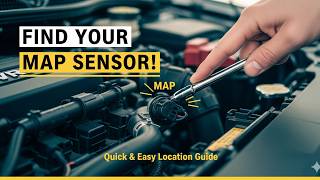
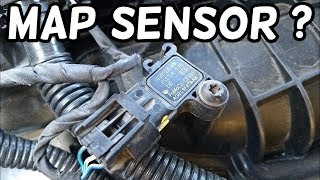
Typical fix: Replace the MAP sensor. It is typically located on the intake manifold and secured with a single bolt. 🎬 Watch: A quick guide to finding the MAP sensor location.
Est. part cost: $50-$150 - Vacuum Leak 🟡 Medium Probability Vacuum hoses (especially PCV lines) and intake gaskets can become brittle and crack over time, leading to unmetered air entering the engine and skewing MAP sensor readings.
How to confirm: Perform a visual inspection of all vacuum lines connected to the intake manifold. A smoke test is the most effective method for finding 🎬 See this quick guide on how to smoke test for leaks. hard-to-see leaks.
Typical fix: Replace the cracked hose or leaking gasket.
Est. part cost: $10-$75 - Wiring or Connector Issue ⚪ Low Probability Vibrations and heat can cause wires to break or the connector to become loose or corroded. A poor connection at the main engine bay ground point (G103) can also introduce electrical noise and cause erratic sensor readings.
How to confirm: Visually inspect the MAP sensor's 3-pin electrical connector and wiring harness for damage, corrosion, or loose pins. Use a multimeter to check for the correct reference voltage (usually 5V), a good ground, and a signal wire that changes voltage with vacuum applied.
Typical fix: Repair the damaged wire or clean/replace the connector.
Est. part cost: $5-$50 - Altitude Change During Transport ⚪ Low Probability As documented in Ford TSBs SSM 50156 and SSM 49446, new vehicles transported to a different altitude can set this code when first started. This is especially noted for the Police Interceptor Utility.
How to confirm: If the vehicle was recently purchased and delivered from another region, this is a strong possibility. The code will likely not return after being cleared.
Typical fix: Clear the diagnostic trouble code with a scan tool.
Est. part cost: $0
Rare But Worth Checking
- Clogged Catalytic Converter: A severely restricted exhaust can increase backpressure, affecting manifold pressure readings. This is usually accompanied by a severe loss of power and potentially other exhaust-related codes.
- Dirty Throttle Body: Heavy carbon buildup around the throttle plate can disrupt airflow at idle and low speeds, causing the PCM to see an irrational MAP reading compared to the throttle position. A forum report on a platform-sharing Lincoln Aviator with P0106 required a full throttle body replacement to fix the issue.
- Faulty Powertrain Control Module (PCM): This is extremely rare and should only be considered after all other possibilities have been exhaustively ruled out.
Diagnosis Steps
- Connect an OBD-II scanner to read the code and check for any other stored codes.
- View freeze frame data to see the engine conditions when the code was set.
- Use the scanner's live data function to monitor the MAP sensor voltage/pressure. With Key On, Engine Off (KOEO), the MAP reading should be close to the Barometric Pressure (BARO) reading, around 4.5 volts.
- Start the engine. At idle, the MAP reading should be low (around 1.0-1.8 volts). Snap the throttle and watch for a smooth and responsive rise in voltage toward 4.5V.
- Visually inspect the MAP sensor, its connector, and wiring for any signs of damage, corrosion, or oil contamination.
- Inspect all vacuum hoses connected to the intake manifold for cracks, breaks, or loose connections.
- If a vacuum leak is suspected, perform a smoke test to pinpoint the source.
- If the sensor is suspected, test its circuit. Check for a 🎬 Watch: How to perform professional circuit testing on your MAP sensor. 5-volt reference, a good ground (check continuity to ground G103), and a signal wire that changes voltage with vacuum applied.
- If all wiring and vacuum systems are good, the MAP sensor is the most likely culprit.
Parts You'll Likely Need
- Manifold Absolute Pressure (MAP) Sensor
(OEM #BB5Z-9F479-B (superseded by BB5Z-9F479-C))— This is the most common component to fail and directly cause a P0106 code.
Trusted brands: Motorcraft, Bosch, NTK, Delphi
OEM price range: $80-$150
Aftermarket price range: $40-$100
Related Codes That Often Appear With This One
- P0107: Manifold Absolute Pressure/Barometric Pressure Circuit Low Input
- P0108: Manifold Absolute Pressure/Barometric Pressure Circuit High Input
- P0068: MAP/MAF - Throttle Position Correlation
Technical Service Bulletins (TSBs) & Recalls
- SSM 50156: Addresses P0106 appearing after vehicle transport due to altitude changes on 2021 models.
- SSM 49446: An earlier TSB also addressing the altitude change issue on 2021 models, specifically mentioning the 3.3L Police Interceptor.
Platform-Specific Known Issues
- Ford Technical Service Bulletins (TSBs) SSM 50156 and SSM 49446 mention that this code can appear on new vehicles, especially Police Interceptor Utilities, after transport to a different altitude. The first step should be to simply clear the code.
Mechanic-Grade Diagnostic Values
- MAP Sensor Signal Voltage (Key On, Engine Off) — expected: ~4.5 V (at sea level, should match BARO reading). Failure: Voltage is significantly different from the BARO sensor reading or is not steady.
- MAP Sensor Signal Voltage (Engine at Idle) — expected: 1.0 - 1.8 V. Failure: Voltage remains high, near the KOEO reading, or is erratic.
- MAP Sensor 5V Reference Voltage (VREF) — expected: 4.8 - 5.2 V. Failure: Voltage is low or absent, indicating a wiring or PCM issue, not a sensor failure.
- MAP Sensor Ground Circuit Voltage — expected: < 0.05 V. Failure: Any significant voltage reading indicates a poor ground connection.
Hidden / Shadow Codes Worth Checking
- Mode 6 Data: While not a 'shadow code,' advanced scan tools like FORScan can analyze Mode 6 data to reveal underlying issues like low-level misfire counts that haven't yet triggered a dedicated misfire code but could be contributing to the irrational MAP signal. (see via FORScan or other professional-grade scan tool with Mode 6 capability.)
Scan Tool Commands That Help
- Ford IDS / FDRS: Datalogger — Use this function to record live data streams for MAP, BARO, throttle position, and engine RPM during a test drive. This is essential for diagnosing an intermittent P0106 by allowing you to graph the sensor relationships and spot moments where the MAP reading becomes irrational relative to engine load.
Wiring & Ground Locations
- G103 — Located on the right-front of the engine compartment, typically on the body structure/fender apron.. This is a primary engine bay ground point. The MAP sensor's reference ground circuit may rely on this point. A loose or corroded G103 can introduce electrical noise, causing erratic and incorrect sensor readings that trigger a P0106.
Real Owner Repair Stories
- YouTube user @rjcartutorials (Ford Explorer (year not specified, but relevant body style)) — Persistent P0106 code.
❌ Tried (didn't work) Replacing the EGR valve
✅ What actually fixed it The problem was a faulty vacuum harness. Specifically, the harness that runs from the intake manifold to the EGR valve, with a leg that also connects to the fuel pressure sensor, had failed. Replacing this entire harness resolved the code. - Reddit user reports (Various makes/models, pattern is applicable) — P0106 code appears immediately after maintenance.
❌ Tried (didn't work) Clearing the code, which would sometimes return.
✅ What actually fixed it The code appeared after the battery was disconnected or the throttle body was cleaned. The fix was to perform an idle relearn procedure. This involves letting the vehicle idle uninterrupted for 10-15 minutes for the PCM to recalibrate the new baseline idle airflow and throttle position, which the MAP sensor reading is compared against.
"I Checked Everything" — The Actual Cause
- On related Ford EcoBoost engines, a hairline crack in a plastic intake manifold can pass a standard vacuum smoke test, but will leak pressure under boost, causing a P0106. The correct test in this case is to pressurize the intake system and listen for leaks or spray with soapy water.
- A faulty vacuum harness with an internal leak or a crack that only opens under specific temperature or vibration conditions may not show up on a simple smoke test but was the ultimate cause of a P0106 in one documented case.
OEM Part Supersession History
BB5Z-9F479-B→BB5Z-9F479-C— Not officially documented, but supersessions typically indicate a revision for improved reliability, material change, or a different supplier to address a known issue.
Model Year Variations Within This Range
- 2023 vs 2024: The 3.3L V6 hybrid powertrain was available to the general public on trims like the Limited in 2023 but was eliminated as a public option for the 2024 model year, largely being reserved for fleet (Police Interceptor) orders.
Diagnostic Flowchart
Other Known Issues on This Vehicle
Issues unrelated to this code that are worth knowing about as an owner of this generation:
- Rear Axle Mounting Bolt Fracture 🔴 High — Widespread enough to trigger multiple recalls (22V255, 23S55) affecting 2020-2022 models. Can lead to loss of power or vehicle rollaway. (Ref: Recall 23S55 / NHTSA 22V255)
- 10R60 Transmission Harsh/Delayed Shifting 🟠 Medium — Common owner complaint across 2020+ models. Often attributed to low transmission fluid from the factory or software issues requiring PCM updates or a main control break-in procedure. (Ref: TSB 23-2176 (for 2.3L but indicative of platform-wide issues))
- Wiring Harness Chafing 🟠 Medium — Affects certain 2020 models with 2.3L and 3.3L engines. The harness can contact the A/C pulley, causing damage. (Ref: Recall 19S32)
- 360-Degree Camera System Failure 🟡 Low — A recall was issued for the rearview camera image flipping or inverting on 2020-2024 models. (Ref: Recall / NHTSA compliance issue)
- Premature Engine Failure (Police Interceptor Utility) 🔴 High — Specific to 3.3L engines in police use, which experience frequent wide-open throttle accelerations. Failures can lead to connecting rod fractures and potential under-hood fires. (Ref: Recall 24V-598)
Used vs. New Parts: Buying Guide for This Vehicle
When a used part is the smart pick: For this repair, used parts are a good option for mechanical components like a replacement intake manifold or a vacuum harness if they are visually inspected for cracks and damage. These parts have no internal wear items that can't be seen.
Donor-vehicle mileage cap: roughly under 60000 miles for the part to have meaningful remaining life.
What to inspect on the donor part:
- For a vacuum harness, check for flexibility; avoid any that are brittle or stiff.
- For an intake manifold, ensure all mounting points are intact and there are no visible cracks or signs of heat warping.
- Verify the donor vehicle was not in a front-end collision, which could have caused unseen stress fractures in plastic components.
OEM-only on this vehicle (don't cheap out):
- Powertrain Control Module (PCM) - Due to programming and security requirements, a PCM should always be sourced new from the dealer or a specialized programming service.
Aftermarket brands forum-validated for this vehicle:
- Motorcraft (OEM)
- Bosch
- NTK/NGK
- Delphi
Brands owners have reported issues with on this vehicle:
- Avoid generic, unbranded sensors from online marketplaces. While cheap, they often have poor accuracy and a high failure rate, frequently causing the code to return.
Real Owner Stories
Aggregated from forums and TSBs cited above. Mileages and costs reflect what owners reported in those sources.
2021 Ford Explorer Police Interceptor Utility 3.3L
Symptoms: The vehicle was recently delivered/transported to a new region and the P0106 code was present upon the first start.
What fixed it: Cleared the diagnostic trouble code with a scan tool as the code was triggered by altitude changes during transport.
Source hint: SSM 49446
2020 Lincoln Aviator 3.3L Hybrid
Symptoms: P0106 code present with symptoms similar to the Explorer platform-mate.
What fixed it: Replacing the throttle body.
Source hint: Go-parts.com blog: 'P0106 on 2021 Ford Explorer: MAP Sensor Performance and Altitude Fixes'
Related OBD-II Codes
Frequently Asked Questions
I just bought a 2021 Ford Explorer Police Interceptor and the P0106 code is on. Does TSB SSM 49446 apply to me?
Could a wiring issue be causing the erratic MAP sensor readings on my 2020 Explorer 3.3L?
Is there a recall for the 3.3L engine in the Police Interceptor that I should be aware of while fixing this?
What are the specific voltage specs I should look for when testing the MAP sensor on my 3.3L V6?
My 2021 Explorer was just delivered from a different state and the Check Engine Light is on for P0106. Is the sensor broken?
Can a transmission issue on the 2020+ Explorer mimic engine performance problems like P0106?
Helpful Videos
We Have This Part in Stock


The information in this article is provided for general reference and educational purposes only. Vehicle specifications, procedures, and part compatibility can vary by production date, trim level, and region. Always consult your vehicle's factory service manual and verify part numbers before purchasing or performing repairs. Safety-critical components such as airbags, seat belts, and braking systems should be installed by a qualified professional.
- Ford Explorer:
- 🎬 Helpful Videos
- 🛍️ Shop This Part
- What's Unique About the 2020-2024 Ford Explorer
- Symptoms You May Notice
- Most Likely Causes
- Rare But Worth Checking
- Diagnosis Steps
- Parts You'll Likely Need
- Related Codes That Often Appear With This One
- Technical Service Bulletins (TSBs) & Recalls
- Platform-Specific Known Issues
- Mechanic-Grade Diagnostic Values
- Hidden / Shadow Codes Worth Checking
- Scan Tool Commands That Help
- Wiring & Ground Locations
- Real Owner Repair Stories
- "I Checked Everything" — The Actual Cause
- OEM Part Supersession History
- Model Year Variations Within This Range
- Diagnostic Flowchart
- Other Known Issues on This Vehicle
- Used vs. New Parts: Buying Guide for This Vehicle
- Real Owner Stories
- 2021 Ford Explorer Police Interceptor Utility 3.3L
- 2020 Lincoln Aviator 3.3L Hybrid
- Related OBD-II Codes
- Frequently Asked Questions
- 🎟️ Get 5% Off