

P0106 on 2013 Ford Escape 1.6L & 2.0L GTDI: Wiring Splice and Sensor Guide
On a 2013 Ford Escape with a 1.6L or 2.0L EcoBoost engine, code P0106 is most often caused by a faulty wiring splice in the engine harness, not a bad sensor. This is a known issue documented in Ford TSB 13-7-5 and addressed by Safety Recall 14S17. Repairing the specific harness splice is the primary fix, and replacing the sensor alone often fails to solve the problem.
- For a 2013 Escape with an EcoBoost engine, suspect a wiring problem before a sensor problem for code P0106.
- Reference Ford TSB 13-7-5, as it directly addresses the most common cause: a faulty wiring splice.
- A 'wiggle test' of the engine harness while monitoring sensor data is the fastest way to confirm a bad splice.
- Do not confuse the MAP sensor on the intake manifold with the boost pressure (TCBP/CACT) sensor on the charge pipe.
- Simply replacing the MAP sensor has a high probability of not fixing the issue.
What's Unique About the 2013-2013 Ford Escape

For this specific vehicle and its GTDI (EcoBoost) engines, P0106 is uniquely tied to a known manufacturing defect. Ford issued Technical Service Bulletin (TSB) 13-7-5, which was later superseded by Safety Recall 14S17, identifying the primary cause as poorly crimped wiring splices in the engine harness. These splices provide the signal return for the MAP sensor and other critical sensors. This makes a wiring check more critical than on other vehicles where the sensor itself is the usual culprit. These engines also use multiple pressure sensors—a MAP sensor on the intake manifold and a boost pressure sensor (called a TCBP/CACT by Ford) on the charge piping—which can lead to diagnostic confusion if the wrong sensor is inspected or replaced.
Symptoms You May Notice
- Check Engine Light is on
- "Engine Fault Service Now" message on the dashboard
- Rough or unstable idle
- Hesitation or lack of power during acceleration
- Engine stalling, especially at low speeds or when stopping
- Reduced fuel economy
- Crank no start or difficult to start
- Replacing the MAP sensor without first checking the wiring harness splices as per TSB 13-7-5 or Recall 14S17.
- Confusing the MAP sensor on the intake manifold with the Turbocharger Boost Pressure (TCBP/CACT) sensor located on the charge air cooler piping. A Reddit user detailed replacing both sensors on their 2.0L Escape to no avail before realizing it was a wiring issue.
Most Likely Causes

- Faulty Wiring Harness Splice 🔴 High Probability This is a known manufacturing defect documented by Ford in TSB 13-7-5 and Safety Recall 14S17. The signal return splices for the MAP and TCBP/CACT sensors were prone to high resistance from insufficient crimping, causing erratic signals. Forum users have confirmed that fixing a bad splice, sometimes after a faulty recall repair, resolved the code after sensor replacement failed. NHTSA ODI #11123158 describes a situation where the engine shut off unexpectedly while driving; although the MAP sensor was replaced, the vehicle stalled again, pointing directly to the harness as the root cause.
How to confirm: Perform a 'wiggle test' as described in TSB 13-7-5: with the key on and engine off, monitor the MAP sensor PID on a scan tool while gently pushing and pulling on the engine harness near the splice locations. If the voltage reading is unstable, the splice is bad. The key splices are S123 (MAP) & S178 (TCBP) on the 1.6L, and S108 (MAP) & S182 (TCBP) on the 2.0L.
Typical fix: The defective splice must be cut out and replaced with a new, properly sealed solder splice. Ford's recall procedure provides specific instructions for this repair, which involves stripping back the harness tape to access and solder the affected wires.
Est. part cost: $5-$20 for wire, solder, and heat shrink - Defective Manifold Absolute Pressure (MAP) Sensor 🟡 Medium Probability While the wiring is the most common cause, the sensor itself can fail. Oil contamination from the PCV system can also coat the sensor element, leading to incorrect readings. An owner report in NHTSA ODI #11417750 noted that they had the sensor replaced twice while experiencing issues identical to those described in the wiring recall.
How to confirm: If the wiring is confirmed to be good, test the sensor. With a scan tool, check if the MAP reading corresponds to atmospheric pressure with the key on/engine off. The voltage should also change smoothly as engine vacuum changes. A properly functioning MAP sensor should relay a signal between 1 and 4.5 volts. Visually inspect the sensor for oil fouling when removed.
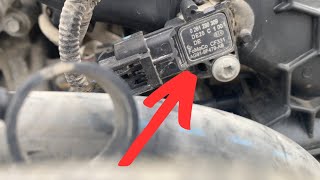
Typical fix: Replace the MAP sensor located on the top of the intake manifold. 🎬 See this walkthrough for replacing the MAP sensor on a 2.0L.
Est. part cost: $40-$90 - Vacuum Leak ⚪ Low Probability TSB 13-1-4 was issued for some 2013 Escapes for a missing plug on the intake manifold, which would cause a significant vacuum leak and could potentially trigger this code. Cracked or disconnected vacuum hoses are also a possibility.
How to confirm: Visually inspect all vacuum hoses connected to the intake manifold for cracks, breaks, or loose connections. Listen for a hissing sound at idle. A smoke test is the most effective way to find a hard-to-see leak.
Typical fix: Replace the cracked hose, re-secure the loose connection, or install the missing plug per the TSB.
Est. part cost: $5-$50 depending on the source of the leak
Rare But Worth Checking
- Clogged Catalytic Converter: A severely restricted exhaust can cause abnormal pressure in the intake manifold, potentially triggering a P0106 code. This is usually accompanied by a severe loss of power, especially at high RPM, and other codes like P0420.
- Powertrain Control Module (PCM) Issue: In very rare cases, the PCM itself can be the source of the problem, but this should only be considered after all other possibilities (wiring, sensors, vacuum leaks) have been exhaustively ruled out.
Diagnosis Steps

- Connect an OBD-II scanner and confirm P0106 is the primary code. Check for other codes like P0236 or P06A7, which are related per TSB 13-7-5.
- Check OASIS (Ford's service database) or with a dealer to see if Safety Recall 14S17 was performed on the vehicle. If not, this is the most likely cause and the repair is covered. If it was, the repair may have been done improperly.
- With the key on and engine off, use the scanner's live data function to view the MAP sensor PID. It should be close to the barometric pressure (BARO) reading and stable.
- Perform a 'wiggle test' on the engine wiring harness, focusing on the areas identified in TSB 13-7-5 (Splice S123 for 1.6L, S108 for 2.0L). Watch the MAP voltage PID for any fluctuations or dropouts. If the reading is unstable, the splice is faulty.
- If the wiggle test is stable, visually inspect all vacuum lines connected to the intake manifold for cracks, damage, or loose fittings. Check for the missing plug mentioned in TSB 13-1-4.
- Inspect the MAP sensor electrical connector for corrosion, damage, or loose pins. Check for 5V reference voltage 🎬 Check this video to find the MAP sensor fuse location. at the connector.
- If wiring and vacuum lines are confirmed good, remove and inspect the MAP sensor for oil contamination. If clean, test its function by comparing voltage readings at idle versus with the throttle snapped open. If contaminated or testing poorly, replace it.
- If all else fails, a professional may need to check for a restricted exhaust or a potential PCM fault.
Parts You'll Likely Need
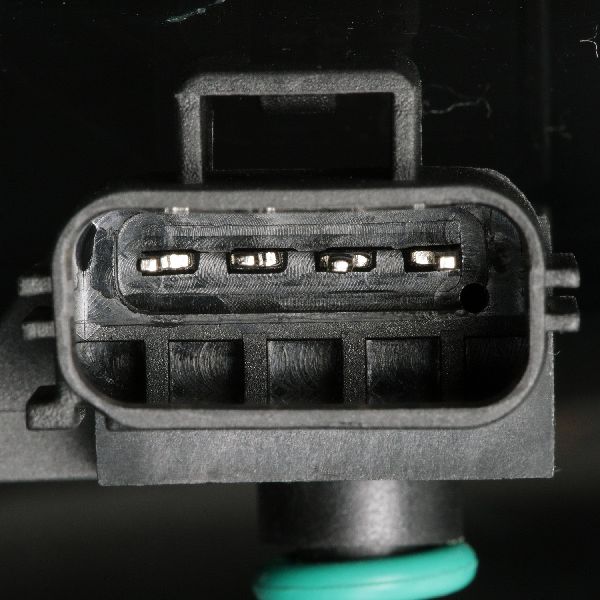
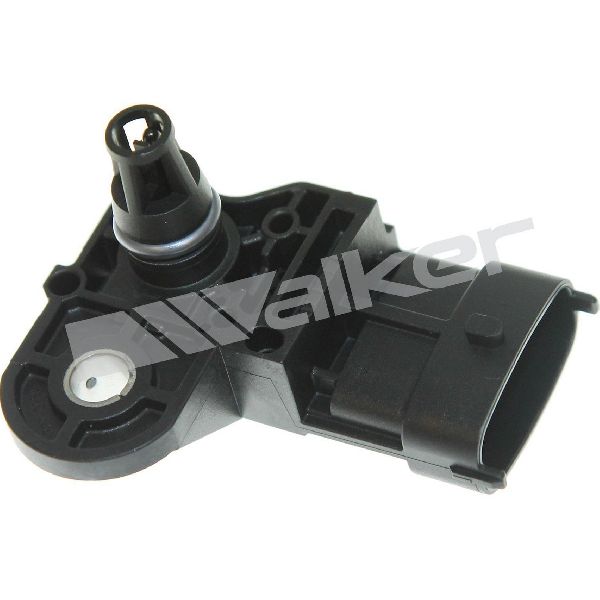
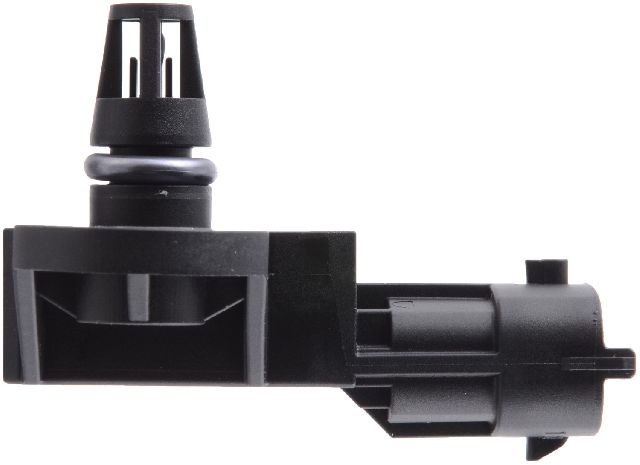
- Manifold Absolute Pressure (MAP) Sensor
(OEM #AG9Z-9F479-B)— This is the sensor that directly measures manifold pressure. While often replaced, it may not be the root cause. The OEM part number AG9Z-9F479-B supersedes AG9Z-9F479-A and CX-2394.
Trusted brands: Motorcraft, Bosch, Delphi, Standard Motor Products (SMP)
OEM price range: $70-$110
Aftermarket price range: $30-$60 - Wire Repair Pigtail/Splice Kit
(OEM #BU2Z-14S411-ATA)— This is often the actual fix. TSB 13-7-5 and Recall 14S17 identify a faulty wiring splice as the most common cause of P0106. This part number, also known as WPT1232, is a generic pigtail that can be used for the repair if a custom splice is not performed.
Trusted brands: Motorcraft
OEM price range: $25-$40
Aftermarket price range: $10-$20
Related Codes That Often Appear With This One
- P0236 — This code ('Turbocharger Boost Sensor 'A' Circuit Range/Performance') is also covered by TSB 13-7-5 and Recall 14S17. If seen with P0106, it strongly points to the wiring harness splice issue, as the sensors share signal return circuits (S108/S182 on 2.0L, S123/S178 on 1.6L).
- P06A7 — This code ('Sensor Reference Voltage 'B' Circuit Range/Performance') is another code mentioned in TSB 13-7-5. Its presence also points towards the documented wiring harness or sensor issues.
Technical Service Bulletins (TSBs) & Recalls
- TSB 13-7-5: Addresses drivability concerns and DTCs P0106, P0236, and P06A7 on 1.6L and 2.0L GTDI engines, pointing to faulty wiring splices (S123, S178, S108, S182) or sensor connector corrosion as the cause. This TSB was effectively superseded by a recall.
- Safety Recall 14S17: A mandatory recall that replaced the diagnostic advice of TSB 13-7-5. It instructed dealers to find and repair the faulty engine wiring harness splices (S108 and S182 on the 2.0L) to resolve unexpected stalling and performance issues.
Platform-Specific Known Issues
- A primary known issue is a faulty signal return splice in the engine wiring harness, as documented in Ford TSB 13-7-5 and mandated for repair under Safety Recall 14S17. This causes an unreliable MAP sensor signal and is the most probable cause for code P0106 on this vehicle.
- There was a recall (14S17) for an 'Engine wiring splice repair' on some 2013 Escapes. Improperly performed recall work has been cited by owners as the cause of this code, requiring a new harness or a second, proper splice repair.
- NHTSA ODI #11408337 highlights the difficulty owners face when a vehicle exhibits the P0106 code but no longer has an "open" recall status, making it harder to secure dealership assistance for the manifold/MAP sensor issue.
Mechanic-Grade Diagnostic Values
- MAP Sensor Signal Voltage — expected: 1.0V to 4.5V, changing smoothly with engine load/vacuum.. Failure: Voltage is stuck, erratic, or outside the expected range. During a 'wiggle test' of the harness, any fluctuation indicates a bad splice.
- MAP Sensor Connector Reference Voltage — expected: ~5.0 Volts at the VREF pin with Key On, Engine Off.. Failure: Voltage is significantly lower than 5.0V or is absent, indicating a problem in the supply circuit from the PCM.
- MAP Sensor PID (Live Data) — expected: With Key On, Engine Off, the MAP reading should be stable and reflect the current barometric pressure.. Failure: The reading is unstable or does not correlate with barometric pressure.
Hidden / Shadow Codes Worth Checking
- Mode 6 Data: Mode 6 is not a specific code, but a diagnostic mode that reveals test results for non-continuously monitored systems. For P0106, a technician can use Mode 6 to check for underlying issues like misfire counts that haven't yet set a separate DTC but could be related to the erratic MAP signal. (see via Advanced scan tools like FORScan or professional-grade scanners can access Mode 6 data.)
Scan Tool Commands That Help
- Ford IDS / FORScan: Live Data PID Monitoring (MAP_V, TCBP_V, TURBO_INLET_V) — This function is critical when performing the 'wiggle test' described in TSB 13-7-5. Monitoring the specific voltage PIDs in real-time while manipulating the harness is the primary method to confirm a faulty splice.
- Ford IDS / FDRS: Datalogger — If the issue is intermittent, a technician can use the datalogger to record MAP, throttle position, and engine RPM during a test drive to capture the fault condition and analyze the sensor's correlation with other engine parameters.
Wiring & Ground Locations

- S123 — In the engine wiring harness, specific to the 1.6L GTDI engine.. This is the signal return splice for the MAP sensor. It is the primary point of failure for P0106 on the 1.6L engine, as documented in TSB 13-7-5.
- S108 — In the engine wiring harness, specific to the 2.0L GTDI engine.. This is the signal return splice for the MAP sensor. It is the primary point of failure for P0106 on the 2.0L engine, as documented in TSB 13-7-5 and Recall 14S17.
- S178 (1.6L) / S182 (2.0L) — In the engine wiring harness, near the other faulty splices.. These are the signal return splices for the TCBP/CACT sensor. They often fail along with the MAP sensor splice and can cause code P0236 to appear with P0106, strongly indicating the wiring issue.
- G104 — Located on the right rear of the transmission.. This is a key ground point for the engine control sensor harness on the 1.6L model. High resistance at this ground could cause similar erratic sensor behavior.
- G103 — Located near the battery junction box on the left side of the engine compartment.. This is another major ground point in the engine compartment. Verifying its integrity is a good practice when diagnosing any electrical sensor fault.
Real Owner Repair Stories
- Reddit user in r/Cartalk (2013 Ford Escape SEL 2.0L AWD) — "Engine Fault Service Now" message, vehicle entering "limp mode", rough idle.
❌ Tried (didn't work) Replaced the MAP sensor on the intake manifold., Replaced the second pressure sensor (TCBP/CACT) located after the air filter., Took apart and inspected air intake hoses for leaks.
✅ What actually fixed it The dealership had performed the 14S17 recall splice repair incorrectly, causing the persistent issues. The ultimate fix was a complete new engine wiring harness, which cost approximately $700. The owner was eventually reimbursed after a two-year dispute. - NHTSA ODI #10510967 — An owner reported that despite "giving it the gas," the vehicle had performance issues. A dealership pulled code P0106 but was unable to reproduce the issue or make repairs after 10 days, illustrating the intermittent nature of this fault.
"I Checked Everything" — The Actual Cause
- In cases where P0106 persists after sensor replacement and a smoke test reveals no vacuum leaks, the root cause is almost certainly the known wiring splice issue. A smoke test cannot detect an electrical fault like a high-resistance splice, which is the specific documented failure for this vehicle.
When the Usual Fixes Don't Work
- A well-documented case showed that even after the official Ford recall (14S17) for the wiring splice was performed, the P0106 code and drivability issues continued. The owner had replaced both the MAP and TCBP sensors with no success. The final diagnosis revealed the recall repair itself was faulty, and a complete wiring harness replacement was required to fix the vehicle. This proves that simply having the recall done is not a guarantee of a fix if the work was performed poorly.
OEM Part Supersession History
AG9Z-9F479-A (or engineering # CX-2394)→AG9Z-9F479-B— Standard part revision and improvement by the manufacturer.
Model Year Variations Within This Range
- 2013: The primary variation is engine-dependent. The 1.6L GTDI engine has faulty splices identified as S123 and S178, while the 2.0L GTDI engine has faulty splices identified as S108 and S182. The diagnostic and repair concept is identical, but the physical wire locations differ.
Diagnostic Flowchart
Other Known Issues on This Vehicle
Issues unrelated to this code that are worth knowing about as an owner of this generation:
- 1.6L GTDI Engine Coolant Intrusion & Fire Risk 🔴 High — Widespread enough to trigger multiple recalls (e.g., 17S09). Lack of coolant circulation can cause the cylinder head to crack, leaking oil onto hot exhaust components and potentially causing a fire. (Ref: Recall 17S09, 13V583)
- 6F35 Transmission Shudder and Failure 🟠 Medium — Common complaint of shuddering, especially between 40-50 mph (4th-5th gear shift), often attributed to torque converter or solenoid issues. Widespread across many Ford models using this transmission. (Ref: TSB 16-0043, Customer Satisfaction Program 20B27)
- Faulty Door Latches 🔴 High — Extremely common issue leading to doors not latching or opening while driving. This prompted a massive recall campaign (16S30) affecting over 2 million Ford vehicles. (Ref: Recall 16S30 (supersedes 15V246, etc.))
- Restraints Control Module (RCM) Failure 🔴 High — A widespread recall was issued because the RCM could short circuit, disabling airbags and stability control systems. (Ref: Recall 14S21)
Used vs. New Parts: Buying Guide for This Vehicle
When a used part is the smart pick: For the MAP sensor itself, a new part is recommended due to the low cost and high reliability of new electronics. However, if the engine wiring harness has been damaged beyond a simple splice repair (e.g., by a botched recall attempt), sourcing a complete, un-repaired used harness from a junkyard vehicle is a cost-effective and viable solution.
Donor-vehicle mileage cap: roughly under 100000 miles for the part to have meaningful remaining life.
What to inspect on the donor part:
- For a wiring harness, inspect for any signs of prior repairs, especially cut-open sheathing or electrical tape near the known splice locations (S108/S123).
- Ensure all connectors are intact with no broken clips or corroded pins.
- Check for any signs of heat damage, melting, or chafing on the harness loom.
OEM-only on this vehicle (don't cheap out):
- If replacing the entire engine wiring harness, using an OEM (Motorcraft) part is strongly recommended to ensure perfect fitment and electrical integrity.
Aftermarket brands forum-validated for this vehicle:
- For the MAP sensor, brands like Bosch, NTK, and Standard Motor Products (SMP) are generally considered reliable alternatives to OEM.
Brands owners have reported issues with on this vehicle:
- Avoid unbranded, 'white-box' sensors from online marketplaces, as their quality control and calibration are often poor and can cause persistent issues.
Real Owner Stories
Aggregated from forums and TSBs cited above. Mileages and costs reflect what owners reported in those sources.
2013 Ford Escape SEL 2.0L GTDI
Symptoms: The owner experienced a long-term battle with the P0106 code, even after replacing two different pressure sensors (the MAP and the TCBP/CACT).
What fixed it: The issue was finally resolved by identifying and repairing a wiring harness problem, confirming that sensor replacement alone often fails to fix this specific vehicle's issue.
Source hint: Reddit (r/Cartalk) - '2013 Ford Escape SEL 2.0 Error Code P0106'
Related OBD-II Codes
Frequently Asked Questions
I have a 2013 Ford Escape with a P0106 code; is there a recall for this?
My 2013 Escape 2.0L shows P0106 and 'Engine Fault Service Now' on the dash. Which wiring splices should I check?
I already had the 14S17 recall performed, but the P0106 code returned. What should I do?
Can a vacuum leak cause P0106 on the 2013 Escape?
How can I confirm if my wiring harness is the problem without cutting it open?
Is the MAP sensor on the 1.6L GTDI prone to oil contamination?
Helpful Videos

We Have This Part in Stock


The information in this article is provided for general reference and educational purposes only. Vehicle specifications, procedures, and part compatibility can vary by production date, trim level, and region. Always consult your vehicle's factory service manual and verify part numbers before purchasing or performing repairs. Safety-critical components such as airbags, seat belts, and braking systems should be installed by a qualified professional.
- Ford Escape:
- 🎬 Helpful Videos
- 🛍️ Shop This Part
- What's Unique About the 2013-2013 Ford Escape
- Symptoms You May Notice
- Most Likely Causes
- Rare But Worth Checking
- Diagnosis Steps
- Parts You'll Likely Need
- Related Codes That Often Appear With This One
- Technical Service Bulletins (TSBs) & Recalls
- Platform-Specific Known Issues
- Mechanic-Grade Diagnostic Values
- Hidden / Shadow Codes Worth Checking
- Scan Tool Commands That Help
- Wiring & Ground Locations
- Real Owner Repair Stories
- "I Checked Everything" — The Actual Cause
- When the Usual Fixes Don't Work
- OEM Part Supersession History
- Model Year Variations Within This Range
- Diagnostic Flowchart
- Other Known Issues on This Vehicle
- Used vs. New Parts: Buying Guide for This Vehicle
- Real Owner Stories
- 2013 Ford Escape SEL 2.0L GTDI
- Related OBD-II Codes
- Frequently Asked Questions
- 🎟️ Get 5% Off