

P0101 on 2013-2018 Nissan Sentra 1.8L: MAF Sensor, ECM Reprogram, and Fixes
On a 2013-2018 Sentra, P0101 is very often caused by outdated engine computer (ECM) software, not a bad MAF sensor. The most likely fix involves cleaning the throttle body, possibly replacing the PCV valve (on 2013-14 models), and having a dealer perform an ECM software update as per Nissan TSB NTB16-027a. A dealer reprogram costs roughly $150-$250. Do not replace the MAF sensor until all other steps have been taken.
- Do NOT immediately replace the MAF sensor. The problem is most likely outdated ECM software, a dirty throttle body, or a bad PCV valve (2013-14 models).
- Follow the procedure in Nissan TSB NTB16-027: Inspect/replace the PCV valve, clean the throttle body, and get the ECM reprogrammed.
- An Idle Air Volume Learn (IAVL) procedure is required after cleaning the throttle body or replacing the ECM.
- If you must replace the MAF sensor, use only a genuine Nissan part or one from the OE manufacturer, Hitachi. Aftermarket sensors are known to be problematic.
What's Unique About the 2013-2018 Nissan Sentra

For this specific generation of Nissan Sentra (B17), the P0101 code is uniquely tied to technical service bulletins (TSBs) that point towards software issues within the Engine Control Module (ECM). Unlike many other vehicles where P0101 is a straightforward MAF sensor failure, on the Sentra it is frequently a combination of a dirty throttle body, a faulty PCV valve on early models, and overly sensitive ECM logic. Owners and technicians often find that simply replacing the MAF sensor—even with an OEM part—does not fix the code until the official Nissan procedure, including an ECM reprogram, is performed. This leads to significant frustration, as documented in numerous owner forums.
Symptoms You May Notice
- Check Engine Light is on
- Engine runs rough or idles poorly
- Sluggish or hesitant acceleration, especially uphill
- Reduced fuel economy
- Engine stalling, especially at idle or when coming to a stop
- Hard starting
- Inability to accelerate over 2,000-2,400 RPM (fail-safe mode)
- Replacing the MAF sensor without first cleaning the throttle body and checking if an ECM update is needed. Many owners replace the sensor, even multiple times, only to have the code return.
- Using a cheap aftermarket MAF sensor. Owners report these parts often fail quickly or don't work correctly out of the box for this specific application.
Most Likely Causes


- Outdated Engine Control Module (ECM) Software 🔴 High Probability Nissan released Technical Service Bulletin NTB16-027 (later amended to NTB16-027a) specifically to address this code with a software update due to overly sensitive monitoring logic, especially when no drivability issues are present. Manufacturer TSB Bulletin #P9328_P9343_P934 further notes that calibration errors can cause the ECM to improperly store a permanent diagnostic trouble code for P0101.
How to confirm: A Nissan dealer or a well-equipped independent shop with a Nissan CONSULT or compatible J2534 pass-thru device can check your vehicle's current software calibration part number against the latest version available from Nissan.
Typical fix: Reprogramming (flashing) the ECM to the latest software version. This must be done with a Nissan-specific tool. The procedure also includes performing an Idle Air Volume Learn (IAVL).
Est. part cost: $0 (software only) - Dirty Throttle Body 🔴 High Probability Carbon and oil vapor from the PCV system can build up on the throttle plate, disrupting airflow at low speeds and idle. This causes a mismatch between the actual airflow and the MAF sensor's readings, triggering the code. TSB NTB16-027a includes cleaning the throttle body as a required step for 2013-2015 models.
How to confirm: Visually inspect the throttle body bore and plate for a layer of black carbon buildup after removing the intake duct.
Typical fix: Clean the throttle body thoroughly with throttle body cleaner and a soft, lint-free cloth. 🎬 Watch: How to properly clean your Sentra's throttle body. An Idle Air Volume Learn (IAVL) procedure is mandatory after cleaning. This can be done with a capable scan tool or sometimes via a manual, timed pedal-press sequence.
Est. part cost: $5-$15 (cleaner and new gasket, part #16175-JA00A) - Dirty Mass Air Flow (MAF) Sensor 🟡 Medium Probability Oil vapor from some aftermarket air filters or fine dust can coat the sensor's delicate hot-wire elements, causing inaccurate readings. While cleaning is a good first step, this is often not the root cause on this platform.
How to confirm: Remove the sensor and visually inspect the two small wire elements inside. If they appear coated or dirty, they need cleaning.
Typical fix: Carefully spray the sensor elements with dedicated MAF sensor cleaner. Do not touch the wires. Allow it to dry completely before reinstalling.
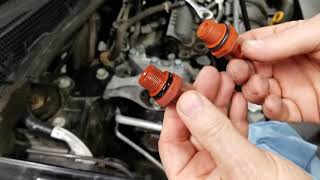
Est. part cost: $10-$20 (cleaner) - Faulty PCV Valve (2013-2014 models) 🟡 Medium Probability TSB NTB16-027a specifically calls for the inspection and replacement of an original-design orange-colored PCV valve on 2013-2014 models. The original design was prone to issues contributing to the P0101 code.
How to confirm: Visually inspect the PCV valve located on the engine. If it is orange, it is the outdated part and should be replaced as per the TSB. 🎬 Watch this quick walkthrough on replacing the PCV valve.
Typical fix: Replace the old orange PCV valve with the updated black version. The TSB initially cited part number 11810-6N202, but 11810-EA200 is also a widely used compatible part.
Est. part cost: $15-$30 - Vacuum Leak (Cracked Intake Duct) ⚪ Low Probability The flexible rubber air intake hose (boot) between the air filter box and the throttle body can develop cracks over time, especially in the ribbed, accordion-like sections. This allows unmetered air to enter the engine, creating a discrepancy with the MAF reading.
How to confirm: With the engine running, listen for a hissing sound around the intake area. Visually inspect the intake hose for cracks, squeezing the ribbed sections to reveal hidden tears. A smoke test is the most definitive way to find a leak.
Typical fix: Replace the cracked intake air duct.
Est. part cost: $40-$80
Rare But Worth Checking
- Failed MAF Sensor: While often the first part replaced, the sensor itself fails less frequently than the other causes listed. If it does fail, it's critical to use an OEM (Nissan) or the OE manufacturer (Hitachi, part #MAF0102) part, as aftermarket sensors are known to be unreliable and often do not resolve the issue on these vehicles.
- Wiring Harness Issue: Damage or corrosion on the MAF sensor connector or its wiring can cause the same symptoms as a failed sensor. Check for a good connection, power, and ground at the sensor's 5-pin connector. In one documented case, adding a new ground wire from the MAF connector to the engine block resolved a persistent P0101.
- Faulty Intelligent Power Distribution Module (IPDM): In at least one complex case documented online, after all common fixes failed, the root cause was a faulty IPDM causing intermittent voltage issues to multiple sensors, including the MAF. This is a very rare but possible cause for a persistent P0101 accompanied by other electrical codes.
Diagnosis Steps
- Check for TSBs. Confirm if TSB NTB16-027 or NTB16-027a applies to your vehicle's year and VIN. This will guide the entire repair process.
- Inspect the engine air filter and replace if it is dirty or clogged.
- Carefully inspect the entire air intake duct between the MAF sensor and the throttle body for any cracks, loose clamps, or disconnections. Squeeze the accordion section to expose hidden tears.
- For 2013-2014 models, inspect the PCV valve. If it is the original orange-colored part, replace it with the updated black version (e.g., 11810-EA200) as per TSB NTB16-027a.
- Remove and inspect the throttle body. If significant carbon buildup is present, clean it thoroughly using throttle body cleaner and a new gasket. Do not spray cleaner directly into the actuator.
- Remove the MAF sensor and clean it using only dedicated MAF sensor cleaner. Let it air dry completely before reinstalling. Do not touch the internal wires.
- After cleaning the throttle body and MAF, perform the Idle Air Volume Learn (IAVL) procedure. This may require a capable scan tool (like Autel) 🎬 See how to perform the idle re-learn using an Autel tool. or can be attempted with a manual pedal-press sequence, though the manual method can be difficult to perform correctly.
- If the code returns, contact a Nissan dealership or qualified shop to determine if your ECM software is outdated. If it is, have them perform the ECM reprogram as detailed in TSB NTB16-027a. This is often the final, necessary step.
- If all previous steps fail, test the MAF sensor's wiring for power, ground, and signal. If the wiring is good, the MAF sensor itself has likely failed and should be replaced with an OEM Nissan or Hitachi part.
Parts You'll Likely Need

- Mass Air Flow (MAF) Sensor
(OEM #22680-1MG0A)— This is the primary sensor for the code. While often misdiagnosed, it can fail. Using the OEM Nissan part or the OE manufacturer (Hitachi, P/N: MAF0102) is critical for a lasting repair.
Trusted brands: Nissan (OEM), Hitachi
OEM price range: $200-$250
Related Codes That Often Appear With This One
- P0171 — System Too Lean (Bank 1). This code often appears with P0101 because a vacuum leak (like a cracked intake boot) or an under-reporting MAF sensor causes the ECM to see more oxygen in the exhaust than expected, leading it to believe the engine is running lean.
Technical Service Bulletins (TSBs) & Recalls
- NTB16-027a: The primary TSB for 2013-2015 Sentras with P0101. It details a multi-step process: inspect/replace the PCV valve (2013-14), clean the throttle body, and reprogram the ECM.
- NTB16-027: The original version of the bulletin, later superseded by NTB16-027a.
- Bulletin #P9328_P9343_P934: Instructs technicians to reprogram the Engine Control Module (ECM) in the event that a permanent diagnostic trouble code for P0101 is recorded, noting that calibration errors can cause improper storage of the code.
Platform-Specific Known Issues
- Permanent DTC Frustration: Many owners report that even after a fix, the P0101 code is stored as a "permanent" DTC in the ECM. Unlike regular codes, a permanent DTC cannot be cleared with a standard scanner. The vehicle's computer must run a series of internal self-tests during normal driving cycles to verify the fix, after which it will clear the code on its own. This can take anywhere from a few days to a month.
- The TSB is the Way: Multiple forum threads and mechanic discussions confirm that deviating from the official TSB procedure is a common reason for failed repairs. Simply cleaning the MAF or replacing it is not enough. The combination of cleaning the throttle body, replacing the PCV valve on early models, and getting the ECM reprogrammed is the most reliable path to a permanent fix.
Mechanic-Grade Diagnostic Values
- Mass Air Flow (MAF) Sensor Signal Voltage at Idle (Engine Warm) — expected: 1.0V to 1.7V. Failure: Voltage is outside this range, erratic, or does not increase smoothly with RPM.
- Mass Air Flow (MAF) Sensor Signal Voltage at 2,500 RPM (No Load) — expected: 1.4V to 1.7V. Failure: Voltage is outside this range or does not respond to RPM changes.
- Mass Air Flow (MAF) Sensor Ground Circuit Voltage — expected: Close to 0V (e.g., < 0.010V). Failure: Voltage significantly above 0V with the key on, engine running, indicates a bad ground connection.
- Mass Air Flow (MAF) Sensor Power Supply Voltage (Key On, Engine Off) — expected: 5 Volts. Failure: No voltage or voltage significantly lower than 5V indicates a wiring or ECM issue.
Scan Tool Commands That Help
- Nissan CONSULT: ECM Reprogramming — This is the dealer-level tool required to perform the software update specified in TSB NTB16-027a, which is a primary fix for the P0101 code on 2013-2015 models.
- Autel (or similar professional scanner): Idle Air Volume Learn (IAVL) — This function is mandatory after cleaning or replacing the throttle body. It resets the ECM's learned value for the throttle plate's closed position, ensuring proper idle. Failure to perform this can cause idle issues and may even prevent the P0101 code from being resolved.
Wiring & Ground Locations
- MAF Sensor Connector Pin 3 — The third pin on the MAF sensor's 5-pin electrical connector.. This is the signal wire that sends the airflow reading to the ECU. Technicians can back-probe this pin to read the live voltage and verify if the sensor's output matches the expected values at idle and under load.
- MAF Sensor Connector Pin 5 — The fifth pin on the MAF sensor's 5-pin electrical connector.. This is the power supply pin from the ECM. It should have 5 volts with the key in the 'ON' position. A lack of power here points to a wiring issue, a blown fuse, or a problem with the ECM itself, not a faulty MAF sensor.
- MAF Sensor Connector Pin 2 — The second pin on the MAF sensor's 5-pin electrical connector.. This pin provides the 5-volt power supply for the integrated Intake Air Temperature (IAT) sensor. Testing this pin helps confirm the overall integrity of the power supply to the sensor assembly.
Real Owner Repair Stories
- CarGurus Forum User (2014 Nissan Sentra) — Engine stalling, hard starts, car randomly going into overdrive, P0101 code.
❌ Tried (didn't work) Replaced MAF sensor with Hitachi brand (twice), Replaced MAF sensor with OEM Nissan part, Dealership updated ECM, cleaned throttle body, performed relearn, replaced spark plugs and coils, Replaced throttle body with an aftermarket part
✅ What actually fixed it The user's post strongly suggests a complex, intermittent wiring fault that was not resolved by any of the common parts replacements. A mechanic's final advice was to find a top-tier diagnostic shop to trace the wiring harness for a short or open circuit, as the cluster of codes (P0123, P2135, P2101, P0112, P0223, P0101) pointed towards a shared electrical problem rather than multiple failed components. - YouTube channel 'One Trick Technician' (2013 Nissan Sentra) — Check Engine Light with code P0101, no drivability issues mentioned.
❌ Tried (didn't work) The video presents the TSB procedure as the direct fix, implying that just replacing the MAF sensor would not work.
✅ What actually fixed it The problem was resolved by following the steps outlined in the Nissan TSB: 1) Replaced the original orange PCV valve with a new black one. 2) Cleaned the throttle body. 3) Performed an 'Idle Air Volume Learn' using an Autel scan tool. The code did not return after several weeks of driving. - ScannerDanner Forum (2018 Nissan Sentra) — P0101 code, no power, sounded like it had a cold air intake.
❌ Tried (didn't work) ECM update per TSB, Replaced MAF sensor
✅ What actually fixed it The root cause was a destroyed catalytic converter. A technician noticed the MAF g/s reading was very low (45 g/s) at full throttle. After disconnecting the front exhaust tube to relieve backpressure, the g/s reading jumped to the 70s and power was restored. The air box silencer was also found to be smashed, contributing to the noise.
Documented NHTSA Reports
- NHTSA ODI #11181976: An owner reported that after the car lost power completely and triggered code P0101, the dealership cleaned the throttle body and reprogrammed the ECU, yet the vehicle continued to experience problems.
- NHTSA ODI #11553612: An owner noted that after having a service bulletin performed for code P0101, the car stalled in the middle of the street and performed worse than before.
- NHTSA ODI #11389616: A report describes a persistent P0101 code even after replacing the MAF sensor with a Nissan part, with the vehicle subsequently showing a low voltage reading.
- NHTSA ODI #11207115: An owner reported the vehicle loses power and struggles to accelerate uphill or enter freeways, specifically citing the P0101 code and fuel performance issues.
OEM Part Supersession History
Unknown (Orange Body)→11810-6N202 or 11810-EA200 (Black Body)— The original orange PCV valve design on 2013-2014 models was prone to failure or sticking, contributing to oil consumption and pressure issues that could trigger the P0101 code.
Heads up: Per TSB NTB16-027a, if a 2013-2014 Sentra has the orange PCV valve, it MUST be replaced with the updated black version as part of the P0101 repair procedure.
Model Year Variations Within This Range
- 2013-2014: These model years may have the original, problematic orange-colored PCV valve. TSB NTB16-027a requires inspecting and, if orange, replacing this valve as part of the P0101 fix.
- 2013-2015: TSB NTB16-027a specifically calls for cleaning the throttle body and reprogramming the ECM for these years to resolve the P0101 code.
- 2016-2018: While not explicitly covered by the most cited TSB for this issue (NTB16-027a), the underlying causes like a dirty throttle body and potential for software sensitivity are still highly relevant. A YouTube guide suggests that 2017-2018 models may only require an Idle Air Volume Learn to fix the issue.
Diagnostic Flowchart
Real Owner Stories
Aggregated from forums and TSBs cited above. Mileages and costs reflect what owners reported in those sources.
2014 Nissan Sentra S
Symptoms: The owner replaced the MAF sensor multiple times using both used and new aftermarket parts, and cleaned the throttle body, but the P0101 code remained stuck as a permanent DTC.
What fixed it: Following the official TSB procedure (NTB16-027a), which requires an ECM software reprogram rather than just replacing sensors.
Source hint: Reddit r/MechanicAdvice - 2014 Nissan Sentra S - P0101 (permanent) issues
2015 Nissan Sentra
Symptoms: The owner replaced the OEM MAF sensor, but the P0101 code remained. They discovered that an ECM software update was necessary to resolve the overly sensitive monitoring logic.
What fixed it: ECM software update at a dealership or equipped shop.
Cost: $200-$400
Source hint: Reddit r/Nissan - Nissan Sentra 2015 - code p0101
2013 Nissan Sentra
Symptoms: The vehicle was struggling to pass a smog check due to a persistent P0101 MAF code, leading the owner to question if reprogramming was required after replacing the sensor.
What fixed it: Performing the ECM reprogram and TSB procedure, as simply replacing the MAF sensor does not clear the permanent code status.
Source hint: Reddit r/NissanDrivers - P0101 MAF Code (PLEASE HELP!!!)
Related OBD-II Codes
Frequently Asked Questions
Does TSB NTB16-027a apply to my 2013-2018 Nissan Sentra?
Why is the P0101 code showing as 'permanent' on my scanner even after I replaced the MAF sensor?
Do I need to replace the PCV valve to fix P0101 on my Sentra?
I cleaned my MAF sensor and throttle body, but the code came back. What's next?
Do I have to perform an Idle Air Volume Learn (IAVL) after cleaning the throttle body?
Can a cracked intake hose cause the P0101 code on my Sentra?
Helpful Videos
![Throttle Body Cleaning [ Nissan Sentra 2013-2019 ]](https://img.youtube.com/vi/eaxQUw2pZZ0/mqdefault.jpg)

Used OEM Parts in Stock


New Aftermarket Parts Available


The information in this article is provided for general reference and educational purposes only. Vehicle specifications, procedures, and part compatibility can vary by production date, trim level, and region. Always consult your vehicle's factory service manual and verify part numbers before purchasing or performing repairs. Safety-critical components such as airbags, seat belts, and braking systems should be installed by a qualified professional.
- Nissan Sentra:
- 🎬 Helpful Videos
- 🛍️ Shop This Part
- What's Unique About the 2013-2018 Nissan Sentra
- Symptoms You May Notice
- Most Likely Causes
- Rare But Worth Checking
- Diagnosis Steps
- Parts You'll Likely Need
- Related Codes That Often Appear With This One
- Technical Service Bulletins (TSBs) & Recalls
- Platform-Specific Known Issues
- Mechanic-Grade Diagnostic Values
- Scan Tool Commands That Help
- Wiring & Ground Locations
- Real Owner Repair Stories
- Documented NHTSA Reports
- OEM Part Supersession History
- Model Year Variations Within This Range
- Diagnostic Flowchart
- Real Owner Stories
- 2014 Nissan Sentra S
- 2015 Nissan Sentra
- 2013 Nissan Sentra
- Related OBD-II Codes
- Frequently Asked Questions
- 🎟️ Get 5% Off