

OBD-II Code P0102: Mass Air Flow (MAF) Circuit Low — The Ultimate Guide
What P0102 means, why it triggers, and how to fix it for good
- P0102 indicates a low voltage signal from the MAF sensor, but in 60% of cases, the root cause is a dirty sensor or a vacuum leak, not a failed part.
- Spend $10 on a dedicated MAF sensor cleaner and spend 15 minutes cleaning the hot wire before buying a $200 replacement sensor.
- If your scanner also shows P0171 or P0174 lean codes, stop testing the sensor and perform a smoke test to find a vacuum leak.
- Driving with P0102 forces the engine to run rich, which destroys a $1,500 catalytic converter within 3 to 6 months if left unfixed.
What Does P0102 Mean?

P0102 means the Powertrain Control Module (PCM) is receiving a voltage signal from the Mass Air Flow (MAF) sensor that falls below the minimum expected threshold. The MAF sensor measures the precise volume and density of air entering the engine so the PCM can inject the correct amount of fuel. A low circuit code indicates a dirty sensor, damaged wiring, a vacuum leak allowing unmetered air into the engine, or a failed sensor.
Technical definition: Mass or Volume Air Flow 'A' Circuit Low Input. The PCM sets this code when the MAF sensor's signal voltage drops below the manufacturer's specified range (typically below 0.2V-0.5V at idle) for a predetermined period.
Can I Drive With P0102?
Yes, But With Caution. You can drive short distances to a repair shop, but extended driving is unsafe. The engine stalls unexpectedly, hesitates, or loses power, creating a safety hazard in traffic. The PCM enters 'limp mode' to protect the engine, severely limiting performance. Continuing to drive causes the engine to run excessively rich, destroying the catalytic converter and adding $800-$2500 to the repair bill.
Common Causes

- Dirty or Contaminated MAF Sensor (Very Common) — Oil vapors from the PCV system, dirt, and oil from aftermarket filters coat the sensor's hot wire, insulating it and causing it to under-report airflow.
- Vacuum Leaks (Common) — Air entering the engine after the MAF sensor is 'unmetered'. Cracked intake boots, loose clamps, or bad manifold gaskets cause the MAF to report lower airflow than is actually entering the engine, triggering P0102 alongside lean codes P0171 or P0174.
- Faulty MAF Sensor (Common) — The sensor's internal electronics fail due to age, heat cycles, or vibration.
- Wiring or Connector Issues (Common) — Damaged, corroded, or loose wires create high electrical resistance, dropping the voltage signal below the normal 0.5V-1.5V idle range.
- Airflow Restrictions (Intake or Exhaust) (Less Common) — A severely clogged air filter, collapsed intake duct, or clogged catalytic converter physically restricts airflow, causing a genuinely low MAF reading.
- Low System Voltage (Rare) — A weak battery or failing alternator drops system voltage, starving the MAF sensor and causing its output signal to fall below the expected range.
Symptoms

- Rough Idle, Hesitation, and Stalling — The engine shakes, surges, or stalls at stops due to an unstable air-fuel mixture, creating a safety hazard in traffic.
- Poor Fuel Economy — The PCM overcompensates for the low airflow reading by injecting too much fuel, noticeably decreasing gas mileage.
- Black Smoke from Exhaust — Indicates a rich fuel condition caused by the PCM enriching the mixture based on faulty MAF data.
- Check Engine Light is On (also visible on scanner) — The PCM stores code P0102 and illuminates the malfunction indicator lamp.
- Reduced Engine Power and 'Limp Mode' — The vehicle feels sluggish. The PCM enters 'limp mode', severely limiting throttle response and RPM to protect the engine.
- Harsh Transmission Shifting — On many vehicles (especially GM), the TCM uses MAF data to calculate engine load. Incorrect signals cause harsh or poorly timed shifts.
Diagnostic Flowchart

Tap your situation to follow the diagnostic path that matches what you're seeing on this code.
Common Fixes & Costs
- Cleaning the MAF Sensor — Parts: $10-$20, Labor: $0-$100, ~0.5 hr book time (DIY)
- Replacing the MAF Sensor — Parts: $100-$300, Labor: $50-$150, ~0.8 hr book time (Intermediate)
- Repairing a Vacuum Leak — Parts: $5-$100, Labor: $100-$300, ~1.5 hr book time (Intermediate)
- Replacing the Engine Air Filter — Parts: $20-$50, Labor: $0, ~0.2 hr book time (DIY)
- Repairing Damaged Wiring or Connector — Parts: $15-$50, Labor: $100-$300, ~1.5 hr book time (Professional)
Used vs. New Parts: Buying Guide
When a used part is worth it: Buying a used MAF sensor is not recommended due to their sensitivity and unknown history. Only use a junkyard part as a cheap, temporary diagnostic tool to confirm the sensor is the issue.
Donor-vehicle mileage cap: roughly under 60000 miles for the part to have meaningful remaining life.
Donor quality checklist:
- Verify the donor vehicle was not scrapped for engine or emissions-related problems.
- Visually inspect the sensor for physical damage or corrosion.
- Match the OEM part number exactly.
Decision logic:
- If The cost of a new, high-quality aftermarket or OEM sensor is under $150. → Buy new. The risk and short lifespan of a used sensor are not worth the minimal savings.
- If You are using the part for diagnosis only and the cost is less than $30. → A used part is acceptable to confirm the fault before buying a new one.
- If The vehicle is very old and has low value, and the budget is extremely tight. → A used part is a gamble, but may be a last resort. Expect potential for premature failure.
Warranty tradeoff: Used parts typically have a 30-day warranty at best. New aftermarket sensors offer a 1-year to limited lifetime warranty. New OEM parts carry a 1-year warranty.
Worst-case if a used part fails: $100-$250 if the used part is dead on arrival, requiring repeat labor costs and the purchase of a new sensor.
What Happens If You Wait — Timeline
- 0-2 weeks: Check Engine Light is on with code P0102. The car runs fine with no noticeable symptoms, or a very slight rough idle on cold starts. (MPG impact: 0-3%% · Added cost: $0)
- 2 weeks - 3 months: Engine performance becomes inconsistent. Noticeable hesitation on acceleration, rough idle, and occasional stalling at stops. A measurable drop in fuel economy occurs. (MPG impact: 5-15%% · Added cost: $50-$150 in wasted fuel)
- 3-6 months: The engine consistently runs rich to compensate for the low MAF reading. This overheats the catalytic converter, causing its internal honeycomb structure to degrade. Spark plugs foul. (MPG impact: 10-20%% · Added cost: $200-$800 (potential damage to O2 sensors, spark plugs))
- 6+ months: Catastrophic failure of the catalytic converter. The melted substrate creates a severe exhaust blockage, causing a dramatic loss of power and potentially leading to engine damage. (MPG impact: 20-40%% · Added cost: $1200-$3000+ (Catalytic converter replacement is now mandatory))
Cost of Not Fixing It
- 0-1 month: Noticeable drop in fuel economy (5-15%), rough idle, and potential stalling. Increased emissions. (Added cost: Negligible, other than increased fuel costs.)
- 1-6 months: An incorrect air-fuel ratio (usually rich) causes the catalytic converter to overheat and degrade. Fouls spark plugs and oxygen sensors. (Added cost: $200-$600 for spark plugs and O2 sensors.)
- 6+ months: Catastrophic failure of the catalytic converter. The internal substrate melts, creating a severe exhaust blockage that drastically reduces engine power. (Added cost: $1200-$2800 for catalytic converter replacement.)
Diagnosis Steps
- Scan for Codes and Freeze Frame Data
Read all stored codes. The combination of P0102 and P0171/P0174 guarantees a vacuum leak. Analyze freeze frame data to see engine RPM and load when the code set.
Tools: OBD-II Scanner (Beginner) - Clean the MAF Sensor
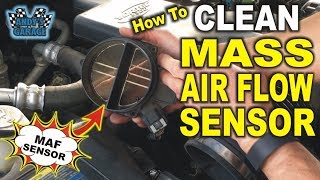
Remove the sensor and spray the hot wire liberally with dedicated MAF cleaner. Do not touch the elements. Let it air dry for 30 minutes before reinstalling.
Tools: Screwdriver/Torx Bit Set, MAF Sensor Cleaner (Beginner) - Inspect the Air Intake System
Visually inspect the path from the airbox to the throttle body. Replace filthy air filters and check for cracks in the flexible intake boot.
Tools: Flashlight, Screwdriver (Beginner) - Analyze Live MAF Data
View the MAF reading in grams per second (g/s). At a warm idle, a 4-cylinder should read 2-4 g/s, and a V6/V8 4-7 g/s. The reading must increase smoothly as you rev the engine.
Tools: OBD-II Scanner with Live Data (Intermediate) - Inspect Wiring and Connector
Unplug the MAF and inspect pins for corrosion or damage. Check the harness for fraying or melting. Wiggle the harness while the engine idles to check for intermittent stumbles.
Tools: Flashlight (Beginner) - Check for Vacuum Leaks
Fill the intake with smoke to reveal hidden leaks in hoses, gaskets, or seals. Pay close attention to intake manifold gaskets and PCV hoses.
Tools: Automotive Smoke Machine (Intermediate) - Test the MAF Circuit
With the key on, engine off, verify the power wire (12V or 5V) and ground wire (<0.1V). Backprobe the signal wire at idle; it should read 0.5-1.5V and increase smoothly to >4.0V at wide-open throttle.
Tools: Multimeter, Backprobe Kit (Advanced)
When This Code Triggers (Freeze-Frame Conditions)
- Engine Coolant Temp: 180-210°F (Fully warmed up)
- RPM: 700-1200 RPM (Idle or low-speed cruise)
- Engine Load: 15-40% (Steady throttle, not under heavy acceleration)
- Vehicle Speed: 0-45 mph (At idle or during city driving)
Related Codes
- P0101 — Indicates the MAF sensor signal is out of the expected performance range, but not necessarily stuck low. Often sets during acceleration when readings don't correlate with throttle position.
- P0171 / P0174 — These 'System Too Lean' codes are the most common companions to P0102. This combination guarantees a vacuum leak is allowing unmetered air into the engine.
- P0103 — The direct opposite of P0102, indicating the MAF circuit input is too high. Typically caused by a short to voltage in the signal wire.
- P0100 — A general MAF circuit malfunction code. P0100 means the circuit is open or shorted, whereas P0102 specifically means a signal is present but weaker than expected.
Climate & Environmental Factors
- High Humidity: Moisture condenses on the sensor's surface, altering its thermal properties and leading to inaccurate readings. It also causes corrosion on connector pins.
- Extreme Cold/Heat: Extreme temperatures affect the sensor's accuracy by altering how heat dissipates from the sensing element, pushing marginal sensors outside their optimal operating range.
- High Altitude: Rapid changes in altitude cause a temporary mismatch between the MAF reading and the PCM's MAP/Baro models, triggering performance codes.
How to Talk to a Mechanic About This Code
Say this: "I have a P0102 MAF Circuit Low code and I'd like to schedule a diagnostic. Please start by checking for vacuum leaks with a smoke machine and verify the MAF sensor's power, ground, and signal voltage before recommending a sensor replacement."
This signals you understand that P0102 is a circuit code, not just a 'bad sensor' code. It directs the technician to perform a proper diagnosis for leaks and wiring, saving you money on misdiagnosis.
Avoid saying:
- 'Just fix whatever's wrong'
- 'My check engine light is on, can you look at it?' (too vague — invites upsell)
- 'Whatever you recommend'
Questions to ask before authorizing the repair:
- Did you perform a smoke test, and if so, did you find any vacuum leaks?
- What were the MAF sensor's live data readings in grams-per-second (g/s) at idle and at 2500 RPM?
- Did you confirm the sensor has proper power and a good ground at the connector?
- If the sensor needs to be replaced, is the replacement part OEM or a quality aftermarket brand, and what is the warranty on the part and labor?
Where to Take It: Dealer vs Independent vs Chain
- Dealer:
Recommended only if the vehicle is under warranty or has a known TSB. Otherwise, not cost-effective for a common code like P0102.
Best for: Vehicles still under powertrain or emissions warranty, Known manufacturer-specific issues covered by a TSB (e.g., Honda harness update), Complex electrical issues on newer or European vehicles
Downsides: Labor rates are 1.5-2x higher than independent shops., Defaults to expensive part replacement over simpler wiring repairs. (Typical cost: +50% vs. baseline) - Independent Shop:
Best fit. P0102 is a routine diagnostic job for any reputable independent shop. They are well-equipped to perform smoke tests and electrical tests to avoid misdiagnosis.
Best for: Most out-of-warranty vehicles., Diagnosing common codes like P0102, especially when combined with lean codes (P0171/P0174).
Downsides: Quality varies widely; vet the shop through reviews and look for ASE certifications. (Typical cost: +0% vs. baseline) - Chain Shop:
Use with caution. Acceptable for cleaning the sensor or replacing an air filter. AVOID for the initial diagnosis of a P0102 code, as they are likely to miss a vacuum leak and simply sell you a new sensor.
Best for: Simple, clear-cut part replacements like an air filter or cleaning the MAF sensor.
Downsides: Technician skill varies dramatically., Lacks diagnostic experience or equipment (like a smoke machine) for proper diagnosis. (Typical cost: -10% vs. baseline)
When to Walk Away From the Repair
If the estimated repair cost exceeds 40-50% of the car's private-party value, seriously consider selling the car as-is or trading it in.
- Car worth $4000, fix is $800: Fix it. The repair cost is only 20% of the car's value, well below the threshold.
- Car worth $12000, fix is $450: Fix it. This is a routine repair cost and a small fraction of the vehicle's value.
- Car worth $2500, fix is $1500: Walk away. The repair cost is 60% of the car's value. It is not financially sensible to proceed with the repair.
What Scan Tool You Need for This Code

Minimum: A scanner that reads and clears codes, displays live sensor data, and shows freeze frame data.
A basic $20 code reader only tells you the code (P0102). It cannot show live data from the sensor (e.g., 0.2 g/s at idle vs. a normal 3.0 g/s), which is essential to confirm if the sensor is reading low or if there's a circuit fault.
Budget: BlueDriver Pro (~$90) — Displays and graphs live MAF data (g/s), shows freeze-frame data, and reads enhanced codes. It provides everything a serious DIYer needs to diagnose P0102 correctly before buying parts.
Mid-range: Innova 5610 (~$320) — Offers robust live data graphing, bidirectional controls to test actuators, and OEM-specific data for complex diagnostics without needing a tablet-based system.
Professional: Autel MaxiCOM MK808 / Launch X431 Series (~$500-1200) — Offers full bidirectional control, advanced live data graphing, and OEM-level diagnostic functions. Overkill for just one P0102 code but invaluable for a serious DIYer working on multiple cars.
Rent vs buy: If this is a one-time diagnosis, AutoZone loans OBD-II scanners for free with a refundable deposit. This reads the code and freeze frame data. For live data diagnosis, buying a tool like the BlueDriver is a better long-term value.
How to Clear the Code After You Fix It
- Reconnect the battery if it was disconnected
- Use an OBD-II scan tool to clear the P0102 code from the PCM's memory
- Perform a complete OBD-II drive cycle to allow readiness monitors to run
Drive cycle (~20 minutes): Start the engine from a cold start and let it idle for 2-3 minutes. Drive in mixed city/highway conditions, including steady cruising between 45-60 mph for 5-10 minutes and some stop-and-go traffic. Allow the vehicle to idle for another 1-2 minutes before shutting it off.
Readiness monitors affected: Catalyst (CAT) monitor, Evaporative System (EVAP) monitor, Oxygen (O2) Sensor monitor, Oxygen Sensor Heater monitor
Before emissions retest: drive at least 50 miles to fully set monitors.
Watch out for:
- Disconnecting the battery clears the code but resets all emissions readiness monitors to 'Not Ready', causing an immediate emissions test failure.
- The code returns immediately if the underlying root cause (like a vacuum leak or wiring fault) was not repaired.
- Certain Toyota/Lexus models store a 'permanent' DTC that only clears by completing a specific, successful drive cycle.
Will This Fail Emissions / State Inspection?
Yes — this code typically fails an OBD-II emissions inspection.
- California: A P0102 code is an automatic failure for a California smog check. All readiness monitors must be 'Ready' before a re-test.
- New York: The NYS DMV inspection includes an OBD-II scan. An active P0102 trouble code results in an emissions test failure.
- Texas: In the 17 Texas counties that require emissions testing, a P0102 code causes the vehicle to fail the OBD portion of the test.
Most Commonly Affected Vehicles
- Chevrolet / GMC Silverado, Sierra, Tahoe, Yukon (1999-2014) — Very common, often caused by failing intake manifold gaskets leading to vacuum leaks, or contaminated sensors.
- Ford F-150, Mustang, Explorer (2004-2018) — Frequently linked to dirty sensors from oiled air filters or vacuum leaks from aged PCV hoses.
- Nissan Altima, Maxima, Sentra (2002-2016) — High incidence rate. The cause is often a failed MAF sensor itself. Aftermarket sensors are notoriously problematic on these models.
- BMW 3-Series (E46), 5-Series (E39), X5 (E53) (1998-2006) — Extremely common on M54 engines. The primary causes are cracks in the lower intake boot (a major vacuum leak) or sensor failure.
- Volkswagen / Audi Jetta, Golf, Passat, A4 (2000-2015) — Common on TDI diesel and 1.8T/2.0T gasoline engines. Wiring harness issues near the connector are a known failure point.
- Honda Civic, CR-V, Accord (2016-2022) — Common on 1.5L Turbo engines. Honda issued TSB 23-012 to address wiring issues causing this code, requiring a harness update.
- Subaru Forester, Impreza, Outback (2002-2014) — Causes range from sensor contamination to vacuum leaks from the intake ducting. Using OEM sensors for replacement is highly recommended.
- Hyundai / Kia Elantra, Tucson, Optima, Sorento (2007-2017) — Diagnostics frequently point to either an internally failed sensor or a fault in the wiring circuit. Cleaning is rarely a permanent fix.
Manufacturer-Specific Notes
- GM (Chevrolet, GMC, Buick): A P0102 code causes harsh transmission shifting because the TCM uses MAF data for load calculation. TSB #24-NA-158 notes water intrusion into the MAF connector causes this code on 2023-2024 models.
- Ford: Ford engines are highly sensitive to aftermarket oiled air filters. The oil easily contaminates the MAF sensor's hot wire, leading to a P0102 code.
- BMW: On M54 engines, the flexible rubber intake boots located after the MAF sensor develop hidden cracks underneath, creating a massive vacuum leak that triggers P0102.
- Toyota/Lexus: Older models used a Karman-Vortex style MAF sensor that cannot be cleaned with spray cleaners. On modern Toyotas, disconnecting the MAF triggers a cascade of error lights requiring dealer reprogramming.
- Honda: For 2016–2023 Civic 1.5L Turbo models, TSB 23-012 addresses P0102 by updating the MAF sensor wiring harness due to a known manufacturing issue.
Real Owner Stories
2002 GMC Yukon 5.3L - The Misdiagnosis Loop
Check Engine Light was intermittent, then became constant with code P0102. Owner cleaned the MAF and replaced the air filter multiple times, but the light always returned.
What they tried:
- Cleaned the MAF sensor with dedicated spray cleaner.
- Replaced the air filter.
- Replaced the MAF sensor with a new part.
Outcome: The code persisted after replacing the sensor. Another user with the same issue found that cleaning their catalytic converters resolved the code, proving an exhaust restriction was the true root cause.
Lesson: If cleaning or replacing the MAF sensor doesn't fix P0102, the problem is a mechanical issue causing low airflow (vacuum leak, exhaust clog) or a wiring fault. Don't keep replacing the same part.
2003 Nissan Sentra SE-R - Aftermarket Parts Nightmare
Car with a K&N filter threw a P0102 code. The car would not rev properly. Code returned instantly after being cleared.
What they tried:
- Replaced the MAF sensor with a cheap aftermarket part.
- Cleared the code, which returned immediately.
Outcome: The problem was unresolved. Nissan MAF sensors are notoriously sensitive, and aftermarket sensors often don't work correctly. The combination of a K&N oiled filter and poor quality replacement parts made diagnosis impossible.
Lesson: For sensitive vehicles, always use an OEM MAF sensor. A cheap sensor makes diagnosis impossible because you can't trust the part.
2007 G35 Sport - The 'Bad Sensor' That Wasn't Bad
Owner of a G35 with dual intakes kept getting a P0102 code. He bought three new MAF sensors, and the code followed whichever sensor he installed.
What they tried:
- Replaced the MAF sensor three times with new parts.
- Swapped the sensors between driver and passenger side intakes.
- Reset the battery.
Outcome: Even brand new, out-of-the-box aftermarket sensors were faulty or incorrectly calibrated for the vehicle. The problem wasn't the car's wiring, but a quality control issue with the replacement parts.
Lesson: Even a new part can be faulty. If a code follows a part when swapped side-to-side, it confirms the part is the issue.
2004 VW GTI 1.8T - The Simple Clean and Drive Fix
Owner got a P0102 code along with a 'running rich' code. He experienced no major drivability issues.
What they tried:
- Cleaned the MAF sensor with dedicated cleaner.
- Checked for air leaks and wiring issues visually.
- Cleared the codes.
Outcome: The lights came back on after idling, but only the P0102 code appeared. After a short drive, the light went off and stayed off. The ECU needed to see a full drive cycle to confirm the fix.
Lesson: After a repair, the code may not clear instantly. The vehicle's computer needs to complete a drive cycle to run its internal tests and verify the fault is gone.
How to Prevent This Code From Triggering
- Use High-Quality Dry Air Filters (At every filter change interval) — Avoids the risk of oil from aftermarket 'oiled' filters contaminating the delicate MAF sensor element.
- Periodically Clean the MAF Sensor (Every 30,000 miles or every 2 years) — Removes the gradual buildup of dirt and oil vapors from the PCV system before it insulates the sensor and triggers a P0102 code.
- Inspect Intake Hoses and Ducting (During every oil change) — Regular visual inspection catches small cracks in the intake boot before they grow into large vacuum leaks.
- Maintain the PCV System (Per manufacturer's schedule (often 60k-100k miles)) — A clogged PCV valve routes excessive oil vapor into the air intake, directly contaminating the MAF sensor.
Frequently Asked Questions
I cleaned my MAF sensor and replaced the air filter, but P0102 came back. What's next?
Perform a smoke test to check for intake leaks. If no leaks exist, use a multimeter to test the power, ground, and signal wires at the MAF connector. Confirm circuit integrity before condemning the sensor.
Can a bad O2 sensor cause a P0102 code?
No, a bad O2 sensor cannot directly cause a P0102 code. P0102 is specific to the MAF sensor circuit. However, a faulty MAF sensor causes rich or lean conditions that eventually trigger O2 sensor codes.
Is it better to use an OEM or aftermarket MAF sensor?
Always use OEM or high-quality OEM-supplier sensors like Bosch, Denso, or Hitachi. Cheap aftermarket sensors are notoriously inaccurate out of the box. They often fail quickly or cause new drivability problems.
How much does it cost to fix a P0102 code?
Costs range from $10 for DIY MAF cleaner to $450 for a professional sensor replacement. A shop diagnosis typically costs $100-$150. If replacing the sensor, expect $200-$450 total depending on the vehicle.
What is the most common misdiagnosis for P0102?
The most common mistake is replacing the MAF sensor without checking for vacuum leaks or wiring faults. P0102 is a circuit code, meaning unmetered air or high electrical resistance often triggers it. Always diagnose the circuit and intake tract first.
My car has P0102 and P0171. What should I check first?
Check for a vacuum leak immediately. This combination means unmetered air is entering the engine after the MAF sensor. A smoke test is the fastest way to pinpoint the leak.
Can I just unplug my MAF sensor to see if it's bad?
Unplugging the MAF forces the PCM into a backup 'limp' mode using pre-programmed fuel tables. If the engine runs better unplugged, the MAF sensor was likely providing faulty data. Do not drive the vehicle in this state.
Key Takeaways
- P0102 indicates a low voltage signal from the MAF sensor, but in 60% of cases, the root cause is a dirty sensor or a vacuum leak, not a failed part.
- Spend $10 on a dedicated MAF sensor cleaner and spend 15 minutes cleaning the hot wire before buying a $200 replacement sensor.
- If your scanner also shows P0171 or P0174 lean codes, stop testing the sensor and perform a smoke test to find a vacuum leak.
- Driving with P0102 forces the engine to run rich, which destroys a $1,500 catalytic converter within 3 to 6 months if left unfixed.
Helpful Videos

The information in this article is provided for general reference and educational purposes only. Vehicle specifications, procedures, and part compatibility can vary by production date, trim level, and region. Always consult your vehicle's factory service manual and verify part numbers before purchasing or performing repairs. Safety-critical components such as airbags, seat belts, and braking systems should be installed by a qualified professional.
- 🎬 Helpful Videos
- What Does P0102 Mean?
- Can I Drive With P0102?
- Common Causes
- Symptoms
- Diagnostic Flowchart
- Common Fixes & Costs
- Used vs. New Parts: Buying Guide
- What Happens If You Wait — Timeline
- Cost of Not Fixing It
- Diagnosis Steps
- When This Code Triggers (Freeze-Frame Conditions)
- Related Codes
- Climate & Environmental Factors
- How to Talk to a Mechanic About This Code
- Where to Take It: Dealer vs Independent vs Chain
- When to Walk Away From the Repair
- What Scan Tool You Need for This Code
- How to Clear the Code After You Fix It
- Will This Fail Emissions / State Inspection?
- Most Commonly Affected Vehicles
- Manufacturer-Specific Notes
- Real Owner Stories
- 2002 GMC Yukon 5.3L - The Misdiagnosis Loop
- 2003 Nissan Sentra SE-R - Aftermarket Parts Nightmare
- 2007 G35 Sport - The 'Bad Sensor' That Wasn't Bad
- 2004 VW GTI 1.8T - The Simple Clean and Drive Fix
- How to Prevent This Code From Triggering
- Frequently Asked Questions
- I cleaned my MAF sensor and replaced the air filter, but P0102 came back. What's next?
- Can a bad O2 sensor cause a P0102 code?
- Is it better to use an OEM or aftermarket MAF sensor?
- How much does it cost to fix a P0102 code?
- What is the most common misdiagnosis for P0102?
- My car has P0102 and P0171. What should I check first?
- Can I just unplug my MAF sensor to see if it's bad?
- Key Takeaways
- 🎟️ Get 5% Off