

P0087 on 2009-2017 Audi Q5 2.0T: Causes and Fixes for Low Fuel Rail Pressure
On a 2009-2017 Audi Q5 2.0T, code P0087 is most often caused by a failed High-Pressure Fuel Pump (HPFP) or a worn cam follower. Always inspect the cam follower when replacing the HPFP, as a worn follower can destroy a new pump and damage the camshaft. Expect to pay $300-$550 for an OEM-quality HPFP and around $40 for the follower.
- P0087 on the Q5 2.0T is a serious code that requires immediate attention to prevent engine damage.
- Always check the engine oil for a gasoline smell first; this is the quickest way to identify a likely HPFP failure.
- Never replace the High-Pressure Fuel Pump (HPFP) without also replacing the cam follower.
- Diagnosis should follow a specific order: check for fuel in oil, inspect the cam follower, test the HPFP, and then test the pressure sensor.
- Using OEM-supplier parts (Hitachi for the pump, Bosch for the sensor, INA for the follower) is highly recommended for longevity.
What's Unique About the 2009-2017 Audi Q5

The Audi Q5's 2.0L TFSI (EA888 Gen 2) engine is well-known for specific failure points that lead to P0087. The most common culprits are the High-Pressure Fuel Pump (HPFP) and its cam follower. Unlike many vehicles, the cam follower is a critical wear item that must be inspected whenever the HPFP is serviced. A worn follower, which can become concave or even develop a hole, can quickly destroy a brand-new pump and even damage the camshaft lobe that drives it. Therefore, diagnosing P0087 on this platform requires a specific focus on the HPFP, its follower, and the camshaft lobe that drives them.
Symptoms You May Notice
- Check Engine Light is on
- Loss of power and poor acceleration, feels like the turbo is not working
- Engine hesitation or stumbling, especially under load or going uphill
- Rough idle
- Engine stalling unexpectedly
- Long crank time or difficulty starting
- EPC (Electronic Power Control) light may illuminate
- Strong smell of gasoline from the engine oil on the dipstick
- Replacing only the High-Pressure Fuel Pump without inspecting or replacing the cam follower. A worn follower will cause the new pump to fail quickly.
- Replacing the in-tank Low-Pressure Fuel Pump (LPFP) before properly diagnosing the high-pressure system components (HPFP, follower, sensor).
- Assuming the code is for a faulty sensor without verifying pressure readings with a mechanical gauge as outlined in TSB 2027306/4.
- Replacing fuel pumps when the issue was actually ignition-related, such as failed spark plugs or coil packs causing similar hesitation symptoms under load.
Most Likely Causes

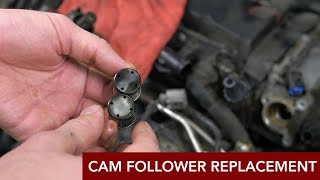
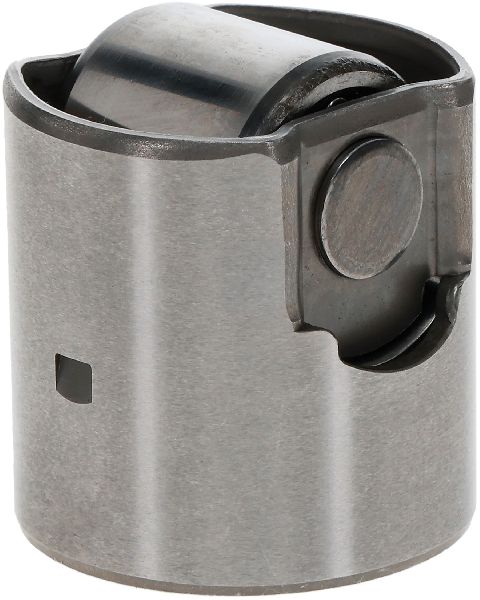
- Worn High-Pressure Fuel Pump (HPFP) Cam Follower 🔴 High Probability The cam follower is a small metal cap that rides on a camshaft lobe to actuate the HPFP. It is a known high-wear item on this engine platform, especially pre-2013 models with the flat tappet design. Its failure is a primary cause of low fuel pressure. The surface can wear down, become concave, or be breached entirely.
How to confirm: Visually inspect the cam follower by removing the HPFP. Look for a hole worn through the top, deep scoring, or a concave surface where it should be flat. A new follower has a perfectly flat, dark-colored surface.
Typical fix: Replace the cam follower. This should be done 🎬 See this DIY walkthrough for replacing the cam follower. any time the HPFP is removed or replaced.
Est. part cost: $30-$50 - Failed High-Pressure Fuel Pump (HPFP) 🔴 High Probability The HPFP is a very common failure point. Internal seals can degrade, causing an inability to build pressure and also allowing fuel to leak into the engine crankcase, diluting the engine oil.
How to confirm: First, check the engine oil for a strong smell of gasoline; this is a definitive sign of HPFP internal seal failure. With a scan tool, monitor requested vs. actual fuel rail pressure. If actual pressure is consistently lower than requested 🎬 Watch: How one owner fixed their P0087 fuel pressure issue. (especially under load) and the cam follower is intact, the HPFP is likely bad.
Typical fix: Replace the High-Pressure Fuel Pump and the cam follower simultaneously. Using the OEM Hitachi pump is strongly recommended by experienced owners.
Est. part cost: $250-$550 - Faulty Fuel Rail Pressure Sensor (G247) 🟡 Medium Probability This sensor, located on the fuel rail, is a known failure item and can send incorrect low-pressure signals to the ECM, triggering the code even if mechanical pressure is fine.
How to confirm: Compare the pressure reading from the sensor (via a scan tool) to a mechanical fuel pressure gauge connected to the system. Per Audi TSB 2027306/4, if there is a discrepancy greater than 500 kPa (5 bar / 73 psi), the sensor is suspect after wiring checks are completed.
Typical fix: Replace the fuel pressure sensor on the fuel rail.
Est. part cost: $50-$150 - Clogged Fuel Filter ⚪ Low Probability This is a standard maintenance item that is often overlooked. A clogged filter can restrict fuel flow from the in-tank pump to the HPFP, starving it of fuel.
How to confirm: Test fuel pressure and volume from the in-tank low-pressure pump (LPFP) before it reaches the HPFP. If it's low, the filter is a likely suspect. The LPFP should be able to supply a baseline pressure of approximately 4-6 bar for the HPFP to work with.
Typical fix: Replace the fuel filter. This is often part of the in-tank fuel pump assembly.
Est. part cost: $30-$70
Rare But Worth Checking
- Worn Intake Camshaft Lobe: This is a severe and expensive repair. If the cam follower is worn through, the HPFP plunger may have been riding directly on the camshaft lobe, causing it to wear down. Audi has a TSB (2013147) for this issue, which describes inspecting for and replacing the camshaft if excessive wear is found. Visual inspection of the lobe is necessary if the follower has failed catastrophically.
- Failing Low-Pressure Fuel Pump (LPFP) or Control Module: The in-tank pump can fail, starving the HPFP of fuel. This is less common than HPFP failure but should be considered if HPFP-related components check out. The fuel pump control module (J538), located under the rear seat, can also fail due to corrosion or overheating pins, cutting power to the pump.
Diagnosis Steps

- Scan for codes. Note any other codes present, especially P2293, misfire codes, or P0192.
- Check the engine oil. Pull the dipstick or open the oil cap and smell for gasoline. A strong fuel smell is a strong indicator of a failed HPFP internal seal.
- Connect a scan tool and monitor fuel rail pressure. In VCDS or a similar tool, monitor both 'requested' and 'actual' pressure at idle and during a brief, careful test drive. A large, consistent deficit where 'actual' is far below 'requested' points to a mechanical fuel delivery issue.
- Relieve fuel system pressure. This is a critical safety step before working on any fuel components.
- Remove the High-Pressure Fuel Pump (HPFP). It is typically held by three bolts and has a fuel line 🎬 Watch: Step-by-step guide to replacing the high-pressure fuel pump. and electrical connector.
- Remove and carefully inspect the cam follower from the pump's bore. Look for wear, holes, or scoring. If it is damaged, this is a primary cause.
- If the cam follower is severely worn (i.e., has a hole in it), carefully inspect the lobe on the intake camshaft for scoring or wear. A damaged camshaft requires replacement.
- If the follower and cam lobe appear okay, and there was no fuel in the oil, the HPFP itself or the fuel pressure sensor (G247) are the next likely culprits.
- Test the G247 sensor by comparing scan tool readings to a mechanical gauge. If the reading differs by more than 500 kPa (5 bar), the sensor is likely faulty.
- Consider testing the low-pressure fuel pump's output to rule it out before replacing expensive high-pressure components. An independent shop quoted around $800 for an LPFP replacement, versus a dealer quote of $3200.
Parts You'll Likely Need

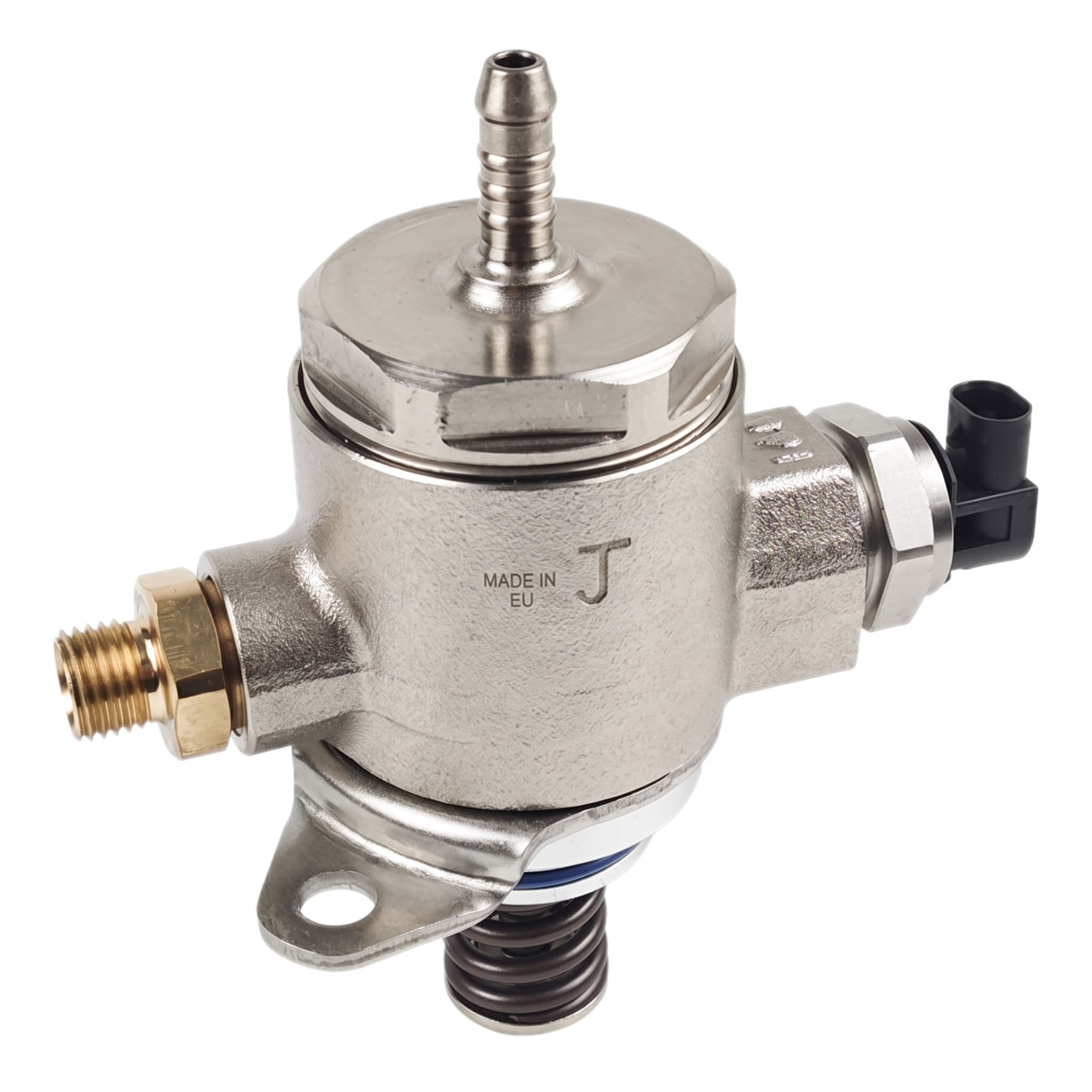
- High-Pressure Fuel Pump (HPFP)
(OEM #06H127025Q)— This is the most common point of failure for code P0087 on this engine. The OEM pump is made by Hitachi (HPP0010) and is highly recommended over other brands for reliability.
Trusted brands: Hitachi (OEM), Bosch
OEM price range: $400-$550
Aftermarket price range: $250-$400 - HPFP Cam Follower
(OEM #06H109311B)— This is a critical wear item that directly causes HPFP failure and must be inspected and likely replaced when servicing the pump.
Trusted brands: INA (OEM), Audi Genuine
OEM price range: $30-$50
Aftermarket price range: $20-$40 - Fuel Rail Pressure Sensor (G247)
(OEM #06J906051D)— A common electronic failure that can incorrectly trigger a P0087 code.
Trusted brands: Bosch (OEM)
OEM price range: $100-$150
Aftermarket price range: $50-$100
Related Codes That Often Appear With This One
- P2293 — This code for 'Fuel Pressure Regulator 2 Performance' often appears with P0087 as they both relate to the performance of the high-pressure fuel system and can be triggered by a failing HPFP or worn cam follower.
- P0300-P0304 — Misfire codes can occur because the low fuel pressure leads to a lean condition, causing incomplete combustion and engine stumbling.
- P0192 — This code for 'Fuel Rail Pressure Sensor "A" Circuit Low Input' points more specifically to the sensor or its wiring and may accompany P0087.
Technical Service Bulletins (TSBs) & Recalls
- TSB 2013147 / 15-14-01: Addresses excessive wear of the intake camshaft lobe that drives the HPFP, which can cause P0087, P2293, and P1093.
- TSB 2027306 / 01-14-01: Provides diagnostic assistance for P0087, P0088, and P0192, specifically on how to test the G247 fuel pressure sensor.
Platform-Specific Known Issues
- A class-action lawsuit previously existed concerning the timing chain tensioner on earlier 2.0T engines, which can affect engine timing and, by extension, the mechanically driven HPFP. While not a direct cause of P0087, it highlights the interconnected nature of this engine's systems.
- Internal seal failure on the HPFP leading to fuel contaminating the engine oil is a well-documented issue that can lead to catastrophic engine damage if not addressed.
- Owner Experience: Misdiagnosis and Final Fix: An owner on Reddit with a 2014 Q5 reported a P0087 code. The seller had claimed to replace both the HPFP and LPFP. The new owner replaced the HPFP again and inspected the cam follower, then replaced the LPFP, but the issue persisted, highlighting the difficulty in diagnosing this code. Another owner on AudiWorld forums ultimately solved their long-running P0087/P2293 issue by replacing a 2-year-old aftermarket HPFP with an OEM Hitachi unit.
Mechanic-Grade Diagnostic Values
- Low-Pressure Fuel System Pressure (LPFP) — expected: 4.0 to 6.0 bar (58 to 87 PSI) supplied to the HPFP.. Failure: Pressure below 4.0 bar (58 PSI) indicates a weak in-tank pump, clogged filter, or failing LPFP controller.
- High-Pressure Fuel Rail at Idle (Warm Engine) — expected: Approx. 40 bar (580 PSI).. Failure: Actual pressure is significantly lower than specified (e.g., dropping to near LPFP pressure) or fails to build from cranking.
- High-Pressure Fuel Rail Under Load — expected: Ramps up to 110+ bar.. Failure: Actual pressure fails to rise significantly above idle pressure during acceleration, while requested pressure climbs.
- G247 Sensor vs. Mechanical Gauge — expected: Readings should be within 500 kPa (5 bar / 73 psi) of each other.. Failure: A difference greater than 500 kPa points to a faulty G247 sensor after wiring has been verified.
- HPFP N276 Regulator Valve Resistance — expected: Approximately 1.0 to 5.0 Ω.. Failure: A reading significantly outside this range (e.g., 15 Ω or 1.2 Ω as seen in one case) indicates a faulty internal regulator on the HPFP.
- G247 Sensor Harness Resistance — expected: Less than 1.5 Ω between the sensor connector and the ECM connector pins.. Failure: Resistance higher than 1.5 Ω indicates a problem in the wiring harness, such as an open circuit or corrosion.
Scan Tool Commands That Help
- VCDS (VAG-COM): Advanced Measuring Values (Adv. Meas. Values) — Essential for simultaneously logging 'Fuel high pressure: specified value' and 'Fuel high pressure: actual value' to see the pressure deficit in real-time under various load conditions.
- VCDS (VAG-COM): Basic Settings - Transfer Fuel Pump (FP) test — Used to manually activate the in-tank low-pressure fuel pump. This is critical for verifying the LPFP receives power and for priming the fuel system after replacing the pump or filter to prevent air pockets.
- VCDS (VAG-COM): Output Test - N276 Fuel Pressure Regulating Valve — This test cycles the solenoid on the HPFP. A technician can listen for an audible click to confirm the solenoid is activating. A weak or absent click can indicate a failing HPFP solenoid.
Wiring & Ground Locations
- G247 Sensor Connector — On the end of the high-pressure fuel rail, under the intake manifold.. This 3-pin connector provides the signal, ground, and 5V reference to the pressure sensor. A poor connection, corrosion, or backed-out pin here can cause intermittent signal loss, triggering P0087 even with perfect mechanical pressure. Pin 1 is signal, Pin 2 is ground, and Pin 3 is 5V reference.
- Ground Connection 12 — In the engine compartment, on the left side frame rail/suspension strut tower area.. This is a primary engine bay ground point. A loose or corroded connection here can cause erratic sensor readings for multiple components, including the G247 sensor and the ECM itself, leading to false fault codes.
- J538 Fuel Pump Control Module Connector — Under the rear seat, connected to the fuel pump control module.. This connector is a known point of failure due to overheating or corrosion. A bad connection here can cut power to the in-tank low-pressure pump, starving the entire fuel system and causing P0087.
Real Owner Repair Stories
- Reddit user Sejo323232 (2006 Audi A3 2.0T (EA113 engine, similar HPFS design)) — Engine completely dies for a split second at high RPM (~5000), then continues normally. Intermittent P0192 code (sensor circuit low).
❌ Tried (didn't work) Replaced G247 high-pressure sensor, Replaced HPFP cam follower ('lobe'), Replaced in-tank fuel pump and relay, Cleaned ECU pins
✅ What actually fixed it The final fix was twofold: tracing the G247 sensor wiring harness under the intake manifold to fix a wiring issue, and replacing a faulty, intermittent crankshaft position sensor that was causing identical symptoms. - Ross-Tech Forums user (2015 Audi A3 2.0T (EA888 Gen3)) — Intermittent P0087, bucking/jolt at low RPM when fully warm. High-pressure rail collapses to low-pressure side values (~11 bar).
❌ Tried (didn't work) Replaced HPFP with new Hitachi unit, Replaced cam follower with new Hitachi unit
✅ What actually fixed it The user diagnosed a significant voltage difference at the HPFP solenoid connector compared to a known-good vehicle (3.7V vs 8.5V). The old, failed HPFP also had a resistance of 1.2Ω compared to the new one at 15Ω. The issue was traced to a problem in the wiring or ECU driver for the HPFP's N276 regulating valve, not the pump itself.
OEM Part Supersession History
06H127025M, 06H127025N, 06H127025P→06H127025Q— Internal revisions by the manufacturer (Hitachi) to improve reliability and address premature failure issues.
Model Year Variations Within This Range
- Approx. 2009-2012 (CAEB/CDNC engine codes): These earlier models use a flat 'tappet' style cam follower (PN: 06D109309C) which is a significant wear item and a primary cause of P0087.
- Approx. 2013-2017: Later models switched to a more durable roller-style cam follower (PN: 06H109311B) which significantly reduces the frequency of this specific failure mode, though it is not completely immune to wear.
Diagnostic Flowchart
Other Known Issues on This Vehicle
Issues unrelated to this code that are worth knowing about as an owner of this generation:
- Excessive Oil Consumption 🔴 High — Very common in pre-2012 models with engine codes like CAEB. Caused by faulty piston ring design. Owners report adding oil every 500-1000 miles. (Ref: Multiple TSBs and a class-action lawsuit were issued. The fix involves a 'Stage 1' oil consumption test followed by a 'Stage 2' repair with new pistons and rings.)
- Timing Chain Tensioner Failure 🔴 High — Common on earlier EA888 Gen 2 engines (approx. before 2013). The original tensioner can fail without warning, allowing the timing chain to jump, causing catastrophic engine damage. (Ref: A class-action lawsuit extended warranty coverage for this part. An updated tensioner design resolves the issue.)
- PCV Valve Failure 🟠 Medium — The diaphragm in the Positive Crankcase Ventilation (PCV) valve can tear, causing a large vacuum leak. Symptoms include a whistling noise, rough idle, and lean fault codes.
- Water Pump Failure 🟠 Medium — The water pump, often made with a plastic housing, is prone to leaking coolant. Failure can occur as early as 40,000-60,000 miles. Symptoms include coolant smell, visible leaks, and overheating warnings. (Ref: No official recall, but it is a widely recognized failure. Replacement pumps often feature an improved metal housing.)
Used vs. New Parts: Buying Guide for This Vehicle
When a used part is the smart pick: For this specific P0087 issue, using used parts is generally not recommended for the core components. However, a used fuel rail assembly (the metal rail itself) from a low-mileage donor could be a cost-effective option if the original is damaged during repair. A used Fuel Pump Control Module (J538) is also a reasonable choice.
Donor-vehicle mileage cap: roughly under 70000 miles for the part to have meaningful remaining life.
What to inspect on the donor part:
- For any used part, check for lack of corrosion on electrical connectors.
- Verify the donor vehicle was not in a major front-end collision.
- If considering a used HPFP (not recommended), insist on seeing the cam follower and camshaft lobe from the donor car to assess wear.
OEM-only on this vehicle (don't cheap out):
- High-Pressure Fuel Pump (HPFP)
- HPFP Cam Follower
- Fuel Rail Pressure Sensor (G247)
Aftermarket brands forum-validated for this vehicle:
- Hitachi (OEM for HPFP)
- Bosch (OEM for G247 Sensor)
- INA (OEM for Cam Follower)
Brands owners have reported issues with on this vehicle:
- Unbranded, 'white-box' High-Pressure Fuel Pumps from online marketplaces are frequently reported on forums to fail very quickly, sometimes within weeks of installation.
Real Owner Stories
Aggregated from forums and TSBs cited above. Mileages and costs reflect what owners reported in those sources.
2014 Audi Q5 2.0T — 118000 miles
Symptoms: P0087 fault code persisted even after the previous owner claimed to have replaced both the HPFP and LPFP.
What fixed it: The owner had to perform deep troubleshooting after replacing the HPFP and LPFP again, highlighting that the code can persist if the root cause isn't correctly identified among the fuel system components.
Source hint: Reddit r/AudiQ5 thread titled '2014 audi q5 20t 118k miles p0087 fault code'
Audi Q5 2.0T
Symptoms: Long-running P0087 and P2293 issues despite having a relatively new fuel pump installed.
What fixed it: Replacing a 2-year-old aftermarket HPFP with an OEM Hitachi unit.
Source hint: AudiWorld forums thread titled 'Updated Repost P0089 P0087'
Related OBD-II Codes
Frequently Asked Questions
Which TSB should I reference for testing the G247 fuel rail pressure sensor on my Audi Q5?
My 2011 Q5 has P0087 and the cam follower is worn; is there a TSB for the camshaft itself?
I'm seeing P0087 on my 2014 Q5 2.0T. Is it true that the HPFP can leak fuel into my oil?
What brand of High-Pressure Fuel Pump is recommended for the Audi Q5 2.0L TFSI?
How much of a discrepancy in fuel pressure indicates a faulty G247 sensor according to Audi?
Is the cam follower wear issue specific to certain years of the Q5?
Helpful Videos


Used OEM Parts in Stock


New Aftermarket Parts Available


The information in this article is provided for general reference and educational purposes only. Vehicle specifications, procedures, and part compatibility can vary by production date, trim level, and region. Always consult your vehicle's factory service manual and verify part numbers before purchasing or performing repairs. Safety-critical components such as airbags, seat belts, and braking systems should be installed by a qualified professional.
- Audi Q5:
- 🎬 Helpful Videos
- 🛍️ Shop This Part
- What's Unique About the 2009-2017 Audi Q5
- Symptoms You May Notice
- Most Likely Causes
- Rare But Worth Checking
- Diagnosis Steps
- Parts You'll Likely Need
- Related Codes That Often Appear With This One
- Technical Service Bulletins (TSBs) & Recalls
- Platform-Specific Known Issues
- Mechanic-Grade Diagnostic Values
- Scan Tool Commands That Help
- Wiring & Ground Locations
- Real Owner Repair Stories
- OEM Part Supersession History
- Model Year Variations Within This Range
- Diagnostic Flowchart
- Other Known Issues on This Vehicle
- Used vs. New Parts: Buying Guide for This Vehicle
- Real Owner Stories
- 2014 Audi Q5 2.0T — 118000 miles
- Audi Q5 2.0T
- Related OBD-II Codes
- Frequently Asked Questions
- 🎟️ Get 5% Off