

P0032 on 2009-2013 Subaru Forester: Front O2 Sensor Heater Circuit Fixes
This code almost always means the internal heater in the front oxygen sensor (also called an Air/Fuel Ratio sensor) has failed. Replacing the sensor is the typical fix. Expect to pay around $120-$200 for an OEM-quality aftermarket part (like Denso) or $200-$280 for an OEM part from Subaru. It's a common DIY job with a difficulty of 2/5.
- P0032 on a 2009-2013 Forester points directly to a problem with the heater circuit in the front Air/Fuel Ratio sensor.
- The most likely cause, by far, is a failed sensor that needs to be replaced.
- Before buying a new sensor, perform a quick visual inspection of the wiring for obvious damage and check the 15A A/F heater fuse (#12) in the engine bay fuse box.
- You can confirm a bad sensor in minutes with a multimeter by checking for very high or infinite resistance on the heater circuit pins (the two black wires). A good sensor should read below 10 ohms.
- This is a DIY-friendly repair; the sensor and its connector are reasonably accessible on the passenger side of the engine. Use a Denso (234-9120) or OEM sensor for best results.
What's Unique About the 2009-2013 Subaru Forester
On the Subaru EJ253 engine, the 'Bank 1, Sensor 1' is technically a wideband Air/Fuel (A/F) Ratio sensor, not a traditional oxygen sensor. It provides more precise data to the ECM for managing the air-fuel mixture. The heater element is critical for its function, and when it fails, fuel economy will suffer as the engine computer defaults to a less efficient fuel map until the sensor warms up on its own from exhaust heat. This is a very common failure point on these vehicles.
Symptoms You May Notice
- Check Engine Light is on
- Cruise control light may flash (a common Subaru feature when the Check Engine Light is on, though some owners report it does not always flash for this specific code).
- Noticeable decrease in fuel economy.
- Vehicle may hesitate or run slightly rough during initial warm-up.
- Failing an emissions test.
- Replacing the rear oxygen sensor (Bank 1, Sensor 2). The code P0032 specifically refers to Sensor 1, which is the upstream sensor before the catalytic converter.
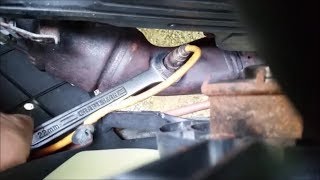
- Replacing the sensor without testing it first. While the sensor is the most likely cause, a 5-minute resistance test can prevent replacing a good part when the real issue is a simple wiring problem or blown fuse. 🎬 Watch: MiracleMAX explains how to diagnose P0032 and P0037 codes.
Most Likely Causes
- Failed Front Air/Fuel (O2) Sensor 🔴 High Probability The internal heater element in oxygen sensors is a common failure item due to constant, rapid heat cycles. It's the most frequent cause for this code on virtually all vehicles, including this Forester.
How to confirm: Unplug the sensor and measure the resistance between the two heater circuit wires (typically the two black wires on the sensor-side connector). A very high or infinite resistance reading (Mega-ohms or 'OL') indicates a broken heater element. A good heater should have low resistance, typically between 2 and 4 ohms. A Subaru service manual specifies a value of 2.2 +0.45 / -0.22 Ω.
Typical fix: Replace the front A/F sensor (Bank 1, Sensor 1).
Est. part cost: $120-$280 - Damaged Wiring or Connector 🟡 Medium Probability The sensor wiring is located near hot exhaust components and the front passenger-side CV axle. Wires can become brittle, melt, or get frayed from contact with the axle if not properly secured in its clips. A visual inspection is critical.
How to confirm: Visually inspect the entire length of the sensor's wiring harness from the sensor body to the connector plug on the engine. Look for any signs of melting, chafing, or broken wires, paying close attention to the area near the CV axle boot. Also, ensure the connector is fully seated; a partially connected plug can cause this code.
Typical fix: Repair the damaged section of wire or replace the connector pigtail.
Est. part cost: $10-$40 - Blown Fuse ⚪ Low Probability
How to confirm: Check the fuse box in the engine bay. According to the owner's manual, fuse #12 (15A) in the engine compartment fuse box powers the A/F sensor relay. Check this fuse for continuity.
Typical fix: Replace the blown fuse. If the fuse blows again immediately, it indicates a short circuit in the wiring that must be found and repaired.
Est. part cost: $1-$5
Rare But Worth Checking
- Faulty Engine Control Module (ECM): This is extremely rare. The ECM should only be considered after all other possibilities (sensor, wiring, fuses) have been exhaustively tested and ruled out. An ECM replacement is expensive and requires programming.
Diagnosis Steps
- Read the code with an OBD-II scanner to confirm P0032 is present.
- Visually inspect the front A/F sensor's wiring harness for any signs of melting, fraying, or damage, especially where it runs near the exhaust or front CV axle. Ensure it is properly secured in all clips.
- Locate and check fuse #12 (15A) in the engine compartment fuse box.
- If the wiring and fuse are okay, disconnect the sensor's electrical connector. It is a gray connector located on the passenger side of the engine, clipped to a bracket near the top of the strut tower.
- Using a multimeter set to measure resistance (Ohms), probe the two pins on the SENSOR side of the connector that correspond to the heater circuit (these are typically the two black wires).
- A reading of very high resistance (Mega-ohms) or an open loop ('OL') confirms the heater element inside the sensor has failed. A good sensor will have a low resistance reading, typically between 2.0 and 4.0 ohms.
- If the sensor's resistance is good, check for 12V power at the vehicle-side harness connector with the key on, engine off. This will verify the integrity of the circuit from the fuse box to the sensor.
- If the sensor has failed, replace it. If the circuit has no power, the wiring issue must be traced back to the relay or fuse box.
Parts You'll Likely Need
- Front Air/Fuel Ratio Sensor (Bank 1, Sensor 1)
(OEM #22641AA480)— This is the component that contains the heater element identified by the P0032 code. The internal heater failing is the most common cause.
Trusted brands: Subaru (OEM), Denso (OEM supplier, part #234-9120), NTK (part #24821)
OEM price range: $200-$280
Aftermarket price range: $120-$200
Platform-Specific Known Issues
- Owner Repair Story: A user on subaruforester.org with a 2010 Forester experienced the P0032 code. After replacing the sensor with a Denso unit, the code returned. Upon further inspection, they realized they had mistakenly installed the new sensor in the rear (Bank 1, Sensor 2) position. After moving the new sensor to the correct front position (pre-catalytic converter), the code was resolved. This highlights the importance of correctly identifying Sensor 1.
- Aftermarket Part Choice: Many owners strongly recommend using either the genuine Subaru part or the Denso equivalent (part #234-9120), as Denso is the original equipment manufacturer. Using cheaper, off-brand sensors can sometimes lead to the code returning or other performance issues due to slight differences in resistance values.
Mechanic-Grade Diagnostic Values
- Front A/F Sensor Heater Circuit Resistance — expected: 2.2 +0.45 / -0.22 Ω at 68°F (20°C). General testing often shows 2-4 Ω.. Failure: A reading of OL (Open Loop) or in the mega-ohm (MΩ) range indicates a failed heater element.
- Heater Circuit Power Supply Voltage — expected: ~12V (Battery Voltage) with Key On, Engine Off (KOEO).. Failure: 0V indicates an open circuit upstream (fuse, relay, wiring). Voltage significantly above battery voltage could indicate a short to another circuit.
- A/F Sensor Heater Current (Live Data) — expected: A current draw should be visible when the heater is commanded on (e.g., ~0.25A to 1.1A depending on conditions).. Failure: 0A current draw when the heater should be active points to an open circuit (likely the sensor itself).
Scan Tool Commands That Help
- Subaru Select Monitor (or equivalent advanced scanner): Current Data Display -> O2 Heater Diagnosis — Use this to view the status of the heater circuit self-test. The ECM reports this as 'Complete' or 'Incomplete'. While not a bidirectional command, it confirms if the ECM has run and failed the test for the heater circuit.
Wiring & Ground Locations
- Front A/F Sensor Connector (Heater Pins) — Gray connector on passenger side strut tower. The heater circuit pins are the two that correspond to the two black wires on the sensor pigtail. On some connectors, these are pins 4 and 6.. These are the exact pins to probe with a multimeter to measure the resistance of the sensor's internal heater. This test definitively confirms if the sensor has failed.
- Engine Grounding (Intake Manifold) — The main ECU grounds are located on the top of the intake manifold.. While not a direct cause of P0032, a poor ground connection between the engine block, intake manifold, and chassis can cause a wide range of bizarre electrical and sensor-related issues. If standard diagnosis doesn't find the fault, ensuring all engine grounds are clean and tight is a crucial step. This is especially important if TGV deletes or phenolic spacers have been installed, as they can interrupt this ground path.
Real Owner Repair Stories
- MiracleMAX (YouTube) (2003 Subaru Forester (similar EJ engine and diagnostics)) — Check Engine Light with O2 sensor codes.
❌ Tried (didn't work) A previous mechanic had worked on the car and likely replaced parts without proper diagnosis.
✅ What actually fixed it The front A/F sensor electrical connector was not fully seated. The mechanic simply pushed it until it clicked into place, and all electrical tests then passed. This resolved the issue without replacing any parts. - YouTube user 'Subaru Forester: O2 Sensor Code P0032' (Subaru Forester (SH generation)) — Check Engine Light with P0032.
❌ Tried (didn't work) Visual inspection of wiring near the CV axle, which was a known chafe point but was found to be intact in this case.
✅ What actually fixed it The mechanic performed a resistance test on the two black heater wires of the A/F sensor and found an open circuit ('OL' on the meter). This confirmed the sensor's internal heater had failed. The definitive fix was to replace the front A/F sensor.
OEM Part Supersession History
22641AA381→22641AA480— Part revision or supplier change.
Diagnostic Flowchart
Other Known Issues on This Vehicle
Issues unrelated to this code that are worth knowing about as an owner of this generation:
- Excessive Oil Consumption 🔴 High — More prevalent in the 2011-2013 models with the newer FB25 engine, but the 2009-2010 EJ253 can also consume oil. A class-action lawsuit was filed regarding this issue on FB series engines. (Ref: TSB 02-157-14R (for FB engines))
- Head Gasket Failure 🟠 Medium — While less common on this specific SOHC EJ253 version than older DOHC EJ25s, external oil and coolant leaks from the head gaskets can still occur at higher mileage (typically over 100k miles).
- Takata Airbag Inflator Recall 🔴 High — Widespread recall affecting most 2009-2013 Foresters. The inflators can rupture, sending metal shrapnel into the cabin. This is a critical safety recall that should be addressed immediately. (Ref: NHTSA Campaign Numbers (multiple, e.g., 19V008000))
- Catalytic Converter Failure 🟠 Medium — The front catalytic converter can fail, sometimes as a result of long-term driving with a faulty A/F sensor. This is an expensive repair. (Ref: Note: Federal emissions warranty covers this component for 8 years/80,000 miles.)
- Timing Belt Replacement 🟠 Medium — The 2009-2010 Forester with the EJ253 engine uses a timing belt that requires replacement at 105,000 miles. This is a critical maintenance item, and failure to replace it can result in catastrophic engine damage. (Note: The 2011-2013 models with the FB25 engine use a timing chain).
Used vs. New Parts: Buying Guide for This Vehicle
When a used part is the smart pick: For this specific repair, a used part is almost never a smart choice. The only exception might be sourcing a small, undamaged section of the engine-side wiring harness or connector pigtail from a junkyard if yours is damaged.
Donor-vehicle mileage cap: roughly under 10000 miles for the part to have meaningful remaining life.
What to inspect on the donor part:
- For a wiring pigtail, ensure wires are not brittle, cracked, or melted.
- Connector should be free of corrosion, with the locking tab intact.
OEM-only on this vehicle (don't cheap out):
- Air/Fuel Ratio Sensor. While not strictly 'OEM-only', using a non-OEM supplier brand (like a generic parts store brand) is highly discouraged. The ECM is sensitive to the specific resistance values of the heater circuit, and off-brand parts frequently cause the code to return.
Aftermarket brands forum-validated for this vehicle:
- Denso (part #234-9120) - This is the Original Equipment Manufacturer (OEM).
- NTK / NGK (part #24821) - A highly reputable OEM supplier for many manufacturers.
Brands owners have reported issues with on this vehicle:
- Generic, unbranded, or 'white-box' sensors from online marketplaces are frequently reported on forums to fail quickly or not resolve the code.
Real Owner Stories
Aggregated from forums and TSBs cited above. Mileages and costs reflect what owners reported in those sources.
2010 Subaru Forester EJ253 2.5L
Symptoms: The P0032 code was present.
What fixed it: After mistakenly installing a new Denso sensor in the rear (Bank 1, Sensor 2) position, the owner moved the new sensor to the correct front position (pre-catalytic converter), which resolved the code.
Source hint: vehicle_specific_issues - Owner Repair Story
2010 Subaru Forester EJ253 2.5L
Symptoms: Owner was diagnosing and trying to resolve a P0032 code, which was sometimes accompanied by P0137.
What fixed it: The issue was resolved by replacing the front A/F sensor with the correct Denso part (234-9120).
Source hint: subaruforester.org - Thread: 'P0032 and P0137'
Subaru Forester
Symptoms: Owner received both P0032 and P0037 codes after a head gasket replacement.
What fixed it: The community advised the owner to check the wiring for damage that may have occurred during the major repair and to use OEM sensors for replacement.
Source hint: Reddit - r/subaru - 'O2 Sensor CEL P0032 & P0037'
Related OBD-II Codes
Frequently Asked Questions
What is the best replacement A/F sensor for my 2010 Forester to avoid the P0032 code returning?
I replaced the O2 sensor on my Forester but the P0032 code is still on. What could be wrong?
Which fuse controls the front A/F sensor heater on a 2009-2013 Subaru Forester?
Why is my cruise control light flashing along with the Check Engine Light for P0032?
What resistance reading should I expect from a good front A/F sensor on my EJ253 engine?
Does the Takata airbag recall affect my 2012 Forester?
My 2010 Forester is approaching 105,000 miles. Is there any critical maintenance I should know about?
Helpful Videos


We Have This Part in Stock


The information in this article is provided for general reference and educational purposes only. Vehicle specifications, procedures, and part compatibility can vary by production date, trim level, and region. Always consult your vehicle's factory service manual and verify part numbers before purchasing or performing repairs. Safety-critical components such as airbags, seat belts, and braking systems should be installed by a qualified professional.
- Subaru Forester:
- 🎬 Helpful Videos
- 🛍️ Shop This Part
- What's Unique About the 2009-2013 Subaru Forester
- Symptoms You May Notice
- Most Likely Causes
- Rare But Worth Checking
- Diagnosis Steps
- Parts You'll Likely Need
- Platform-Specific Known Issues
- Mechanic-Grade Diagnostic Values
- Scan Tool Commands That Help
- Wiring & Ground Locations
- Real Owner Repair Stories
- OEM Part Supersession History
- Diagnostic Flowchart
- Other Known Issues on This Vehicle
- Used vs. New Parts: Buying Guide for This Vehicle
- Real Owner Stories
- 2010 Subaru Forester EJ253 2.5L
- 2010 Subaru Forester EJ253 2.5L
- Subaru Forester
- Related OBD-II Codes
- Frequently Asked Questions
- 🎟️ Get 5% Off