

P0030 on 2007-2011 Subaru Impreza 2.5L: Heater Circuit Failure Causes & Fixes
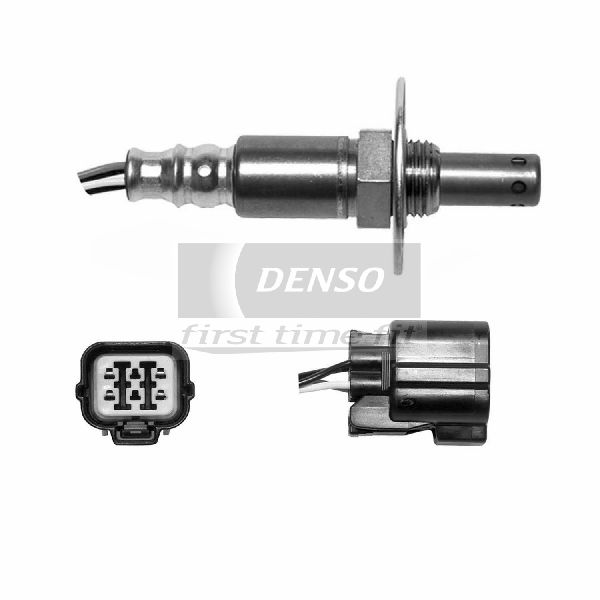
On a 2007-2011 Subaru Impreza with the 2.5L engine, code P0030 almost always means the internal heater for the front oxygen sensor has failed. The most reliable fix is to replace the sensor, which costs about $100-$180 for a quality aftermarket part (like Denso) and is a 2/5 difficulty DIY job. Before replacing, check the A/F heater fuse (often SBF #5 in the engine bay fuse box) as this can also cause the code.
- P0030 on this Impreza almost always means you need a new front oxygen (A/F) sensor.
- Before buying a new sensor, take 5 minutes to check the 'A/F Heater' fuse (often SBF #5) in the engine bay fuse box.
- Use a quality aftermarket brand like Denso (the likely OEM supplier) or NTK for the best results.
- You will need a special 22mm offset oxygen sensor socket to remove and install the sensor.
- The Check Engine Light and flashing cruise control will turn off on their own after a few drive cycles once the repair is complete.
What's Unique About the 2007-2011 Subaru Impreza
For the EJ253 engine in this Impreza generation, the P0030 code is a very common and straightforward fault. Unlike some other vehicles where wiring or fuse issues are equally probable, on this platform, the vast majority of cases are simply the result of the sensor's internal heater element burning out after years of service. The original equipment manufacturer for these sensors is typically Denso, and using a direct-fit Denso replacement is often recommended by enthusiasts for a reliable repair. The issue is so common that it also affects other Subarus with the same or similar engines from this era.
Generation note: This range covers two Impreza generations: the 2007 model year (GD/GG 'Hawkeye') and the 2008-2011 model years (GE/GH/GR). While the 2.5L EJ253 engine is used in both, and the cause of the code is the same, the exact part number for the oxygen sensor may differ. Always verify the part number for your specific year. For example, 2007 models may use 22641AA450, while a 2011 model often uses 22641AA610.
Symptoms You May Notice
- Check Engine Light is on
- Flashing cruise control light (a common Subaru trait when a CEL is present; cruise control is disabled as a safety precaution).
- Decreased fuel economy.
- Slightly rough idle or hesitation when the engine is cold.
- Failure to pass an emissions/smog test.
- Replacing the rear oxygen sensor (Sensor 2) instead of the front one (Sensor 1). P0030 specifically refers to Sensor 1.
- Replacing the catalytic converter when the code is only P0030.
- Ignoring a blown fuse and repeatedly replacing the sensor, only for the code to return.
Most Likely Causes
- Failed Front Air/Fuel Ratio Sensor 🔴 High Probability The internal heater element has a finite lifespan and eventually burns out from thousands of heating and cooling cycles. It's considered a common wear-and-tear item.
How to confirm: Disconnect the sensor and measure the resistance between the two heater circuit pins (usually the two wires of the same color). A reading of 'OL' (Over Limit) or infinite resistance on a multimeter indicates a broken heater element. A good sensor will have a low resistance, typically between 2 and 5 ohms.
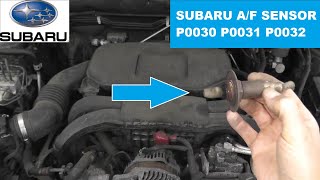
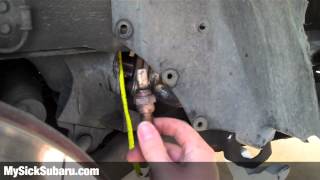
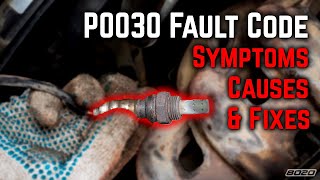
Typical fix: Replace the front Air/Fuel Ratio (Oxygen) sensor. It is located on the passenger side exhaust manifold, before the catalytic converter. Penetrating oil and a special 22mm offset oxygen sensor socket are recommended for removal. 🎬 Watch this step-by-step diagnosis and repair for Bank 1 Sensor 1.
Est. part cost: $100-$180 - Blown A/F Heater Fuse ⚪ Low Probability A short circuit in the sensor or its wiring can cause the fuse to blow as a protective measure. Water intrusion into the sensor connector is a known cause for this. On some Subaru models, this is fuse SBF #5 in the main fuse box under the hood.
How to confirm: Locate the main fuse box in the engine bay. Check the fuse labeled 'A/F Heater' or similar (consult your owner's manual for the exact location and name, often SBF #5). Visually inspect the fuse or use a multimeter to check for continuity.
Typical fix: Replace the blown fuse with one of the same amperage. If the new fuse blows immediately, a short circuit exists in the wiring or the sensor itself that must be diagnosed.
Est. part cost: $1-$5 - Damaged Wiring or Connector ⚪ Low Probability The wiring is close to the hot exhaust and can become brittle, melt, or get damaged over time. The connector can also corrode or fill with debris, leading to a poor connection.
How to confirm: Visually inspect the wiring harness from the sensor to where it connects to the main engine harness. Look for any signs of melting, chafing, or broken wires. Check that the connector is secure and the pins are clean and free of corrosion.
Typical fix: Repair the damaged section of wiring or clean/replace the connector.
Est. part cost: $10-$50
Rare But Worth Checking
- Faulty Engine Control Module (ECM): This is extremely rare. Before condemning the ECM, all other possibilities (sensor, fuse, wiring) must be exhaustively ruled out. A forum user on Ultimate Subaru Message Board detailed a case where the ECU's internal ground switching circuit for the heater failed, which was confirmed by swapping in a known-good ECU.
Diagnosis Steps
- Read the code with an OBD-II scanner to confirm P0030 is the primary code.
- Inspect the A/F Heater fuse in the engine bay fuse box (often labeled SBF #5). Replace if blown.
- If the fuse is good, locate the front A/F sensor on the passenger-side exhaust manifold. Inspect its wiring and connector for any visible damage, melting, or corrosion.
- Disconnect the sensor's electrical connector. Identify the two wires for the heater circuit (they are typically the same color).
- Set a multimeter to measure resistance (Ohms). Probe the two heater pins on the sensor side of the connector. A good sensor should read a low resistance (e.g., 2-5 Ohms). An infinite reading (OL) means the heater is broken and the sensor must be replaced.
- If the sensor's resistance is good, check for power at the harness connector (vehicle side). With the ignition ON (engine OFF), one pin should have battery voltage (~12V). If not, there is a wiring issue between the fuse box and the sensor.
- If voltage is present, the other heater circuit wire is the ground, which is controlled by the ECM. A failure here is rare but points towards a wiring problem back to the ECM or an internal ECM fault.
- Once the repair is complete, the Check Engine Light may turn off on its own after several drive cycles, or you can clear it with a scanner. Disconnecting the battery for 15 minutes can also reset the light.
Parts You'll Likely Need
- Front Air/Fuel Ratio Sensor
(OEM #22641AA610 (for 2011), 22641AA450 (verify for 2007-2010))— This is the most common point of failure for a P0030 code, as the internal heater element burns out.
Trusted brands: Denso (OEM supplier), NTK, Bosch
OEM price range: $190-$290
Aftermarket price range: $100-$180
Related Codes That Often Appear With This One
- P0031 — P0031 indicates the heater circuit has low voltage (a short), which is a specific type of failure within the same circuit as P0030.
- P0032 — P0032 indicates the heater circuit has high voltage, another specific failure mode of the same circuit.
- P0134 — P0134 means 'O2 Sensor Circuit No Activity Detected'. This can be triggered along with P0030 because if the heater fails, the sensor may not warm up enough to produce a signal, especially on cold starts.
Platform-Specific Known Issues
- Flashing Cruise Control Light: On most Subarus of this era, any Check Engine Light fault, including P0030, will automatically cause the cruise control light to flash and disable the system. This is a designed safety feature and does not indicate a separate problem with the cruise control system itself. The flashing light will stop once the P0030 code is resolved and cleared.
Mechanic-Grade Diagnostic Values
- A/F Sensor Heater Element Resistance — expected: 2.5 to 5.0 Ohms. Failure: Infinite resistance (OL) or very high resistance (over 50 Ohms) indicates a failed heater element.
- A/F Sensor Harness Connector Voltage (Key On, Engine Off) — expected: ~12V (Battery Voltage). Failure: Voltage significantly below 10V or 0V indicates a problem with the power supply from the fuse/relay, not the sensor itself.
- A/F Sensor Live Data (Subaru Select Monitor) — expected: The 'A/F Sensor #1 Resistance' PID should display a value within the expected Ohm range (e.g., 2-20 Ohms, varies by spec).. Failure: An out-of-range or fault status on this PID points directly to a sensor heater issue.
Scan Tool Commands That Help
- Subaru Select Monitor: Current Data Display > 'A/F Sensor #1 Resistance' — This allows a technician to check the sensor's heater resistance value directly through the OBD-II port without needing to physically access the sensor connector for manual testing. It's a quick way to confirm or deny a failed heater element.
- Subaru Select Monitor: On-Board Diagnosis Display > 'O2 Heater Diagnosis' — This function runs the ECM's internal self-test for the oxygen sensor heater circuit and will display a 'Complete' or 'Incomplete' status, which can help verify if the fault is currently active.
Wiring & Ground Locations
- E23 / E22 — The front A/F sensor connector is typically designated as E23 (plug) and E22 (receptacle) in Subaru wiring diagrams. It is located on a bracket near the passenger side strut tower in the engine bay.. This is the primary connector to test for power, ground, and sensor resistance. Corrosion or damage here is a common cause of failure besides the sensor itself.
- Engine Ground Strap (Intake Manifold) — A critical ground point for the ECU is located on the top of the intake manifold. Other key grounds are on the engine block and where the negative battery cable meets the chassis.. The ECM provides the ground for the heater circuit. A poor engine-to-chassis ground can cause erratic voltage and trigger various sensor codes, including P0030, even if the sensor and its direct wiring are good. This is often overlooked.
Real Owner Repair Stories
- YouTube channel CarsNToys (2010 Subaru Impreza (non-turbo)) — Check Engine Light with code P0030.
❌ Tried (didn't work) The video focused on diagnosis. The technician first verified 12V power was reaching the sensor harness connector, which confirmed the fuse and wiring from the car were good.
✅ What actually fixed it The video demonstrated testing the sensor's heater resistance, which read 2.5 Ohms (a good reading). The video's purpose was instructional, but the clear implication is that if the reading had been 'OL' (open), replacing the sensor would have been the fix. The video then proceeds to show the replacement procedure.
OEM Part Supersession History
22641AA211→22641AA450— Standard part evolution and supplier changes.
Heads up: 22641AA450 is generally listed for 2007-2010 non-turbo Impreza models.N/A→22641AA610— Change in engine/exhaust configuration for the 2011 model year.
Heads up: Part 22641AA610 is specified for the 2011 Impreza 2.5L without turbo and is not backward compatible with earlier years in this range. Using the wrong sensor can result in persistent codes.
Model Year Variations Within This Range
- 2007-2010: These years typically use the front A/F sensor part number 22641AA450 (or its aftermarket equivalent like Denso 234-9123).
- 2011: The 2011 model year uses a different front A/F sensor, part number 22641AA610 (or aftermarket equivalent Denso 234-9109). The connectors and calibration are different, and the parts are not interchangeable.
Diagnostic Flowchart
Used vs. New Parts: Buying Guide for This Vehicle
When a used part is the smart pick: For this repair, a used part is almost never a smart choice. The A/F sensor is a wear-and-tear item with a finite lifespan. The internal heater element that causes P0030 fails due to age and heat cycles. A used sensor from a junkyard has an unknown number of cycles and could fail soon after installation, wasting time and money.
Donor-vehicle mileage cap: roughly under 5000 miles for the part to have meaningful remaining life.
What to inspect on the donor part:
- If forced to use a used sensor, only consider one from a very low-mileage wreck (<5,000 miles).
- Ensure the connector is free of corrosion and the wiring has no visible damage or melting.
- Test the heater resistance with a multimeter before purchase; it must be within the 2-5 Ohm range.
Aftermarket brands forum-validated for this vehicle:
- Denso (OEM supplier for Subaru, highly recommended by enthusiasts)
- NTK
Brands owners have reported issues with on this vehicle:
- Generic, unbranded, or 'white-box' sensors from online marketplaces are frequently reported on forums to be calibrated incorrectly, fail prematurely, or cause other running issues, even if they clear the P0030 code initially.
Real Owner Stories
Aggregated from forums and TSBs cited above. Mileages and costs reflect what owners reported in those sources.
2010 Subaru Impreza non-turbo
Symptoms: Check Engine Light was on with code P0030.
What fixed it: The front upstream air/fuel sensor (Bank 1, Sensor 1) was tested and found to have a bad heater circuit. Replacing the sensor resolved the issue.
Source hint: YouTube comment on 'Air Fuel (A/F) Sensor P0030 | Testing and Replacement - YouTube'
2007 Hawkeye Impreza STI
Symptoms: The owner's primary complaint was a P0172 (running rich) code with a lumpy idle and fuel smell. During diagnosis, a dealership also found a P0030 code.
What fixed it: The P0030 code was resolved by replacing the front A/F ratio sensor. However, this did not fix the running rich symptoms, which were ultimately caused by a bad evap purge valve solenoid.
Source hint: ScoobyNet.com thread titled 'Running rich at idle, -25% fuel correction, P0172 codes - Hawkeye STI'
Subaru Legacy/Outback
Symptoms: A persistent P0030 code that would not go away even after the front O2 sensor was replaced and the wiring was confirmed to be good.
What fixed it: After eliminating the sensor and wiring as causes, the owner found the fault was a rare failure of the driver circuit inside the Engine Control Unit (ECU). The issue was resolved by swapping the ECU.
Source hint: Ultimate Subaru Message Board thread titled 'P0030 upstream o2 sensor keeps failing'
Related OBD-II Codes
Frequently Asked Questions
Why is my cruise control light flashing now that the Check Engine Light is on for P0030?
Where is the front Air/Fuel Ratio sensor located on my 2.5L Impreza?
I need to check the A/F heater fuse. Where is it and what is it called?
What resistance reading should I get when testing the A/F sensor's heater circuit?
I also own a 2008 Forester. Does it have the same P0030 problem?
What special tool is recommended for replacing the front A/F sensor?
Helpful Videos


We Have This Part in Stock


The information in this article is provided for general reference and educational purposes only. Vehicle specifications, procedures, and part compatibility can vary by production date, trim level, and region. Always consult your vehicle's factory service manual and verify part numbers before purchasing or performing repairs. Safety-critical components such as airbags, seat belts, and braking systems should be installed by a qualified professional.
- Subaru Impreza:
- 🎬 Helpful Videos
- 🛍️ Shop This Part
- What's Unique About the 2007-2011 Subaru Impreza
- Symptoms You May Notice
- Most Likely Causes
- Rare But Worth Checking
- Diagnosis Steps
- Parts You'll Likely Need
- Related Codes That Often Appear With This One
- Platform-Specific Known Issues
- Mechanic-Grade Diagnostic Values
- Scan Tool Commands That Help
- Wiring & Ground Locations
- Real Owner Repair Stories
- OEM Part Supersession History
- Model Year Variations Within This Range
- Diagnostic Flowchart
- Used vs. New Parts: Buying Guide for This Vehicle
- Real Owner Stories
- 2010 Subaru Impreza non-turbo
- 2007 Hawkeye Impreza STI
- Subaru Legacy/Outback
- Related OBD-II Codes
- Frequently Asked Questions
- 🎟️ Get 5% Off