

P0024 on 2015-2020 Ford Explorer: Over-Advanced Cam Timing Causes and Fixes
On a 2015-2020 Ford Explorer with a V6 engine, code P0024 is most often caused by a faulty Variable Camshaft Timing (VCT) solenoid on Bank 2. This is often due to dirty, low, or incorrect viscosity engine oil. Replacing the Bank 2 exhaust VCT solenoid is a common and effective fix, with the part costing around $50-$100.
- P0024 on a V6 Explorer means the exhaust camshaft on the front-side of the engine (Bank 2) is too far advanced.
- Before buying any parts, check your engine oil. Low, old, or dirty oil is a primary cause of this code.
- The most likely failed part is the Bank 2 exhaust VCT solenoid, which gets stuck due to oil debris.
- Replacing the VCT solenoid is a DIY-friendly job with a difficulty of 2 out of 5.
- This code only applies to V6 models (3.5L, 3.3L, 3.0L), not the 4-cylinder 2.3L EcoBoost.
What's Unique About the 2015-2020 Ford EXPLORER
The V6 engines in the 2015-2020 Ford Explorer, part of the 'Cyclone' family, are well-documented to have VCT solenoid issues. Ford has issued multiple Technical Service Bulletins (TSBs) acknowledging that small debris or sludge in the engine oil can cause the VCT solenoids to stick, leading to codes like P0024. This makes regular, high-quality oil changes using the manufacturer-specified oil viscosity especially critical on these engines to prevent this common failure. This code only applies to the V6 engine options, as the 4-cylinder engine only has one bank.
Diagnostic Flowchart
Tap your situation to follow the diagnostic path that matches what you're seeing on this vehicle.
Generation note: This range covers the end of the 5th generation (2015-2019) and the start of the 6th generation (2020). While the chassis and some engines differ, the V6 engines (3.5L, 3.3L, 3.0L) all use a similar dual overhead cam (DOHC) VCT system, making the causes and diagnostics for P0024 consistent across these model years. This code does not apply to the 2.3L I4 EcoBoost engine, which has only one cylinder bank.
Symptoms You May Notice
- Check Engine Light illuminated
- Rough, uneven, or shaking idle
- Reduced engine power and sluggish acceleration, feeling 'bogged down'
- Engine hesitation or stalling, especially at low speeds or when coming to a stop
- Rattling, knocking, or ticking noises from the engine, particularly on startup
- Decreased fuel economy by 5-15%
- Engine may be hard to start
- Replacing the camshaft position sensor when the issue is the VCT solenoid or oil quality.
- Replacing the expensive camshaft phaser when the root cause is simply a clogged and much cheaper VCT solenoid.
- Performing a full timing chain replacement when only the VCT solenoids were faulty.
Most Likely Causes
- Dirty, Low, or Incorrect Viscosity Engine Oil 🔴 High Probability The VCT system is entirely dependent on clean oil and proper oil pressure to function. Ford TSBs specifically mention debris and sludge in oil as a primary cause for solenoid failure and related timing codes. [24, SSM 47170, SSM 50067] Using oil thicker than the manufacturer's recommendation can also clog passages.
How to confirm: Check the oil level on the dipstick and inspect its color and consistency. If it's low, excessively black, or sludgy, it's overdue for a change. This should always be the first step.
Typical fix: Perform an engine oil and filter change using the manufacturer-specified grade (e.g., 5W-30 or 5W-20 depending on the specific engine). Clear the codes and drive to see if P0024 returns. Some owners on forums report success with an engine flush or adding a cleaning additive before the oil change to clear sludge.
Est. part cost: $40-$80 - Failing Bank 2 Exhaust VCT Solenoid 🔴 High Probability As cited in Ford TSBs SSM 47170 and SSM 50067, these solenoids are prone to sticking due to small debris in the oil. They are a very common failure point on the Ford 3.5L and related V6 engines.
How to confirm: Use a scan tool to command the solenoid on and off while monitoring engine RPM; there should be a noticeable change. If not, test the solenoid's resistance and check for voltage at the electrical connector. On the Ford V6, Bank 2 is the front bank (near the radiator), making the solenoids relatively accessible. The exhaust solenoid is typically the lower of the two on the valve cover.
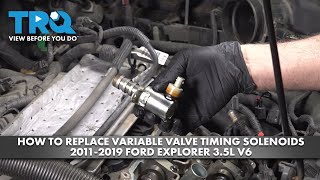
Typical fix: Replace the Bank 2 exhaust VCT solenoid. It is highly recommended to replace both the intake and exhaust solenoids on Bank 2 at the same time, as they are subjected to the same conditions. The repair requires removing the valve cover. 🎬 See this walkthrough for replacing solenoids on a 3.5L V6
Est. part cost: $50-$120 - Worn Timing Chain or Guide ⚪ Low Probability While less common than solenoid failure, high-mileage (typically over 100,000 miles) 3.5L engines can experience timing chain stretch. A stretched chain can throw off the base timing enough to trigger this code, often accompanied by a rattling noise on startup.
How to confirm: This is a complex diagnosis usually suspected after oil and VCT solenoid issues are ruled out. It often presents with rattling noises on a cold start. Confirmation requires significant engine disassembly to check chain tension and alignment of timing marks.
Typical fix: Replace the timing chain, tensioners, and guides. This is a labor-intensive and expensive job, often costing over $2,000. It's common to replace the water pump at the same time since it is driven by the timing chain.
Est. part cost: $400-$800 - Failed Camshaft Phaser ⚪ Low Probability The phaser is the mechanical gear that actually adjusts the cam. It can get stuck in the advanced position due to internal failure or oil contamination. Phaser failure is less common than solenoid failure but more common than timing chain stretch on these engines.
How to confirm: This is diagnosed after confirming the VCT solenoid and oil are good. It often requires a mechanic with advanced diagnostic tools to differentiate from a solenoid issue. Sometimes both P0024 (over-advanced) and P0025 (over-retarded) will appear together, pointing to an erratic phaser.
Typical fix: Replace the camshaft phaser for the Bank 2 exhaust camshaft. This is a labor-intensive job that requires timing cover removal. It is often done as part of a full timing chain service.
Est. part cost: $150-$300
Rare But Worth Checking
- Faulty Camshaft Position Sensor: While possible, a bad camshaft position sensor will typically throw its own specific sensor circuit code (e.g., P0345, P0349) in addition to a timing performance code like P0024.
- Clogged VCT Oil Passages: Severe engine sludge from extremely neglected oil changes can block the small oil passages in the cylinder head leading to the VCT solenoid and phaser, starving them of the pressure needed to operate. This usually indicates a history of severe neglect and may require extensive engine cleaning or replacement.
- PCM/ECM Fault: In very rare cases, the Powertrain Control Module itself can have a software glitch or internal failure, causing it to misinterpret signals or incorrectly command the VCT system. This should only be considered after all mechanical and electrical possibilities have been exhausted.
Diagnosis Steps
- Verify Engine Oil: This is the first and most important step. Check the oil level and condition on the dipstick. If it is low, dirty, or the wrong viscosity, perform an oil and filter change with the correct OEM-spec oil, clear the code, and drive to see if it returns.
- Scan Tool Data: Use a scan tool to monitor the desired vs. actual camshaft position for Bank 2 Exhaust (PIDs VCT_EXH_ACT2 and VCT_EXH_DIF2). A large, persistent discrepancy confirms the fault.
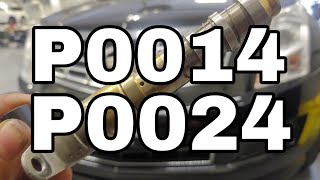
- Test the VCT Solenoid: Locate the Bank 2 (front) valve cover. The exhaust solenoid is typically the lower one with a black connector. Use a scan tool's bidirectional controls to command the solenoid on and off. Listen for an audible click from the solenoid and watch for a change in engine idle. 🎬 Watch: Two quick DIY methods to fix the P0024 code
- Inspect Solenoid and Connector: Unplug the solenoid. Check the connector pins for corrosion or damage. With the key on and engine off, use a multimeter to check for power at the connector.
- Remove and Inspect Solenoid: The solenoid is held by a single 8mm or 10mm bolt. On the 3.5L, this requires removing the valve cover. Once removed, inspect its screens for metal shavings or sludge. A clogged screen is a clear sign of a problem. You can also bench-test it by applying 12V to its pins to see if the internal plunger actuates.
- Check for Deeper Mechanical Issues: If the oil is clean and the solenoid tests good (or is replaced and the code returns), the problem is likely more serious. This points towards a failed camshaft phaser or a stretched timing chain, and diagnosis is best left to a professional.
Parts You'll Likely Need
- Engine Variable Valve Timing (VVT) Solenoid
- Valve Cover Gasket Kit
- Engine Oil Filter
- Engine Oil
Related Codes That Often Appear With This One
- P0025 — P0025 is for an over-retarded condition on the same camshaft (Bank 2 Exhaust). Seeing both may indicate an erratic VCT solenoid or a failing camshaft phaser that is not holding a stable position.
- P0014 — This is the equivalent over-advanced code for Bank 1 (the rear bank, near the firewall). If both P0014 and P0024 appear, it strongly points to a systemic issue like low oil pressure, severe oil contamination, or incorrect oil viscosity affecting both banks of the engine.
- P0300, P0304, P0305, P0306 — These are misfire codes. P0300 is a random misfire, while P0304, P0305, and P0306 are for the individual cylinders on Bank 2. Incorrect cam timing can disrupt the combustion process enough to cause misfires on the affected bank.
Technical Service Bulletins (TSBs) & Recalls
- SSM 47170: Notes that P0024 can be caused by small debris causing the VCT solenoid to stick.
- SSM 54366: References specific diagnostic pinpoint tests in the workshop manual for P0024.
- SSM 50067: Also points to debris causing a sticking VCT solenoid as a potential cause for P0024 and recommends a specific diagnostic test to attempt to clear it.
- TSB 19-2188: While not directly for P0024, this TSB for the 2.7L EcoBoost highlights Ford's awareness of oil-related issues in their V6 engines, in this case, an oil supply tube problem causing smoke.
Platform-Specific Known Issues
- Ford Technical Service Bulletin SSM 47170 notes that DTCs like P0024 may be caused by small debris causing the VCT solenoid to stick, and advises against immediate component replacement before checking for this.
- Ford Technical Service Bulletin SSM 50067 reiterates the issue of debris causing a sticking VCT solenoid and suggests a diagnostic procedure to cycle the solenoid to attempt to clear the debris before replacement.
- On the transverse-mounted V6 engines in the Explorer, Bank 2 is the cylinder bank located at the front of the vehicle, near the radiator. This makes access to its VCT solenoids and valve cover significantly easier than for Bank 1, which is tucked against the firewall.
- Owner Experience: A user on Ford F150 Forum with both P0014 and P0024 on a 3.5L EcoBoost reported a fix where a technician performed an engine flush with ATF before a standard oil change to clear sludge from the VCT screens, which resolved the codes.
Mechanic-Grade Diagnostic Values
- VCT Solenoid Internal Resistance — expected: 6.9 to 7.9 Ohms at 68°F (20°C). Some Ford service documents state a broader range of 5-14 Ohms.. Failure: A reading outside the specified range, or an open circuit (infinite resistance), indicates a failed solenoid coil.
- VCT Solenoid Connector Voltage — expected: Greater than 10.5 Volts with the key on, engine off.. Failure: Low or no voltage at the power supply pin points to a wiring issue, a blown fuse, or a problem with the PCM power relay.
- FORScan Live Data PIDs — expected: The 'VCT_EXH_ERR2' (Bank 2 Exhaust Cam Error) PID should read at or very close to 0 degrees at idle and throughout the RPM range.. Failure: A consistent or spiking deviation from 0 degrees on this PID indicates the camshaft is not at its commanded position, confirming a fault in the VCT system.
Scan Tool Commands That Help
- Ford IDS, FORScan, or other professional scan tools: VCT Solenoid On/Off Test or Actuator Active Command — This bidirectional control is used to functionally test the VCT solenoid. When the engine is idling, a technician can command the solenoid to actuate. A properly functioning solenoid and phaser will cause a noticeable change in engine idle speed, or may even cause the engine to stumble or stall. If the command is sent but the engine operation does not change, it points to a stuck solenoid, clogged oil passages, or a failed phaser.
Wiring & Ground Locations
- Bank 2 VCT Solenoids — On the 3.5L V6, Bank 2 is the cylinder bank at the front of the vehicle, near the radiator. The VCT solenoids are located on the front of the valve cover for that bank.. P0024 specifically refers to the 'B' (exhaust) camshaft on Bank 2. The exhaust solenoid is typically the lower of the two solenoids and often has a black electrical connector, while the intake solenoid is upper and may have a white or grey connector. Correctly identifying the Bank 2 exhaust solenoid is critical to avoid replacing the wrong part.
- VCT Solenoid Wiring — The 2-wire connector plugs directly into the solenoid on the valve cover. One wire provides power from the battery junction box (fuse box), and the other wire is the control line that is ground-switched by the Powertrain Control Module (PCM).. A fault can occur in the wiring harness due to chafing or corrosion at the connector. Testing for power at the connector and continuity to the PCM on the control wire are key electrical diagnostic steps after confirming the solenoid itself is good.
Real Owner Repair Stories
- YouTube channel 'Bo Knows Cars' (Vehicle with P0014 and P0024 (affecting both banks)) — Check engine light, live data showing exhaust cam timing variance spiking up to 7 degrees when letting off the throttle.
❌ Tried (didn't work) An engine flush using Seafoam and a fresh oil/filter change helped reduce the timing variance but did not eliminate the spikes or the codes.
✅ What actually fixed it Replacing both the Bank 1 and Bank 2 exhaust VVT solenoids completely resolved the issue. Post-repair live data showed the timing variance was stable and near zero degrees.
When the Usual Fixes Don't Work
- While a simple oil and filter change is the correct first step and can sometimes resolve the code if it was caused by low or dirty oil, it is not a guaranteed fix. In many cases, the VCT solenoid is already clogged or has failed internally due to accumulated debris or wear. As documented in one repair, an engine flush and oil change improved the condition, but the code and symptoms persisted until the faulty VCT solenoid was replaced. Therefore, if an oil change does not resolve the code, the solenoid should be considered the next most likely point of failure before moving to more expensive timing chain or phaser repairs.
OEM Part Supersession History
Various→HL3Z-6M280-A (Example of a current OEM part)— Ford often updates VCT solenoid designs to improve durability and resistance to contamination.
Heads up: While multiple part numbers like AT4Z-6M280-A/B/C exist for different cam positions (intake/exhaust) and banks, it is critical to verify the correct part for the specific application (Bank 2 Exhaust). Aftermarket solenoids, even with a matching part number, may use lower quality coil windings or spool valve materials, leading to premature failure compared to the OEM Motorcraft part.
Model Year Variations Within This Range
- 2015-2016: Models with the first-generation 3.5L EcoBoost V6 are considered more susceptible to timing chain stretch due to the original primary chain design. While P0024 is still most often a solenoid issue, the probability of a stretched timing chain as the root cause is higher on these earlier models compared to the revised 2017+ engines.
- 2020: The 2020 Explorer introduced new engine options, including the 3.0L EcoBoost and 3.3L Hybrid V6. While they use a similar DOHC VCT system, the physical part numbers for solenoids, phasers, and timing components are different from the 3.5L engines used in the 2015-2019 models. Diagnostic principles remain the same, but parts are not interchangeable.
Helpful Videos

![How to Fix P0024 Engine Code in 4 Minutes [2 DIY Methods / Only $6.74]](https://img.youtube.com/vi/0tbOM7HEJsQ/mqdefault.jpg)
Used OEM Parts in Stock


New Aftermarket Parts Available






The information in this article is provided for general reference and educational purposes only. Vehicle specifications, procedures, and part compatibility can vary by production date, trim level, and region. Always consult your vehicle's factory service manual and verify part numbers before purchasing or performing repairs. Safety-critical components such as airbags, seat belts, and braking systems should be installed by a qualified professional.
- Ford EXPLORER:
- 🎬 Helpful Videos
- 🛍️ Shop This Part
- What's Unique About the 2015-2020 Ford EXPLORER
- Diagnostic Flowchart
- Symptoms You May Notice
- Most Likely Causes
- Rare But Worth Checking
- Diagnosis Steps
- Parts You'll Likely Need
- Related Codes That Often Appear With This One
- Technical Service Bulletins (TSBs) & Recalls
- Platform-Specific Known Issues
- Mechanic-Grade Diagnostic Values
- Scan Tool Commands That Help
- Wiring & Ground Locations
- Real Owner Repair Stories
- When the Usual Fixes Don't Work
- OEM Part Supersession History
- Model Year Variations Within This Range
- 🎟️ Get 5% Off