

P0022 on 2015-2019 Ford Transit: Causes and Fixes for Over-Retarded Camshaft Timing
On a 2015-2019 Ford Transit, code P0022 is most often caused by a sticking Variable Camshaft Timing (VCT) solenoid on the driver's side of the engine (Bank 2), frequently due to dirty or low engine oil. Replacing the Bank 2 intake VCT solenoid is a common fix, costing around $40-$80 for an aftermarket part or $100-$150 for an OEM Motorcraft part. Regular oil changes with the correct oil type are critical for prevention.
- P0022 on a Ford Transit means the intake camshaft timing on the driver's side (Bank 2) is lagging.
- The most likely cause is a sticking VCT solenoid, often due to dirty or low engine oil.
- Always check your oil level and condition first. An oil change is the cheapest and easiest first step.
- Replacing the Bank 2 (driver's side) intake VCT solenoid is the most common repair for this code.
- Ignoring this code can lead to poor engine performance, bad fuel mileage, and potential long-term engine damage.
What's Unique About the 2015-2019 Ford TRANSIT

For this generation of Ford Transit with the 3.5L or 3.7L V6 engines, the Variable Camshaft Timing (VCT) system is sensitive to oil condition and cleanliness. Ford has issued multiple Technical Service Bulletins (TSBs) acknowledging that small debris in the engine oil can cause the VCT solenoids to stick, directly leading to code P0022 and related timing faults. [SSM 50067, SSM 47170] This makes regular, high-quality oil changes especially critical on these engines to prevent this specific issue. The TSBs recommend using a scan tool to cycle the suspect solenoid multiple times to try and dislodge debris before component replacement.
Diagnostic Flowchart
Tap your situation to follow the diagnostic path that matches what you're seeing on this vehicle.
Symptoms You May Notice
- Check Engine Light is on
- Rough or unstable idle, sometimes jumping between 400 and 1100 RPM.
- Engine hesitates or feels sluggish during acceleration
- Reduced fuel economy
- Difficulty starting the engine, may require longer cranking.
- Stalling at low speeds or when stopping.
- Rattling or clicking noises from the engine bay, sometimes described as a 'diesel-like' rattle, especially on startup.
- Replacing the camshaft position sensor first. While it's a component in the system, the VCT solenoid and oil condition are far more common culprits for this specific code. Diagnose other DTCs, especially for the CMP sensor, before replacing it for P0022.
- Replacing only the VCT solenoids on a high-mileage engine that also has a startup rattle. The rattle often indicates worn phasers or a stretched timing chain, and the P0022 code may return if the underlying mechanical issue isn't addressed.
Most Likely Causes

- Sticking/Failing VCT Solenoid 🔴 High Probability Ford TSBs SSM 50067 and SSM 47170 directly state that small debris in the oil can cause the VCT solenoid to stick, which is a primary cause for this code on Ford vehicles. The screens on the solenoids can also become clogged with sludge or tear, allowing debris to enter and jam the mechanism.
How to confirm: Use a scan tool to monitor desired vs. actual cam timing for Bank 2. You can also command the solenoid on/off to check for a response. Swapping the Bank 2 intake solenoid with another one (like the exhaust or one from Bank 1) and seeing if the code follows the part is a definitive test. A visual inspection upon removal may show torn screens or sludge.
Typical fix: Replace the Bank 2 intake VCT solenoid. Before replacing, Ford recommends cycling the solenoid with a scan tool 10 times to try and clear debris. This requires removing the driver's side valve cover.
Est. part cost: $40 - $150 - Low or Dirty Engine Oil 🔴 High Probability The VCT system is hydraulic and relies entirely on clean engine oil at the correct pressure to function. Delays in oil changes or using the wrong viscosity oil can lead to sludge and debris that clog the small passages in the VCT solenoids and phasers.
How to confirm: Check the oil level on the dipstick and inspect its condition. If the oil is dark, gritty, or below the 'add' line, this is a likely contributor. An oil change is the first and cheapest diagnostic step.
Typical fix: Perform an engine oil and filter change using the manufacturer-specified grade of oil (e.g., 5W-30 for 3.5L EcoBoost, 5W-20 for 3.7L V6). Clear the codes and see if the problem returns.
Est. part cost: $50 - $100 - Failing Camshaft Phaser 🟡 Medium Probability The phaser is the mechanical gear that the solenoid controls. Over time, the internal locking pins or vanes can wear out or break, causing it to get stuck in the retarded position. This is a well-documented issue on the 3.5L EcoBoost engine family.
How to confirm: This is typically diagnosed after confirming the VCT solenoid and oil are good. A persistent startup rattle that goes away after a few seconds is a strong indicator. Diagnosis requires significant labor to access the timing components.
Typical fix: Replace the camshaft phaser for the Bank 2 intake camshaft. This is a very labor-intensive job that also requires replacing the timing chain, tensioners, and guides at the same time.
Est. part cost: $150 - $400 for the phaser, but a full timing job parts kit is $600 - $1,200. - Worn Timing Chain or Guides ⚪ Low Probability While durable, the timing chains on higher-mileage engines (typically over 100,000 miles) can stretch. A stretched chain causes a constant retard in cam timing that the VCT system cannot compensate for, leading to the code.
How to confirm: This is suspected in high-mileage engines, especially if there is a persistent startup rattle. Confirmation requires significant engine disassembly to check chain slack and guide condition. A dealership found a stretched chain and weak tensioner to be the cause in one owner's vehicle.
Typical fix: Replace the timing chain, tensioners, and guides. This is almost always done in conjunction with a camshaft phaser replacement. This is a job for an experienced mechanic.
Est. part cost: $400 - $800
Rare But Worth Checking
- Faulty Camshaft Position Sensor: While possible, a bad sensor itself usually triggers its own specific circuit codes (like P0345 or P0349). However, if it's providing slow or inaccurate readings, it could contribute to a timing deviation code like P0022. It's often replaced as a precaution but is rarely the root cause for P0022 alone.
- Wiring Harness Damage: An open or short in the wiring to the VCT solenoid can prevent it from operating correctly, mimicking a failed solenoid. Always inspect the connector and nearby wiring for damage, especially after other engine work, before replacing parts.
Diagnosis Steps
- Check the engine oil level and condition. If it is low or dirty, perform an oil change with the correct viscosity oil and a new filter, clear the code, and re-test.
- Use an OBD-II scanner to check for any other codes. Prioritize diagnosing any camshaft position (CMP) sensor circuit codes (like P0345) first.
- With a capable scanner, monitor the desired vs. actual camshaft position for the Bank 2 intake cam. A significant and persistent deviation confirms the fault.
- Use the scanner's bidirectional controls to command the Bank 2 intake VCT solenoid on and off. Listen for a clicking sound from the driver's side valve cover and watch for a change in engine idle. No response suggests a bad solenoid or wiring issue.
- If the solenoid is suspect, swap the Bank 2 intake solenoid with the Bank 2 exhaust solenoid (if accessible and identical). Clear the codes and drive the vehicle. If the code changes to P0024 (Exhaust Cam Over-Retarded), the solenoid is confirmed faulty.
- Inspect the wiring and connector at the VCT solenoid for any signs of damage, corrosion, or loose pins. Check for battery voltage at the power supply pin of the connector with the key on.
- If the solenoid and wiring are good, the next step is to inspect the camshaft phaser and timing chain. This is an advanced procedure that requires removing the valve cover and timing cover and is best left to a professional.
Parts You'll Likely Need

- Variable Camshaft Timing (VCT) Solenoid
(OEM #7T4Z-6M280-C)— This is the most common failure point for code P0022, as identified in Ford's own service bulletins. It gets stuck due to oil debris or internal screen failure. This part number supersedes 7T4Z-6M280-A, 7T4Z-6M280-AA, and 7T4Z-6M280-B.
Trusted brands: Motorcraft, Dorman, SKP, NTK
OEM price range: $70-$150.
Aftermarket price range: $40-$80 - Engine Oil and Filter — Low or dirty oil is a primary cause of VCT system faults. An oil change is a critical first step in diagnosis and repair. Use Motorcraft Synthetic Blend 5W-20 for the 3.7L and 5W-30 for the 3.5L EcoBoost.
Trusted brands: Motorcraft, Mobil 1, Castrol
OEM price range: $50 - $100
Aftermarket price range: $40 - $80
Related Codes That Often Appear With This One
- P0012 — This is the same over-retarded timing fault but for Bank 1 (passenger side). If both appear, it strongly suggests a systemic issue like low/dirty oil, low oil pressure, or stretched timing chains affecting both banks of the engine.
- P0021 — This is for an 'over-advanced' condition on the same bank (Bank 2). Seeing them together could indicate an erratic VCT solenoid or phaser that is not controlling timing properly in either direction, or a wiring issue to the solenoid.
- P0345/P0349 — These codes point to a circuit malfunction for the Bank 2 camshaft position sensor. If you see these alongside P0022, the sensor or its wiring should be diagnosed first, as a bad signal from the sensor can cause the PCM to misinterpret the camshaft's position.
Technical Service Bulletins (TSBs) & Recalls
- SSM 50067: Notes that P0022 can be caused by small debris causing the VCT solenoid to stick. Suggests cycling solenoid with scan tool before replacement.
- SSM 47170: An earlier version of the same bulletin, also pointing to debris in oil as the cause for VCT-related codes like P0022.
- SSM 54366: References Pinpoint Test HK in the Powertrain Control/Emissions Diagnosis (PC/ED) manual for diagnosing a range of VCT codes including P0022.
Platform-Specific Known Issues
- TSB SSM 50067 and SSM 47170: These bulletins from Ford state that various timing codes, including P0022, may be caused by small debris causing the VCT solenoid to stick. The suggested procedure is to use a scan tool to cycle the solenoid multiple times to attempt to clear the debris before replacing any parts. [SSM 50067, SSM 47170, 20]
Mechanic-Grade Diagnostic Values
- VCT Solenoid Resistance — expected: 6.9 to 7.9 Ohms at 68°F (20°C). Failure: No reading (open circuit) or a reading significantly outside this range indicates a faulty solenoid.
- VCT Advanced Error PID (Live Scan Data) — expected: Should hover around 0° at idle in closed loop.. Failure: A persistent deviation greater than +/- 5° indicates the camshaft is not tracking the PCM's command, pointing to a VCT system fault.
- VCT Solenoid Connector Voltage — expected: Battery voltage (approx. 12V) on the power supply pin with the ignition on, engine off.. Failure: No voltage indicates an issue in the power supply circuit (e.g., fuse, wiring).
Hidden / Shadow Codes Worth Checking
- Mode $06, Test ID $A2-$AF: This is not a DTC, but a diagnostic function within the generic OBD-II system. On Ford vehicles, Mode 6 can be used to view non-continuous monitor test results, including misfire counts per cylinder for the last 10 driving cycles. This can help identify related issues even when no misfire codes are present. (see via A scan tool that supports Mode 6 data, such as FORScan or some professional-grade scanners.)
Scan Tool Commands That Help

- Ford IDS (or FORScan): VCT Solenoid Bidirectional Control (On/Off or Duty Cycle) — This command is used to manually activate the VCT solenoid while the engine is idling. A healthy solenoid will produce an audible click and cause a noticeable change in engine idle quality. A lack of response points to a failed solenoid or a wiring/connector issue. This is a key step before removing the valve cover.
- Ford IDS (or FORScan): Monitor PIDs: VCT_INT_DIF2, RCAM, RCAM_DSD — These PIDs are crucial for live diagnosis. VCT_INT_DIF2 (Intake Cam Difference/Error for Bank 2) shows how far the actual cam angle is from the desired angle. RCAM is the actual angle, and RCAM_DSD is the desired angle. Graphing these while driving can show if the solenoid is slow to respond or sticking, which is a classic failure pattern.
Wiring & Ground Locations
- VCT Solenoid Connector — On the front of the valve cover for the respective cylinder head (Bank 2 is driver's side).. This 2-pin connector provides power and control to the VCT solenoid. The connector itself or its wiring can be damaged, leading to an open or shorted circuit that mimics a failed solenoid. The connector is black.
- VCT Solenoid Wiring — Runs from the PCM to the VCT solenoid connector on the valve cover.. One wire is the power supply (should have battery voltage with key on), and the other is the control wire, which the PCM pulses to ground to activate the solenoid. Damage to this harness can cause P0022.
- Intake vs. Exhaust Solenoid Identification — On the valve cover, typically the top solenoid is for the intake camshaft and the bottom is for the exhaust.. On many Ford 3.5L engines, the intake solenoid has a white connector body, while the exhaust solenoid has a black one, aiding in correct identification during diagnosis and replacement.
Real Owner Repair Stories
- Ford F150 Forum user (Ford F-150 with 3.5L EcoBoost (same engine family)) — After 2+ hours of highway driving, the engine would shudder, misfire, idle roughly, and sometimes stall at stops. Threw code P0022.
❌ Tried (didn't work) Initial diagnosis was uncertain between phaser and solenoid.
✅ What actually fixed it The user captured live data with FORScan during the event. The log showed the VCT_INT_DIF2 (Bank 2 Intake Cam Error) PID having large, slow-to-correct deviations from the desired position. Another user confirmed this data pattern—slow reaction and overcorrection—is characteristic of a failing VCT solenoid, not a phaser, pointing to the solenoid as the likely fix.
When the Usual Fixes Don't Work
- In some cases, owners have replaced the VCT solenoids and performed an oil change, yet the P0022 code returned. One owner of a Ford with a V6 and 140k miles reported this exact scenario. This situation strongly suggests the problem lies deeper in the mechanical timing system, such as a stretched timing chain or a failing camshaft phaser, which are more expensive and labor-intensive repairs. The initial TSBs from Ford also point to debris as a cause, and if the debris is not cleared or is indicative of a larger problem (like failing chain guides), a new solenoid may stick again.
OEM Part Supersession History
7T4Z-6M280-A, 7T4Z-6M280-AA, 7T4Z-6M280-B→7T4Z-6M280-C— Ford often updates parts to improve reliability, materials, or manufacturing processes. The multiple supersessions suggest revisions were made to address the known failure modes of these solenoids.
Model Year Variations Within This Range
- 2015-2019: The Transit was offered with a standard 3.7L Ti-VCT V6 (275 hp) and an optional 3.5L EcoBoost V6 (310 hp). While both use VCT technology and can experience code P0022, the 3.5L EcoBoost is more widely associated with timing component issues (phasers, chains) at higher mileage. The naturally aspirated 3.7L is generally regarded as simpler and potentially more durable long-term.
- 2018-2019: General reliability ratings suggest that 2018-2021 models, including the later years in this range, featured improved engines and fewer overall complaints compared to the earlier 2015-2017 models.
Helpful Videos
![How to Fix P0022 Engine Code in 4 Minutes [2 DIY Methods / Only $6.53]](https://img.youtube.com/vi/BO7HzbeFxqo/mqdefault.jpg)
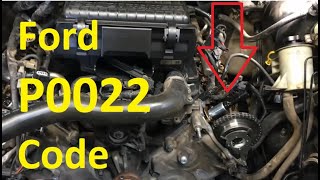
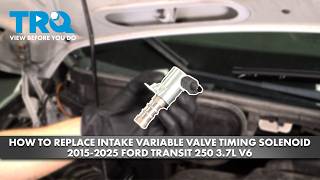
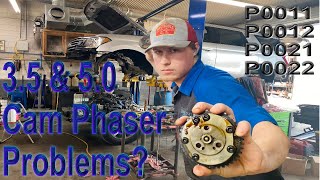
Used OEM Parts in Stock

New Aftermarket Parts Available


The information in this article is provided for general reference and educational purposes only. Vehicle specifications, procedures, and part compatibility can vary by production date, trim level, and region. Always consult your vehicle's factory service manual and verify part numbers before purchasing or performing repairs. Safety-critical components such as airbags, seat belts, and braking systems should be installed by a qualified professional.
- Ford TRANSIT:
- 🎬 Helpful Videos
- 🛍️ Shop This Part
- What's Unique About the 2015-2019 Ford TRANSIT
- Diagnostic Flowchart
- Symptoms You May Notice
- Most Likely Causes
- Rare But Worth Checking
- Diagnosis Steps
- Parts You'll Likely Need
- Related Codes That Often Appear With This One
- Technical Service Bulletins (TSBs) & Recalls
- Platform-Specific Known Issues
- Mechanic-Grade Diagnostic Values
- Hidden / Shadow Codes Worth Checking
- Scan Tool Commands That Help
- Wiring & Ground Locations
- Real Owner Repair Stories
- When the Usual Fixes Don't Work
- OEM Part Supersession History
- Model Year Variations Within This Range
- 🎟️ Get 5% Off