

P0021 on 2020-2025 Kia Telluride: Causes for Over-Advanced Cam Timing and Fixes
On a 2020-2025 Kia Telluride, code P0021 is most often caused by low or dirty engine oil. Before buying parts, check your oil level and condition. If the oil is good, the next most likely cause is a faulty Bank 2 (front) intake Oil Control Valve (OCV), which costs about $70-$150 for the part. This is a common issue for this engine, which is also used in the Hyundai Palisade.
- First and foremost, check your engine oil level and condition. Low or dirty oil is the #1 cause of P0021 on the Kia Telluride.
- Do not immediately replace the camshaft position sensor; it is rarely the cause of this code.
- The most likely failed part is the Bank 2 (front) intake Oil Control Valve (OCV). A simple DIY test is to swap it with the Bank 1 (rear) OCV to see if the code follows the part (changing to P0011).
- Due to potential oil consumption, it is wise to manually check your oil level every 1,000-2,000 miles.
What's Unique About the 2020-2025 Kia Telluride
The Lambda II 3.8L GDi V6 engine in the Telluride, shared with the Hyundai Palisade, is generally reliable but can be sensitive to oil level and condition. Some owners have reported oil consumption, sometimes as much as a quart every 1,000 miles, which makes checking the oil level frequently critical. Because the CVVT system is entirely dependent on hydraulic oil pressure, low or dirty oil is the leading trigger for timing-related codes like P0021 on this specific platform. Furthermore, as a Gasoline Direct Injection (GDI) engine, it can be prone to carbon buildup on intake valves over time, which can contribute to oil consumption and other performance issues, though carbon buildup is not a direct cause of P0021.
Symptoms You May Notice
- Check Engine Light is on
- Rough or unstable idle
- Poor acceleration and loss of power
- Engine hesitation or stalling, especially at low speeds
- Decreased fuel economy
- Rattling or knocking sounds from the engine on startup or while running (indicates a more serious issue)
- Replacing the Camshaft Position Sensor (CMP). The CMP sensor reads the camshaft's position, but it is rarely the cause of a P0021 code. The problem is usually with the mechanical system that controls the timing (oil pressure or OCV), not the sensor that reads it. Replacing the sensor without diagnosing the underlying cause will not fix the issue.
Most Likely Causes
- Low, Dirty, or Incorrect Viscosity Engine Oil 🔴 High Probability The Lambda II 3.8L GDi engine has documented cases of oil consumption. The CVVT system, which controls cam timing, is entirely dependent on clean oil at the correct pressure to function. Even slightly low or degraded oil can cause the mechanical phasers to respond slowly or incorrectly, triggering this code.
How to confirm: Check the engine oil dipstick. The level should be between the 'F' and 'L' marks. The oil should be amber and smooth, not black, thick, or sludgy. An oil change is the first and most crucial diagnostic step. 🎬 Watch: Step-by-step Telluride oil change guide
Typical fix: Perform an oil and filter change using a high-quality full synthetic 5W-30 oil that meets manufacturer specifications. Reset the code and monitor oil levels closely, checking every 1,000 miles.
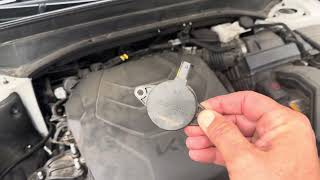
Est. part cost: $50-$100 - Faulty Bank 2 Intake Oil Control Valve (OCV) 🟡 Medium Probability The OCV (also called a VVT solenoid) is an electromechanical part that can get clogged with engine sludge or fail electronically. It is a common failure point on many modern engines, including this one, and is often the next part to check after verifying oil condition.
How to confirm: The most effective DIY diagnostic is to swap the Bank 2 (front/radiator side) intake OCV with the Bank 1 (rear/firewall side) intake OCV. Clear the codes and drive. If the code returns as P0011 (the Bank 1 equivalent), the OCV is confirmed to be faulty. You can also test the OCV's resistance with a multimeter; it should be between 6.9 and 7.9 ohms.
Typical fix: Replace the faulty Bank 2 intake Oil Control Valve. It is typically held in by a single bolt and is accessible from the top of the engine. 🎬 See: How to locate and replace the VVT solenoid Many technicians recommend replacing both intake OCVs at the same time as a preventative measure.
Est. part cost: $70-$150
Rare But Worth Checking
- Failing Camshaft Phaser: This is a more serious mechanical failure inside the engine. It would likely be accompanied by a distinct rattling or knocking noise from the engine. If you suspect this, professional diagnosis is recommended as it is a much more involved and expensive repair.
- Stretched Timing Chain or Failed Tensioner: While possible, this is uncommon on a well-maintained, newer vehicle. This issue is usually associated with high mileage or severe lack of maintenance (e.g., infrequent oil changes) and would typically present with rattling noises, especially on a cold start.
- Clogged Oil Passages: Severe oil sludge can block the small passages that feed the CVVT system and camshaft phasers. This typically only occurs in cases of extreme maintenance neglect. An engine flush may help, but disassembly might be required in severe cases.
Diagnosis Steps
- Check Engine Oil: Immediately check the oil level and condition on the dipstick. If it's low, top it off. If it's dark, sludgy, or past its service interval, perform a full oil and filter change with the correct 5W-30 synthetic oil. This is the most common fix.
- Scan for Codes: Use an OBD-II scanner to confirm P0021 and check for any other stored codes. Note any other codes like P0011 or P0024.
- Inspect OCV Wiring: Visually inspect the wiring harness and connector for the Bank 2 intake OCV (on the front cylinder bank) for any signs of damage, corrosion, or loose connections.
- Perform OCV Swap Test: This is the most definitive and cost-effective test. Swap the intake OCV from Bank 2 (front) with the intake OCV from Bank 1 (rear). They are identical parts. Clear the codes and drive the vehicle.
- Re-Scan for Codes: If the trouble code changes to P0011 (the code for Bank 1), you have confirmed the OCV you moved is faulty and needs to be replaced.
- Test OCV Resistance (Optional): If you have a multimeter, you can test the resistance of the suspected faulty OCV. A healthy OCV should read between 6.9 and 7.9 ohms. An open circuit or a reading far outside this range indicates a failed solenoid.
- If Code P0021 Returns: If the same code comes back after the swap, the problem is not the OCV. The issue could be a clogged oil passage, a problem with the camshaft phaser, or a timing chain issue. At this point, professional diagnosis with advanced tools is recommended.
Parts You'll Likely Need
- Engine Oil Control Valve (VVT Solenoid)
(OEM #24375-3LAA2 (Verify with VIN))— This solenoid controls the oil flow that adjusts the camshaft timing. It is the most common part to fail or become clogged, leading to code P0021 after low/dirty oil has been ruled out.
Trusted brands: Kia Genuine, Hyundai, Standard Motor Products (SMP), Dorman
OEM price range: $100-$150
Aftermarket price range: $70-$120
Related Codes That Often Appear With This One
- P0011 — This is the same over-advanced timing code but for Bank 1. Seeing both P0011 and P0021 together strongly suggests a systemic issue affecting the whole engine, like critically low/dirty oil or low oil pressure from a failing oil pump.
- P0024 — This code is for the exhaust camshaft on the same bank (Bank 2). Seeing it with P0021 could indicate a more significant oil pressure or supply problem affecting the entire Bank 2 cylinder head, or a potential timing chain issue on that bank.
Technical Service Bulletins (TSBs) & Recalls
- TSB ENG219 (July 2020): While not directly for P0021, this TSB discusses the 'Maintenance Reminder Feature' and notes that Kia's evaluations show many owners operate under 'SEVERE' conditions and should change their oil more frequently (e.g., every 3,750 miles), which is a key preventative measure for this code.
- TSB ENG211 (NHTSA ID 10187821): Provides an update to the ECM logic for misfire detection on 2020 Tellurides, which can sometimes be a symptom of timing issues.
Platform-Specific Known Issues
- The Lambda II 3.8L GDi engine can be prone to oil consumption. Owners should check their oil level more frequently than the recommended oil change interval to prevent low oil levels from causing CVVT system faults.
- A petition filed with the NHTSA mentions issues with oil drain plug gaskets being fused with paint from the factory, which can lead to improper sealing and oil leaks if not carefully handled during an oil change.
Mechanic-Grade Diagnostic Values
- Oil Control Valve (OCV) / VVT Solenoid Resistance — expected: 6.9 - 7.9 Ohms at 68°F (20°C). Failure: A reading of zero (short), infinity/OL (open circuit), or a value significantly outside the expected range. 🎬 Watch: How to diagnose P0011/P0021 and perform a timing relearn
- High Pressure Fuel Pump Mounting Bolt Torque — expected: 13.7 Nm (10.1 lb-ft). Failure: Improper torque can lead to fuel leaks or pump damage.
- High Pressure Fuel Pipe Flare Nut Torque — expected: 29.5 Nm (21.8 lb-ft). Failure: Incorrect torque can cause dangerous high-pressure fuel leaks.
- Mass Air Flow (MAF) Rate at Idle — expected: 2 to 7 g/s. Failure: Values outside this range can indicate intake leaks or sensor issues that affect engine load calculations.
- Mass Air Flow (MAF) Rate at 2500 RPM (No Load) — expected: 15 to 25 g/s. Failure: A MAF reading that doesn't rise with RPM can indicate a faulty sensor or restriction.
Scan Tool Commands That Help
- Kia GDS (Global Diagnostic System) or equivalent: CVVT Actuator Test / VVT Solenoid Bi-Directional Control — This command allows a technician to manually activate the Bank 2 intake OCV while the engine is idling. If activating the solenoid causes the engine to stumble or run rough, the OCV and phaser are likely responding. If there is no change in engine operation, it points to a stuck OCV, a clogged oil passage, or a failed cam phaser.
Real Owner Repair Stories
- MyG37 Forum User (Infiniti G37 (similar V6 CVVT system)) — Check engine light with codes P0021 (Bank 2) and P0524 (Oil Pressure Low).
❌ Tried (didn't work) Clearing codes, but they returned immediately.
✅ What actually fixed it The user swapped the VVT solenoids and camshaft position sensors between Bank 1 and Bank 2. The code changed to P0011 (Bank 1), indicating the problem moved with the parts. By swapping just the sensor back, the code remained P0011, confirming the VVT solenoid was the faulty component. - Kia Owner Report (NHTSA ODI #11562317) — An owner of a similar Kia V6 model reported that after finding code P0021, the service department determined the engine was burning oil and eventually required a full engine replacement.
Diagnostic Flowchart
Other Known Issues on This Vehicle
Issues unrelated to this code that are worth knowing about as an owner of this generation:
- Spontaneous Windshield Cracking 🟠 Medium — Widespread owner complaints across all model years (2020-2024). Hundreds of complaints filed with NHTSA. A class-action lawsuit has been filed alleging the windshields are defective. (Ref: Kia issued a 'Customer Satisfaction Initiative' for some 2020 models but no formal recall exists.)
- Tow Hitch Harness Fire Risk 🔴 High — Affects 2020-2022 models equipped with the genuine Kia 4-pin tow hitch harness. Moisture and debris can short the module, causing a fire while parked or driving. (Ref: Recall NHTSA 22V-626 / Kia SC247. Owners are advised to park outside until the repair is completed.)
- Roll-Away Risk When in Park 🔴 High — Affects over 427,000 Tellurides from 2020-2024 model years due to potentially improperly assembled driveshafts. (Ref: Recall issued. Dealers will inspect the driveshafts and install a software update to automatically engage the electronic parking brake.)
- High Beam Failure (Halogen Models) 🟠 Medium — Affects 2020 models with halogen headlights. Heat from the bulb can damage the high beam shield mechanism, causing failure. (Ref: Recall NHTSA 24V-148 / Kia SC299. Dealers will install a reinforcing clip or replace the headlamp assembly.)
- Power Seat Motor Fire Risk 🔴 High — Affects over 462,000 Tellurides from 2020-2024 model years. A stuck power seat slide knob can cause the motor to overheat. (Ref: Recall NHTSA SC316. Owners advised to park outside. Dealers will install a bracket for the switch covers.)
Used vs. New Parts: Buying Guide for This Vehicle
When a used part is the smart pick: A used Oil Control Valve (OCV) is generally not recommended due to the high risk of inheriting sludge or wear from the donor vehicle. However, obtaining a used wiring harness pigtail/connector from a junkyard can be a cost-effective fix if only the connector is damaged.
Donor-vehicle mileage cap: roughly under 50000 miles for the part to have meaningful remaining life.
What to inspect on the donor part:
- When inspecting a donor vehicle for any part, remove the oil filler cap and look for signs of heavy sludge or 'coking' inside the valve cover. Avoid any parts from an engine that looks poorly maintained.
- Ensure the OCV screens are intact and free of debris or tearing.
- Check connectors for corrosion, brittleness, or broken locking tabs.
OEM-only on this vehicle (don't cheap out):
- Oil Control Valve (VVT Solenoid)
- Camshaft Phaser
Aftermarket brands forum-validated for this vehicle:
- Standard Motor Products (SMP)
- Dorman
Brands owners have reported issues with on this vehicle:
- No-name or unbranded solenoids from online marketplaces like Amazon or eBay are frequently reported on forums to fail prematurely or be dead-on-arrival.
Real Owner Stories
Aggregated from forums and TSBs cited above. Mileages and costs reflect what owners reported in those sources.
2020 Kia Telluride 3.8L GDi V6
Symptoms: Owners frequently discuss oil consumption as a primary concern, noting that the engine can run low on oil between recommended service intervals.
What fixed it: Keeping oil topped off and performing more frequent oil changes (every 3,750 miles) as suggested by Kia's evaluation of severe operating conditions.
Source hint: tellurideforum.org and r/KiaTelluride
2020 Kia Telluride 3.8L GDi V6
Symptoms: Misfire detection and rough running symptoms.
What fixed it: Updating the ECM logic for misfire detection as per TSB ENG211.
Source hint: TSB ENG211 (NHTSA ID 10187821)
Related OBD-II Codes
Frequently Asked Questions
Does TSB ENG219 apply to my 2020 Kia Telluride regarding oil maintenance?
Could the misfire I'm feeling on my 2020 Telluride be related to a software issue instead of P0021?
Is there a specific oil type I should use in my Lambda II 3.8L GDi V6 to prevent this code?
I'm seeing P0021 on my Telluride; should I be worried about the oil drain plug?
Can I test the Bank 2 intake Oil Control Valve myself before buying a new one?
Is the P0021 code common on the Hyundai Palisade as well?
Helpful Videos
![How to Fix KIA P0021 Engine Code in 4 Minutes [1 DIY Method / Only $19.45]](https://img.youtube.com/vi/H8rdCDH1sdE/mqdefault.jpg)

We Have This Part in Stock


The information in this article is provided for general reference and educational purposes only. Vehicle specifications, procedures, and part compatibility can vary by production date, trim level, and region. Always consult your vehicle's factory service manual and verify part numbers before purchasing or performing repairs. Safety-critical components such as airbags, seat belts, and braking systems should be installed by a qualified professional.
- Kia Telluride:
- 🎬 Helpful Videos
- 🛍️ Shop This Part
- What's Unique About the 2020-2025 Kia Telluride
- Symptoms You May Notice
- Most Likely Causes
- Rare But Worth Checking
- Diagnosis Steps
- Parts You'll Likely Need
- Related Codes That Often Appear With This One
- Technical Service Bulletins (TSBs) & Recalls
- Platform-Specific Known Issues
- Mechanic-Grade Diagnostic Values
- Scan Tool Commands That Help
- Real Owner Repair Stories
- Diagnostic Flowchart
- Other Known Issues on This Vehicle
- Used vs. New Parts: Buying Guide for This Vehicle
- Real Owner Stories
- 2020 Kia Telluride 3.8L GDi V6
- 2020 Kia Telluride 3.8L GDi V6
- Related OBD-II Codes
- Frequently Asked Questions
- 🎟️ Get 5% Off