

OBD-II Code P0024: Exhaust Camshaft Timing Over-Advanced (Bank 2)
What P0024 means, why it triggers, and how to fix it
- Code P0024 indicates the Bank 2 exhaust camshaft is over-advanced, with dirty or low engine oil causing over 60% of these faults.
- Check your oil dipstick immediately; a $60 oil and filter change is the most common and cheapest fix for this code.
- If the oil is clean, the VVT solenoid (Oil Control Valve) is the most likely failed part, costing between $150 and $350 to replace at a shop.
- Stop driving if you experience stalling or flashing warning lights, as ignoring P0024 can destroy your catalytic converter and lead to a $2,000+ repair bill.
What Does P0024 Mean?

Code P0024 means the Engine Control Module (ECM) detects the Bank 2 exhaust camshaft is rotated too far forward ('over-advanced') compared to its commanded position. This disrupts the precise opening and closing of the exhaust valves, destroying engine performance, fuel efficiency, and emissions control.
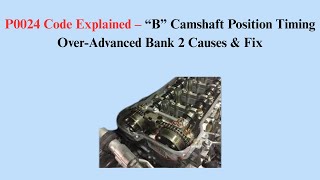
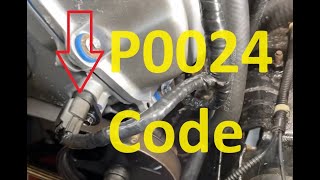
🎬 Watch: A quick overview of P0024 causes and common fixes.Technical definition: The official SAE/OBD-II definition is "'B' Camshaft Position - Timing Over-Advanced or System Performance (Bank 2)". 'Bank 2' is the side of the engine opposite cylinder #1, and the 'B' camshaft is the exhaust camshaft.
Can I Drive With P0024?

Yes, But With Caution. Do not drive unless absolutely necessary. While you can drive short distances (under 10 miles) to a repair shop, stop immediately if the check engine light flashes, the engine stalls, or you hear loud rattling. Continued driving with an over-advanced camshaft forces the engine into 'limp mode' with severely reduced power. More importantly, it causes misfires that destroy the catalytic converter, resulting in a $1,000 to $4,000 repair bill.
Common Causes

- Low, Dirty, or Incorrect Engine Oil (Very Common) — The Variable Valve Timing (VVT) system uses hydraulic oil pressure to adjust camshafts. Low, sludgy, or incorrect viscosity oil clogs passages and prevents adjustment. This is the single most common cause of P0024.
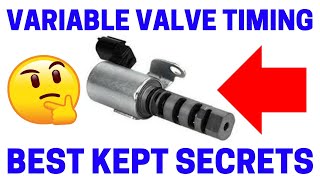
- Faulty VVT Solenoid (Oil Control Valve) (Very Common) — This electronic valve directs oil flow to the camshaft phaser. It clogs with debris or fails electrically, sticking open and allowing continuous, unregulated oil flow to the phaser. 🎬 Watch: How to tell if your VVT solenoid is bad.
- Clogged VVT Oil Filter Screens (Common) — Small mesh filter screens inside oil passages or banjo bolts clog with sludge, starving the VVT system of oil pressure even if the main engine oil filter is clean.
- Failed Camshaft Phaser (Actuator) (Common) — The mechanical gear on the camshaft end fails internally, clogs with sludge, or breaks its locking pin, permanently sticking in the advanced position.
- Worn Timing Chain or Tensioner (Less Common) — A stretched timing chain or weak tensioner alters the physical timing between the crankshaft and camshaft. The ECM interprets this mechanical misalignment as an over-advanced condition.
- Faulty Camshaft Position Sensor (Rare) — The sensor reads camshaft position and sends data to the ECM. A failure sends erratic voltage, falsely indicating advanced timing. This usually triggers a specific sensor code (like P0349) alongside P0024.
- Wiring or Connector Issues (Rare) — Damaged wires or corroded connectors interrupt the VVT solenoid or camshaft sensor signals, preventing the ECM from controlling or reading the timing.
- Faulty ECM/PCM (Very Rare) — Internal circuitry or firmware corruption causes the ECM to send incorrect advance commands or misinterpret accurate sensor data.
Symptoms

- Check Engine Light On — The ECM illuminates the Malfunction Indicator Lamp (MIL) immediately upon detecting the timing fault.
- Rough Idle and Stalling — The engine shakes, runs unevenly, or stalls completely when stopped at a traffic light.
- Reduced Engine Power and Acceleration — The vehicle feels sluggish and struggles to accelerate because valve timing is incorrect for power generation.
- Engine Noise (Rattling, Ticking) — A loud rattling or ticking sound from the engine, especially on startup, indicates a failing cam phaser or loose timing chain.
- Poor Fuel Economy — Miles per gallon (MPG) decreases by 10-20% because the engine burns fuel inefficiently.
- Hard Starting — The engine cranks excessively before firing up.
- Engine Hesitation or Bogging — The engine hesitates or 'bogs down' when pressing the gas pedal, especially under load like climbing a hill.
- Engine Enters Failsafe / Limp Mode — The computer intentionally limits engine power and RPM to prevent catastrophic internal damage.
Diagnostic Flowchart
Tap your situation to follow the diagnostic path that matches what you're seeing on this code.
Common Fixes & Costs
- Engine Oil and Filter Change — Parts: $30-$80, Labor: $40-$80, ~0.5 hr book time (DIY)
- Replace VVT Solenoid (Oil Control Valve)
— Parts: $40-$150, Labor: $80-$200, ~1.2 hr book time
(DIY)
: OEM 8L3Z-6M280-B (Motorcraft) (Alt: Dorman 917-200)
: OEM 10917AA070 (Alt: Denso 025-0003)
: OEM 24360-3CAB2 (Alt: Dorman 918-032) - Replace Camshaft Phaser(s)
— Parts: $200-$600 per phaser, Labor: $800-$2500, ~11.5 hr book time
(Professional)
: OEM 3R2Z-6A257-DA (Motorcraft) (Alt: Dorman 917-250) - Replace Timing Chain, Tensioners, and Guides — Parts: $400-$1200, Labor: $1000-$2500, ~14 hr book time (Professional)
- ECM/PCM Software Update or Replacement — Parts: $0-$1000, Labor: $100-$300, ~1.5 hr book time (Professional)
DIY vs Professional
- Engine Oil and Filter Change — Beginner: Yes, this is fundamental maintenance.
Tools: Wrench for drain plug, oil filter wrench, drain pan, funnel. - Replace VVT Solenoid (Oil Control Valve) — Beginner: Yes. Solenoids are usually accessible on the engine exterior.
Tools: Socket set, ratchet, torque wrench, screwdrivers, rags. - Replace Camshaft Phaser(s) — Beginner: No. Stop DIY and tow to a shop.
Tools: Full mechanic's tool set, engine-specific timing chain wedge tools, phaser locking tools, heavy-duty torque wrench. - Replace Timing Chain, Tensioners, and Guides — Beginner: No. Stop DIY and tow to a shop.
Tools: Same as cam phaser replacement, plus harmonic balancer puller.
Used vs. New Parts: Buying Guide
When a used part is worth it: Never buy a used VVT solenoid. For a cam phaser, a used OEM part from a verified low-mileage donor beats a cheap aftermarket part.
Donor-vehicle mileage cap: roughly under 60000 miles for the part to have meaningful remaining life.
Donor quality checklist:
- Verify the donor vehicle's mileage and reason for being scrapped.
- Visually inspect the part for sludge, scoring, or damage.
- Match the part number exactly to ensure you have the latest revision.
Decision logic:
- If The part is a VVT solenoid → Always buy new. The risk of a used part failing quickly is too high.
- If The part is a cam phaser and the vehicle has over 120k miles → A used OEM phaser from a low-mileage donor is a better value than a new aftermarket part.
- If The part has a known design flaw (e.g., early Ford cam phasers) → Buy the latest revised new OEM part only.
Warranty tradeoff: Used parts carry a 30-90 day warranty. New aftermarket parts offer 1-year warranties. New OEM parts carry a 1-2 year warranty.
Worst-case if a used part fails: $1000-$2500 if a used cam phaser fails, as you must pay the extensive labor cost again.
What Happens If You Wait — Timeline
- 0-1 month: Check Engine Light illuminates. Minor idle instability and a slight drop in fuel economy. (MPG impact: 3-5%% · Added cost: $0-$40 in wasted fuel.)
- 1-4 months: Rough idle becomes consistent. Engine hesitates during acceleration with noticeable power loss. (MPG impact: 5-15%% · Added cost: $50-$150 in wasted fuel.)
- 4-8 months: Engine stalls at low speeds. Unburnt fuel enters the exhaust, overheating the catalytic converter. (MPG impact: 10-20%% · Added cost: $800-$2,500 for catalytic converter replacement.)
- 8+ months: Catastrophic damage. A stuck phaser or stretched timing chain fails completely, causing pistons to strike valves. (MPG impact: N/A (vehicle undrivable)% · Added cost: $4,000-$8,000 for engine replacement.)
Cost of Not Fixing It
- 0-1 month: Fuel economy drops 5-15%, rough idle, and sluggish acceleration. (Added cost: $20-$60 per month in wasted fuel.)
- 1-6 months: Unburnt fuel enters the exhaust, overheating and melting the catalytic converter. (Added cost: $800-$2,500 for catalytic converter replacement.)
- 6+ months: A stuck phaser or stretched timing chain fails completely, causing pistons to smash into valves. (Added cost: $4,000-$8,000 for engine replacement or major rebuild.)
Diagnosis Steps

- Check Engine Oil Level and Condition
Pull the dipstick. If the oil is low, dark, thick, or sludgy, perform an oil and filter change using the manufacturer-specified viscosity immediately. This solves the code in over half of all cases.
Tools: Rag/paper towel (Beginner) - Scan for Codes & Review Freeze Frame Data
Use an OBD-II scanner to confirm P0024 and check for related codes (like P0014 or P0349). Review the freeze frame data to identify the exact RPM and engine load when the fault occurred.
Tools: OBD-II Scanner (Beginner) - Check for Technical Service Bulletins (TSBs)
Search online for manufacturer TSBs related to P0024 for your specific year, make, and model. Manufacturers frequently release updated diagnostic procedures or redesigned parts for known VVT flaws.
Tools: Internet access (Beginner) - Swap VVT Solenoids (Best DIY Test)
Swap the Bank 2 exhaust VVT solenoid with the Bank 1 exhaust solenoid. Clear the codes and drive. If the code changes to P0014 (Bank 1), the solenoid is definitively faulty. If P0024 returns, the issue is mechanical or wiring.
Tools: Socket set (Intermediate) - Inspect Wiring and Connectors
Visually inspect the wiring harness and electrical connector at the Bank 2 exhaust VVT solenoid. Look for frayed wires, melted plastic, or oil intrusion inside the connector.
Tools: Flashlight (Beginner) - Test VVT Solenoid Resistance
Disconnect the solenoid and measure resistance across its two pins with a multimeter. Expected resistance is typically 7 to 12 ohms (check your manual). Infinite or zero resistance means the solenoid is dead.
Tools: Multimeter, Socket set (Intermediate) - Analyze Live Data with an Advanced Scanner
Monitor the 'Commanded Cam Position' and 'Actual Cam Position' PIDs for Bank 2 Exhaust. At idle, both should be near 0 degrees. If the 'Actual' position overshoots the 'Commanded' position by more than 5 degrees, the timing fault is confirmed.
Tools: Advanced OBD-II Scanner (Intermediate) - Test VVT Solenoid with Bidirectional Control
Use an advanced scanner to command the VVT solenoid to a 20% duty cycle while idling. The engine should immediately stumble or run rough. If idle remains smooth, the solenoid is stuck or the oil passage is blocked.
Tools: Advanced OBD-II Scanner (with bidirectional control) (Intermediate) - Check Engine Oil Pressure
Connect a mechanical gauge to the engine block. Fully warmed up, idle pressure must meet manufacturer specs (typically 15-25 PSI). Low pressure starves the VVT system and points to a failing oil pump or internal leaks.
Tools: Mechanical oil pressure gauge, Socket set (Advanced) - Test Camshaft Position Sensor Voltage
Back-probe the sensor connector while the engine runs. The signal wire voltage must fluctuate between 0.5V and 4.5V. A flatlined voltage indicates a dead sensor.
Tools: Multimeter (graphing preferred), Back-probe kit (Advanced) - Inspect Mechanical Timing Components
Remove the valve cover and timing cover. Inspect the timing chain for slack, check guides for wear, and examine the camshaft phaser. Stop DIY and tow to a shop if you lack engine teardown experience.
Tools: Extensive mechanic's tool set (Advanced)
When This Code Triggers (Freeze-Frame Conditions)
- Engine Coolant Temp: 180-200°F (82-93°C) (The engine is at full operating temperature.)
- RPM: 2000-3000 RPM (During steady cruise or light acceleration when the VVT system actively adjusts timing.)
- Engine Load: 30-60% (The code sets under moderate load, rarely at idle or full throttle.)
- Vehicle Speed: 40-60 mph (Highway or steady-speed driving is the primary trigger condition.)
Related Codes
- P0014 — Identical fault for Bank 1. Seeing P0014 and P0024 together means a systemic issue like low oil pressure or a stretched timing chain, not simultaneous solenoid failures.
- P0025 — Opposite problem: 'Timing Over-Retarded'. The cam lags behind the commanded position, often due to a solenoid stuck closed.
- P0021 — 'Over-advanced' code for the 'A' (intake) camshaft on Bank 2. Points to a Bank 2 oil supply issue or faulty phaser.
- P0349 — Electrical fault with the Bank 2 sensor. If present with P0024, the sensor is the culprit. If P0024 appears alone, the issue is mechanical/hydraulic.
Climate & Environmental Factors
- Cold Weather: Extreme cold thickens engine oil. Using a thicker-than-specified viscosity (e.g., 10W-40 instead of 5W-20) slows the VVT system's hydraulic response on cold starts, triggering timing codes.
- High Altitude: Reduced air density amplifies existing performance issues like rough idle or power loss caused by the timing fault.
- Humidity: Prolonged extreme humidity accelerates corrosion on unsealed electrical connectors, interrupting sensor signals.
How to Talk to a Mechanic About This Code
Say this: "I have code P0024 for 'camshaft timing over-advanced on Bank 2'. Please check the oil condition and pressure, then electronically test the Bank 2 VVT solenoid before recommending a phaser or timing chain replacement."
This directs the mechanic to follow a logical, cost-effective diagnostic path, starting with the cheapest failures (oil and solenoid) before moving to expensive ones (phasers/timing chain).
Avoid saying:
- 'My check engine light is on, can you look at it?'
- 'The car is running rough, just fix whatever is wrong.'
- 'I think I need a new camshaft sensor.'
Questions to ask before authorizing the repair:
- Did you command the VVT solenoid with a scan tool, and did the engine's idle change?
- Can you provide a printout of the live data showing the commanded vs. actual cam position for Bank 2?
- What was the engine oil pressure reading at idle?
- If recommending a timing chain, what specific evidence confirms that diagnosis over a simpler solenoid issue?
- What is the warranty on parts and labor for this repair?
Where to Take It: Dealer vs Independent vs Chain
- Dealer:
Best for: Vehicles under powertrain warranty., Known manufacturer-specific issues (e.g., GM timing chain special coverage)., Complex timing chain replacements requiring OEM-specific tools.
Downsides: Highest labor rates, typically 1.5-2x more than an independent shop., May recommend a full timing job when only a less expensive component failed. (Typical cost: +50% vs. baseline) - Independent Shop:
Best fit for most situations. A reputable independent shop cost-effectively diagnoses and fixes the most common causes of P0024.
Best for: Out-of-warranty vehicles where cost is a major factor., Diagnosing and replacing common failure parts like VVT solenoids.
Downsides: Quality varies; ensure the shop has ASE-certified technicians., May lack brand-specific specialty tools for complex jobs. (Typical cost: +0% vs. baseline) - Chain Shop:
Avoid for diagnosis and repair. The risk of misdiagnosis and being sold unneeded parts is too high.
Best for: An oil and filter change if you are certain that is the only service needed.
Downsides: Technician skill varies dramatically and is often inadequate for diagnosing complex VVT issues., High pressure to upsell unnecessary services. (Typical cost: -10% vs. baseline)
When to Walk Away From the Repair
If repair costs exceed 40-50% of the vehicle's Kelley Blue Book value, sell or trade it in.
- Car worth $4000, fix is $2800: Walk away. The repair cost is 70% of the car's value.
- Car worth $15000, fix is $250: Fix it. The repair is a minor fraction of the vehicle's value.
- Car worth $7000, fix is $3200: Borderline. At 46% of the car's value, get a second opinion. If the car has other issues, walk away.
What Scan Tool You Need for This Code
Minimum: A scanner that graphs live data, specifically 'Commanded Camshaft Position' and 'Actual Camshaft Position' PIDs.
A $20 code reader only tells you the code exists. It cannot show the live data proving the timing is actually off, leading to guessing and replacing the wrong parts.
Budget: BlueDriver Pro Scan Tool (~$100) — Connects to your smartphone and graphs live data PIDs to compare commanded vs. actual camshaft position.
Mid-range: Foxwell NT510 Elite / Innova 5610 (~$180) — Adds bidirectional control, allowing you to command the VVT solenoid to open and close to test its function.
Professional: Autel MaxiCOM MK808 (~$500) — Offers full bidirectional controls, OE-level diagnostics, and advanced data logging.
Rent vs buy: Buy. Free loaner scanners from auto parts stores are basic code readers that cannot view live data or perform bidirectional tests.
How to Clear the Code After You Fix It
- Use an OBD-II scan tool to clear the diagnostic trouble codes.
- Perform a complete OBD-II drive cycle to allow the vehicle's readiness monitors to run.
- Verify the Check Engine Light remains off after the drive cycle.
Drive cycle (~20 minutes): Cold start, idle 3 minutes, drive 45-55 mph for 8 minutes, stop-and-go for 5 minutes, cool down completely.
Readiness monitors affected: Catalyst Monitor, Evaporative System Monitor, Oxygen (O2) Sensor Monitor
Before emissions retest: drive at least 100 miles to fully set monitors.
Watch out for:
- Disconnecting the battery deletes readiness monitors but does not permanently clear the code if the mechanical fault remains.
- Failing to complete the full drive cycle leaves readiness monitors incomplete, causing an automatic emissions test failure.
Will This Fail Emissions / State Inspection?
Yes — this code typically fails an OBD-II emissions inspection.
- California: Automatic failure. Requires 100+ miles of driving post-repair to reset monitors before a retest.
- New York: Immediate OBD-II failure during the NYS DMV inspection.
- Texas: An illuminated Check Engine Light guarantees failure in emissions-testing counties.
Most Commonly Affected Vehicles
- Ford F-150, Expedition, Edge (2004-2021) — Extremely common on 5.4L 3V, 5.0L, and 3.5L EcoBoost engines. A distinct startup rattle confirms phaser failure. Bank 2 is the driver's side. A full timing job costs over $3,000.
- Subaru Impreza (WRX/STI), Ascent, Forester, Crosstrek (2011-Present) — Frequent misdiagnosis involves replacing the top-mounted intake solenoid. P0024 requires replacing the lower-mounted exhaust Oil Control Valve (OCV) on the driver's side.
- Hyundai / Kia Sonata, Azera, Santa Fe, Optima, Sorento (2011-2019) — Common on 3.3L V6 GDI engines due to oil sludge clogging OCVs. Non-OEM oil filters cause oil pressure deviations triggering this code. Always use OEM filters.
- Nissan / Infiniti Maxima, Murano, G35, EX35 (2007-2016) — Often caused by failing internal oil gallery gaskets losing oil pressure to cylinder heads. If P0014 and P0024 appear together, gallery gaskets are the primary suspect.
- Toyota Camry, Highlander, Sienna (2007-2019) — Caused by a clogged OCV from oil sludge, or a stretched timing chain on high-mileage 2GR-FE V6 engines.
- Honda Accord, Odyssey, Pilot (2003-2024) — The VTC oil control valve leaks externally or fails internally. Bank 2 is typically the front bank near the radiator.
- BMW 3 Series (E90), 5 Series (E60), X3 (E83), X5 (E70) (2006-2013) — VANOS solenoids clog from carbon buildup during extended oil change intervals. Swapping intake and exhaust solenoids is the definitive diagnostic step.
- Chevrolet / GMC Colorado / Canyon, Traverse, Acadia, Equinox (2010-2022) — The 3.6L V6 suffers from premature timing chain stretch. GM Special Coverage #11340C extended warranties for this exact defect, making the chain the primary suspect.
Manufacturer-Specific Notes
- Ford: A loud cold-start rattle on 3.5L and 5.4L engines guarantees failing cam phasers. Always use OEM Motorcraft parts; aftermarket phasers fail rapidly.
- Toyota / Lexus: Oil sludge clogs the tiny OCV filter screens on the 2GR-FE V6. Regular oil changes are mandatory to prevent this.
- Subaru: On turbocharged engines, the fault is the lower exhaust OCV (part 10917AA070), not the easily accessible upper intake solenoid.
- Chevrolet / GMC: Premature timing chain stretch on the 3.6L V6 is a documented factory defect causing P0024.
- Hyundai / Kia: Aftermarket oil filters bypass valves alter oil pressure, triggering VVT codes. Always use OEM filters.
Real Owner Stories
2013 Ford F-150 EcoBoost with ~110k miles
Check engine light came on with P0014 and P0024 simultaneously. Engine ran fine.
What they tried:
- Owner feared a timing chain issue since both banks coded at once.
- A technician diagnosed oil sludging clogging the VVT phaser screens.
Outcome: A professional engine oil flush and filter change cleared the codes permanently. The owner now changes oil every 4,000 miles.
Lesson: If you get timing codes for both banks (P0014 & P0024), suspect a systemic oiling problem before assuming multiple parts failed.
2015 Kia Sorento with P0024
Check engine light was on with sluggish acceleration.
What they tried:
- Owner debated replacing the camshaft sensor.
- Forum advice pointed to the VVT solenoid as the true culprit.
Outcome: Replacing the VVT solenoid fixed the issue for under $100 in parts.
Lesson: Don't assume a camshaft timing code means the sensor is bad. The VVT solenoid is a much more probable cause.
2013 Scion FR-S (Subaru Boxer Engine)
Owner neglected oil changes. Check engine light came on for P0024.
What they tried:
- Owner suspected the overdue oil change was the root cause.
Outcome: An oil change and cleaning the VVT solenoid restored normal operation.
Lesson: Be honest about maintenance history. If your oil is old, it is the direct cause of the P0024 code.
2012 Chevy Impala with P0024 on a road trip
Check engine light appeared during a road trip with no symptoms.
What they tried:
- Owner researched the code to see if driving was safe.
Outcome: Owner safely drove 2.5 hours home without issue before replacing the VVT solenoid.
Lesson: If the car drives perfectly fine, it is safe to drive a moderate distance to a repair shop. Address it promptly upon arrival.
How to Prevent This Code From Triggering
- Use the correct, high-quality engine oil and filter. (Every oil change) — The VVT system requires specific hydraulic pressure. Correct viscosity prevents sludge buildup in tiny VVT passages.
- Perform regular oil changes. (Every 5,000 miles.) — Old oil loses its ability to clean, allowing contaminants to form sludge that destroys VVT components.
- Clean or replace VVT solenoids. (Inspect/clean every 60,000 miles.) — Cleaning solenoids with electronic parts cleaner removes debris and prevents them from sticking.
- Ensure engine reaches full operating temperature regularly. (Weekly) — Highway driving burns off moisture and fuel contaminants in the oil, preventing sludge.
- Perform a professional engine oil flush. (Every 100k miles if needed.) — Dissolves and removes deposits from oil passages that a simple drain-and-fill won't clear.
Frequently Asked Questions
What are the most common misdiagnosis mistakes for P0024?
The most common mistake is replacing the camshaft position sensor. P0024 is a timing performance code, not a sensor circuit code. Unless you also have a code like P0349, the sensor is rarely the problem.
I have P0024 and P0014 at the same time. What does that mean?
Seeing over-advanced codes for both banks simultaneously means a systemic engine issue. It is highly improbable two solenoids failed at once. Focus on low oil pressure, severe oil sludging, or a stretched timing chain.
Can I just clear the P0024 code and keep driving?
You can clear the code, but it will return within a few drive cycles. Ignoring it leads to severe engine and catalytic converter damage.
Will code P0024 cause me to fail an emissions test?
Yes. An active Check Engine Light causes an automatic failure in most jurisdictions. Incorrect valve timing also increases harmful emissions, failing tailpipe tests.
What is 'Bank 2' and how do I find it?
Bank 2 is the side of the engine opposite cylinder #1. On most V-type engines, find cylinder #1 at the most forward point in the engine bay; Bank 2 is the other side. For transverse V6 engines (Honda, Toyota), Bank 2 is typically the bank closer to the firewall.
How can a simple oil change fix a P0024 code?
The VVT system is hydraulic and relies on clean oil at the correct pressure. Old, sludgy oil clogs the tiny passages in the VVT solenoid and phaser. Fresh oil cleans these passages and restores function.
Will P0024 clear itself?
No. It indicates a persistent fault in a critical engine system. The underlying mechanical or electrical issue must be repaired for the code to stay cleared.
What is the difference between P0024 and P0025?
Both point to Bank 2 exhaust camshaft timing, but describe opposite conditions. P0024 means the cam is too far ahead (over-advanced), often a solenoid stuck open. P0025 means the cam lags behind (over-retarded), often a solenoid stuck closed.
Key Takeaways
- Code P0024 indicates the Bank 2 exhaust camshaft is over-advanced, with dirty or low engine oil causing over 60% of these faults.
- Check your oil dipstick immediately; a $60 oil and filter change is the most common and cheapest fix for this code.
- If the oil is clean, the VVT solenoid (Oil Control Valve) is the most likely failed part, costing between $150 and $350 to replace at a shop.
- Stop driving if you experience stalling or flashing warning lights, as ignoring P0024 can destroy your catalytic converter and lead to a $2,000+ repair bill.
Helpful Videos


The information in this article is provided for general reference and educational purposes only. Vehicle specifications, procedures, and part compatibility can vary by production date, trim level, and region. Always consult your vehicle's factory service manual and verify part numbers before purchasing or performing repairs. Safety-critical components such as airbags, seat belts, and braking systems should be installed by a qualified professional.
- 🎬 Helpful Videos
- What Does P0024 Mean?
- Can I Drive With P0024?
- Common Causes
- Symptoms
- Diagnostic Flowchart
- Common Fixes & Costs
- DIY vs Professional
- Used vs. New Parts: Buying Guide
- What Happens If You Wait — Timeline
- Cost of Not Fixing It
- Diagnosis Steps
- When This Code Triggers (Freeze-Frame Conditions)
- Related Codes
- Climate & Environmental Factors
- How to Talk to a Mechanic About This Code
- Where to Take It: Dealer vs Independent vs Chain
- When to Walk Away From the Repair
- What Scan Tool You Need for This Code
- How to Clear the Code After You Fix It
- Will This Fail Emissions / State Inspection?
- Most Commonly Affected Vehicles
- Manufacturer-Specific Notes
- Real Owner Stories
- 2013 Ford F-150 EcoBoost with ~110k miles
- 2015 Kia Sorento with P0024
- 2013 Scion FR-S (Subaru Boxer Engine)
- 2012 Chevy Impala with P0024 on a road trip
- How to Prevent This Code From Triggering
- Frequently Asked Questions
- What are the most common misdiagnosis mistakes for P0024?
- I have P0024 and P0014 at the same time. What does that mean?
- Can I just clear the P0024 code and keep driving?
- Will code P0024 cause me to fail an emissions test?
- What is 'Bank 2' and how do I find it?
- How can a simple oil change fix a P0024 code?
- Will P0024 clear itself?
- What is the difference between P0024 and P0025?
- Key Takeaways
- 🎟️ Get 5% Off