

P0017 on 2017-2020 Lincoln Continental: Crank/Cam Correlation Causes and Fixes
P0017 on a 2017-2020 Lincoln Continental typically points to a sticking Variable Camshaft Timing (VCT) solenoid, often caused by low or dirty engine oil. Before major repairs, an oil change and testing or replacing the Bank 1 exhaust VCT solenoid is the most likely and cost-effective fix. On 3.7L models, this code can also be a symptom of a failing internal water pump contaminating the oil.
- P0017 on a 2017-2020 Continental means the exhaust camshaft on Bank 1 is out of sync with the crankshaft.
- Before any other repairs, check your engine oil. Low or dirty oil is the most common cause of this code.
- The most likely failed part is the Bank 1 exhaust VCT solenoid, a known issue cited in multiple Ford/Lincoln TSBs.
- Do not immediately replace the camshaft sensor; it is usually reporting a real timing problem.
- If you hear a rattling noise on startup, the issue is more likely a stretched timing chain, which is a more serious and expensive repair.
What's Unique About the 2017-2020 Lincoln CONTINENTAL
The 2017-2020 Continental uses V6 engines (3.7L, 2.7L EcoBoost, 3.0L EcoBoost) where the VCT system is highly sensitive to oil condition. Ford/Lincoln has issued multiple Technical Service Bulletins (TSBs) like SSM 48423, acknowledging that P0017 and related codes are often caused by debris causing VCT solenoids to stick, rather than a catastrophic mechanical failure. The TSBs recommend attempting to clear the debris by cycling the solenoid with a scan tool before replacement. Additionally, on the 3.7L V6, the water pump is driven by the timing chain, and a pump failure can contaminate the oil with coolant, leading to this code and severe engine damage. This internal water pump issue is a well-documented failure point across the Ford/Lincoln lineup for this engine family.
🎬 Watch: Expert timing chain and water pump tips for the 3.7L V6.Diagnostic Flowchart
Tap your situation to follow the diagnostic path that matches what you're seeing on this vehicle.
Symptoms You May Notice
- Check Engine Light (MIL) illuminated
- Rough or erratic idle
- Engine stalling at low speeds
- Loss of engine power and acceleration
- Increased fuel consumption
- Rattling noise from the engine, especially on a cold start
- Immediately replacing the camshaft or crankshaft position sensors. These sensors are often accurately reporting a mechanical timing or oil pressure problem, and replacing them will not fix the root cause.
Most Likely Causes
- Low, Old, or Dirty Engine Oil 🔴 High Probability The VCT system is hydraulically operated and highly sensitive to oil pressure and cleanliness. The manufacturer TSBs directly link this code to oil debris, and it is the first diagnostic step recommended by technicians.
How to confirm: Check the engine oil level on the dipstick and inspect its color and consistency. Verify the last oil change interval. Oil that appears milky may indicate coolant contamination from a failing water pump (3.7L).
Typical fix: Perform an engine oil and filter change using the manufacturer-specified grade (e.g., Motorcraft 5W-30 Synthetic Blend for the 3.7L, or 5W-30 Full Synthetic for EcoBoost engines) and a quality oil filter (e.g., Motorcraft FL-500S).
Est. part cost: $50-$100 - Sticking or Failed Variable Camshaft Timing (VCT) Solenoid 🔴 High Probability Multiple TSBs (SSM 54366, SSM 48423, SSM 47170) state this is a common issue caused by small debris. This is the most frequently cited cause across platform mates like the Ford Edge and Lincoln MKZ.
How to confirm: A technician can use a bidirectional scan tool to command the solenoid on and off (per TSB SSM 48423, cycle it 10 times) to check for response and attempt to clear debris. The solenoid can also be removed and tested for mechanical binding or electrical failure.
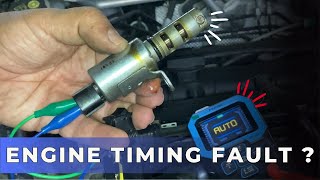
Typical fix: Replace the Bank 1 exhaust VCT solenoid. The solenoids are located on the valve covers.
Est. part cost: $40-$80 - Stretched Timing Chain or Failed Tensioner 🟡 Medium Probability Timing chains on the EcoBoost and Cyclone V6 engine families can stretch over time, particularly with extended oil change intervals or oil contamination. A rattling noise on cold starts is a key indicator. This is a well-documented issue on platform mates like the F-150 and Explorer.
How to confirm: This is a complex diagnosis requiring partial engine disassembly to physically inspect the timing marks, chain slack, and tensioner condition. It is usually confirmed after ruling out oil issues and VCT solenoids. If codes P0016 and P0017 are present together, a stretched chain is highly likely.
Typical fix: Replacement of the timing chain, guides, and tensioners. This is a labor-intensive job. For the 3.7L engine, the internal water pump should always be replaced at the same time.
Est. part cost: $400-$700 - Failed Camshaft Position Sensor ⚪ Low Probability
How to confirm: The sensor's signal can be monitored with an oscilloscope. Swapping the Bank 1 exhaust sensor with the Bank 1 intake sensor (if identical) to see if the code changes from P0017 to P0016 is a common diagnostic trick.
Typical fix: Replace the Bank 1 exhaust camshaft position sensor. The Bank 1 sensors are located on the rear cylinder head, closer to the firewall.
Est. part cost: $30-$60
Rare But Worth Checking
- Failed Internal Water Pump (3.7L V6 Only): On the 3.7L V6 engine, the water pump is driven by the timing chain. If its bearing or seal fails, it can leak coolant directly into the engine oil, causing widespread lubrication failure, VCT issues, timing chain stretch, and eventually catastrophic engine failure.
- Damaged Camshaft Phaser/Actuator: The phaser is the gear at the end of the camshaft that actually adjusts the timing. It can fail mechanically or become clogged with debris, but this is less common than a solenoid failure. A phaser issue is usually suspected after a new solenoid fails to resolve the code.
- Failed Crankshaft Position Sensor: While possible, it is much less common for the crankshaft sensor to fail than the camshaft sensor or VCT components for this specific code. A failure here would likely cause more severe running issues or a no-start condition.
- Damaged Reluctor Ring: The sensor reads a toothed wheel (reluctor ring) on the camshaft or crankshaft. If this wheel is damaged, has shifted, or has debris on it, it can cause an incorrect signal. This is rare and typically only occurs after major engine work.
Diagnosis Steps
- Check Engine Oil: Verify the oil level is correct and the oil is clean. If low, dirty, or milky (coolant contamination), perform an oil and filter change, clear the code, and see if it returns. This is the most important first step.
- Scan for Other Codes: Check for other related DTCs that can provide more clues (e.g., P0016, P0018, P0019, or misfire codes). The presence of P0016 is a strong indicator of a base timing issue.
- Inspect Sensor Wiring: Visually inspect the wiring harnesses and connectors for the Bank 1 exhaust camshaft sensor and the crankshaft position sensor for any signs of damage, corrosion, or loose connections.
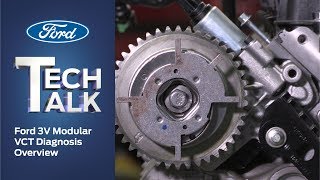
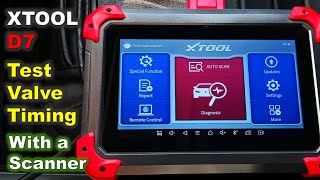
- Test the VCT Solenoid: Use a bidirectional scan tool to command the Bank 1 exhaust VCT solenoid on and off. Per TSB SSM 48423, cycle the solenoid 10 times to attempt to clear debris. Listen for a click and watch for a change in engine idle. If it fails to respond, it is likely faulty.
- Test the Camshaft Position Sensor: Monitor the sensor's output with a scan tool or oscilloscope to ensure it is producing a clean, consistent signal. Compare it to the other camshaft sensors. A common DIY test is to swap the suspect sensor with an identical one from another position and see if the code follows.
- Inspect Mechanical Timing: If all else fails, a more in-depth mechanical inspection is needed. This involves removing the valve cover and potentially the timing cover to check for a stretched timing chain, worn guides, or a failed tensioner. On the 3.7L, this is also when the internal water pump would be inspected. This step is best left to a professional.
Parts You'll Likely Need
- Variable Camshaft Timing (VCT) Solenoid
(OEM #FT4Z-6M280-B (For 2.7L), CJ5Z-6M280-A (For 3.7L))— This is the most common point of failure according to multiple TSBs, often due to sticking from oil debris.
Trusted brands: Motorcraft, Dorman, NTK
OEM price range: $40-$80
Aftermarket price range: $25-$50 - Engine Oil and Filter
(OEM #Motorcraft FL-500S (Filter for all engines))— Low or dirty oil is the leading cause of VCT system faults and can trigger P0017. An oil change is the first and most important diagnostic step.
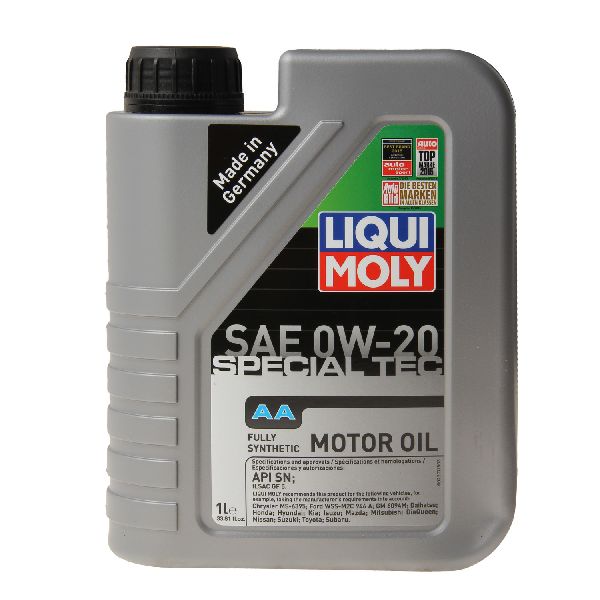
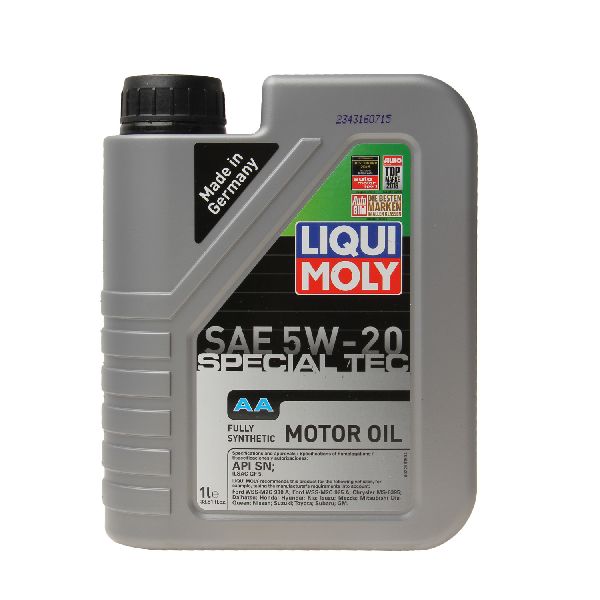
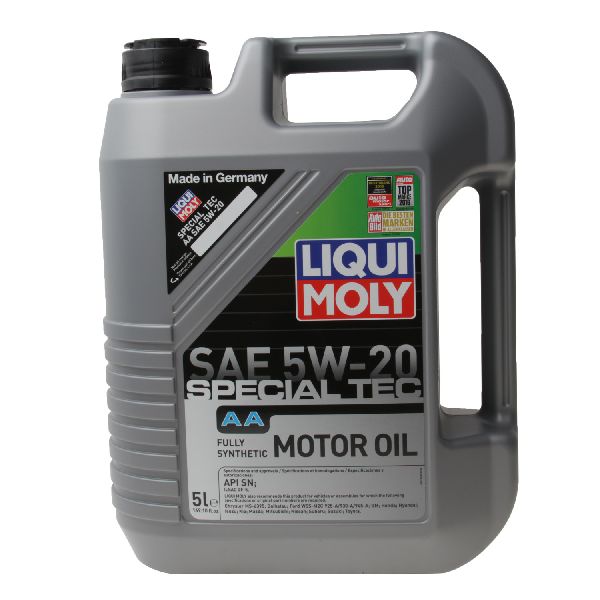
Trusted brands: Motorcraft, Mobil 1, Valvoline
OEM price range: $50-$100
Aftermarket price range: $
Related Codes That Often Appear With This One
- P0016 — This is the correlation code for the intake camshaft on the same bank (Bank 1). If both P0016 and P0017 are present, it strongly suggests a base timing issue like a stretched timing chain affecting the entire bank.
- P0018, P0019 — These are the equivalent correlation codes for Bank 2 (radiator side). If codes for both banks are present, it points to a problem affecting the entire engine, such as a stretched primary timing chain or severe oil pressure/quality issues.
- P0300, P0301, P0302, P0303 — These are misfire codes. Incorrect camshaft timing on Bank 1 can easily lead to misfires in the cylinders of that bank (Cylinders 1, 2, and 3).
- P0015 — This code is for 'Camshaft Position B - Timing Over-Retarded (Bank 1)'. Seeing it with P0017 reinforces that the issue lies with the Bank 1 exhaust cam, pointing strongly to the VCT solenoid or phaser.
Technical Service Bulletins (TSBs) & Recalls
- SSM 54366: Notes that various 2015-2021 Ford/Lincoln vehicles may show P0017 among other codes and points to specific diagnostic tests.
- SSM 48423: States that P0017 on 2015-2020 Ford/Lincoln vehicles may be due to small debris causing the VCT solenoid to stick.
- SSM 47170: An earlier bulletin with similar guidance to SSM 48423, indicating a known issue with sticking VCT solenoids due to debris.
Platform-Specific Known Issues
- The provided NHTSA records and related TSBs (SSM 48423, SSM 54366) indicate a recurring issue across 2015-2021 Ford and Lincoln vehicles where VCT solenoids stick due to small debris, triggering a host of timing-related codes including P0017. The official procedure is to attempt to clear the solenoid by cycling it with a scan tool before replacement.
- For the 3.7L Cyclone V6 engine specifically, the internal, timing-chain-driven water pump is a critical point of failure. When it fails, it leaks coolant into the oil, which quickly degrades the oil's lubricating properties, leading to VCT solenoid failure, timing chain stretch, and ultimately, catastrophic engine damage. Any P0017 code on a 3.7L should be investigated with this possibility in mind, especially if the oil appears milky or contaminated.
Mechanic-Grade Diagnostic Values
- VCT Solenoid Internal Resistance — expected: 5 to 15 Ohms. Failure: A reading outside this range, or an open/short circuit (0 or infinite Ohms), indicates a failed solenoid coil.
- Camshaft Position Sensor (Hall-Effect) Signal Test — expected: With the engine running, an oscilloscope should show a clean, repeating digital square wave pattern toggling between 0V and approximately 5V.. Failure: A missing, erratic, or noisy signal indicates a faulty sensor or wiring issue. A simple multimeter is not sufficient for this test.
- Mode $06 VCT Position Error — expected: Within the MIN/MAX values specified by the manufacturer when viewed on a capable scan tool.. Failure: A test value that exceeds the maximum limit indicates the camshaft is not reaching its commanded position, confirming a correlation fault even before a DTC is set.
Hidden / Shadow Codes Worth Checking
- Mode $06, Test ID $A5: This test monitor checks for VCT phase angle error. Component IDs $11 and $12 typically correspond to Bank 1 and Bank 2. A failure here is a strong indicator of a mechanical or hydraulic VCT system problem. (see via An advanced scan tool like Ford's IDS or FORScan is needed to access and interpret Mode $06 data.)
Scan Tool Commands That Help
- Ford IDS, FORScan: VCT Solenoid Test (e.g., Pinpoint Test HK11) — As per TSB SSM 48423, this command cycles the solenoid rapidly (e.g., 10 times) to dislodge small debris that may be causing it to stick. This can be both a diagnostic step and a potential fix.
- Ford IDS, FORScan: Parameter Reset — After replacing major timing components like the chain, phasers, or the PCM itself, a parameter reset may be required to clear learned values and force the system to relearn the new component tolerances.
Wiring & Ground Locations
- Engine Harness Ground (e.g., G101/G104) — Typically located on the cylinder head, engine block, or inner fender near the battery. It will be a wire (usually black) bolted directly to the chassis or engine.. The camshaft and crankshaft sensors rely on a clean ground reference. A loose or corroded ground can introduce electrical noise or voltage offsets, causing the PCM to receive an inaccurate signal and potentially set a false correlation code.
- OBD-II Port — Located under the driver's side dashboard, to the left of the steering column.. This is the connection point for the scan tool required to read the code, view live data, and perform bidirectional tests like cycling the VCT solenoids.
Real Owner Repair Stories
- Ford Edge Forum (platform mate) (Ford Edge with 3.7L V6 engine) — P0016 and P0017 codes present, slight engine rattle on startup.
❌ Tried (didn't work) Replacing VCT solenoids, Replacing camshaft position sensors
✅ What actually fixed it A full timing job, including replacement of the timing chains, guides, tensioners, and the internal water pump. The original chain had stretched, causing the correlation codes. - F-150 Forum (platform mate with 2.7L) (Ford F-150 with 2.7L EcoBoost V6) — P0017 code returned shortly after repair.
❌ Tried (didn't work) Engine oil and filter change, Replacement of the Bank 1 exhaust VCT solenoid with an aftermarket part
✅ What actually fixed it The aftermarket VCT solenoid was found to be faulty out of the box. Replacing it again with a genuine Motorcraft VCT solenoid resolved the code permanently. - Lincoln Forum (2018 Lincoln Continental with 3.0L EcoBoost V6) — P0017 and P0018 codes present (both banks).
❌ Tried (didn't work) Owner was concerned about a major timing chain failure.
✅ What actually fixed it A dealership technician performed an engine oil and filter change (oil was low and overdue) and ran the VCT solenoid cleaning procedure outlined in TSB SSM 48423. This cleared the debris and resolved the codes without replacing parts.
When the Usual Fixes Don't Work
- While replacing the Bank 1 exhaust VCT solenoid is a very common fix, it is not a guaranteed solution. A documented case on an F-150 with a 2.7L EcoBoost showed that an aftermarket VCT solenoid was defective upon installation and the P0017 code immediately returned. The problem was only solved by replacing the new aftermarket part with a genuine Motorcraft solenoid. This highlights the potential for poor quality control in aftermarket parts and underscores the recommendation to use OEM components for critical systems like variable valve timing.
OEM Part Supersession History
7T4Z-6M280-A→CJ5Z-6M280-A— Updated design for improved reliability and resistance to debris for the 3.7L V6 and other Ford engines.
Heads up: The older part should not be used; always install the latest revision (CJ5Z-6M280-A) for repairs.FT4Z-6M280-A→FT4Z-6M280-B— Minor revision for the VCT solenoid used in the 2.7L and 3.0L EcoBoost engines, likely for improved durability or internal filtering.
Helpful Videos
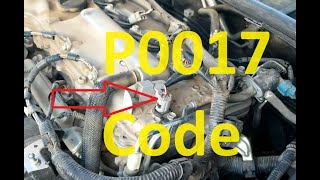
![How to Fix P0017 Engine Code in 6 Minutes [4 DIY Methods / Only $6.81]](https://img.youtube.com/vi/Vcj-f_J2hyo/mqdefault.jpg)

Used OEM Parts in Stock

New Aftermarket Parts Available


The information in this article is provided for general reference and educational purposes only. Vehicle specifications, procedures, and part compatibility can vary by production date, trim level, and region. Always consult your vehicle's factory service manual and verify part numbers before purchasing or performing repairs. Safety-critical components such as airbags, seat belts, and braking systems should be installed by a qualified professional.
- Lincoln CONTINENTAL:
- 🎬 Helpful Videos
- 🛍️ Shop This Part
- What's Unique About the 2017-2020 Lincoln CONTINENTAL
- Diagnostic Flowchart
- Symptoms You May Notice
- Most Likely Causes
- Rare But Worth Checking
- Diagnosis Steps
- Parts You'll Likely Need
- Related Codes That Often Appear With This One
- Technical Service Bulletins (TSBs) & Recalls
- Platform-Specific Known Issues
- Mechanic-Grade Diagnostic Values
- Hidden / Shadow Codes Worth Checking
- Scan Tool Commands That Help
- Wiring & Ground Locations
- Real Owner Repair Stories
- When the Usual Fixes Don't Work
- OEM Part Supersession History
- 🎟️ Get 5% Off