

P0016 on 2020-2024 Hyundai Palisade 3.8L V6: Causes, Symptoms, and Fixes
P0016 on a Hyundai Palisade or its platform-mate, the Kia Telluride, indicates a timing mismatch between the crankshaft and the Bank 1 intake camshaft. The most common causes are low or dirty engine oil, or a failing intake Oil Control Valve (OCV). An OCV replacement is a complex job on this engine as the part is located under the upper and lower intake manifolds, making it a significant labor cost.
- Before any other diagnosis, check your engine oil level and condition. Use the 'wipe and re-dip' method for an accurate reading on this engine.
- P0016 is a serious code that should be addressed promptly to avoid poor performance and potential engine damage.
- The most likely failed part after an oil issue is the Bank 1 intake Oil Control Valve (OCV).
- Be aware that replacing the intake OCV on the Palisade 3.8L V6 is a labor-intensive job because the part is located under the intake manifold, making it a costly repair.
What's Unique About the 2020-2024 Hyundai Palisade

The 3.8L Lambda II V6 in the Palisade uses a Dual Continuously Variable Valve Timing (D-CVVT) system that relies on oil pressure to adjust timing for both intake and exhaust cams. What makes this code particularly challenging on this platform is the location of the intake Oil Control Valve (OCV), a primary cause. While the exhaust OCVs are accessible on the front of the valve covers, the intake OCVs are buried beneath the upper and lower intake manifolds. This design choice turns a relatively simple part replacement into a 4-6 hour labor job, significantly increasing the repair cost.
Symptoms You May Notice
- Check Engine Light is on
- Rough or unstable idle
- Reduced engine power and sluggish acceleration
- Noticeably worse fuel economy
- Engine cranks but may not start, or has a delayed start
- Rattling or ticking noise from the engine, especially on startup
- Engine stalling, particularly at low speeds or when coming to a stop
- Replacing the Camshaft Position Sensor without testing it first. While it's a possible cause, oil-related issues or a faulty OCV are more common, and the sensor is often replaced unnecessarily.
- Assuming the timing chain has stretched without performing proper oil pressure and OCV diagnostics. A timing chain replacement is one of the most expensive possible fixes and should be the last resort after ruling out simpler causes.
- Replacing the accessible exhaust OCV on Bank 1 instead of the correct, harder-to-reach intake OCV.
Most Likely Causes

- Low, Dirty, or Incorrect Viscosity Engine Oil 🔴 High Probability The CVVT system is highly dependent on clean oil at the correct pressure to function. Delayed oil changes can cause sludge to build up and clog the small passages in the Oil Control Valves (OCVs) and cam phasers. This is often the first and easiest thing to check.
How to confirm: Check the engine oil level and condition. Note: This engine's dipstick can give a false low reading on the first pull; the owner's manual specifies to pull the dipstick, wipe it, re-insert it fully, then pull it again for an accurate reading. If the oil is dark, gritty, or below the 'L' mark, this is the likely starting point. 🎬 Watch: 4 simple DIY methods to fix a P0016 code An oil change immediately preceding the code can also be a clue, suggesting an incorrect filter or oil type was used.
Typical fix: Perform an engine oil and filter change using a high-quality OEM filter and the manufacturer-recommended full synthetic 5W-30 oil. Clear the codes and drive to see if the issue returns.
Est. part cost: $50-$100 - Failing Bank 1 Intake Oil Control Valve (OCV) 🟡 Medium Probability The OCV (also called a VVT solenoid) is an electromechanical valve that can fail electrically or become clogged with debris from the oil, causing it to stick. Due to its location under the intake manifold, it is subjected to significant heat, which can contribute to failure over time.
How to confirm: A technician can command the OCV on and off with a diagnostic scan tool to check its response. Resistance can also be measured across its terminals (typically 6.7-7.9 Ohms). However, due to its location under the intake manifold, physical inspection and testing is labor-intensive and is usually performed after ruling out simpler causes.
Typical fix: Replace the Bank 1 intake Oil Control Valve. This requires removing the upper and lower intake manifolds for access. The gaskets for the manifolds should be replaced at the same time. Given the labor involved, many owners opt to replace both Bank 1 and Bank 2 intake OCVs simultaneously.
Est. part cost: $100-$180 - Stretched Timing Chain or Worn Timing Components ⚪ Low Probability While the Lambda II is generally robust, high mileage, infrequent oil changes, or running the engine with low oil pressure can lead to timing chain stretch or failure of the plastic chain guides or hydraulic tensioners, causing slack in the system.
How to confirm: This is a mechanical issue confirmed by physical inspection, which requires removing the timing cover. A technician may first use an oscilloscope to compare cam and crank sensor signals to look for a pattern that indicates a timing deviation. A significant timing chain issue often presents with a noticeable rattling sound on startup. 🎬 Watch: Diagnosing timing codes and engine noise on Hyundai GDI engines
Typical fix: Replace the timing chains, guides, and tensioners. This is a major, labor-intensive engine repair.
Est. part cost: $40-$800 - Failing Camshaft or Crankshaft Position Sensor ⚪ Low Probability
How to confirm: A failing sensor may send erratic signals. This can be diagnosed by monitoring the sensor's live data on a scan tool or by using an oscilloscope. A common diagnostic trick is to swap the Bank 1 intake cam sensor with the easily accessible Bank 2 intake cam sensor. If the code changes to P0018 (Bank 2 correlation), it confirms the sensor is faulty.
Typical fix: Replace the faulty sensor (either the Bank 1 intake camshaft position sensor or the crankshaft position sensor).
Est. part cost: $40-$120
Rare But Worth Checking
- Clogged OCV Filter: There are small filter screens that protect the OCVs from debris. These can become clogged, restricting oil flow even if the OCV itself is functional. They should be inspected or replaced when servicing the OCV. In some cases, these filters can be completely blocked by sludge from neglected oil changes.
- Failing CVVT Cam Phaser: The mechanical gear (phaser/actuator) on the camshaft itself can fail internally, getting stuck in one position or having a broken lock pin. This is less common than an OCV failure and typically requires timing chain removal to replace.
- PCM/ECM Malfunction: In very rare instances, the Powertrain Control Module itself can be faulty, incorrectly interpreting sensor data. This should only be considered after all other possibilities have been exhaustively ruled out.
Diagnosis Steps
- Verify Engine Oil Level and Condition: Turn the engine off on a level surface. Pull the dipstick, wipe it clean, re-insert it fully, then pull it out again to get an accurate reading. If the oil is low, dirty, or past its service interval, perform an oil and filter change with OEM-spec products (Full Synthetic 5W-30). Clear the code and see if it returns. This simple step resolves the issue in a surprising number of cases.
- Scan for Other DTCs: Use an OBD-II scanner to check for any other pending or active codes that could provide more clues (e.g., sensor circuit codes, other bank timing codes).
- Inspect Sensor and OCV Wiring: Visually inspect the wiring harnesses and connectors for the crankshaft position sensor, Bank 1 camshaft position sensor, and the accessible Bank 1 exhaust OCV for any signs of damage, corrosion, or looseness. The intake OCV wiring is not visible without removing the intake manifold.
- Test the Camshaft Position Sensor: Using a scan tool, observe the live data from the Bank 1 and Bank 2 cam sensors. If the Bank 1 sensor's reading is erratic or absent, it may be faulty. A definitive test is to swap the Bank 1 and Bank 2 intake cam sensors. If the fault code changes to P0018, the sensor is bad.
- Professional Diagnosis - OCV and Mechanical Timing: If the above steps do not resolve the issue, professional diagnosis is required. A technician will likely: a) Use a bi-directional scan tool to command the Bank 1 intake OCV to verify its operation (though this is an indirect test). b) Remove the intake manifold to directly test the OCV's resistance and apply voltage to check for mechanical clicking. c) Use an oscilloscope to compare crankshaft and camshaft sensor waveforms for precise timing analysis. d) As a final step, perform a mechanical timing inspection by removing the engine's timing cover to physically inspect the chain, guides, and tensioners.
Parts You'll Likely Need

- Engine Oil Control Valve (Bank 1, Intake)
(OEM #24355-3L100)— This solenoid is a common failure point, either getting clogged with debris or failing electrically. It is responsible for controlling the oil flow that adjusts the intake cam timing.
Related Codes That Often Appear With This One
- P0017 — Crankshaft Position - Camshaft Position Correlation (Bank 1, Sensor B - Exhaust). If both P0016 and P0017 appear together, it strongly suggests a problem affecting all of Bank 1, such as a slipped timing chain on that bank, a major oil pressure issue, or a problem with the main timing chain.
- P0340 — Camshaft Position Sensor 'A' Circuit (Bank 1). This code points more directly to an electrical fault with the sensor or its wiring (open, short, etc.), whereas P0016 is a correlation/performance issue detected by the PCM.
- P0018 — Crankshaft Position - Camshaft Position Correlation (Bank 2, Sensor A - Intake). Seeing this code instead of P0016 points the issue to the other cylinder bank (the one closer to the radiator).
Technical Service Bulletins (TSBs) & Recalls
- Hyundai TSB 23-EM-008H - Provides guidelines for diagnosing and repairing engine oil consumption issues, which can be a root cause of low oil levels leading to P0016.
- Hyundai TSB 23-EM-007H - Details the official combustion chamber cleaning procedure, which can be necessary if carbon buildup from oil consumption is severe.
Mechanic-Grade Diagnostic Values
- Intake Oil Control Valve (OCV) Coil Resistance — expected: 6.7 ~ 7.7 Ohms (if Delphi-supplied) or 6.9 ~ 7.9 Ohms (if Denso-supplied) at 68°F (20°C).. Failure: A reading of infinity (open circuit), near zero (short circuit), or significantly outside the specified range indicates a failed solenoid.
- Camshaft Position Sensor (CMP) Signal Voltage — expected: The sensor signal wire should switch between approximately 0V and 5V as the engine is rotated.. Failure: A constant voltage or no voltage indicates a faulty sensor or wiring issue.
Scan Tool Commands That Help
- Hyundai GDS (or equivalent bi-directional scanner): Actuation Test for OCV — To functionally test the Oil Control Valve. When activated with the engine running, a working OCV should cause the engine to hesitate or stall. This helps confirm if the solenoid is mechanically stuck or electrically unresponsive before undertaking the labor to physically access it.
Real Owner Repair Stories
- Kia Telluride Forum user @chrisecklund (2020 Kia Telluride SX with 66,000 miles (platform-mate to Palisade)) — Check Engine Light on, sluggish acceleration, slightly off idle.
❌ Tried (didn't work) The user's post is the initial report of the problem.
✅ What actually fixed it The code P0016 appeared within 30 miles of having a full synthetic 5W-30 oil change performed. While the final fix is not posted, this strongly implicates the oil change as the trigger, either from an incorrect filter causing a pressure issue, or debris being dislodged and clogging an OCV passage.
Diagnostic Flowchart

Other Known Issues on This Vehicle
Issues unrelated to this code that are worth knowing about as an owner of this generation:
- Trailer Hitch Wiring Fire Risk 🔴 High — Affects 2020-2022 models with an OEM or dealer-installed tow hitch. Widespread enough to trigger a major recall (NHTSA Campaign 22V633000). (Ref: Recall 235.)
- Excessive Wind Noise 🟡 Low — Very common on 2020-2021 models, particularly from the driver's side mirror/window area at highway speeds. (Ref: Hyundai TSB 21-BD-003H (and earlier versions) provides a fix involving new moldings and foam pads.)
- Foul Interior Odor 🟡 Low — A widely reported issue on early 2020 models, especially Limited/Calligraphy trims, where headrests and seats developed a strange, unpleasant smell often described as garlic or old socks. (Ref: Hyundai issued a TSB outlining a cleaning procedure and, if necessary, headrest replacement.)
- Excessive Oil Consumption 🟠 Medium — Some owners have reported higher-than-normal oil consumption, which can lead to low oil levels between changes if not monitored. (Ref: Hyundai TSB 23-EM-008H provides dealers with a procedure to test for and address oil consumption concerns.)
- Windshield Cracks Easily 🟠 Medium — A recurring complaint among owners is that the windshield seems prone to cracking from minor impacts that would not damage other vehicles.
Used vs. New Parts: Buying Guide for This Vehicle
When a used part is the smart pick: For this specific repair, using used parts is not recommended. The primary causes are related to oil contamination and mechanical wear.
What to inspect on the donor part:
- Not applicable, as used parts are ill-advised.
OEM-only on this vehicle (don't cheap out):
- Oil Control Valve (OCV): Given the high labor cost to access this part, using a new OEM or OEM-supplier (e.g., Delphi) part is critical to avoid repeat failures. A used OCV may be clogged or worn from its previous life.
- Timing Chain, Guides, and Tensioners: These are wear items. Never install used timing components, as they have an unknown service life and could lead to catastrophic engine failure.
- Camshaft/Crankshaft Position Sensors: While less critical than the OCV, the cost savings of a used sensor are minimal compared to the risk of premature failure. New OEM or reputable aftermarket sensors are recommended.
Aftermarket brands forum-validated for this vehicle:
- For sensors, brands like NTK and Denso are generally considered reliable if OEM is unavailable.
Brands owners have reported issues with on this vehicle:
- Avoid unbranded, white-box electronic parts from online marketplaces, as their quality control is often poor and can lead to incorrect readings or premature failure.
Real Owner Stories
Aggregated from forums and TSBs cited above. Mileages and costs reflect what owners reported in those sources.
2020-2024 Kia Telluride (3.8L GDI V6)
Symptoms: P0016 error code appeared immediately after an oil change.
What fixed it: The issue highlighted the sensitivity of the CVVT system to oil service, emphasizing the need for correct oil type and filter.
Source hint: https://tellurideforum.org/threads/p0016-error-after-oil-change.16913/
Documented NHTSA Reports
While the Palisade shares its 3.8L engine architecture with other models, broader manufacturer trends show the impact of oil maintenance on this code. For instance, NHTSA ODI #11690688 describes a vehicle with a P0016 code and severe oil sludge at 73,000 miles, highlighting how sludge buildup can trigger timing correlation issues in similar engine designs.
Related OBD-II Codes
Frequently Asked Questions
I just had an oil change on my Palisade and now the P0016 code is on. Could the shop have caused this?
How do I get an accurate oil level reading on the 3.8L Lambda II engine to rule out P0016?
Does Hyundai TSB 23-EM-008H apply to the P0016 code on my Palisade?
Is there a TSB for cleaning the engine if sludge is causing my P0016 code?
Can I swap sensors to test if the Bank 1 Camshaft sensor is the problem?
Why is the labor so expensive to replace the Oil Control Valve (OCV) on the Palisade?
Helpful Videos
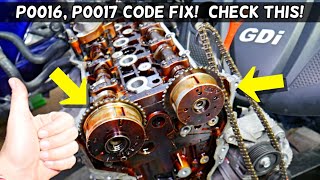
![How to Fix P0016 Engine Code in 6 Minutes [4 DIY Methods / Only $6.94]](https://img.youtube.com/vi/extiOvtV8_Y/mqdefault.jpg)
We Have This Part in Stock


The information in this article is provided for general reference and educational purposes only. Vehicle specifications, procedures, and part compatibility can vary by production date, trim level, and region. Always consult your vehicle's factory service manual and verify part numbers before purchasing or performing repairs. Safety-critical components such as airbags, seat belts, and braking systems should be installed by a qualified professional.
- Hyundai Palisade:
- 🎬 Helpful Videos
- 🛍️ Shop This Part
- What's Unique About the 2020-2024 Hyundai Palisade
- Symptoms You May Notice
- Most Likely Causes
- Rare But Worth Checking
- Diagnosis Steps
- Parts You'll Likely Need
- Related Codes That Often Appear With This One
- Technical Service Bulletins (TSBs) & Recalls
- Mechanic-Grade Diagnostic Values
- Scan Tool Commands That Help
- Real Owner Repair Stories
- Diagnostic Flowchart
- Other Known Issues on This Vehicle
- Used vs. New Parts: Buying Guide for This Vehicle
- Real Owner Stories
- 2020-2024 Kia Telluride (3.8L GDI V6)
- Documented NHTSA Reports
- Related OBD-II Codes
- Frequently Asked Questions
- 🎟️ Get 5% Off