

P0014 on 2009-2019 Cadillac CTS 3.6L V6: Exhaust Cam Timing Causes and Fixes
On a Cadillac CTS with the 3.6L V6, code P0014 is most often caused by low/dirty engine oil or a faulty Bank 1 exhaust camshaft position actuator solenoid. An oil change with dexos-spec synthetic oil is the first step. If that fails, replacing the solenoid is a common DIY fix, with the part costing around $30-$75. A persistent code, especially with rattling, could indicate a more serious timing chain issue, a known problem on pre-2012 LLT engines.
- P0014 on a 3.6L CTS points to the exhaust camshaft on the rear cylinder bank (Bank 1) being too far advanced.
- Always check your engine oil level and condition first. A simple oil change with the correct dexos-spec oil can often fix this code.
- The most common failed part is the exhaust camshaft position actuator solenoid, which is relatively inexpensive and easy to replace.
- A simple diagnostic is to swap the exhaust and intake solenoids on Bank 1 to see if the code follows the part (changes to P0011).
- Be aware that these engines have a known history of stretched timing chains. If the code persists after addressing oil and solenoid issues, or is accompanied by rattling or codes like P0008/P0017, a more serious mechanical issue is likely.
What's Unique About the 2009-2019 Cadillac CTS
The GM 3.6L V6 engine (LLT and LFX versions) used in the CTS has a well-documented sensitivity to oil quality and level, which directly impacts the VVT system. While the most common cause of P0014 is a simple solenoid failure, these engines are also known for premature timing chain stretching, especially in the earlier 2009-2012 models with the LLT engine. This history means that while you should start with the simple fixes, a persistent P0014, especially if accompanied by rattling noises or other timing codes (like P0008, P0009, P0017), could point to this more serious underlying issue for which GM issued special coverage programs.
Generation note: The 2009-2019 range covers the second generation (2009-2014) and third generation (2014-2019) of the Cadillac CTS. Both generations used versions of the 3.6L V6. The earlier LLT engines (approx. 2008-2012) are more susceptible to the severe timing chain stretching issue. GM issued special coverage program #11340C for this, extending the warranty to 10 years/120,000 miles for certain 2007-2009 models. The later LFX engine (approx. 2012-2016) had improvements to the timing chain system, but all versions remain sensitive to oil quality for VVT health.
Symptoms You May Notice
- Check Engine Light is on
- Rough idle or stalling, sometimes after an auto-stop event on newer models.
- Poor acceleration and reduced engine power
- Decreased fuel economy.
- Engine rattling, buzzing, or knocking noises, especially on startup.
- Replacing the camshaft position *sensor* instead of the camshaft position actuator *solenoid*. The sensor's job is to read the camshaft's position, while the solenoid's job is to control it. P0014 is a performance code almost always related to the control side (solenoid, oil) or mechanical timing (chain), not the sensor itself.
Most Likely Causes
- Low or Dirty Engine Oil 🔴 High Probability The VVT system is entirely dependent on clean oil and correct pressure to function. Debris in the oil can clog the fine mesh screens on the actuator solenoids, causing them to stick. GM has issued TSBs pointing to this as a primary cause, and owners report the code can appear when oil is very low.
How to confirm: Check the engine oil level on the dipstick and assess its condition. If the oil is low, dark, or sludgy, it needs to be changed. One owner noted their P0014 was triggered when the oil was too low to register on the dipstick.
Typical fix: Perform an engine oil and filter change using a high-quality full synthetic oil that meets GM's dexos specification (typically 5W-30).
Est. part cost: $50-$100 - Faulty Exhaust Camshaft Position Actuator Solenoid (Bank 1) 🔴 High Probability These solenoids are a known failure point on many GM engines. They can fail electrically or become clogged with sludge and debris from the engine oil, causing them to stick in the advanced position. Bulletin #PIP5162 notes that technicians should remove the camshaft solenoids and inspect the screens for debris, cleaning them with brake cleaner if necessary.
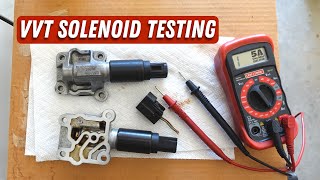
How to confirm: A definitive diagnostic step is to swap the Bank 1 exhaust solenoid (passenger side, lower position) with the Bank 1 intake solenoid (passenger side, upper position). Clear the codes and drive. If the code changes to P0011 (Intake Camshaft Position), the solenoid is confirmed to be faulty. You can also test the solenoid's resistance with a multimeter; it should be between 8-12 ohms. 🎬 See this video for three easy ways to test solenoids.
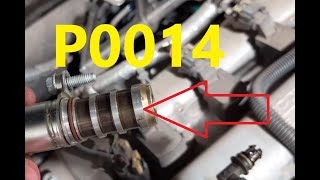
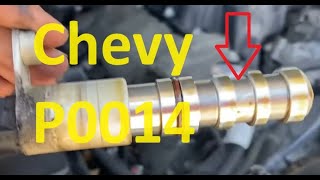
Typical fix: Replace the Bank 1 exhaust camshaft position actuator solenoid. It is held in by a single 10mm bolt and is accessible after removing the engine cover. 🎬 Watch: A quick walkthrough for replacing the VVT solenoid.
Est. part cost: $30-$75 - Stretched Timing Chain 🟡 Medium Probability The 3.6L V6, particularly the LLT version used until about 2012, is notorious for premature timing chain wear. This was so common that GM issued TSBs (like #12-06-01-009F) and a special coverage program (#11340C) for earlier models. A stretched chain causes a mismatch in cam/crank correlation that can trigger P0014, often along with P0008 or P0009.
How to confirm: This is difficult to confirm without a professional. A mechanic can use a scan tool to check cam/crank deviation values. A key symptom is a rattling noise on startup. Physical confirmation requires significant engine disassembly. This is usually suspected if P0014 persists after solenoid replacement and is accompanied by codes like P0008, P0009, or P0017.
Typical fix: Replace all three timing chains, tensioners, and guides. This is a complex and expensive job, often costing over $2,000 at a shop.
Est. part cost: $400-$700 for a kit
Rare But Worth Checking
- Failed Camshaft Phaser: The phaser is the mechanical gear that actually adjusts the cam timing. It can get stuck due to sludge or internal failure, but this is far less common than a solenoid issue. TSB #PIP5162 mentions this as a possibility if solenoid cleaning/replacement doesn't work.
- Clogged Oil Passages: In cases of severe engine sludge, the oil passages in the cylinder head that feed the VVT system can become blocked. TSB #PIP5162 suggests blowing out oil passages with light air pressure as a diagnostic step. This indicates a serious issue requiring major engine work to clean.
- Outdated ECM Software: On some newer GM models with the 3.6L LGX engine (like the Cadillac XT5), TSB N192266190 was issued for P0014 and other codes appearing after an auto-stop event. The fix is an ECM reprogram, not a part replacement.
Diagnosis Steps
- Check the engine oil level and condition. If it is low or dirty, perform an oil and filter change with the correct Dexos-spec oil, clear the code, and see if it returns.
- If the oil is fine, the next step is to test the Bank 1 exhaust camshaft actuator solenoid. Bank 1 is the rear bank (passenger side, closer to the firewall). 🎬 Watch: How to identify the correct solenoid location and bank. The exhaust solenoid is the lower of the two solenoids on that bank's cylinder head cover.
- For a definitive test, swap the Bank 1 exhaust solenoid with the Bank 1 intake solenoid (the top one). They are identical parts. Clear the codes and drive the vehicle.
- If the code changes to P0011 (Intake Camshaft Position System Performance), the solenoid you moved is faulty and needs to be replaced.
- If the P0014 code returns, the problem is not the solenoid. Inspect the wiring and connector for the solenoid for any damage or corrosion.
- If wiring is good and the code persists, the issue may be more severe. Use a scan tool to monitor desired vs. actual cam angles. A large, persistent deviation points towards a stuck camshaft phaser or a stretched timing chain. At this point, professional diagnosis is recommended.
Parts You'll Likely Need
- Exhaust Camshaft Position Actuator Solenoid (Bank 1)
(OEM #12679099)— This is the most common part to fail or become clogged with debris, directly causing the P0014 code.
Trusted brands: ACDelco, Delphi, Dorman
OEM price range: $40-$60
Aftermarket price range: $25-$45 - Timing Chain Kit
(OEM #12650230)— If the cause is a stretched timing chain, a complete kit including chains, tensioners, and guides is required. This is a known weak point on the 3.6L V6 engine, especially the LLT.
Trusted brands: ACDelco, Cloyes
OEM price range: $400-$600
Aftermarket price range: $250-$450
Related Codes That Often Appear With This One
- P0011 — Intake camshaft timing code for the same bank. This will appear if you swap a faulty exhaust solenoid to the intake position for diagnosis. If both appear together without swapping, it could indicate a wider oil pressure problem or an ECM software issue.
- P0017 — Crankshaft Position - Camshaft Position Correlation (Bank 1, Sensor B). This code points more strongly to a mechanical timing issue like a stretched timing chain, as it indicates a direct mismatch between the crank and cam sensors that the VVT system cannot account for.
- P0008 / P0009 — These are general engine timing correlation codes that are very strong indicators of a stretched timing chain on the GM 3.6L V6 engine. If you have P0014 along with these, a timing chain issue is highly probable and was the primary reason for GM's Special Coverage #11340C.
Technical Service Bulletins (TSBs) & Recalls
- TSB #PIP5096C: For P0011, P0014, P0021, or P0024 on 3.0L/3.6L LFX engines, directs technicians to perform specific checks. This bulletin notes that if no other drivability concerns are found, the technician should inspect the engine EUN sticker for an (A) before the sequence number.
- Bulletin #PIP5568E: Communicates an investigation into the cause and correction for a group of DTCs setting together (P0011, P0014, P0021, P0024), including the possibility of them setting in pairs and causing drivability concerns.
- TSB #12-06-01-009F: Announces updated timing chain kits for repairing worn timing chains that cause codes like P0008, P0009, and P0017, and provides detailed service information.
- Special Coverage #11340C: Extends warranty coverage for premature timing chain wear on certain 2007-2009 models with the 3.6L V6 to 10 years or 120,000 miles. It covers the replacement of the timing chain at no charge if the condition is confirmed.
Platform-Specific Known Issues
- Premature Timing Chain Wear: The 3.6L V6 engines in this year range, especially the LLT version (pre-2012), are known for timing chains stretching prematurely. GM issued Special Coverage Adjustment #11340C extending the warranty to 10 years/120,000 miles for this issue on certain 2007-2009 models, highlighting the prevalence of the problem.
Mechanic-Grade Diagnostic Values
- Camshaft Position Actuator Solenoid Resistance — expected: 8 to 12 Ohms is the common specification. Some sources cite a tighter tolerance of 6.9 to 7.9 Ohms.. Failure: A reading of open loop (OL), near zero, or significantly outside the 7-13 Ohm range indicates a failed solenoid.
- Engine Oil Pressure (3.6L V6, Hot at Idle) — expected: Minimum of 24-25 PSI at 1,000 RPM.. Failure: Pressure significantly below this threshold can starve the VVT system, leading to timing codes.
- Camshaft Position (CMP) Sensor 5V Reference Circuit — expected: 4.8 to 5.2 Volts with ignition on, engine off.. Failure: Voltage outside this range suggests a wiring or ECM issue, though this would typically set a sensor-specific code, not P0014.
Scan Tool Commands That Help
- GDS2 / Tech2 (or equivalent professional scan tool): Camshaft Position Actuator Control / Actuator Test — This bidirectional control is used to manually command the Bank 1 exhaust solenoid ON and OFF while the engine is running. A healthy system will cause the engine to hesitate or stall, confirming the solenoid, oil passages, and phaser are responding. No change in engine operation points to a fault in that system, helping to isolate the problem from the ECM or wiring.
Wiring & Ground Locations
- ECM Connector C1, Pin 13 — On the main Engine Control Module (ECM). For a 2006 model, this was a Light Green wire. The ECM on many CTS models is located on the valve cover.. This is the specific control circuit pin for the Bank 1 Exhaust Camshaft Actuator Solenoid. Testing for signal here can confirm if the ECM is sending the command, isolating a wiring problem from an ECM problem.
- G107 — On the front of the right (Bank 1) cylinder head.. This is a primary engine ground on the same cylinder bank where the fault is occurring. A poor connection here can cause erratic behavior and incorrect readings for sensors and actuators on that bank.
- G103 — On the cowl at the rear of the engine compartment, often above the brake booster.. This is a major chassis and module ground. While less direct, a fault here can cause widespread communication issues that can complicate diagnosis.
Real Owner Repair Stories
- YouTube channel 'Zane's Automotive' (2014-2019 Cadillac CTS 3.6L V6 (principle applies, video shows similar GM VVT tech)) — Error codes P0011 and P0014, rough idle, stalling when slowing down, lack of acceleration.
❌ Tried (didn't work) The owner was concerned the cause was a major mechanical issue like a stretched timing chain due to the code definitions.
✅ What actually fixed it Replacing all four camshaft position actuator solenoids resolved all symptoms and cleared the codes. - YourMechanic Q&A (Car with 50,000 miles) — After an oil change, the car ran rough, smelled of burning oil, and the Check Engine Light came on with code P0014.
❌ Tried (didn't work) The shop that performed the oil change cleared the code and added more oil, but the light came back on the next day.
✅ What actually fixed it The root cause was an improperly installed oil filter that led to a major oil leak and low oil level/pressure, which in turn triggered the P0014 code. The fix required correcting the filter installation and restoring the proper oil level.
"I Checked Everything" — The Actual Cause
- In a documented case on a similar GM 3.6L engine, a P0014 code returned shortly after a complete timing chain replacement. This indicates that even when the most common severe cause (stretched chain) is addressed, the true root cause can be a faulty camshaft phaser that was not replaced with the chains, or a clogged oil gallery in the cylinder head preventing adequate oil flow to the new components.
OEM Part Supersession History
12628347, 12655420→12679099, which was later superseded by 12687162 and then 12707054.— GM often updates parts to improve reliability or change suppliers to address known failure patterns.
Heads up: While physically interchangeable, some TSBs like PIP5096C advised against swapping old and new design solenoids for diagnosis, recommending replacement with the latest part number to ensure compatibility with any manufacturing updates.
Model Year Variations Within This Range
- 2009-2012 (LLT Engine): These earlier models are significantly more prone to timing chain stretch. The LFX engine, introduced around 2012, featured a stronger timing chain design and improved PCV system which helped mitigate the issue.
- Varies by production date: Per TSB PIP5096C, some engines have an 'A' on their Engine Unit Number (EUN) sticker. For these engines, if a VVT code is present, the solenoid should be replaced with the newest service part and not swapped with another solenoid from the engine for diagnosis, indicating a known production variance.
Diagnostic Flowchart
Real Owner Stories
Aggregated from forums and TSBs cited above. Mileages and costs reflect what owners reported in those sources.
2014 Cadillac CTS 3.6L V6
Symptoms: Triggered P0011 and P0014 codes related to the variable valve timing system.
What fixed it: Replaced all four VVT solenoids using a 10mm socket and swivel. The owner noted that if one solenoid fails, the others are likely near the end of their life.
Source hint: YouTube - Easily Fix p0011 p0014 variable valve timing solenoid. Cadillac CTS 3.6L V6. 2014-2019. (stollo770)
2011 Cadillac CTS 3.6L V6
Symptoms: Persistent P0014 code requiring professional diagnosis.
What fixed it: Used a scan tool to command the solenoid and watch for a response in the data PID, confirming a control-side electrical failure rather than a mechanical timing issue.
Source hint: ScannerDanner Forum - 2011 Cadillac CTS 3.6L V6 P0014
2007-2009 Cadillac CTS 3.6L V6
Symptoms: P0014 code accompanied by P0008/P0009 and a rattling noise on startup due to premature timing chain wear.
What fixed it: Replaced all three timing chains, tensioners, and guides at no charge under GM Special Coverage #11340C.
Source hint: cadillacforums.com / Special Coverage #11340C
Related OBD-II Codes
Frequently Asked Questions
Does the timing chain special coverage apply to my 2014 Cadillac CTS 3.6L?
Which solenoid is the Bank 1 exhaust camshaft actuator on the 3.6L V6?
How can I test if the VVT solenoid is causing the P0014 code on my CTS?
What oil should I use to prevent P0014 on my 3.6L engine?
Are there any TSBs for the P0014 code on the newer LFX engines?
My CTS has a rattling noise on startup along with P0014. What does this mean?
Helpful Videos
We Have This Part in Stock



The information in this article is provided for general reference and educational purposes only. Vehicle specifications, procedures, and part compatibility can vary by production date, trim level, and region. Always consult your vehicle's factory service manual and verify part numbers before purchasing or performing repairs. Safety-critical components such as airbags, seat belts, and braking systems should be installed by a qualified professional.
- Cadillac CTS:
- 🎬 Helpful Videos
- 🛍️ Shop This Part
- What's Unique About the 2009-2019 Cadillac CTS
- Symptoms You May Notice
- Most Likely Causes
- Rare But Worth Checking
- Diagnosis Steps
- Parts You'll Likely Need
- Related Codes That Often Appear With This One
- Technical Service Bulletins (TSBs) & Recalls
- Platform-Specific Known Issues
- Mechanic-Grade Diagnostic Values
- Scan Tool Commands That Help
- Wiring & Ground Locations
- Real Owner Repair Stories
- "I Checked Everything" — The Actual Cause
- OEM Part Supersession History
- Model Year Variations Within This Range
- Diagnostic Flowchart
- Real Owner Stories
- 2014 Cadillac CTS 3.6L V6
- 2011 Cadillac CTS 3.6L V6
- 2007-2009 Cadillac CTS 3.6L V6
- Related OBD-II Codes
- Frequently Asked Questions
- 🎟️ Get 5% Off