

C1219 on 2015-2023 Ford Mustang: Steering Angle Sensor Causes and Fixes
Code C1219 on a 2015-2023 Mustang means the Steering Angle Sensor is sending erratic signals, disabling stability and traction control. The most common causes are a miscalibrated sensor after a wheel alignment or a faulty clockspring assembly. A sensor recalibration using a tool like FORScan is the first step; if that fails, replacing the clockspring assembly is the likely fix, costing around $150-$250 for the OEM part.
- C1219 disables your Mustang's AdvanceTrac stability and traction control systems.
- Before replacing any parts, have a shop with a proper scan tool attempt a Steering Angle Sensor (SAS) recalibration. This is often required after a wheel alignment or suspension work.
- If calibration doesn't fix it, the most likely culprit is the clockspring assembly, which contains the sensor.
- This is not a DIY-friendly repair for beginners due to the safety risk of handling the airbag.
- Always ensure the battery is healthy and fully charged before diagnosing electronic faults.
What's Unique About the 2015-2023 Ford Mustang
The S550 Mustang (2015-2023) uses an Electric Power-Assisted Steering (EPAS) system that relies heavily on the Steering Angle Sensor for proper operation, including features like drift and pull compensation. Because the SAS is integrated into the clockspring assembly behind the airbag, any work on the steering column, suspension modifications like lowering springs, or even a simple wheel alignment can trigger this code if the sensor isn't recalibrated correctly. While not subject to a specific recall for this code, the platform's sensitivity to steering geometry changes makes proper SAS calibration a critical step in routine service. Some owners have successfully used diagnostic tools like FORScan to perform the recalibration themselves.
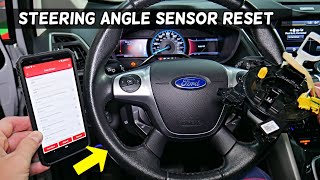
🎬 Watch how to reset the steering angle sensor on a FordSymptoms You May Notice
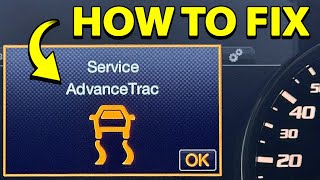
- "Service AdvanceTrac" warning message
- ABS warning light is on
- Traction control/Stability control warning light is on
- Traction and stability control are disabled
- Backup camera guide lines may not turn with the steering wheel
- Steering may feel intermittently heavy or strange if the EPAS system is affected
- Replacing a wheel speed sensor. This code specifically points to the steering angle sensor circuit, not a wheel speed sensor.
- Replacing the ABS module unnecessarily before confirming the sensor, its calibration, and wiring are all good.
- Replacing the clockspring when only a calibration was needed after an alignment.
Most Likely Causes
- Steering Angle Sensor (SAS) Needs Calibration 🔴 High Probability Occurs frequently after wheel alignments, suspension work (e.g., installing lowering springs), pothole impacts, or battery disconnection if the steering wheel wasn't perfectly straight. The S550's stability control is very sensitive to the steering wheel's center position.
How to confirm: Use a bidirectional scan tool (like FORScan for Fords) to view the SAS live data. If the angle does not read 0 degrees when the steering wheel is centered and driving straight, it needs calibration.
Typical fix: Perform a Steering Angle Sensor calibration using a compatible diagnostic scan tool. This procedure resets the sensor's zero-point. Many owners successfully use FORScan software with an appropriate OBD-II adapter to do this at home.
Est. part cost: $0 - Faulty Clockspring / Steering Angle Sensor Assembly 🟡 Medium Probability The SAS is integrated into the clockspring, which is a wear item. The internal ribbon cables can break from repeated turning of the steering wheel over time, causing a loss of signal. This can also cause airbag lights or steering wheel control button failures.
How to confirm: If SAS calibration fails or the scan tool shows no signal or a value that is stuck or jumps erratically (e.g., from 0 to 360 degrees), the component has likely failed. An airbag warning light appearing at the same time is a strong indicator of clockspring failure.
Typical fix: Replace the clockspring assembly located behind the steering wheel. This requires removing the airbag and steering wheel. A new SAS calibration is required after installation.
Est. part cost: $150-$250 - Poor Wheel Alignment 🟡 Medium Probability If the steering wheel is not perfectly centered after an alignment, the SAS will report a turning angle even when the car is going straight. This conflicts with wheel speed sensor data, triggering the code. This is a common complaint on forums after suspension work.
How to confirm: Visually inspect if the steering wheel is crooked when driving in a straight line. An alignment rack check will confirm the toe and thrust angles are incorrect relative to the steering wheel position.
Typical fix: Perform a four-wheel alignment, ensuring the technician centers the steering wheel *before* adjusting toe. Afterwards, perform an SAS calibration as a final step.
Est. part cost: $0 (parts), $100-$200 (labor for alignment) - Wiring or Grounding Issue ⚪ Low Probability While less common, loose connections or a corroded ground for the EPAS or ABS module can introduce electrical noise or an intermittent signal from the SAS.
How to confirm: Inspect the wiring harness and connectors between the clockspring and the ABS module for damage. Check main chassis and module ground points for corrosion or looseness, especially the EPAS ground strap.
Typical fix: Repair or clean the damaged wiring, connector, or ground point.
Rare But Worth Checking
- Faulty ABS Module: This is rare. Before condemning the expensive ABS module, all other possibilities (sensor, calibration, wiring) must be exhaustively ruled out. Sometimes a software glitch can be resolved by a dealer re-flash of the module.
- Low Battery Voltage: A weak or failing battery can cause a host of seemingly unrelated electronic issues and codes in modern vehicles, including EPAS and AdvanceTrac faults. Always ensure the battery and charging system are healthy (maintaining above 12.4V at rest) before diagnosing complex electronic faults.
Diagnosis Steps
- Read the fault codes from the ABS module with a scan tool capable of reading C-codes (Chassis codes).
- Use the scan tool to access live data and monitor the 'Steering Angle Sensor' value. Verify it reads near 0.0 degrees when the steering wheel is centered. A value within ±15° is generally acceptable before calibration.
- Turn the steering wheel lock-to-lock to ensure the angle value changes smoothly and logically without jumping or getting stuck.
- If the value is off-center or doesn't change, first attempt a Steering Angle Sensor (SAS) calibration procedure with the scan tool. This is often found under 'ABS Service Functions' or similar menus in tools like FORScan or IDS.
- If calibration fails or the code returns immediately, inspect the vehicle's wheel alignment. Check if the steering wheel is physically straight when the car drives straight. Correct alignment if necessary and recalibrate the SAS.
- If alignment and calibration are correct but the signal is still erratic or absent, inspect the wiring and connectors for the clockspring assembly. Check for any other related codes, like airbag faults.
- If wiring is intact and especially if an airbag light is also present, the clockspring/SAS assembly is the most likely failed component. Replace the assembly.
- After replacement, a final SAS calibration is mandatory to clear the code and restore system function.
Parts You'll Likely Need
- Air Bag Clockspring Assembly
(OEM #FR3Z-14A664-A (Common, Non-Heated Wheel), HL3Z-14A664-B (Heated Wheel, F-150 part often cross-referenced))— The Steering Angle Sensor is integrated into this assembly. It is the most common hardware failure for code C1219. Note that part numbers are specific to options like a heated steering wheel, so always verify with your VIN.
Trusted brands: Motorcraft, Dorman, Standard Motor Products, Carquest Premium
OEM price range: $150-$250
Aftermarket price range: $110-$150
Related Codes That Often Appear With This One
- An airbag/SRS warning light is a strong indicator that the clockspring assembly itself has failed, as the airbag wiring also runs through it.
- C1B00:2F (Signal Erratic) or C1B00:64 (Signal Plausibility Failure) are related EPAS codes that can be set by the Power Steering Control Module (PSCM) due to the same underlying SAS signal issues.
Platform-Specific Known Issues
- On the S550 platform, installing lowering springs or making other suspension modifications is a common trigger for this code if a proper alignment and SAS recalibration are not performed immediately after.
- Owner Experience: A user on YouTube with code C1219 found their steering angle was off by a full 360 degrees after a steering rack installation. They used a live data scanner (Autel AP200) to monitor the angle while they disconnected the steering column and rotated the wheel one full turn to correct it before performing the final calibration.
Mechanic-Grade Diagnostic Values
- Steering Angle Sensor Live Data (Wheels Straight) — expected: Within ±15° of 0°. Failure: A value significantly outside this range, or one that is stuck or jumps erratically, indicates a calibration issue or a failed sensor.
- System Voltage at ABS/PSCM Module — expected: 11.5V - 14.5V. Failure: Low voltage can cause modules to set false codes, including C1219.
Hidden / Shadow Codes Worth Checking
- C1B00:2F: A related code from the Power Steering Control Module (PSCM) for 'Signal Erratic'. This often sets in conjunction with C1219 and points to the same root cause of an unreliable SAS signal. (see via A comprehensive scan tool like FORScan or Ford IDS that can read codes from the PSCM module.)
- C1B00:64: A PSCM code for 'Signal Plausibility Failure', indicating a mismatch between the SAS signal and other vehicle dynamics sensors. This is an informational code that points towards an issue with the SAS, alignment, or related sensors. (see via A comprehensive scan tool like FORScan or Ford IDS that can read codes from the PSCM module.)
- C121A: Steering Angle Sensor Not Initialized. This code often appears with C1219 if the fault is due to a lost calibration after a battery replacement or alignment, rather than a hardware failure. (see via A scan tool capable of reading Chassis (C) codes from the ABS module.)
Scan Tool Commands That Help
- FORScan / Ford IDS: ABS Module Service Function: 'Calibrate Steering Angle Sensor' — This is the primary function used to reset the steering angle sensor's zero point. It should be performed after any wheel alignment, suspension work, or replacement of the clockspring or steering rack.
- Hunter Alignment System with CodeLink: Steering Angle Sensor Reset — Modern alignment racks can communicate with the vehicle's OBD-II port to perform the SAS reset as the final step of an alignment, ensuring the new steering center corresponds to a zero-degree sensor reading.
Wiring & Ground Locations
- Fuse F13 (Passenger Compartment Fuse Box) — Located in the passenger side footwell, behind the kick panel. It is a Micro3 type fuse.. This fuse provides power to the Steering Column Control Module (SCCM), which incorporates the clockspring and steering angle sensor. A loss of power here will cause C1219 and other related faults.
- G104 Ground — Located in the engine bay, next to the battery.. This ground point serves the Data Link Connector (DLC). While not a direct cause, a poor ground here can interfere with scan tool communication during diagnosis.
- EPAS Ground Strap — A braided strap connecting the engine/subframe to the main chassis on the driver's side.. The Electric Power Assisted Steering (EPAS) system is sensitive to poor grounding. A corroded or loose main ground strap can introduce electrical noise and cause various steering-related faults, including those related to the SAS.
Real Owner Repair Stories
- Mustang6G.com Forum User (2015+ Mustang (lowered with suspension mods)) — Steering wheel was off-center to the left after multiple alignment attempts at different shops.
❌ Tried (didn't work) Alignment at a Firestone, which they could not complete correctly., A second alignment at a specialty shop that improved specs but failed to center the wheel.
✅ What actually fixed it A user suggested the rear subframe may not be square, a common issue on S550s. The fix was to install a subframe alignment kit, then perform another alignment, which finally allowed the steering wheel to be centered correctly, resolving the issue. - Mustang6G.com Forum User (2017 Mustang) — After a cluster swap, the steering wheel buttons and horn stopped working during the first drive, accompanied by a strange noise.
❌ Tried (didn't work) Re-seating all connectors.
✅ What actually fixed it The user had received a new clockspring that was not locked in the centered position and had spun it multiple times. The diagnosis was that the internal ribbon cable had snapped from being over-rotated. The fix required replacing the brand new, but now broken, clockspring assembly.
OEM Part Supersession History
4R3Z-14A664-AA→6R3Z-14A664-AA— Part update/revision for older (2009) Mustang models, but demonstrates Ford's practice of superseding these parts.BL3Z-14A664-A→GL3Z-14A664-A— Part update for F-150 models, whose clocksprings are sometimes cross-referenced for Mustangs with specific options.
Heads up: Using truck parts on a Mustang should only be done after careful verification of compatibility by part number and features (heated wheel, etc.).
Model Year Variations Within This Range
- 2018-2023: Models equipped with the optional Lane Keep Assist (LKA) feature require an additional calibration step during an alignment that involves a test drive. Models without LKA do not require this specific procedure, only the standard SAS reset.
- 2015-2017 vs 2018-2023: While the fundamental clockspring/SAS function is the same, the 2018 facelift introduced different steering wheel controls and a digital cluster option, which can lead to different clockspring part numbers. Always verify the part number with the vehicle's VIN.
Diagnostic Flowchart
Other Known Issues on This Vehicle
Issues unrelated to this code that are worth knowing about as an owner of this generation:
- A/C Evaporator Leak 🔴 High — Very common on 2015-2017 models, often failing between 20k-40k miles. Symptom is warm air from driver vents and cold air from passenger vents. (Ref: TSB 18-2256 (supersedes 18-2166) was issued to address this, providing a procedure to replace the evaporator core.)
- Coyote V8 'BBQ Tick' 🟡 Low — A common, intermittent ticking noise from the 5.0L V8 engine at idle, often more noticeable after an oil change or when hot. It has been present across Coyote engine generations. (Ref: None. Ford has generally stated this noise is a normal characteristic of the engine and does not require a fix unless accompanied by performance issues or oil consumption.)
- MT82 Manual Transmission Issues 🟠 Medium — Common complaints include a notchy/stiff shifter, grinding noises, and being locked out of gears at high RPM. Affects both early and later S550 models. (Ref: No specific recall, but it's a widely discussed issue with many aftermarket solutions available.)
- 10R80 Automatic Transmission Shift Quality 🟠 Medium — Some owners report harsh or erratic shifting with the 10-speed automatic transmission. Software updates from the dealer can sometimes improve behavior. (Ref: Various software-related TSBs have been issued for shift quality concerns on vehicles with the 10R80.)
- Paint/Corrosion on Aluminum Panels 🟡 Low — Some owners have reported bubbling or corrosion under the paint, particularly on the aluminum hood and trunk lid. This was also an issue on the prior S197 generation. (Ref: Ford has addressed this for some customers under the corrosion warranty, but it is not a formal recall.)
Used vs. New Parts: Buying Guide for This Vehicle
When a used part is the smart pick: A used clockspring is generally NOT recommended. It is a known wear item with a delicate internal ribbon cable that fatigues over time. The cost savings are minimal compared to the risk of premature failure and the labor involved in replacement.
Donor-vehicle mileage cap: roughly under 40000 miles for the part to have meaningful remaining life.
What to inspect on the donor part:
- Ensure the used part comes with a locking tab in place to prevent it from spinning and breaking the internal ribbon.
- Verify the part number exactly matches your original, paying close attention to suffixes that denote features like a heated wheel.
- Inspect connectors for any bent or corroded pins.
- Ask for the donor vehicle's mileage; a low-mileage part is a slightly lower risk.
OEM-only on this vehicle (don't cheap out):
- Clockspring / Steering Angle Sensor Assembly
Aftermarket brands forum-validated for this vehicle:
- Motorcraft (OEM)
- Dorman (Often provides a reliable alternative with good availability)
Brands owners have reported issues with on this vehicle:
- Unnamed, no-brand parts from online marketplaces should be avoided due to the critical safety function of the airbag and stability control systems connected through this part.
Real Owner Stories
Aggregated from forums and TSBs cited above. Mileages and costs reflect what owners reported in those sources.
2015-2023 Ford Mustang
Symptoms: The steering angle was found to be off by a full 360 degrees after a steering rack installation.
What fixed it: Used a live data scanner (Autel AP200) to monitor the angle while disconnecting the steering column and rotating the wheel one full turn to correct it before performing the final calibration.
Source hint: YouTube - Aricwithautoreplay: A video titled 'Steering angle sensor erratic C1219'
2015-2023 Ford Mustang (S550)
Symptoms: Traction control warnings and 'Service AdvanceTrac' messages appearing after suspension work.
What fixed it: Ensuring the steering wheel is locked straight during a four-wheel alignment followed by an SAS recalibration.
Source hint: Mustang6G.com forum threads
Related OBD-II Codes
Frequently Asked Questions
Why did my 2015-2023 Mustang trigger C1219 after I installed lowering springs?
Can I fix the C1219 code on my Mustang at home without going to a dealer?
Does the C1219 code affect my Mustang's backup camera?
Is the Steering Angle Sensor a separate part I need to buy for my S550?
Could a low battery cause the 'Service AdvanceTrac' message and C1219?
Why is my steering wheel feeling heavy or strange along with the ABS light?
Helpful Videos
We Have This Part in Stock


The information in this article is provided for general reference and educational purposes only. Vehicle specifications, procedures, and part compatibility can vary by production date, trim level, and region. Always consult your vehicle's factory service manual and verify part numbers before purchasing or performing repairs. Safety-critical components such as airbags, seat belts, and braking systems should be installed by a qualified professional.
- Ford Mustang:
- 🎬 Helpful Videos
- 🛍️ Shop This Part
- What's Unique About the 2015-2023 Ford Mustang
- Symptoms You May Notice
- Most Likely Causes
- Rare But Worth Checking
- Diagnosis Steps
- Parts You'll Likely Need
- Related Codes That Often Appear With This One
- Platform-Specific Known Issues
- Mechanic-Grade Diagnostic Values
- Hidden / Shadow Codes Worth Checking
- Scan Tool Commands That Help
- Wiring & Ground Locations
- Real Owner Repair Stories
- OEM Part Supersession History
- Model Year Variations Within This Range
- Diagnostic Flowchart
- Other Known Issues on This Vehicle
- Used vs. New Parts: Buying Guide for This Vehicle
- Real Owner Stories
- 2015-2023 Ford Mustang
- 2015-2023 Ford Mustang (S550)
- Related OBD-II Codes
- Frequently Asked Questions
- 🎟️ Get 5% Off