

OBD-II Code B0001: Driver-Side Airbag Circuit Fault
What B0001 means, why it triggers, and how to fix it
- Code B0001 disables the driver's airbag entirely, meaning it will not deploy in a crash and renders the vehicle unsafe to drive.
- A broken clock spring inside the steering column causes over 60% of B0001 faults, often accompanied by a dead horn or failing steering wheel buttons.
- On 2020-2024 GM trucks and SUVs, code B0001-1B guarantees a corroded airbag connector requiring an $850+ dealer replacement of the airbag and harness per TSB 21-NA-005.
- DIY repairs require an SRS-capable OBD-II scanner and a mandatory 15-minute battery disconnection to prevent accidental, potentially fatal airbag deployment.
What Does B0001 Mean?

Trouble code B0001 means the Supplemental Restraint System (SRS) module detects a fault in the driver's frontal airbag deployment circuit. The computer has identified an open circuit, a short, or incorrect resistance, and disabled the driver's airbag as a mandatory safety precaution.
Technical definition: The SAE/OBD-II definition is "Driver Frontal Stage 1 Deployment Control." It indicates a fault in the deployment loop for the primary stage of the driver's frontal airbag. On GM vehicles, the "-1B" suffix (B0001-1B) specifically flags high circuit resistance over 4.0 ohms.
Can I Drive With B0001?
No — Do Not Drive. It is not safe to drive. The airbag warning light is on, and the driver's airbag will not deploy in a crash, significantly increasing injury risk. The NHTSA notes multiple real-world crashes where the driver's airbag failed to deploy with this active code.
Common Causes

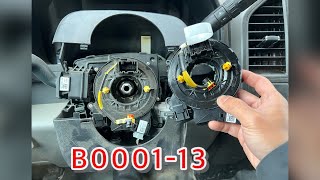
- Faulty Airbag Clock Spring (Spiral Cable) (Very Common) — The clock spring's internal ribbon cable breaks from constant steering wheel rotation, creating an open circuit or high resistance.
- Corrosion at Airbag Module Connector (GM T1 Platform) (Very Common Specific Vehicles) — On 2020-2024 GM trucks and SUVs, rust particles from the inflator housing contaminate the electrical connector, triggering B0001-1B. This requires a specific fix outlined in GM TSB 21-NA-005.
- Damaged Wiring or Poor Connector Contact (Common) — Wiring between the SRS module and the airbag degrades, loosens, or corrodes over time, altering the precise circuit resistance required by the computer.
- Previous Accident or Improper Repair (Common) — A prior collision stores crash data in the SRS module. Improper repairs or incorrect aftermarket parts cause persistent circuit faults.
- Defective Driver's Airbag Module (Less Common) — The airbag inflator (squib) fails internally due to a short or open circuit within the unit itself.
- Faulty SRS Airbag Control Module (Rare) — The main SRS computer fails from software corruption, moisture damage, or cracked solder joints. This is the last component to suspect after verifying all wiring.
- Low System Voltage (Rare) — A failing battery causes voltage drops that trigger false resistance readings within the SRS system during its startup self-check.
Symptoms
- Airbag Warning Light is On — The SRS warning light illuminates and stays on the dashboard permanently.
- Horn or Steering Wheel Controls Not Working — When the clock spring fails, the horn, cruise control, and radio controls stop working entirely.
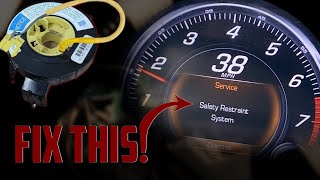
- Service Safety Restraint System Message — On GM vehicles, this specific warning message appears on the Driver Information Center. 🎬 See common causes and fixes for the safety restraint message.
- Driver's Airbag is Disabled (scan-tool only — no driver-felt sign) — The SRS module disables the driver's airbag, preventing deployment in an accident.
Diagnostic Flowchart

Tap your situation to follow the diagnostic path that matches what you're seeing on this code.
Common Fixes & Costs
- Replace the Airbag Clock Spring — Parts: $50-$400, Labor: $100-$250, ~1.5 hr book time (Intermediate)
- Replace Driver's Airbag and Harness (GM TSB Fix) — Parts: $700-$1500, Labor: $150-$300, ~2 hr book time (Professional)
- Replace the Driver's Airbag Module — Parts: $500-$950, Labor: $100-$250, ~1 hr book time (Professional)
- Repair or Clean Wiring/Connectors — Parts: $5-$50, Labor: $100-$300, ~1 hr book time (Intermediate)
- Replace the SRS Airbag Control Module — Parts: $600-$900, Labor: $200-$300, ~2.5 hr book time (Professional)
Used vs. New Parts: Buying Guide
When a used part is worth it: Buying used SRS parts is highly discouraged due to extreme safety risks. Never buy a used airbag inflator module. A used clock spring from a low-mileage donor is a budget option for older vehicles, but carries a high risk of premature failure.
Donor-vehicle mileage cap: roughly under 50000 miles for the part to have meaningful remaining life.
Donor quality checklist:
- Verify the donor vehicle was not in a flood or frontal collision.
- Ensure the clock spring part number is an exact match.
- A used SRS Control Module requires professional reprogramming to your car's VIN.
Decision logic:
- If The required part is an airbag inflator module. → Always buy new OEM. The safety risk of a used explosive charge is unacceptable.
- If The required part is a clock spring and the vehicle is less than 10 years old. → Buy a new OEM part. The labor cost justifies using a part with a guaranteed lifespan.
- If The required part is a clock spring, vehicle is over 10 years old, and budget is the top priority. → A used part from a low-mileage donor is acceptable, but expect a shorter service life.
Warranty tradeoff: Used parts carry a 30-day warranty. New aftermarket parts offer 1-year warranties. New OEM parts carry a 12-month/12,000-mile warranty.
Worst-case if a used part fails: For a used airbag inflator, the cost is severe injury. For a used clock spring, the cost is repeat labor ($150) plus a new part.
What Happens If You Wait — Timeline
- Immediate: The B0001 code sets, the warning light turns on, and the SRS module disables the driver's airbag. The primary safety failure occurs instantly. (MPG impact: 0%% · Added cost: $0)
- 1-3 months: If a failing clock spring is the cause, internal wires degrade further. The horn or cruise control fail intermittently. (MPG impact: 0%% · Added cost: $0 (Loss of horn is a secondary safety risk))
- 3-6 months: The intermittent connection becomes a permanent open circuit. All steering wheel controls die completely. (MPG impact: 0%% · Added cost: $250-$500 (Cost of a clock spring replacement))
- In case of an accident: The disabled airbag fails to deploy, causing severe head and chest injuries or death. (MPG impact: N/A% · Added cost: $10,000+ (Medical bills and liability))
Cost of Not Fixing It
- Immediate: The driver's airbag is disabled and will not deploy in an accident. The vehicle fails state safety inspections. (Added cost: N/A)
- 0-6 months: If the clock spring is failing, the horn and steering wheel controls die completely. (Added cost: 0)
- In case of an accident: Failure of the airbag to deploy causes severe injuries or death. Insurance claims face denial for operating a vehicle with a disabled safety system. (Added cost: $10,000+)
Diagnosis Steps
- Scan for All SRS Codes
Use an OBD-II scanner capable of reading SRS codes to confirm B0001. Note any manufacturer-specific suffix digits (like -1B for high resistance on GM vehicles) to pinpoint the exact electrical fault.
Tools: SRS-capable OBD-II Scanner (Beginner) - Check for Technical Service Bulletins (TSBs)
Search manufacturer TSBs for your specific VIN. GM TSB 21-NA-005 directly addresses code B0001-1B on 2020-2024 models, providing a mandatory replacement procedure that supersedes generic troubleshooting.
Tools: Internet access, VIN (Beginner) - Pro Tip: Test Clock Spring with Resistance Monitoring
Monitor the airbag circuit resistance on a scan tool while turning the steering wheel slowly from lock to lock. If the resistance value jumps from a normal 2.5 ohms to over 10 ohms or OL (Open Loop), the clock spring is broken.
Tools: Professional SRS Scan Tool (Intermediate) - Pro Tip: Monitor Live Data While Wiggling Components
Watch the live data for the driver's airbag circuit resistance. Carefully wiggle the steering wheel harness connectors and the airbag cover. On affected GM vehicles, moving the airbag module spikes the resistance, confirming connector corrosion.
Tools: Professional SRS Scan Tool (Intermediate) - Disconnect Battery and Inspect Airbag Connectors
Disconnect the negative battery terminal and wait 15 minutes to discharge system capacitors. Remove the driver's airbag and inspect the yellow connector pins for corrosion, damage, or loose fitment.
Tools: Wrench set, trim removal tools, flashlight (Intermediate) - Test with an SRS Simulator (Resistor Tool)
Connect a 2.2 to 3.3-ohm SRS simulator to the airbag harness in place of the airbag module. If the code clears with the simulator installed, the airbag module is faulty. If the code remains, the fault is in the clock spring or wiring.
Tools: SRS simulator/resistor tool (Advanced) - Test the Circuit with a Multimeter (Airbag Disconnected)
With the battery disconnected and airbag unplugged, test continuity of the clock spring and wiring harness. Resistance must be under 1 ohm. NEVER use a multimeter directly on the airbag module, as the meter's current triggers deployment.
Tools: Multimeter, vehicle-specific service manual (Advanced)
When This Code Triggers (Freeze-Frame Conditions)
- System Voltage: 11.5-14.5V (The SRS module monitors voltage continuously. The code sets during the initial key-on self-test if voltage drops.)
- Driver Airbag Loop Resistance: > 4.0 Ohms or < 1.5 Ohms (The direct trigger. The code sets the instant measured resistance exits the manufacturer's specified range (typically 1.5-3.5 Ohms).)
- Vehicle Speed: Any (SRS circuit faults are independent of vehicle speed. An intermittent clock spring fault triggers while turning at any speed.)
Related Codes
- B0002 — Indicates a fault in the 'Driver Frontal Stage 2 Deployment Control.' If B0001 and B0002 appear together, the problem is a shared component like the clock spring.
- B0010 — The passenger-side equivalent. If B0001 and B0010 appear together, the central SRS control module is failing, as both independent circuits rarely fail simultaneously.
- B0001-1B — A GM-specific suffix indicating 'High Resistance.' This points directly to connector corrosion (TSB 21-NA-005) rather than a broken wire.
- B0001-04 — A GM-specific suffix indicating an 'Open Circuit.' This points to a completely broken wire in the clock spring or a disconnected harness.
Climate & Environmental Factors
- High Humidity / Moisture: Water leaks or flooding accelerate corrosion on SRS connectors. This directly causes the GM TSB 21-NA-005 issue, where moisture rusts the inflator housing and contaminates the connector.
- Extreme Cold: Cold weather shrinks plastic connectors and stiffens wires, exposing micro-cracks and causing intermittent high resistance.
- Temperature Cycling: Repeated expansion and contraction from daily temperature swings stresses solder joints inside the SRS module, breaking electrical continuity.
How to Talk to a Mechanic About This Code
Say this: "I have an airbag warning light on, and my scanner shows code B0001. I'd like to schedule a diagnostic. If it's a GM truck, please reference TSB 21-NA-005. If not, please check the clock spring and associated wiring."
This proves you understand the code. Mentioning the GM TSB directs the shop to the exact fix, preventing unnecessary clock spring replacements. For other cars, it focuses attention on the most probable failure point.
Avoid saying:
- 'My airbag light is on, can you just turn it off?'
- 'I have a B0001 code, just replace the clock spring.' (Leads to wrong repairs on GM vehicles)
- 'Just fix whatever is wrong with the airbag.' (Invites unnecessary part replacements)
Questions to ask before authorizing the repair:
- What were the specific resistance readings from the driver's airbag circuit?
- Did you inspect the airbag connectors for corrosion or damage?
- If recommending a clock spring, did you confirm it by monitoring resistance while turning the wheel?
- What is the warranty on the parts and labor for this specific repair?
Where to Take It: Dealer vs Independent vs Chain
- Dealer:
Highly recommended for GM vehicles with the TSB issue or any vehicle under warranty.
Best for: Vehicles under warranty., Newer GM trucks/SUVs (2020+) where TSB 21-NA-005 is the guaranteed cause., Complex cases requiring SRS module programming.
Downsides: Highest labor rates., Refusal to perform non-standard repairs (e.g., connector cleaning). (Typical cost: +50% vs. baseline) - Independent Shop:
The best choice for common clock spring replacements on out-of-warranty vehicles.
Best for: Out-of-warranty vehicles requiring a clock spring replacement., Owners looking for a balance of cost and expertise.
Downsides: Quality varies. Ensure the shop is ASE certified with airbag diagnostic experience., Often lack access to the latest manufacturer TSBs. (Typical cost: +0% vs. baseline) - Chain Shop:
AVOID entirely. Airbag repairs require specialization not found at chain shops.
Best for: Oil changes and tires.
Downsides: Technicians lack the specialized training required for explosive SRS systems., High risk of misdiagnosis and unnecessary part replacement. (Typical cost: -10% vs. baseline)
When to Walk Away From the Repair
If the estimated repair cost for the B0001 fault exceeds 40-50% of the car's private-party value, stop and evaluate your options.
- Car worth $4000, fix is $1800: Borderline. The repair is nearly half the car's value. Consider selling the car 'as-is' with full disclosure.
- Car worth $15000, fix is $1200: Fix it. The cost is well below the threshold and restores a critical safety feature.
- Car worth $2500, fix is $1500: Walk away. The repair cost is 60% of the car's value. It is financially irresponsible to proceed.
What Scan Tool You Need for This Code

Minimum: An OBD-II scanner with SRS/Airbag system access. A basic $20 engine code reader cannot see or clear B-codes.
Standard scanners only read 'P' (Powertrain) codes. B0001 is a 'B' (Body) code stored in the SRS module. You need a tool that communicates with the airbag system to read the fault, view live resistance data, and clear the light.
Budget: BlueDriver Bluetooth Pro (~$100) — Reads and clears SRS codes on most major brands and displays live data for basic diagnosis.
Mid-range: Autel AL619 or Foxwell NT630 Plus (~$120-150) — Dedicated handheld scanners with robust SRS capabilities. They read codes and view live data streams (like clock spring resistance) essential for diagnosis.
Professional: Autel MaxiCOM MK808 (~$450-500) — Offers OE-level access to the SRS module, reading manufacturer-specific sub-codes (like GM's -1B) and providing detailed live data graphing.
Rent vs buy: Auto parts stores do NOT rent SRS-capable scanners due to liability. If this is a one-time repair, paying a shop's $150 diagnostic fee is cheaper than buying a mid-range scanner.
How to Clear the Code After You Fix It
- Ensure the physical fault (bad clock spring, corroded connector) is repaired.
- Reconnect the negative battery terminal.
- Use an SRS-capable OBD-II scan tool to access the SRS module.
- Select 'Clear DTCs' or 'Erase Codes'.
- Turn the ignition off, wait 10 seconds, then turn the ignition to ON.
- Verify the airbag warning light illuminates for a 5-second bulb check, then turns off permanently.
Drive cycle (~1 minutes): No drive cycle is needed. A simple ignition cycle (OFF to ON) forces the SRS module to perform its self-check. If the light stays off, the repair is successful.
Watch out for:
- Using a basic $20 engine code reader that cannot communicate with the SRS module.
- Failing to fix the electrical fault, causing the code to return instantly upon key-on.
- Disconnecting the battery to clear the code, which fails on all modern SRS systems.
Will This Fail Emissions / State Inspection?
Yes — this code typically fails an OBD-II emissions inspection.
- California: An airbag light fails the visual/functional safety portion of the overall inspection process.
- New York: NYS requires all safety equipment to be functional. An illuminated airbag light is an automatic failure.
- Texas: In counties requiring safety inspections, an active airbag light results in immediate failure.
Most Commonly Affected Vehicles
- GMC Sierra 1500/2500/3500, Yukon/Yukon XL (2020-2024) — Highly prone to driver's airbag connector corrosion, addressed by GM TSB #21-NA-005.
- Chevrolet Silverado 1500/2500/3500, Tahoe, Suburban, Blazer (2020-2024) — Affected by the exact same airbag connector corrosion issue as GMC models under TSB #21-NA-005.
- Cadillac Escalade (2021-2024) — Shares the GM T1 platform and the identical airbag connector fault included in TSB 21-NA-005.
- Ford F-Series (F-150, F-250), Edge, Fusion (2015-2020) — Frequently caused by a failing clock spring. Diagnosed by monitoring resistance while turning the wheel.
- Nissan Altima, Sentra, Rogue (2015-2020) — High frequency of this code pointing to a faulty clock spring (spiral cable) assembly.
- Honda Civic, Accord (2013-2016) — Often points to a faulty driver's airbag module or clock spring.
Manufacturer-Specific Notes
- General Motors (GM): On 2020-2024 trucks and SUVs, code B0001-1B guarantees corrosion on the driver's airbag connector pins. GM TSB 21-NA-005 mandates replacing both the airbag module and the steering wheel wiring harness. Cleaning the connector fails permanently.
- Ford: A failing clock spring is the dominant cause. Technicians diagnose it by monitoring circuit resistance with a scan tool while turning the steering wheel; a sudden spike to 65+ ohms confirms the failure.
- Citroen/Peugeot: The SRS module requires an extremely narrow resistance range (e.g., 1.7 to 4.5 ohms). A reading of 4.6 ohms triggers a fault, making diagnosis highly sensitive to aftermarket parts.
Real Owner Stories
2020 Ford F-150: The 'Phantom' Open Circuit
The airbag light illuminated with code B0001:13-8B (open circuit). All steering wheel controls and the horn worked perfectly, ruling out a broken clock spring.
Outcome: Reconnecting the battery cleared the code permanently. A slightly loose connector caused the 'open circuit' fault, requiring zero dollars in parts.
Lesson: Always disconnect the battery and reseat the airbag electrical connectors before buying expensive parts like a clock spring.
2021 Chevy Silverado: Misdiagnosing the Clock Spring
The truck displayed the 'Service Safety Restraint System' message with code B0001-1B (high resistance). The owner assumed a faulty clock spring based on generic advice.
Outcome: The dealer replaced the driver's airbag module and steering wheel wiring harness per the TSB for $1,200. Replacing the clock spring would have wasted $400.
Lesson: On 2020-2024 GM trucks, code B0001-1B guarantees the TSB corrosion issue. Do not replace the clock spring.
2019 Ford Escape: The Aftermarket Part Trap
The OEM clock spring failed, killing the horn. The owner installed a cheap aftermarket clock spring.
Outcome: The sensitive SRS system detected the incorrect resistance of the non-OEM part. The owner had to buy a genuine OEM clock spring to clear the code.
Lesson: Airbag circuits require exact resistance values. Never use cheap aftermarket clock springs.
How to Prevent This Code From Triggering
- Keep Cabin Dry and Fix Water Leaks (Annually or after heavy rain) — Moisture causes the corrosion that triggers B0001 on GM vehicles. Sealing windshields and doors protects sensitive SRS electronics.
- Center the Clock Spring During Repairs (During any steering column service) — If the clock spring spins freely while the steering wheel is removed, its internal cable snaps upon reassembly. Always secure it with tape.
- Avoid Holding Steering at Full Lock (Daily driving habit) — The clock spring's ribbon cable hits maximum stress at full steering lock. Avoiding this reduces mechanical wear over the vehicle's lifetime.
Frequently Asked Questions
Can I just clear the B0001 code and keep driving?
No. The code returns immediately because the electrical fault remains. The driver's airbag stays disabled until the circuit is repaired.
What is a common misdiagnosis for code B0001?
On 2020-2024 GM vehicles, replacing the clock spring is a costly misdiagnosis. The actual problem is a corroded airbag connector covered by TSB 21-NA-005. Wasting money on a clock spring will not fix the issue.
Is it safe to work on the airbag system myself?
It is highly dangerous for beginners. Airbags contain explosive charges that cause severe injury if deployed accidentally. Always disconnect the battery and wait 15 minutes before touching SRS components.
Will my car pass a safety inspection with the B0001 code?
No. An illuminated airbag warning light is an automatic failure for safety inspections in all jurisdictions. The fault must be repaired.
Why are the airbag connectors always yellow?
Airbag wiring is colored bright yellow by industry standard. This warns technicians they are handling the sensitive and explosive SRS circuit.
Can a low battery cause the B0001 code?
Yes. A failing battery causes voltage fluctuations that the SRS module interprets as a circuit fault. If the code appeared after a dead battery, charge the system and clear the code first.
What is the difference between Stage 1 and Stage 2 airbags?
Stage 1 (B0001) deploys the airbag with less force for lower-speed impacts. Stage 2 (B0002) deploys with maximum force for high-speed collisions. A fault in either stage disables the entire airbag.
Can I reset the SRS module after an accident instead of replacing it?
Yes. Specialized mail-in services clear stored 'crash data' from the original module for around $50. This avoids expensive dealer replacement and programming.
Key Takeaways
- Code B0001 disables the driver's airbag entirely, meaning it will not deploy in a crash and renders the vehicle unsafe to drive.
- A broken clock spring inside the steering column causes over 60% of B0001 faults, often accompanied by a dead horn or failing steering wheel buttons.
- On 2020-2024 GM trucks and SUVs, code B0001-1B guarantees a corroded airbag connector requiring an $850+ dealer replacement of the airbag and harness per TSB 21-NA-005.
- DIY repairs require an SRS-capable OBD-II scanner and a mandatory 15-minute battery disconnection to prevent accidental, potentially fatal airbag deployment.
Helpful Videos

The information in this article is provided for general reference and educational purposes only. Vehicle specifications, procedures, and part compatibility can vary by production date, trim level, and region. Always consult your vehicle's factory service manual and verify part numbers before purchasing or performing repairs. Safety-critical components such as airbags, seat belts, and braking systems should be installed by a qualified professional.
- 🎬 Helpful Videos
- What Does B0001 Mean?
- Can I Drive With B0001?
- Common Causes
- Symptoms
- Diagnostic Flowchart
- Common Fixes & Costs
- Used vs. New Parts: Buying Guide
- What Happens If You Wait — Timeline
- Cost of Not Fixing It
- Diagnosis Steps
- When This Code Triggers (Freeze-Frame Conditions)
- Related Codes
- Climate & Environmental Factors
- How to Talk to a Mechanic About This Code
- Where to Take It: Dealer vs Independent vs Chain
- When to Walk Away From the Repair
- What Scan Tool You Need for This Code
- How to Clear the Code After You Fix It
- Will This Fail Emissions / State Inspection?
- Most Commonly Affected Vehicles
- Manufacturer-Specific Notes
- Real Owner Stories
- 2020 Ford F-150: The 'Phantom' Open Circuit
- 2021 Chevy Silverado: Misdiagnosing the Clock Spring
- 2019 Ford Escape: The Aftermarket Part Trap
- How to Prevent This Code From Triggering
- Frequently Asked Questions
- Can I just clear the B0001 code and keep driving?
- What is a common misdiagnosis for code B0001?
- Is it safe to work on the airbag system myself?
- Will my car pass a safety inspection with the B0001 code?
- Why are the airbag connectors always yellow?
- Can a low battery cause the B0001 code?
- What is the difference between Stage 1 and Stage 2 airbags?
- Can I reset the SRS module after an accident instead of replacing it?
- Key Takeaways
- 🎟️ Get 5% Off