

2011-2012 Audi Q5 ZF 8HP55A: Problems, Identification, and Used Replacement
Identify the NXX transmission code, understand common mechatronic failures, and learn when to buy used.
- You must verify the three-letter transmission code is 'NXX' to ensure compatibility with the 2.0L engine; other codes will not work.
- A used replacement transmission is not plug-and-play due to an anti-theft feature called 'Component Protection', which requires programming by a dealer or specialist.
- Using the correct fluid (ZF Lifeguard 8 / Audi G 060 162 A2) is mandatory; generic ATF will cause shifting problems and damage.
- When installing a used unit, it is critical to replace the pan/filter, all single-use aluminum bolts, and various seals, and to flush the transmission cooler lines.
- For harsh shifting without fault codes, first investigate a TCM software update (TSB 37-12-65) before considering expensive mechanical repairs.
Identifying the Correct Transmission for Your 2011-2012 Q5


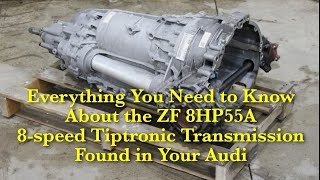
The 2011-2012 Audi Q5 with the 2.0L TFSI turbocharged four-cylinder engine and Quattro All-Wheel Drive uses a specific 8-speed automatic transmission known as the ZF 8HP55A. This unit is a transaxle, which means it includes the transmission, front differential, and center differential in a single housing. When buying a used replacement, you must verify the three-letter transmission code to ensure it fits and works correctly.
| Family Name | ZF 8HP55A (Audi type 0BK / AL551-8Q) |
| Configuration | Longitudinal AWD Transaxle with integrated front differential and Torsen center differential |
| Engine Application | 2.0L TFSI 4-Cylinder (Engine Code: CAEB) |
| Drivetrain | Quattro All-Wheel Drive |
| Transmission Code | NXX |
How to Confirm Fitment
To guarantee you are buying the correct transmission, you must match the code "NXX". There are two reliable places to find this code:
- Vehicle Build Sticker: Look for a white paper sticker in the spare tire well in the trunk. This sticker lists many codes for the vehicle's original equipment. The transmission code is a three-letter code usually located next to the engine code.
- Transmission ID Plate: The code is also stamped on a metal data plate (typically green or black) located on the underside or driver's side rear of the transmission housing itself. This is the most definitive source.
Warning: Not all 8-speed transmissions from Audi Q5 models are the same. This "NXX" unit is specific to the 2.0L engine. Transmissions from a Q5 with a 3.2L V6 engine or those with different codes (like MXV or NEV) will not work. They have different internal gear ratios, bellhousings that connect to the engine, torque converter dimensions, and electronic programming.
What is Included with a Used Assembly
When purchasing a used OEM replacement transmission, it is important to know what parts come with it. A standard used assembly includes the transmission case, all internally lubricated parts, the valve body and internal solenoids (mechatronics unit), the integrated front differential, the Torsen center differential (transfer case), the transmission oil pan, and the torque converter.
It will not include external sensors, the external wiring harness, the shifter assembly, linkage, shift cables, the engine flexplate/flywheel, or external transmission fluid cooler lines. You must transfer the external wiring harness from your original unit.
Common Failure Symptoms

When the 8HP55A transmission begins to fail, it can show several distinct symptoms. Problems often relate to the valve body, torque converter, or fluid condition.
Shifting Problems and Noises
- Harsh or Jerky Shifts: You may feel a noticeable bang or jolt when the transmission shifts, especially between lower gears (upshifts 1-2, 2-3, 3-4 or downshifts 3-2, 4-3).
- Hesitation or Slipping: The engine may rev up, but the vehicle hesitates to accelerate as if the gear is not fully engaged. This can be caused by worn internal parts or degraded fluid.
- Torque Converter Shudder: A vibration or shuddering feeling under light acceleration, often between 45-60 mph, can point to a failing torque converter lock-up clutch. 🎬 Watch: 9 common failing torque converter symptoms explained
- Erratic Shifting: The transmission may seem confused, shifting at the wrong times or hunting for the right gear at low speeds. This is often a sign of a problem with the mechatronics unit.
Leaks and Warnings
- Transmission Fluid Leaks: Reddish-brown fluid spots under the vehicle are a major warning sign. Leaks commonly occur from the plastic oil pan gasket or the mechatronics connector sleeve.
- Dashboard Warning Lights: A "Gearbox Malfunction" or similar message on the dashboard indicates that the transmission's computer has detected a serious fault.
Diagnostic Flowchart
Known Issues, TSBs, and Recalls
Several Technical Service Bulletins (TSBs) have been issued for this transmission. A TSB is a guide from the manufacturer to its technicians for diagnosing and repairing a known common problem.
| Issue | Affected Years | Symptoms | Solution & TSB Number |
|---|---|---|---|
| Harsh Shifting | 2011-2012 | Customer reports harsh gearshifts, but no fault codes are stored in the computer. | An authorized dealer can perform a software update for the Transmission Control Module (TCM) using SVM code 02A072. (TSB 37-12-65 / 2030007/4) |
| Transmission Pan Fluid Leak | 2011-2012 | Fluid leaking from the transmission oil pan. | Replace the pan gasket and the single-use aluminum stretch bolts. The bolts must be torqued to the correct specification to avoid warping the new pan. (TSB 00146320335762) |
| Torque Converter Shudder | 2011-2012 | Vibration under light acceleration at highway speeds (45-60 mph). | This is a widely discussed issue in owner communities. The typical remedy is to replace the torque converter. |
| Mechatronic Failure | 2011-2012 | Erratic shifting, gearbox malfunction warnings, or getting stuck in one gear. Often caused by degraded fluid or solenoid failure. | This often requires replacing the entire mechatronics unit (the combined valve body and computer) or individual solenoids, and addressing internal cross-leakage. |
While there are no specific recalls for the transmission assembly itself, the 2011-2014 Q5 was part of a class-action lawsuit settlement related to premature turbocharger failure on the 2.0L engine, which is directly connected to this transmission.
What Fails at Every Mileage Band
Pro Tip: The mileage bands below describe what typically fails on USED replacement units at these mileages. The checklists provided are critical steps you must take WHILE INSTALLING the purchased unit to ensure it survives, not just maintenance advice for your broken transmission.
Under 60,000 Miles
Transmissions in this range are generally healthy, but early mechatronic unit faults causing harsh or failed shifts can occur. Harsh shifting between 1st, 2nd, and 3rd gears is sometimes related to fluid degradation or software calibration. Fluid leaks from seals, the oil pan, or cooler lines can also start here.
- ✓Do during install (required): Replace transmission fluid with ZF Lifeguard 8 / Audi G 060 162 A2. Replace the integrated pan/filter assembly and all single-use aluminum bolts. Perform a complete flush of the external transmission cooler and lines to remove any potential debris from the donor vehicle.
- ✓Do during install (recommended): Replace the mechatronics connector sleeve seal, a very common leak point.
- ✓Cheap insurance while the engine is out: Replace axle seals and the torque converter input shaft seal.
60,000 - 100,000 Miles
This is where torque converter shudder or vibration often begins, described as driving over a rumble strip under light acceleration. Mechatronic solenoid failure due to fluid contamination leads to erratic shifting, slipping, and hesitation. There is an increased likelihood of fluid leaks from the pan gasket and connector sleeve if not previously serviced, along with hard downshifts or juddering when coming to a stop.
- ✓Do during install (required): All mandatory items from the Under 60k band.
- ✓Do during install (recommended): Inspect and consider replacing motor and transmission mounts, as worn mounts can cause vibrations and stress on components.
- ✓Cheap insurance while the engine is out: Strongly consider replacing the torque converter if the donor vehicle had any history of shudder, or as a preventative measure, as this is the mileage where issues often begin.
100,000 - 150,000 Miles
Expect a higher incidence of mechatronic unit failure, requiring full replacement or rebuild. Torque converter clutch wear-out leads to slipping, overheating, and fault codes. Internal wear on clutch packs (e.g., 'A' clutch, 'E' clutch) occurs due to high mileage and accumulated fluid degradation, causing slipping or hesitation when accelerating from a stop.
- ✓Do during install (required): All mandatory items from previous bands.
- ✓Do during install (recommended): If the original mechatronic unit from your vehicle is known to be good, swapping it into the replacement transmission is a viable strategy to avoid immobilizer programming and transfer a known-good component.
- ✓Cheap insurance while the engine is out: At this mileage, installing a used transmission without proactively replacing the torque converter is a significant risk.
Over 150,000 Miles
This is general end-of-life for units with neglected maintenance. Internal mechanical failures become much more likely. While many can last longer, units in this range are considered to be on borrowed time without a documented history of regular fluid services.
- ✓Do during install (required): All mandatory items from previous bands. A used transmission in this mileage band is a high-risk purchase. Assume it will require significant preventative work.
- ✓Do during install (recommended): Budget for a new torque converter and consider the possibility of needing to address the mechatronics unit.
- ✓Cheap insurance while the engine is out: This is a prime candidate for a professional rebuild rather than a direct used swap, unless a detailed service history is available.
Real Owner Experiences
| Source | Mileage | What Happened | Cost |
|---|---|---|---|
| Reddit r/Audi | 34,000 | Owner reported a mechatronics issue just three months after acquiring the vehicle. | Not specified. |
| AudiWorld Forums | <40,000 | Advised by forum members that the dealer quote was insane and to seek an independent transmission shop. | Quoted $8,000 for mechatronics replacement and $2,000 for shifter at an Audi service center. |
| ozAudi Forums | 50,000 km | After researching the issue online, Audi replaced the unit under 'good will' as the car was 5 months out of warranty. | Quoted $7,000. Paid $0 for the part, only labor. |
| Reddit r/Audi | 55,000 | Owner of a Q5 reported a mechatronic unit failure requiring a tow. | Significant dealer repair. |
| AudiSRS.com Forums | ~70,000 | Transmission was flawless until approaching second service interval, then began juddering into 1st gear when stopping. Fluid change did not resolve. | Multiple dealer visits for adaptation resets failed to fix it. |
| Ross-Tech Forums | 98,000 | Owner experienced shuddering when coming to a stop after accelerating from a cold start. A fluid and filter change was performed. | DIY cost of parts (fluid and pan/filter kit). |
| AudiWorld Forums | 100,000 km | Owner was considering options, with forum advice leaning towards sourcing a used transmission to avoid high costs. | Quoted AU$8,000 for a new Mechatronic Unit and new clutch. |
| Reddit r/Audi | 108,000 | Owner experienced slipping when accelerating from a stop and during kick-down, along with a persistent hard shift from 1-2 when cold. | Ongoing issue, not resolved. |
| AudiWorld Forums | 125,000 | Owner notes the transmission is still performing well after a fluid and filter change was done at 95,000 miles. | Preventative maintenance cost only. |
| Reddit r/Audi | 135,000 | Owner of a 12-year-old Q5 reports the vehicle has been very low maintenance. | N/A |
| AutoWin [LT] | 150,000-200,000+ | General owner consensus suggests reaching this mileage is common for diligent owners who perform routine service. | N/A |
| Reddit r/Audi | Over 150,000 | Audi technician commented they have seen these over 150k miles with no problems; 100% internal failures are rare. | N/A |
| Not specified | Owner seeking opinions on a suspected fork issue. Commenter noted a used replacement might cost around $2,500 installed. | Quoted $12,000 for a new transmission. |
Repair or Replace?
Deciding whether to repair your existing transmission or replace it with a used unit comes down to the specific failure and the cost of parts. The cost of replacing a transmission varies widely. Used units typically run $850 to $1,800, while remanufactured units range from $3,400 to $9,999+, and brand new OEM units cost between $10,000 and $14,500+. Installation labor adds another $1,050 to $3,000 to the total bill.
| Failure Mode | Typical Repair Cost | When Repair Makes Sense |
|---|---|---|
| Harsh Shifting / Jerking | $200 - $500 | This is the first step for any shifting issue. A TCM software update (TSB 37-12-65 / 2030007/4) at a dealer or specialist can often resolve harshness without physical repair. |
| Transmission Pan Fluid Leak | $300 - $600 | Always. This is a maintenance item involving a new pan gasket and single-use aluminum bolts. It should be addressed immediately to prevent fluid starvation. |
| Mechatronic Unit / Solenoid Failure | $800 - $2,500 | When the transmission case and mechanical gears are healthy. A specialist can replace the mechatronics unit or its solenoids for significantly less than a full transmission. A repair kit can cost as little as $400, avoiding an $8,000+ dealer quote. |
| Torque Converter Shudder / Vibration | $1,000 - $2,000 | If the shudder is the only symptom. The transmission must be removed to replace the converter, so labor is high. A new torque converter part itself ranges from $150 to $500. |
When Replacement is Smarter: Replacement with a used unit is often more economical when multiple internal problems exist, such as a failed mechatronic unit combined with evidence of mechanical gear or clutch damage (e.g., metal debris in the fluid). Given that a used NXX transmission can be purchased for under $1,000, it can be a more cost-effective and faster solution than attempting multiple complex internal repairs.
Installation and Programming Essentials

Replacing this transmission is an expert-level job, estimated at 7 to 12 shop labor hours. Several steps are critical for success, especially the electronic programming required after installation.
Warning: Component Protection is Active. This transmission is not "plug-and-play." The internal computer (mechatronics unit) is electronically locked to the original vehicle's anti-theft system. After installing a used transmission, the car will not move and will display a "transmission lock" error until this lock is removed. This process is called Component Protection adaptation and must be done in one of two ways:
- Dealer Programming: An Audi dealer or certified independent shop with online access to Audi's servers can use a tool called ODIS to "marry" the used transmission to your vehicle.
- Mechatronics Swap/Clone: A specialist can physically swap the original, functioning mechatronics unit from your old transmission into the replacement unit. Alternatively, the data from the old unit can be electronically cloned to the new one. This bypasses the need for dealer programming.
Special Tools & Consumables
Beyond a standard mechanic's toolset, this job requires several specialty items:
- Required Fluid: Only use ZF Lifeguard 8 fluid or an OEM equivalent meeting Audi's G 060 162 A2 specification. Using generic fluid will cause damage.
- Specialty Tools: You will need an engine support bar, a transmission jack, Triple Square (XZN) sockets (specifically M12 and M14), a Torx T40 socket, Hex/Allen sockets (5mm and 10mm), a fluid filling pump with a curved hook adapter, and an OBD2 diagnostic scan tool (Ross-Tech VCDS, OBDeleven, or ODIS).
- Required New Parts: Always replace single-use stretch bolts for the subframe X-brace and transmission pan. It is also critical to install a new transmission filter/pan kit, torque converter seal, axle seals, and driveshaft/mount stretch bolts.
Pro Tip: Before installation, ensure the torque converter is fully seated into the transmission's internal oil pump. You should feel it drop into place three separate times. Failure to do this will crush the oil pump when the transmission is bolted to the engine, destroying the new unit instantly.
Common Buyer Mistakes to Avoid
- Assuming the transmission is plug-and-play and failing to plan for the Component Protection programming/unlock.
- Reusing the single-use aluminum pan bolts, which leads to bolt breakage or fluid leaks.
- Checking the transmission fluid level with the engine turned off, which causes severe underfilling. Fluid level must be checked only when the transmission fluid temperature is between 30°C and 50°C (or 30°C and 40°C depending on spec) with the engine running at idle in Park.
- Using generic multi-vehicle ATF instead of the required ZF Lifeguard 8 / Audi G 060 162 A2 spec fluid.
- Skipping the professional transmission cooler and line flush, which can contaminate the replacement unit with debris from the failed transmission.
- Ordering the transmission without verifying the specific three-letter "NXX" code on the original unit's ID plate.
Freight and Delivery Reality

When you order a used 8HP55A transmission, it will not arrive in a standard cardboard box. Verified shipping data shows this assembly weighs approximately 330 lbs and measures roughly 48" x 40" x 28" before crating. Because of its size and weight, it ships as LTL (Less-Than-Truckload) freight on a wooden pallet.
You must ensure your delivery location can accommodate a freight truck. If you are having it delivered to a residential address or a shop without a loading dock, you will need to request a liftgate service to lower the pallet to the ground. Always inspect the transmission thoroughly for any physical damage to the case, oil pan, or electrical connectors before signing the driver's delivery receipt.
Frequently Asked Questions (FAQ)
Can I just swap the transmission without programming?
No. Due to the Component Protection anti-theft system, the vehicle will be immobilized until the replacement transmission is electronically adapted to the car by a dealer using ODIS, or by swapping/cloning the original mechatronics unit.
Is it okay to use a cheaper, universal transmission fluid?
No. This transmission is extremely sensitive to fluid type. You must use fluid that meets the Audi G 060 162 A2 / ZF Lifeguard 8 specification. Using the wrong fluid can lead to harsh shifting, overheating, and premature failure.
My mechanic says the transmission is fine, but it still jerks. What else could it be?
For the 2011-2012 models, a known issue with harsh shifting can often be fixed with a simple software update at an Audi dealership, as outlined in TSB 2030007/4 (SVM code 02A072). If the fluid level and condition are good and there are no fault codes, this should be your first step before considering a replacement.
How do I check the fluid level after installing the replacement?
The fluid level check is a strict temperature-based procedure. The vehicle must be level, the engine must be running at idle in Park, and the transmission fluid temperature must be between 30°C and 50°C (or 30°C and 40°C depending on the exact spec). You will need a diagnostic scan tool to monitor the internal fluid temperature while filling.
Will a transmission from a 3.2L Q5 fit my 2.0L?
No. You must match the three-letter transmission code "NXX". Transmissions from the 3.2L V6 or other Audi models have different bellhousing patterns, gear ratios, torque converter dimensions, and software calibrations, making them incompatible.
How will the used transmission be delivered?
It will be delivered via LTL freight on a pallet, weighing around 330 lbs. You will need a loading dock, a forklift, or a delivery truck equipped with a liftgate to unload it.
Helpful Videos

Technical Specifications
Family Name: ZF 8HP55A (Audi type 0BK / AL551-8Q); Configuration: Longitudinal AWD Transaxle with integrated front differential and Torsen center differential; Engine Application: 2.0L TFSI 4-Cylinder (Engine Code: CAEB); Drivetrain: Quattro All-Wheel Drive; Transmission Code: NXX; Required Fluid: ZF Lifeguard 8 / Audi G 060 162 A2; Weight: Approx. 330 lbs
We Have This Part in Stock


The information in this article is provided for general reference and educational purposes only. Vehicle specifications, procedures, and part compatibility can vary by production date, trim level, and region. Always consult your vehicle's factory service manual and verify part numbers before purchasing or performing repairs. Safety-critical components such as airbags, seat belts, and braking systems should be installed by a qualified professional.
- Audi Q5:
- 🎬 Helpful Videos
- 🛍️ Shop This Part
- Identifying the Correct Transmission for Your 2011-2012 Q5
- How to Confirm Fitment
- What is Included with a Used Assembly
- Common Failure Symptoms
- Shifting Problems and Noises
- Leaks and Warnings
- Diagnostic Flowchart
- Known Issues, TSBs, and Recalls
- What Fails at Every Mileage Band
- Under 60,000 Miles
- 60,000 - 100,000 Miles
- 100,000 - 150,000 Miles
- Over 150,000 Miles
- Real Owner Experiences
- Repair or Replace?
- Installation and Programming Essentials
- Special Tools & Consumables
- Common Buyer Mistakes to Avoid
- Freight and Delivery Reality
- Frequently Asked Questions (FAQ)
- 🎟️ Get 5% Off