

2020 Nissan Pathfinder 3.5L V6 AWD CVT: Problems, Identification, and Used Replacement
Identify the Jatco CVT8, understand common judder and failure points, and learn when to swap in a used OEM transmission.
- Mandatory programming, known as 'IP Characterization Write,' must be performed with a professional scan tool when installing a replacement CVT to prevent immediate shifting problems and damage.
- Only an AWD-specific CVT (codes RE0F10E, RE0F10J) from a 3.5L V6 Pathfinder will fit; FWD and other Nissan/Infiniti model transmissions are incompatible.
- Thoroughly flushing the transmission cooler and lines per TSB NTB15-013 and using only Genuine Nissan NS-3 fluid are critical steps to prevent repeat failure of the replacement unit.
- Be aware of common failure symptoms like judder, slipping, and whining, often linked to DTCs P17F0/P17F1, which indicate significant internal issues.
- The most common failure window is 60,000-100,000 miles, but proactive fluid changes every 30,000 miles can significantly extend the transmission's lifespan.
Part Identification: Confirming the Correct CVT for Your Pathfinder


The 2020 Nissan Pathfinder with the 3.5L V6 engine uses a specific variant of the Jatco CVT8 continuously variable transmission. A continuously variable transmission, or CVT, uses a steel belt or chain and a pair of variable-width pulleys to create a continuous range of gear ratios, unlike a traditional automatic which has a fixed number of gears.
This particular unit is configured for All-Wheel Drive (AWD) and is not interchangeable with Front-Wheel Drive (FWD) models. Proper identification is critical before purchasing a used replacement.
Key Identifiers
| Family Name | Jatco CVT8 / CVT8 HT |
| Common Codes | RE0F10E, RE0F10J, JF017E |
| Configuration | Transverse, All-Wheel Drive (AWD / 4x4) |
| Engine | 3.5L V6 (VQ35DD) |
How to Verify Fitment on Your Vehicle
Before buying, confirm your vehicle requires this exact transmission:
- Check Drivetrain: Ensure your Pathfinder is an All-Wheel Drive (AWD or 4x4) model. It should have a rear driveshaft and a front transfer case.
- Verify VIN: The 8th digit of your Vehicle Identification Number (VIN) should be 'Y', which indicates the 3.5L V6 engine.
- Locate Transmission ID: Find the barcode sticker glued to the top of the transmission case near the range sensor, or the unit code stamped on the bellhousing flange (where the transmission bolts to the engine). Look for codes RE0F10E or RE0F10J to confirm a match.
Warning: This AWD transmission will NOT fit a Front-Wheel Drive (FWD / 4x2) Pathfinder. The FWD version lacks the necessary tailhousing and output mounting provisions for the transfer case. Transmissions from other Nissan or Infiniti models like the Altima 3.5L, Murano, Maxima, or QX60 are also incompatible due to different bellhousing bolt patterns, mounting brackets, internal gear ratios, and wiring harness pinouts.
Common Failure Symptoms and Diagnosis

The Jatco CVT8 transmission family is known for several distinct failure symptoms. Drivers often report issues as the vehicle ages or accumulates mileage.
Symptoms of a Failing CVT
- Judder or Shudder: A shaking, shuddering, or vibrating feeling during acceleration or when slowing to a stop.
- Delayed Acceleration: A noticeable hesitation or lag when you press the gas pedal.
- Engine Revving Without Speed Increase: The engine RPMs climb, but the vehicle doesn't accelerate accordingly, indicating the transmission is slipping.
- Whining or Grinding Noises: Unusual noises from the transmission area that change with engine speed.
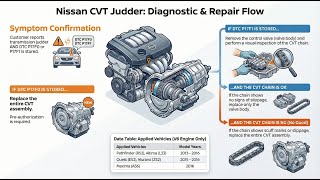
- Check Engine Light: Diagnostic Trouble Codes (DTCs) like P17F0 or P17F1 are specific indicators of CVT judder detected by the vehicle's computer.
Confirming the Diagnosis
A qualified technician will typically start by scanning the Transmission Control Module (TCM) for fault codes. If codes like P17F0 or P17F1 are present, they will likely follow the diagnostic procedure outlined in Nissan's Technical Service Bulletins (TSBs). This may involve a physical inspection of the CVT chain with a borescope and checking the fluid condition. 🎬 Watch: How to inspect the CVT chain and diagnose judder codes Dark, burnt-smelling fluid or significant metal debris on the internal magnets are clear signs of severe internal wear.
Diagnostic Flowchart
Known Issues, TSBs, and Recalls
While no broad recalls have been issued for this specific transmission issue in the 2020 model year, Nissan has released several TSBs and faced class-action lawsuits (such as Stringer v. Nissan) regarding the CVT's performance and longevity.
Severe: CVT Judder and Chain Damage (TSB NTB17-039O)
This is the most widely recognized issue. TSB NTB17-039O details the diagnosis and repair for a judder condition accompanied by DTCs P17F0 or P17F1. The problem stems from the CVT fluid breaking down, leading to slippage between the steel chain and the pulleys. Depending on the severity found during a chain inspection, the remedy can be replacing the valve body or the entire transmission assembly. This issue applies to the full 2013-2020 production range of the Pathfinder with this CVT.
Severe: Oil Pump Flow Control Valve Wear
Wear in the oil pump's flow control valve can cause a loss of hydraulic line pressure. This starves the transmission of the pressure needed to grip the chain, leading to slippage, overheating, and eventual catastrophic failure. This is a known failure mode within the repair industry for the 2013-2020 CVT8 family, requiring replacement of the internal oil pump or flow control valve.
Moderate: Cooler and Filter Contamination (TSB NTB15-013)
TSB NTB15-013 emphasizes the mandatory procedure for flushing the transmission cooler and lines whenever a transmission or valve body is replaced. Debris from the original failing unit can become trapped in the cooler. If not flushed, this debris will immediately contaminate the replacement transmission, leading to a repeat failure.
Recalls
There are no major transmission recalls specifically for the 2020 Pathfinder. An earlier recall for the 2017-2018 model years addressed a potential leak from an oil cooler hose that could pose a fire risk, highlighting potential manufacturing or design vulnerabilities in the family, but this does not apply to the 2020 model.
Transmission Replacement Cost
The cost to replace a 2020 Pathfinder transmission varies significantly based on the type of replacement unit chosen.
| Part Type | Estimated Cost (Part Only) |
|---|---|
| New OEM | $5,000 - $8,000 |
| Remanufactured | $2,300 - $4,200 |
| Used OEM | $1,200 - $2,000 |
Labor and Installation Costs
Professional installation is estimated to take between 8 and 12 shop hours. With typical labor rates, this translates to an estimated cost of $1,200 to $2,400. This does not include fluids, filters, or any required programming.
Installation: Critical Steps for a Successful Replacement
Installing a used CVT8 is an Advanced / Expert procedure. Several steps are absolutely mandatory to prevent immediate damage to the replacement unit and to ensure it functions correctly.
Warning: Mandatory Programming Required! This transmission requires a calibration procedure known as "IP Characterization Write." Every Jatco CVT8 valve body is custom-calibrated at the factory with unique flow data. This data, provided on a QR code on the transmission case/range sensor or via a calibration file, must be written to your vehicle's Transmission Control Module (TCM) using a professional scan tool (like Nissan Consult III+ or equivalent). Skipping this step causes immediate harsh shifting, triggers trouble codes (P17F0/P17F1), and voids the warranty.
Required Special Tools
- Engine support bar/gantry
- Heavy-duty transmission jack
- Fluid charging pump with Nissan-specific CVT fill adapter
- OEM-compatible professional scan tool (Nissan Consult III+ or equivalent)
Essential Procedures and "Gotchas"
Warning: Critical Torque Converter Seating! The torque converter must slide back and engage three distinct splines, sitting at least 13mm (approx. 0.51 inches) recessed into the bellhousing. Bolting the transmission to the engine with an unseated converter will instantly crush the internal oil pump gear.
Warning: Mandatory Cooler Flush! As outlined in TSB NTB15-013, you MUST flush the transmission cooler lines and warmer with a professional aerosol cooler flush to remove all debris from the previous failure.
- Fluid Level Check: This transmission has no dipstick. The fluid level must be checked via an overflow plug procedure while monitoring the fluid temperature with a scan tool until it reaches the specified operating range.
- Wiring Harness: The external wiring harness is not included with a used unit; you must transfer your original external harness. Pinouts differ significantly from FWD or non-Pathfinder CVT8 applications.
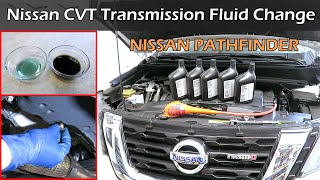
Pro Tip: Use ONLY Genuine Nissan NS-3 CVT fluid. Do not use NS-2 or generic multi-vehicle fluids, as this causes immediate belt/chain slippage. Also, be sure to replace the external cartridge filter, internal pan filter, oil pan gasket, axle seals, and front pump/input shaft metal-clad seal (torque converter seal) during installation.
What Fails at Every Mileage Band
Pro Tip: The mileage bands below describe used replacement units of that mileage. The checklists are things to do WHILE INSTALLING the purchased engine (or transmission), not maintenance for the reader's current engine.
Under 60,000 Miles
While less common in this mileage range, some 2020 Pathfinders have experienced premature transmission failure, sometimes as early as 66,000 miles. Issues like shuddering, jerking, and hesitation during acceleration can appear, which are often precursors to more significant transmission problems.
- ✓Do during install (required): Even on a low-mileage unit, performing a full cooler and line flush is non-negotiable to remove any potential debris from the donor vehicle. Replace the external cartridge-style transmission filter.
- ✓Do during install (recommended): Perform the first drain-and-fill of the CVT fluid if service history is unknown. Many experts recommend the first service as early as 30,000 miles.
- ✓Cheap insurance while the engine is out: Replace external seals (axle seals, input shaft seal) as they are inexpensive and accessible.
60,000 - 100,000 Miles
This is the most common mileage range for catastrophic CVT failure, often occurring just outside the standard 60,000-mile powertrain warranty. Symptoms include pronounced judder/shudder, slipping, delayed throttle response, and complete loss of power. Inadequate cooling is a frequently cited cause, leading to fluid breakdown and accelerated wear on the belt and pulleys.
- ✓Do during install (required): Mandatory replacement of all required consumables: Genuine NS-3 fluid, internal pan filter, external cartridge filter, pan gasket, and all external seals. Thoroughly inspect and clean the transmission cooler.
- ✓Do during install (recommended): Replacement of the transmission cooler is recommended if significant contamination is found from the failed unit.
- ✓Cheap insurance while the engine is out: Strongly consider replacing transmission mounts, as they will have experienced significant wear.
100,000 - 150,000 Miles
Failures in this range are still common, often due to accumulated wear and tear, especially if fluid service has been neglected. While some units fail, others continue to operate, highlighting the variability in lifespan based on maintenance and driving habits. A 2013 model with a similar CVT required a third transmission at 136,000 miles, indicating that even replacement units can fail.
- ✓Do during install (required): Assume all required items from the 60-100k band are mandatory. This is a critical point to perform a drain-and-fill with filter changes if not already done. Given the mileage, a buyer should assume the fluid is degraded.
- ✓Do during install (recommended): Carefully inspect all related components that are removed for access, such as driveshaft U-joints and exhaust gaskets, and replace as needed.
- ✓Cheap insurance while the engine is out: Replace engine and transmission mounts.
Over 150,000 Miles
Survival to this mileage is less common but possible, almost always associated with rigorous maintenance. Failure at this stage is considered to be the end of the transmission's expected service life. A used transmission with this mileage is a significant gamble and should be purchased with the expectation that its remaining service life is limited.
- ✓Do during install (required): All installation procedures and consumable replacements from lower mileage bands are absolutely critical.
- ✓Do during install (recommended): The buyer should have a clear understanding that this is likely a short-term solution before another replacement is needed.
- ✓Cheap insurance while the engine is out: Replace all accessible seals and mounts.
Real Owner Experiences
| Source | Mileage | What Happened | Cost |
|---|---|---|---|
| ~66,000 | Owner reported a 'burnt out' transmission on a 2020 Pathfinder. | Not specified, but likely a warranty or dealer-assisted repair just outside the 60,000-mile powertrain warranty window. | |
| CarComplaints.com / Class Action Lawsuit records | 20,000-80,000 | Widespread reports of shaking, jerking, and random stalling for the 2015-2018 model years, which use a similar CVT, led to a class-action lawsuit. These symptoms indicate potential early-life failure modes. | Repairs were often covered under warranty or as part of the lawsuit settlement, which extended warranties. |
| Consumer Reports Investigation | 60,000-100,000 | A 2020 investigation found this to be the primary failure window for Nissan CVTs. | $3,000 to $6,000 for a replacement or rebuild. |
| ~74,000 | Owner of a 2020 Pathfinder reported a 'judder' and the vehicle was in the shop for diagnosis. | Pending diagnosis, but facing a potential multi-thousand dollar repair bill for a new CVT. | |
| CarComplaints.com | ~90,000 | Transmission failure is a widespread issue for Pathfinders in this mileage range, particularly noted in the 2005-2010 and 2013-2014 model years which also used CVTs. | Up to $7,000 for replacement. |
| 110,000 | Owner of a 2019 Pathfinder reported no issues, having purchased it at 65,000 miles and keeping it serviced. | N/A (preventative maintenance) | |
| 138,000 | On a similar Nissan (Rogue), a replacement CVT failed after only 39,000 miles (original failed at 99k). | $6,000 out of pocket for the second replacement. | |
| 150,000+ | A technician noted seeing CVTs last over 150k miles, but only if the fluid is changed regularly (every 30k, with the first change before 60k). | N/A | |
| Forum Owner Report | 220,900 | A 2013 Pathfinder owner reached high mileage with regular maintenance, though specific transmission history was not detailed. | N/A |
| 195,000 | An Altima owner with a similar CVT reported reaching high mileage by changing the fluid every 30,000 miles. | N/A | |
| 40,000 | Owner was experiencing progressive CVT judder and vibration. Proactively had the fluid flushed at a dealer, but the issue persisted. They were contemplating a full replacement at the dealership. | Quoted $7,000-$10,000 | |
| N/A | Owner's transmission failed; they had it replaced at a Nissan dealership in Tennessee. | $6,200 | |
| N/A | A user in the comments was quoted $8,000 for a replacement by a Nissan Dealership. | Quoted $8,000 | |
| RepairPal | N/A | This is a general estimate for transmission replacement, with labor estimated between $1,116 and $1,637 and parts around $4,888. | Quoted $6,003-$6,525 |
Repair or Replace?
Deciding whether to repair your existing transmission or replace it entirely depends on the severity of the failure.
When Repair Makes Sense
- CVT Judder / Shudder (if caught early): Typical repair cost is $150-$400. When the issue is caused by degraded fluid or needs a software calibration, and has not been ignored for thousands of miles. A fluid exchange and TCM update can often resolve the shudder if no hard part damage has occurred.
- Solenoid or Valve Body Failure: Typical repair cost is $500-$1,500. If diagnostic trouble codes point specifically to a faulty solenoid or valve body and the rest of the transmission (belt, pulleys) is in good condition. A remanufactured valve body can be installed without removing the entire transmission.
- Leaking Seals (Axle, Torque Converter): Typical repair cost is $300-$800. When the leak is the only issue and the transmission is otherwise functioning correctly. This is preventative maintenance to avoid fluid loss and subsequent internal damage.
When Replacement is Smarter
Replacement is the recommended course of action when internal hard parts have failed, such as a stretched or broken push belt, or scored pulleys. These failures often result from long-term issues like fluid breakdown or overheating. If the vehicle exhibits severe slipping, whining noises, or has logged judder codes (like P17F0) for an extended period, the damage is likely too widespread for a simple repair, making a complete used or remanufactured unit more economical than a component-level rebuild.
Freight & Delivery Reality

When ordering a used Jatco CVT8 assembly, it is important to understand how it will arrive. This transmission weighs approximately 235 lbs and measures roughly 38" x 28" x 26" before crating. Because of its size and weight, it ships as LTL (Less Than Truckload) freight on a pallet—NOT as a standard parcel.
- Delivery Requirements: If you are having the transmission delivered to a residential address or a shop without a forklift or loading dock, you must request liftgate service so the driver can safely lower the pallet to the ground.
- Inspect Before Signing: Always inspect the transmission while the driver is present. Check for case cracks, broken sensors, or damage to the transmission oil pan that may have occurred during transit. Do not sign the delivery receipt until you have verified the unit is undamaged.
- Pre-Purchase Verification: A reputable supplier will conduct a pre-purchase verification interview. They will ask you to confirm your vehicle is AWD, verify the 8th digit of your VIN is 'Y', and ask you to check the barcode sticker (RE0F10E or RE0F10J) to ensure you receive the exact match.
Frequently Asked Questions (FAQ)
Can I use a transmission from a Front-Wheel Drive (FWD) Pathfinder?
No. The FWD transmission is physically different and does not have the output shaft or mounting points for the AWD transfer case. You must use a transmission from an AWD Pathfinder.
Is the programming (IP CHAR Write) step really necessary?
Yes, it is absolutely critical. The TCM needs the specific calibration data from the replacement transmission's valve body to control hydraulic pressures correctly. Skipping this step will result in poor performance, fault codes, and likely damage the replacement unit.
What happens if I use the wrong fluid?
Using any fluid other than Genuine Nissan NS-3 will damage the transmission. The fluid is engineered with a specific friction modifier to allow the steel chain to grip the pulleys. Incorrect fluid will cause immediate slippage, juddering, and rapid, irreversible wear.
What is the expected service life of this CVT?
The expected service life is highly variable. While numerous owner reports point to a common failure window between 60,000 and 100,000 miles, diligent proactive maintenance can change outcomes. Owners who perform fluid changes every 30,000 miles have reported lifespans exceeding 150,000 to 200,000 miles. Neglecting fluid service leads to overheating and premature failure.
What questions should I ask my installer before the swap?
Before handing over your vehicle, ask your installer: Have you confirmed this is an AWD-specific (RE0F10E/J) unit? Will you be performing the mandatory cooler and line flush? Do you have the Nissan-specific scan tool (Consult III+ or equivalent) required for the IP Characterization Write? Can you confirm the torque converter is fully seated (3 distinct clicks) before mating the transmission to the engine? How will you verify the correct fluid level without a dipstick?
Helpful Videos



Technical Specifications
OEM Part Numbers: RE0F10E RE0F10J JF017E
Family Name: Jatco CVT8 / CVT8 HT; Common Codes: RE0F10E, RE0F10J, JF017E; Configuration: Transverse, All-Wheel Drive (AWD / 4x4); Engine: 3.5L V6 (VQ35DD)
We Have This Part in Stock


The information in this article is provided for general reference and educational purposes only. Vehicle specifications, procedures, and part compatibility can vary by production date, trim level, and region. Always consult your vehicle's factory service manual and verify part numbers before purchasing or performing repairs. Safety-critical components such as airbags, seat belts, and braking systems should be installed by a qualified professional.
- Nissan Pathfinder:
- 🎬 Helpful Videos
- 🛍️ Shop This Part
- Part Identification: Confirming the Correct CVT for Your Pathfinder
- Key Identifiers
- How to Verify Fitment on Your Vehicle
- Common Failure Symptoms and Diagnosis
- Symptoms of a Failing CVT
- Confirming the Diagnosis
- Diagnostic Flowchart
- Known Issues, TSBs, and Recalls
- Severe: CVT Judder and Chain Damage (TSB NTB17-039O)
- Severe: Oil Pump Flow Control Valve Wear
- Moderate: Cooler and Filter Contamination (TSB NTB15-013)
- Recalls
- Transmission Replacement Cost
- Labor and Installation Costs
- Installation: Critical Steps for a Successful Replacement
- Required Special Tools
- Essential Procedures and "Gotchas"
- What Fails at Every Mileage Band
- Under 60,000 Miles
- 60,000 - 100,000 Miles
- 100,000 - 150,000 Miles
- Over 150,000 Miles
- Real Owner Experiences
- Repair or Replace?
- When Repair Makes Sense
- When Replacement is Smarter
- Freight & Delivery Reality
- Frequently Asked Questions (FAQ)
- 🎟️ Get 5% Off