

2010 Nissan Frontier 2.5L RE5R05A Transmission: Problems, Identification, and Used Replacement
Identify the Jatco RE5R05A, understand the fatal SMOD failure, and learn what to check before buying and installing a used OEM replacement unit.
- The most critical failure is "SMOD" from a radiator defect in 2005-2010 models; you must replace the radiator or bypass its cooler when installing a replacement transmission to prevent immediate failure.
- Verify you have the correct RE5R05A variant for the 2.5L RWD Frontier by checking the VIN, confirming 2WD, and locating the '97X' code on the transmission's ID tag.
- When installing a replacement, the torque converter must be fully seated (3 distinct clicks) before bolting the transmission to the engine to prevent catastrophic damage to the new unit's front pump.
- After installation, a TCM Adaptive Learning Reset must be performed with a professional scan tool to ensure smooth shifting and proper operation.
Identifying the Correct Transmission

The 2010 Nissan Frontier with a 2.5L 4-cylinder engine and two-wheel drive uses a 5-speed automatic transmission from the Jatco RE5R05A family. This specific variant (identifying codes JR507E, JR509E) is designed only for the 2.5L (QR25DE) engine and rear-wheel drive (RWD / 2WD) applications. It is crucial to verify this is the correct unit for your truck before purchasing a replacement.
How to Confirm Fitment on Your Vehicle
- Check the VIN: The Vehicle Identification Number (VIN) contains codes about your truck's factory equipment. The 4th digit of the VIN should be 'B' or '2' to confirm the 2.5L 4-cylinder engine. The VIN can be found on the driver's side dashboard (viewable through the windshield) and on the driver's door jamb sticker.
- Inspect the Drivetrain: Confirm your truck is 2WD (two-wheel drive). A 2WD Frontier will have a single driveshaft going to the rear axle and will not have a 4WD selector switch or lever inside the cab.
- Locate the ID Tag: There is a metal identification tag on the right (passenger) side of the transmission case, just above the oil pan rail. For this specific unit, the JATCO model code should begin with 97X.
Pro Tip: The ID tag is the most definitive way to identify the transmission.
Warning: This transmission will NOT fit Frontier models with the 4.0L V6 engine or any 4WD (four-wheel drive) models. The V6 and 4WD versions use a different RE5R05A variant with a different bellhousing (the part that bolts to the engine), different internal gear ratios (Type A vs Type B/C), and a different tailhousing to accommodate a transfer case.
Common Failure Symptoms

When the RE5R05A transmission begins to fail, it can exhibit several distinct symptoms. If you experience any of the following, it's time to have the transmission inspected by a professional.
- Delayed or Harsh Shifting: The truck may pause excessively before engaging a gear when shifting from Park to Drive or Reverse. Shifts between gears while driving may be rough or jerky.
- Gear Slipping: The engine RPMs may suddenly increase without a corresponding increase in speed, as if the transmission is momentarily in neutral.
- Limp Mode: The truck may get stuck in a single gear (often 4th or 5th) and refuse to shift, with very poor acceleration. This is a self-preservation mode triggered by the Transmission Control Module (TCM) when it detects a serious fault.
- Check Engine Light: Faults within the transmission, especially with its internal electronics, will trigger a Check Engine Light. Common Diagnostic Trouble Codes (DTCs) include P1757, P1759, P1754, P1764, and U1000.
- Pink, Milky Fluid (SMOD): If you check the transmission fluid and it looks like a strawberry milkshake, this is a definitive sign of catastrophic failure from coolant contamination.
Diagnostic Flowchart
Known Problems, TSBs, and Recalls
Radiator Failure & "Strawberry Milkshake of Death" (SMOD)
The most notorious and destructive issue affecting 2005-2010 Nissan Frontiers is the failure of the built-in transmission cooler located inside the radiator. An internal crack can develop, allowing engine coolant to mix with the automatic transmission fluid (ATF). This mixture quickly destroys the friction materials and sensitive electronics inside the transmission, leading to total failure.
| Affected Years | 2005-2010 |
| Symptoms | Transmission failure often occurs suddenly. The key indicator is contaminated fluid that appears pink and milky. |
| Official Action | While no safety recall was ever issued by the NHTSA, Nissan did extend the warranty on the radiator assembly after a class-action lawsuit. This extended coverage went up to 10 years or 100,000 miles, but many failures occurred outside this window. |
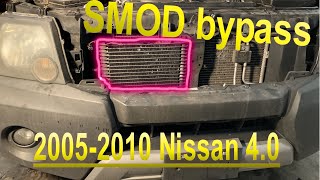
| Remedy | The only permanent fix is to replace the radiator with a new, updated unit or to install an auxiliary external transmission cooler, bypassing the radiator's internal cooler completely. Flush all lines thoroughly. |
Warning: If you are replacing a transmission due to SMOD, you MUST replace the radiator and thoroughly flush all cooler lines before installing the new unit. Reusing a SMOD-contaminated radiator will cause the replacement transmission to fail almost immediately.
Internal TCM and Solenoid Failures
The Transmission Control Module (TCM) is located internally on top of the valve body inside the oil pan. It is susceptible to failure, which can cause a variety of shifting problems and diagnostic trouble codes.
| Affected Years | All years using the RE5R05A. |
| Symptoms | The vehicle may enter "limp mode," and you may see DTCs like P1757, P1759, P1754, P1764 (Internal TCM Lead Frame & Solenoid Circuit Failures), or U1000 (CAN Communication Failure). |
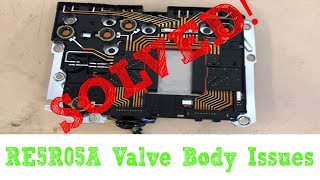
| Remedy | This issue often requires repairing or replacing the internal TCM/lead frame or the entire valve body assembly. Check main electrical connector pins for corrosion. |
Replacement Cost Estimates
The cost to replace a transmission can vary widely based on the type of replacement unit, labor rates in your area, and whether associated parts like the radiator need to be replaced. Shop labor is estimated at 5.0 to 8.0 hours.
| Part or Service | Estimated Cost (USD) |
|---|---|
| New OEM Transmission | $4,800 - $7,700+ (Part only) |
| Remanufactured Transmission | $2,100 - $3,500 (Part only) |
| Used OEM Transmission | $750 - $1,500 (Part only, depending on mileage) |
| Labor to Install | $600 - $1,637 |
What Fails at Every Mileage Band
Pro Tip: The mileage bands below describe the condition of used replacement units of that mileage. The checklists provided are things to do WHILE INSTALLING the purchased transmission, not maintenance for your current transmission.
Under 60,000 Miles
The most significant risk in this mileage band is the catastrophic "Strawberry Milkshake of Death" (SMOD), where a failure in the integrated radiator-transmission cooler allows coolant to mix with the transmission fluid. This contamination quickly destroys the transmission's internal components, including the clutch friction materials and the electronic valve body/TCM. This was a known issue in 2005-2010 models and could occur at very low mileages.
- ✓Do during install (required): Replace the radiator with a post-2010 OEM or quality aftermarket unit to eliminate the SMOD risk. Alternatively, bypass the radiator's internal cooler entirely and install a dedicated external transmission cooler.
- ✓Do during install (required): Perform a complete transmission fluid flush using a professional aerosol machine (e.g., Lubegard Kooler Kleen) to remove any potential contaminants from the lines.
- ✓Do during install (required): Install a new torque converter seal (front pump input shaft seal).
- ✓Do during install (recommended): Replace the transmission filter (metal screen) and pan gasket.
60,000 - 100,000 Miles
SMOD remains the primary concern for any unit with its original radiator. The risk increases with age and mileage. Failures of the internal Transmission Control Module (TCM) or its integrated solenoids can begin to appear, often presenting as harsh shifting, getting stuck in one gear (limp mode), or throwing diagnostic trouble codes (DTCs) like P1757/P1759. Torque converter shudder can also develop, sometimes due to the TCM's adaptive learning strategy lowering line pressure over time.
- ✓Do during install (required): All items from the 'Under 60K' band are still critical if not previously done. Replace all external seals, including the driveshaft output seal.
- ✓Cheap insurance while the engine is out: While the transmission is out, consider replacing the internal valve body/TCM assembly as a preventative measure, especially if the vehicle's history is unknown. A remanufactured unit can prevent future electronic failures.
- ✓Do during install (recommended): Inspect and replace worn transmission mounts.
100,000 - 150,000 Miles
If the original radiator is still in use, SMOD is not a matter of "if" but "when". Internal electronic failures of the TCM and solenoids become more common. Mechanical wear on internal components like clutch packs and the brake band can occur, especially if the vehicle was used for towing or subjected to aggressive driving. Torque converter issues, such as shudder or failure of the lock-up clutch, may arise.
- ✓Do during install (required): All items from the previous bands apply.
- ✓Cheap insurance while the engine is out: If installing a used unit, replacing the valve body/TCM and torque converter is cheap insurance against immediate failure. Inspect the engine flexplate (flywheel) for cracks and engine/transmission mounts for wear.
Over 150,000 Miles
At this mileage, any unit that survived likely had its radiator replaced or the cooler bypassed. General mechanical wear is the main concern. This includes worn clutch packs, stretched brake bands, and worn internal seals and bushings, which can lead to slipping or shifting issues. Failures of the valve body, solenoids, and TCM are common, as is torque converter failure.
- ✓Do during install (required): At this mileage, installing a used transmission without a full rebuild is a major gamble. A professionally remanufactured unit is the most reliable path. If rebuilding, a master kit including all frictions, steels, seals, gaskets, and bushings is necessary.
- ✓Do during install (required): Always replace the valve body/TCM assembly and the torque converter. Replace the radiator, all cooler lines, and transmission mounts.
Real Owner Experiences
| Source | Mileage | What Happened | Cost |
|---|---|---|---|
| Car Complaints | Under 10,000 miles | Radiators in 2005-2008 models were reported to rupture, leading to coolant contaminating the transmission fluid and causing gearbox breakdown. | Not specified |
| Consumer Affairs | 101,000 miles | A 2007 Frontier experienced SMOD. The transmission was stuck in third gear with a check engine light, and shifting from 1st to 2nd was a large jump. | $5,300 (quoted) |
| XterraNation | 80,000-100,000 miles | Nissan offered extended warranty coverage for SMOD-related repairs with a customer co-pay in this mileage range, indicating a high failure rate. | $2,500 - $3,000 (co-pay) |
| Tri-City Transmission Case Study | 116,742 miles | A well-maintained 2006 Frontier broke down due to SMOD. | Over $4,000 (quoted) |
| CarKiller Forum | 147,000 miles | An owner reported shaking at idle and in park, suspecting a torque converter issue on their 2011 Frontier. | Not specified |
| 162,000 miles | Owner caught SMOD just as it started. Replaced radiator with aftermarket, flushed engine/lines, replaced thermostat, and did a drain/fill on the transmission. Still experienced a 'rumble strip' vibration afterward. | ~$150 for radiator/fluids (Quoted $6,000 at dealer) | |
| Unknown | Owner was quoted for a preventative radiator replacement to avoid SMOD. | $700 (quoted) | |
| 175,000 miles | Transmission was failing (slipping, over-revving). Advised to replace. | ~$3,000 reman + ~$2,000 labor (estimated) | |
| Quora | Unknown | Owner was exploring options for a failed transmission on a 2008 model. | $5,000 (quoted by dealer for reman) |
| NICOclub Forums | 225,000 miles | An owner reported their first transmission problem at this high mileage, highlighting the potential longevity if SMOD is avoided. | Not specified |
| ~242,000 miles (390,000 km) | An owner of a high-mileage 2007 Frontier was proactively considering bypassing the radiator cooler to prevent SMOD. | Not specified |
Repair or Replace?

Deciding whether to repair your current transmission or replace it entirely depends on the exact failure mode.
- When Repair Makes Sense: If SMOD has not occurred yet, spending $300 - $700 for a preventative radiator replacement is highly recommended. If SMOD has just begun and the transmission has not started to show severe symptoms (like major slipping or loss of gears), an immediate radiator replacement and multiple fluid flushes might save it. Additionally, if the transmission's mechanical components are healthy and the failure is isolated to the internal electronics (confirmed by DTCs like P1757/P1759), repairing the TCM ($150+ for mail-in soldering) or replacing the valve body/TCM assembly ($200 to $850 plus labor) is far more economical than replacing the entire transmission.
- When Replacement is Smarter: Replacement is the smarter option when the transmission has suffered catastrophic internal damage from advanced SMOD (coolant has circulated for an extended period, causing clutch material delamination and widespread corrosion), or when there are multiple mechanical failures (e.g., loss of multiple gears, loud whining/grinding noises). If the cost of a rebuild approaches or exceeds the price of a quality used or remanufactured unit, replacement offers a faster turnaround.
Questions to Ask Your Installer
- Have you confirmed the torque converter is fully seated (3 distinct clicks) before installation?
- Will you be flushing the transmission cooler and lines completely before connecting the replacement unit?
- Are you using Genuine Nissan Matic-S ATF or a certified full-synthetic equivalent?
- Given the vehicle's history, do you recommend replacing the radiator as a precaution, even if it hasn't failed yet?
- Do you have a professional scan tool to perform the adaptive memory relearn procedure after installation to ensure smooth shifting?
- What warranty do you offer on your labor, and what is the warranty on the used/remanufactured transmission unit itself?
Installation & Programming Considerations

What's Included in a Used Assembly
A used transmission assembly from a recycler typically includes the core components but not external accessories. Expect it to include:
- Transmission case and all internally lubricated parts
- Valve body and internal solenoids
- Internal Transmission Control Module (TCM)
- Torque converter
- RWD extension/tail housing
- Transmission oil pan
It will likely NOT include:
- External sensors (such as crankshaft position sensor)
- External wiring harnesses
- Shifter assembly or shift linkage/cables
- The engine flexplate (flywheel)
- External transmission fluid cooler lines
- Driveshaft
Pro Tip: Before installation, always replace consumable parts like the front pump seal (torque converter seal), pan gasket, and filter. Use a professional-grade aerosol flush to clean the external cooler lines thoroughly.
Critical Installation Steps & Gotchas
Proper installation is key to the longevity of a replacement transmission. This is an Advanced/Expert DIY job requiring special tools like a heavy-duty transmission jack and extra-long socket extensions (30 inches or more) with universal swivels.
- Fully Seat the Torque Converter: The torque converter must be pushed and rotated until it drops/clicks into place three distinct times. When fully seated, it should be recessed at least 1 inch (or 25.0 mm) inside the bellhousing face.
- Check Dowel Pins: Ensure alignment dowel pins remain in the engine block and are not missing or doubled up.
- Dipstick Tube Removal: The transmission dipstick tube on the 2.5L Frontier is secured to the firewall with a 10mm bolt that must be removed to pull the dipstick.
- Manual Selector Shaft: Ensure the manual selector shaft aligns perfectly with the shift cable.
- Fluid Level Check: Fluid level must be checked with the vehicle level, engine idling at operating temperature (122°F to 176°F), after shifting slowly through all gears.
Warning: The first step is the most important. Failure to fully seat the torque converter will crush and destroy the transmission's front pump gear when the engine is bolted on.
Programming and Relearn Procedure
While a used transmission with its original TCM does not require a full dealer re-flash (ECU/PCM remarriage is not required), performing a TCM Adaptive Learning Reset is highly recommended. The TCM learns and adapts to wear patterns over time. Clearing this memory allows it to start fresh and learn the shift characteristics of the replacement unit, preventing persistent harsh shifting. This procedure requires a bi-directional OBD2 scan tool (Nissan Consult II or equivalent).
Freight & Delivery Reality

If you are ordering a used RE5R05A transmission online, it will not arrive in a standard cardboard box via regular mail. This assembly weighs approximately 255 lbs and measures roughly 39" x 23" x 22" before crating. It ships as LTL (Less-Than-Truckload) freight on a wooden pallet.
- Delivery Requirements: You will need a delivery location capable of handling freight. If delivering to a residential address, you must request a truck with a liftgate to lower the pallet to the ground.
- Inspect Before Signing: Always inspect the transmission while the delivery driver is present. Check for cracked bellhousings, broken sensors, or a crushed oil pan. If the unit is damaged, note it on the delivery receipt before signing.
Frequently Asked Questions (FAQ)
Can I use this transmission in my V6 or 4x4 Frontier?
No. This unit is only for the 2.5L 4-cylinder, 2WD model. The V6 and 4x4 models have different bellhousings, internal gear ratios, and tailhousings that make them physically incompatible.
What is SMOD and how can I prevent it?
SMOD stands for "Strawberry Milkshake of Death." It happens when the radiator's internal transmission cooler fails, mixing engine coolant and transmission fluid. To prevent it, you can proactively replace your radiator with a newer design or install an external transmission cooler to bypass the radiator's cooler circuit entirely.
Do I have to program the computer after installing a used transmission?
You don't need to "program" it in the sense of installing new software, as the internal TCM already contains the factory software. However, you should use a bi-directional scan tool to perform a TCM adaptive memory reset. This clears the old learned shift data and allows the computer to adapt to the replacement transmission, which prevents harsh shifting.
What is the correct transmission fluid for a 2010 Frontier 2.5L?
The required fluid is Genuine Nissan Matic-S ATF. You can also use a high-quality, fully synthetic multi-vehicle fluid (like Valvoline MaxLife) that explicitly lists Matic-S as a compatible equivalent. Do not use generic Dexron III or any type of CVT fluid.
How do I properly check the transmission fluid level?
The fluid level must be checked with the vehicle parked on a level surface, with the engine idling at operating temperature (between 122°F and 176°F). Before checking, you must shift slowly through all the gears (P-R-N-D-3-2-1) and back to Park. Note that the dipstick tube is secured to the firewall with a 10mm bolt that must be removed first.
Helpful Videos
Technical Specifications
Name: Jatco RE5R05A; Application: 2010 Nissan Frontier 2.5L (QR25DE) RWD/2WD; Type: 5-Speed Automatic; Jatco Variant Codes: JR507E, JR509E; ID Tag Code Prefix: 97X; Weight: ~255 lbs; Dimensions: ~39" x 23" x 22"; Required Fluid: Genuine Nissan Matic-S ATF
We Have This Part in Stock


The information in this article is provided for general reference and educational purposes only. Vehicle specifications, procedures, and part compatibility can vary by production date, trim level, and region. Always consult your vehicle's factory service manual and verify part numbers before purchasing or performing repairs. Safety-critical components such as airbags, seat belts, and braking systems should be installed by a qualified professional.
- Nissan Frontier:
- 🎬 Helpful Videos
- 🛍️ Shop This Part
- Identifying the Correct Transmission
- How to Confirm Fitment on Your Vehicle
- Common Failure Symptoms
- Diagnostic Flowchart
- Known Problems, TSBs, and Recalls
- Radiator Failure & "Strawberry Milkshake of Death" (SMOD)
- Internal TCM and Solenoid Failures
- Replacement Cost Estimates
- What Fails at Every Mileage Band
- Under 60,000 Miles
- 60,000 - 100,000 Miles
- 100,000 - 150,000 Miles
- Over 150,000 Miles
- Real Owner Experiences
- Repair or Replace?
- Questions to Ask Your Installer
- Installation & Programming Considerations
- What's Included in a Used Assembly
- Critical Installation Steps & Gotchas
- Programming and Relearn Procedure
- Freight & Delivery Reality
- Frequently Asked Questions (FAQ)
- 🎟️ Get 5% Off