

2018-2022 Mitsubishi Outlander PHEV Rear Drive Unit: Problems, Identification, and Used Replacement
Identify the F1E1A e-Axle, diagnose common clunks and failures, and learn when to replace it with a used OEM unit.
- A "clunk" or "thud" noise is almost always a failed rear motor mount bushing (part 3517A090/3517A053), a common and inexpensive fix that should be checked before condemning the entire drive unit.
- Replacement is not plug-and-play; it requires a Mitsubishi MUT-III scan tool to perform a mandatory resolver offset calibration, and failure to do so will result in a non-operational vehicle.
- This F1E1A unit is exclusive to the Outlander PHEV (VIN 4th digit 'J') and is not interchangeable with parts from standard gasoline-only models.
- Due to lethal high-voltage risks, installation must only be performed by a qualified technician trained in hybrid/EV repair using proper safety equipment.
- The correct fluid is Mitsubishi Diamond ATF SP-III; using standard gear oil or CVT fluid will cause severe damage to the unit.
Part Identification: Confirming the F1E1A Rear Drive Unit

The 2018-2022 Mitsubishi Outlander Plug-in Hybrid (PHEV) uses a specialized rear electric transaxle, also known as an e-Axle or rear motor assembly. This single-speed unit, part of the F1E1A family, integrates the rear electric motor, reduction gearing, and differential into one assembly. It is a critical component of the vehicle's Super All-Wheel Control (S-AWC) system.
Verifying this is the correct part for your vehicle is crucial, as it does not interchange with parts from gasoline-only Outlander models.
| Check | Details |
|---|---|
| Vehicle Confirmation | Ensure the vehicle is a Plug-in Hybrid model, identifiable by "PHEV" badging and a charge port door. |
| VIN Check | The 4th character of the Vehicle Identification Number (VIN) should be 'J', which designates the PHEV powertrain. |
| Engine Type | This unit is paired with either the 2.0L (4B11) or 2.4L (4B12) gasoline engine as part of the hybrid system. |
| Part & Casting Numbers | Look for identifying codes stamped on the transaxle casing. Common identifiers include F1E1A, F1E1A-2-B5Z, and the integrated motor code Y61 (a 60 kW or 70 kW motor). OEM part numbers for the complete assembly include 2500A511 and 3501A383. |
Warning: This assembly is exclusively for the Outlander PHEV. It will not fit standard front-wheel-drive or all-wheel-drive gasoline models, which use a completely different rear differential and driveline.
Common Symptoms and Failure Diagnosis

Failures in the rear drive unit can manifest in several ways. However, it's important to distinguish between a problem with the unit itself and a failure of its supporting components.
- "Clunk" or "Thud" on Acceleration: The most common issue is a loud clunk or jolt from the rear of the vehicle when accelerating from a stop, or when the system transitions between acceleration and regenerative braking. This is almost always caused by a failed rear motor mount bushing, not an internal transaxle failure.
- Whining Noise: A persistent whining noise from the rear that changes with vehicle speed can indicate bearing or gear wear inside the unit. Some minor whining when the unit is warm is considered normal by some owners, but a loud or grinding noise points to a problem.
- "PHEV System Fault" Warning: A generic but serious warning on the dashboard can be triggered by a fault within the rear motor or its sensors. This requires a diagnostic scan with a capable tool to read the specific trouble codes.
- Fluid Leaks: Leaks of red-colored Automatic Transmission Fluid (ATF) from the axle seals or case seams indicate a seal failure.
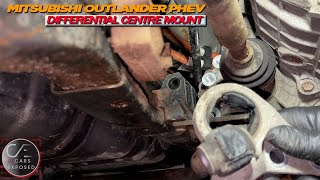
Pro Tip: Before condemning the entire drive unit for a "clunking" noise, thoroughly inspect the rear motor mount front bracket bushing (OEM part 3517A090 or 3517A053 🎬 Watch: Step-by-step rear differential mount bushing replacement). This inexpensive rubber bushing frequently fails and is a much more common and cheaper fix than replacing the whole assembly.
Diagnostic Flowchart
Known Problems, Recalls, and Technical Service Bulletins (TSBs)
While this unit is generally reliable, a few key issues have been identified across the 2018-2022 model years.
Rear Motor Mount Bushing Failure
This is the most prevalent problem associated with the rear drive unit. The high torque of the electric motor puts significant stress on the rubber bushing that secures the front of the motor assembly to the subframe. Over time, the rubber degrades, splits, or separates, causing the entire drive unit to move excessively under load. This results in the common "thud" or "clunk" noise. The remedy is to replace the bushing. Upgraded polyurethane bushings are available from aftermarket suppliers like Polybush (e.g., Polybush 17AW) and Powerflex, which offer a more durable solution.
Oil Seal Leaks
A moderate issue is the failure of the oil seal between the electric motor and the reduction gearbox. This allows the unit's lubricating fluid (ATF SP-III) to leak. If not addressed, fluid loss can lead to overheating and failure of the gears and bearings.
Software and Calibration Errors
Hesitation, rough power transition, or system fault warnings can sometimes be traced to software issues. Ensuring the vehicle's PHEV ECU and other related modules have the latest firmware from Mitsubishi is a critical diagnostic step. Sometimes, a simple recalibration can resolve communication errors between the various vehicle computers.
Technical Service Bulletin TSB-24-54-005
Mitsubishi issued TSB-24-54-005 to provide corrected procedures for the removal and installation of the rear motor assembly. This indicates the importance of following specific, updated instructions during repair to avoid damage or improper installation.
Replacement Cost Estimates
The cost to replace the F1E1A rear drive unit can vary significantly based on the source of the part. Labor costs are also a major factor due to the complexity and high-voltage safety requirements.
| Item | Estimated Cost (USD) | Notes |
|---|---|---|
| New OEM Assembly | $2,700 - $5,000+ | Part number 2500A511, ordered from a Mitsubishi dealership. |
| Remanufactured Assembly | $2,300 - $3,100 | Availability for this specific e-Axle is extremely limited. Prices reflect general Outlander remanufactured units. |
| Used OEM Assembly | $1,500 - $3,400 | Sourced from automotive recyclers. Price depends on mileage and condition. |
| Estimated Labor | $600 - $1,200 | Estimated 4 to 7 hours of shop time. Requires technicians trained in high-voltage systems. |
Installation and Programming: What to Know

Replacing this unit is a complex job that should not be attempted by untrained individuals due to the serious risks involved.
Warning: High-Voltage Shock Hazard! This assembly is part of a high-voltage system. Installation must only be performed by a qualified professional technician with specific training in hybrid and electric vehicle repair. Proper procedures, including pulling the main drive battery service plug, waiting at least 10 minutes, testing for zero voltage, and using Class 0 (1000V) insulated safety gloves, are mandatory to prevent severe injury or death.
What's Included with a Used Assembly
A used F1E1A assembly typically includes the transaxle case, the integrated electric motor (Y61), and the internal reduction gears and differential. Because this is an electric drive unit, it does not feature a traditional torque converter, flexplate, clutch assembly, or transmission pan. Components that are generally not included and must be transferred from the old unit or purchased new are:
- External rear motor inverter/controller (MCU)
- High-voltage orange wiring harnesses
- External coolant hoses and lines
- Mounting brackets and hardware
- CV axles/driveshafts
- External sensors and control modules (like the PHEV ECU)
Required Fluids and Consumables
- Gear Lubricant: The reduction gearset is lubricated with Mitsubishi Genuine ATF SP III (or Dia Queen / Diamond ATF SP-III). Do NOT use standard gear oil (like 75W-90/80W-90 GL-5) or CVT fluid, as this will cause severe damage. Always remove the 10mm hex fill plug before removing the 24mm drain plug.
- Coolant: The electric motor has its own liquid cooling loop. This system must be refilled with Mitsubishi Genuine Super Long Life Coolant and properly bled to remove all air pockets from the water-cooling jacket to prevent overheating and limp mode.
- Seals and Bushings: It is highly recommended to install new left and right rear axle shaft seals and inspect/replace the rear motor mount bushings during the job.
Required Calibration and Programming
This is not a "plug-and-play" part. The integrated electric motor contains a resolver, which is a rotor position sensor that tells the vehicle's computer the exact rotational position of the motor. After installing a replacement unit, this resolver must be calibrated to the vehicle's PHEV ECU.
- Tool Required: This calibration, often called "resolver offset learning" or "encoding," requires the official OEM scan tool, the Mitsubishi MUT-III.
- Consequences of Skipping: Failure to perform this electronic pairing will result in the motor shuddering, running backwards, triggering system error codes, entering limp mode, or resulting in a non-operational vehicle.
Freight, Delivery, and Arrival Checks

When ordering a used F1E1A rear drive unit, it is important to understand how it ships and what to look for when it arrives.
- Shipping Reality: Verified shipping data shows this assembly weighs approximately 44 lbs and measures roughly 18" x 14" x 12" before crating. Despite its relatively light weight for a drivetrain component, it ships as LTL (Less-Than-Truckload) freight on a pallet, NOT as a standard parcel.
- Delivery: You will need a commercial address with a forklift or loading dock, or you must request liftgate service for a residential delivery. Always inspect the pallet before signing the delivery receipt.
- Arrival Checks (EV Specific): Before installation, inspect the high-voltage orange connector pins for any signs of arcing, melting, or corrosion. Check the aluminum casing for cracks or impact damage. Rotate the input/output shafts by hand to feel for smooth operation without binding. If your shop is equipped, perform an insulation resistance test (the EV equivalent of a compression test) to ensure the internal motor windings are not shorting to the casing.
- Pre-Purchase Verification: A reputable recycler will conduct a pre-purchase interview. Be prepared to confirm your VIN (specifically the 4th digit 'J') and verify that your vehicle is indeed the Plug-in Hybrid model, not a standard gas Outlander.
What Fails at Every Mileage Band
Pro Tip: The mileage bands below describe what to expect from used replacement units of that mileage. The checklists provided are things to do WHILE INSTALLING the purchased unit, not maintenance for your current vehicle.
Under 60,000 Miles
At this low mileage, the core mechanicals of the e-Axle are generally in excellent condition. The most common failure is external to the unit itself: the rear motor mount bushing. The OEM rubber bushing (part numbers 3517A090, 3517A053) is known to split or wear prematurely, sometimes in as little as 10,000 to 22,000 miles. Software glitches causing hesitation or rough transitions are also reported in this band, alongside occasional rear wheel bearing noise.
- ✓Do during install (required): Perform All Software/Firmware Updates. Ensure the PHEV ECU and related modules are updated to the latest versions to resolve any potential hesitation or rough shifting issues.
- ✓Do during install (recommended): Upgrade Rear Motor Mount Bushing. If the transaxle is out for any reason, replace the OEM rubber bushing with a more durable polyurethane (poly) version, such as those from Powerflex or Polybush. This is considered a permanent fix to a common failure point.
- ✓Cheap insurance while the engine is out: Replace Axle Seals. Install new left and right axle shaft seals as a low-cost preventative measure against future leaks.
60,000 - 100,000 Miles
If the rear motor mount bushing was replaced with another OEM rubber part early in the vehicle's life, it is highly likely to fail again within this mileage band (e.g., a second failure around 66,000 miles). Owners also report rear drive mount gasket leaks and continued instances of noisy rear wheel bearings. The internal reduction gear fluid should be inspected and changed in this window.
- ✓Do during install (required): Mandatory Rear Motor Mount Bushing Upgrade. Do not consider reinstalling the unit without upgrading to a polyurethane bushing. The likelihood of a second OEM failure is high.
- ✓Do during install (recommended): Change Reduction Gear Fluid. A full fluid replacement with Mitsubishi Diamond ATF SP-III is a critical preventative maintenance step for the internal gears and bearings.
- ✓Cheap insurance while the engine is out: Inspect Axle Boots and Shafts. Thoroughly inspect the rear CV axles connected to the unit for torn boots or wear.
100,000 - 150,000 Miles
The core transaxle and motor unit appear to be very robust, with few reports of catastrophic failure. Many owners report high mileage with only routine maintenance. While general "transmission failure" is sometimes noted for the broader Outlander platform at higher mileages, it is not widely reported by PHEV owners for this specific rear e-Axle.
- ✓Do during install (required): Full Fluid and Seal Service. If the unit is being installed at this mileage, a complete service including a fluid change (Mitsubishi Diamond ATF SP-III), new axle seals, and a new polyurethane motor mount bushing is essential.
- ✓Do during install (recommended): Inspect Motor Coolant Loop. Thoroughly inspect all coolant hoses connected to the rear motor for brittleness or wear and bleed the system properly upon reinstallation.
- ✓Cheap insurance while the engine is out: Replace all mounting hardware if corroded or fatigued.
Over 150,000 Miles
The F1E1A rear e-axle assembly demonstrates remarkable longevity. Owners have reported reaching 159,000 and 160,000 miles with only routine maintenance and no repairs needed to the drive unit. At this stage, longevity framing shifts: mileage means bearing and gear wear, and coolant/oil service history is paramount. The lifespan of the vehicle is more likely to be limited by the degradation of the main high-voltage battery than by a mechanical failure of this transaxle.
- ✓Do during install (required): Assume All Consumables are Due. When installing a high-mileage used unit, it is critical to replace the reduction gear fluid, all seals, and upgrade the rear motor mount bushing as a baseline.
- ✓Do during install (recommended): Thorough Inspection of All Related Parts. Carefully inspect the condition of the high-voltage cable connections, coolant lines, and mounting points for any signs of corrosion or fatigue.
- ✓Cheap insurance while the engine is out: Replace the rear drive mount gasket to prevent future leaks.
Real Owner Experiences
| Source | Mileage | What Happened | Cost |
|---|---|---|---|
| Mitsubishi Outlander PHEV Forum | 22,000 miles | Dealer advised that the rear electric motor mount bushings were worn and splitting during an MOT inspection. They quoted £200 for the repair, claiming it was 'wear and tear' and not covered by warranty. | £200 (dealer quote) |
| Polybush Blog | as low as 10,000 miles | Reports of the OEM rear motor mount bushing failing, leading to a knock on acceleration and an unresponsive drive feel. | N/A |
| CarComplaints.com | 21,300 miles (average) | A 2022 Outlander (non-PHEV, but relevant to shared chassis components) experienced significant rear-end bounce and jump over slight road imperfections. | N/A |
| Mitsubishi Outlander PHEV Forum | 66,000 miles | The rear motor mount, which had been replaced once before, failed again. The owner opted to replace it with a more durable Powerflex polyurethane bushing for £145 instead of another OEM part. | £145 (part only) |
| Mitsubishi Outlander PHEV Forum | 95,000 miles | An owner of a 2018 PHEV GT had the rear drive mount gasket replaced under warranty. | Covered by warranty |
| Mitsubishi Outlander PHEV Forum | 90,000 km (approx. 56,000 miles) | Rear motor mounts were replaced under warranty due to wear. | Covered by warranty |
| Mitsubishi Outlander PHEV Forum | 189,000 km (approx. 117,000 miles) | Owner reported zero mechanical problems with the vehicle, indicating high reliability of the drivetrain components. | $0 |
| TorqueNews | 160,000 miles | A 2018 Outlander PHEV used for a ride-share business required no repairs, only routine maintenance, over its entire service life with the owner. | $0 (for non-maintenance repairs) |
| Mitsubishi Outlander PHEV Forum | 159,000 miles | Owner reports their 2020 model is still running well. They note that the most common major problem seems to be the transmission, but used units are affordable. | N/A |
| myoutlanderphev.com forum | 22,000 | Dealer advised replacing worn rear electric motor mount bushings. | £200 (quoted) |
| myoutlanderphev.com forum | Unknown | Replaced rear motor mount under warranty. | €0 (under warranty) |
| youtube.com | Unknown | Replaced the rear differential center mount/bracket to fix a 'thud' noise. | £127 for the part from a main dealer plus £30 for labor. |
| myoutlanderphev.com forum | Unknown | Owner was advised a £600 quote for 'differential mounting ware' was a rip-off and the bushing part itself is much cheaper. | £600 (quoted) |
Repair or Replace?
When facing issues with the rear drive unit, deciding whether to repair the existing unit or replace it entirely depends on the specific failure mode.
When Repair Makes Sense
- Worn/Failed Rear Motor Mount Bushing: This should almost always be the first step if the symptom is a 'clunk' or 'thud' noise when accelerating or shifting. It is a very common failure item, often misdiagnosed as a catastrophic transmission or differential failure. The OEM bracket/bushing assembly (3517A090) costs around $160-$250 USD, and aftermarket polyurethane bushings are available from about $200. Labor is low, estimated at 0.5 to 1.5 hours. Given the low cost of the part and labor compared to a full assembly replacement, this repair is highly economical.
- Fluid Leaks from Axle Seals: If the unit is functioning correctly with no noise or performance issues but is leaking fluid, simply replacing the seals is the correct and cost-effective repair. This typically costs $200 - $500, mostly in labor to remove the CV axles.
When Replacement is Smarter
Replacement of the entire e-Axle assembly is necessary in cases of internal mechanical failure, such as damaged reduction gears or catastrophic failure of the integrated electric motor. If the unit is noisy (a persistent whine or grinding, not just a clunk) or if there are diagnostic trouble codes pointing to an internal motor or resolver fault that cannot be cleared or repaired via software, replacement is the only viable option. It is also the necessary route if the aluminum casing is cracked or damaged from an impact.
Questions to Ask Your Installer
- Have you confirmed the 'clunk' noise is not just the rear motor mount bushing (Part 3517A090/3517A053)? This is a very common, cheap fix that is often misdiagnosed.
- Are you certified and equipped to work on high-voltage (HV) hybrid systems, including having Class 0 (1000V) insulated gloves and proper HV disconnect procedures?
- Do you have a Mitsubishi MUT-III scan tool (or equivalent) to perform the mandatory resolver offset calibration and ECU encoding after the new unit is installed?
- Will you be replacing the axle seals and bleeding the rear motor's cooling loop as part of the installation?
- What fluid are you planning to use? (It must be Mitsubishi Diamond ATF SP-III, not gear oil or CVT fluid).
- Can you provide a detailed breakdown of the total cost, including the used part, labor, required fluids, and any shop supplies?
Arrival Inspection: Checking Your Used Rear Drive Unit
When your used rear motor assembly arrives, inspect it closely before installation. Because this is an electric drive unit, it does not have a traditional transmission oil pan or a torque converter. Focus your inspection on the fluid and the connection points.
- Fluid Color and Smell: Remove the fill plug to check any remaining fluid. The reduction gearbox uses automatic transmission fluid (ATF) to lubricate the gears and cool the electric motor. The fluid should be red or light brown. If the fluid is pitch black, thick, or smells strongly of burnt electronics or burnt oil, the internal motor may have overheated.
- Magnetic Drain Plug: Remove the bottom drain plug. This plug has a built-in magnet to catch metal dust. A small amount of fine, gray metal paste is normal wear. If you find large metal shavings, chunks, or sharp flakes, the internal gears or bearings are failing.
- Output Spline Condition: Look inside the side holes where the rear CV axles (half-shafts) connect. Check the splines (the grooved metal teeth). The teeth must be straight and clean. If the teeth are flattened, rusted, or chipped, the axles will slip or fail to lock into place.
Frequently Asked Questions (FAQ)
Can I install this myself to save money?
No. This is strongly discouraged. The unit is part of a high-voltage system that poses a lethal shock risk. It also requires specialized tools for programming (MUT-III scan tool) that are typically only available to professional shops or dealerships.
What fluid does the Outlander PHEV rear drive unit take?
It uses Mitsubishi Genuine ATF SP III (or Dia Queen / Diamond ATF SP-III). It does not use standard gear oil or CVT fluid. Using the wrong fluid will cause severe damage. Always remember to remove the 10mm hex fill plug before removing the 24mm drain plug.
Does a used rear drive unit need to be programmed?
Yes, absolutely. The motor's position sensor (resolver) must be calibrated to the vehicle's main computer using a Mitsubishi MUT-III scan tool. The vehicle will not work correctly without this step, and the motor may shudder or run backwards.
Is a clunk from the rear always a bad drive unit?
No, it is most often a failed rear motor mount bushing (OEM part 3517A090 or 3517A053). This is a much cheaper and simpler repair. Always have the mounts inspected first before condemning the entire drive unit.
What is included when buying a used F1E1A rear drive unit?
A used assembly typically includes the transaxle casing, internally lubricated reduction gears, integrated rear differential, integrated rear electric motor (Y61), and axle/tail housings. It does NOT include the external rear motor inverter/controller (MCU), high-voltage orange wiring harnesses, CV axles, or external coolant hoses.
How do I safely disconnect the high-voltage system before installation?
You must pull the main drive battery service plug, wait at least 10 minutes for the capacitors to discharge, wear Class 0 (1000V) insulated safety gloves, and test for zero voltage before disconnecting any orange high-voltage cables. This must only be done by a trained professional.
Helpful Videos
Technical Specifications
OEM Part Numbers: 2500A511 3501A383 3517A090 3517A053
Family: F1E1A; Common Casting Numbers: F1E1A, F1E1A-2-B5Z; Integrated Motor: Y61 (60 kW or 70 kW); Gear Lubricant: Mitsubishi Genuine ATF SP III; Motor Coolant: Mitsubishi Genuine Super Long Life Coolant; Weight: Approx. 44 lbs; Dimensions: Approx. 18" x 14" x 12"; Required Tool: Mitsubishi MUT-III; TSB: TSB-24-54-005
We Have This Part in Stock


The information in this article is provided for general reference and educational purposes only. Vehicle specifications, procedures, and part compatibility can vary by production date, trim level, and region. Always consult your vehicle's factory service manual and verify part numbers before purchasing or performing repairs. Safety-critical components such as airbags, seat belts, and braking systems should be installed by a qualified professional.
- Mitsubishi Outlander:
- 🎬 Helpful Videos
- 🛍️ Shop This Part
- Part Identification: Confirming the F1E1A Rear Drive Unit
- Common Symptoms and Failure Diagnosis
- Diagnostic Flowchart
- Known Problems, Recalls, and Technical Service Bulletins (TSBs)
- Rear Motor Mount Bushing Failure
- Oil Seal Leaks
- Software and Calibration Errors
- Technical Service Bulletin TSB-24-54-005
- Replacement Cost Estimates
- Installation and Programming: What to Know
- What's Included with a Used Assembly
- Required Fluids and Consumables
- Required Calibration and Programming
- Freight, Delivery, and Arrival Checks
- What Fails at Every Mileage Band
- Under 60,000 Miles
- 60,000 - 100,000 Miles
- 100,000 - 150,000 Miles
- Over 150,000 Miles
- Real Owner Experiences
- Repair or Replace?
- When Repair Makes Sense
- When Replacement is Smarter
- Questions to Ask Your Installer
- Arrival Inspection: Checking Your Used Rear Drive Unit
- Frequently Asked Questions (FAQ)
- 🎟️ Get 5% Off