

2014-2020 Mitsubishi Outlander 3.0L V6 Transmission: Problems, Identification, and Used Replacement
Identify the Jatco JF613E transaxle, understand what causes torque converter and solenoid failures, and learn when to swap in a used OEM assembly.
- A TCM Initialization and Adaptive Relearn procedure is mandatory after installation using a dealer-level scan tool; skipping this step will cause rapid failure of the replacement unit.
- You must use Mitsubishi DiaQueen ATF-J3 fluid or a certified equivalent; using CVT fluid or other incorrect types will destroy the transmission's clutches.
- The external transmission cooler and lines must be thoroughly flushed to remove debris from the old unit, as failure to do so will contaminate the replacement and void most warranties.
- Before purchasing, verify you have the V6 W6AJA model by checking that the 8th digit of the VIN is 'X' and the door jamb placard lists 'W6AJA', as it is not interchangeable with the 4-cylinder CVT.
- When installing, the torque converter must be fully seated (three distinct 'clicks') before bolting the transmission to the engine to prevent immediate oil pump destruction.
Is This the Right Transmission for Your Outlander?


The automatic transmission for the 2014-2020 Mitsubishi Outlander with the 3.0L V6 engine is a 6-speed transaxle from the Jatco JF613E family, specifically the W6AJA variant for All-Wheel Drive (AWD) models. A transaxle is a single unit that combines the transmission and the differential, common in front-wheel and all-wheel drive vehicles. This specific transmission was designed for transverse (sideways) engine mounting.
Before purchasing a replacement, it's crucial to verify that your vehicle has this exact unit. You can confirm this by checking the following:
| Verification Point | What to Look For |
|---|---|
| Vehicle Identification Number (VIN) | The 8th digit of your VIN should be 'X', which confirms the 3.0L V6 engine. |
| Driver's Door Jamb Placard | Look for the vehicle information placard on the B-pillar (the post between the front and rear doors). It should list 'W6AJA' under the 'TRANS' or 'TRANSAXLE' section. |
| Engine Bay | The engine cover should have a 'V6 MIVEC' badge. |
| Exterior & Interior | Confirm the vehicle has an 'S-AWC' (Super All-Wheel Control) badge on the tailgate and a drive-mode selector button on the center console. |
Pro Tip: The transmission's identification code is stamped on a metal plate or sticker on top of the transmission case, usually located just above the starter motor. Other associated part numbers and codes for this unit include 2700A325, E1ZA, and E1ZB.
Warning: This transmission will NOT fit other Outlander models. The 4-cylinder gasoline models use a completely different Continuously Variable Transmission (CVT). 🎬 See: Step-by-step CVT fluid and filter service guide It is also not compatible with Front-Wheel Drive (FWD) V6 models (which use the F6AJA), Plug-in Hybrid (PHEV) models, or diesel variants sold outside North America.
Common Failure Symptoms

When the W6AJA transmission begins to fail, it can exhibit several distinct symptoms. Being aware of these signs can help you determine if the transmission is the source of your vehicle's problems.
- Harsh Shifting: A noticeable clunk or jolt, especially during the shift from 1st to 2nd gear. This can be caused by old, degraded fluid or a loss of the transmission's electronic calibration. 🎬 Watch: How to change your Outlander's automatic transmission fluid
- Shuddering at Highway Speeds: A vibration or shudder felt during light acceleration at cruising speeds. This often points to a worn Torque Converter Clutch (TCC), which is designed to lock the engine and transmission together for better fuel efficiency.
- Delayed Engagement or Slipping: A lag between selecting a gear (like Drive or Reverse) and feeling the transmission engage. You might also notice the engine RPMs flaring up during shifts, indicating the clutches are not holding properly.
- "Transmission Service Required" Light: The vehicle's computer can detect problems with hydraulic pressure or gear ratios and will illuminate a warning on the dashboard.
Diagnostic Flowchart
Known Issues, TSBs, and Recalls
While generally durable, this transmission family has a few well-documented issues. No major safety recalls have been issued by the National Highway Traffic Safety Administration (NHTSA) for the W6AJA transmission itself, though recalls for CVT-equipped Outlanders are common.
Torque Converter Clutch (TCC) Wear & Solenoid Issues
A common problem involves premature wear of the torque converter's lock-up clutch lining. This friction material breaks down and contaminates the transmission fluid with debris. This abrasive fluid can then clog the small passages and linear solenoids within the valve body (the transmission's hydraulic control center), leading to harsh shifts, shuddering, and slipping. Regular fluid and filter changes are the best prevention.
Harsh 1st-to-2nd Gear Shift
This is often a result of either degraded transmission fluid or the Transmission Control Module (TCM) losing its adaptive memory. The TCM constantly adjusts hydraulic pressures for smooth shifts, and this calibration can be lost over time or after a battery disconnect. A fluid service and a TCM adaptive relearn procedure often resolve this.
Overdrive (O.D.) Piston Failure
Earlier production versions of the broader JF613E family were known to have a weak overdrive piston design. However, models from 2016 and later feature an updated, more durable piston, making this less of a concern for the later years in this range.
TSB-19-23-001: Service Manual Correction
Mitsubishi issued this Technical Service Bulletin in February 2019 for 2007-2016 Outlander models. This was not a recall for a defective part, but a minor correction to the diagnostic data tables in the official workshop manual for both the F6AJA and W6AJA transmissions. It simply updated reference values for technicians using diagnostic tools.
Replacement Cost Estimates
The cost to replace a transmission can vary widely based on the type of replacement unit you choose. Labor costs for this job are also significant due to its complexity.
| Part / Service | Estimated Cost (USD) |
|---|---|
| New OEM | $5,000 - $6,900+ (Part only) |
| Remanufactured | $2,500 - $5,000 |
| Used OEM | $650 - $2,200 |
| Installation Labor | $900 - $2,100 |
What's Included in a Used Assembly?
When buying a used W6AJA transmission from a recycler, it's important to know what parts are typically included. Based on industry standards, you should expect the following:
| Status | Components |
|---|---|
| Typically Included | The transmission case, all internally lubricated parts, the torque converter, and the transmission oil pan. |
| Not Included | External sensors, wiring harnesses (which are not interchangeable with FWD, CVT, or diesel variants), the Transmission Control Module (TCM), shifter assembly, shift linkage, control cables, the flexplate / flywheel, and external transmission cooler lines. |
Pro Tip: The Transmission Control Module (TCM) for this vehicle is not mounted on the transmission. It is located inside the cabin, under the left-hand side of the dashboard. Your original TCM is reused.
Installation and Programming: Critical Steps

Professional Installation Recommended
Replacing this transaxle is an expert-level task that typically takes 6.0 to 12.0 shop labor hours. It requires supporting the engine from above while the entire front subframe is lowered. Special tools are mandatory, including an engine support bar / engine hoist, a heavy-duty transmission jack, and specific E-Torx sockets (E16, E18, E20).
Mandatory Programming
Warning: A TCM Initialization and Adaptive Relearn procedure is required after installation. This cannot be skipped. It must be performed with a Mitsubishi MUT-III scan tool or a compatible high-end J2534 pass-thru device. Failure to do so will result in incorrect hydraulic pressures, causing severe shift shock, clutch slippage, and rapid permanent failure of the replacement transmission.
Essential Replacement Parts & Fluids
Always install new seals and the correct fluid to protect your investment. Using the wrong fluid can cause immediate and irreversible damage.
| Item | Specification / Part Number |
|---|---|
| Transmission Fluid | Must use Mitsubishi DiaQueen ATF-J3 or a fully certified J3-equivalent fluid (like Ravenol J2/S or Liqui Moly Top Tec 1200). Do NOT use CVT fluid (like DiaQueen CVTF-J4). |
| Seals and Gaskets | Always replace the front pump/torque converter seal, both axle seals, and the oil pan gasket (Mitsubishi Part # 2705A015 or 2705A049). |
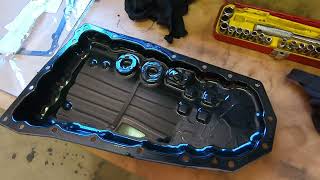
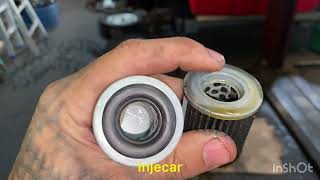
| Filter | Install a new transmission oil filter cartridge (Mitsubishi Part # 2824A012 or 2824A007). |
Warning: You must flush the external transmission cooler and lines with a transmission cooler flush solvent to remove any metal debris from the previous failure. Skipping this step will contaminate the new unit and void most warranties.
Installation "Gotchas"
Even for experienced technicians, there are several critical points to watch for during installation:
- Torque Converter Seating: The torque converter must be carefully rotated and pushed until it makes three distinct "clicks" or "thunks" as it engages the input shaft, stator, and oil pump drive. If it is not fully seated, bolting the transmission to the engine will destroy the oil pump instantly.
- Alignment Dowels: Ensure the two alignment dowel pins between the engine and transmission are present and clean. Missing or doubled-up dowels will cause severe misalignment, leading to vibration and catastrophic pump failure.
- Spline Lubrication: The splines on the AWD transfer case intermediate shaft must be cleaned and lubricated with high-pressure spline grease to prevent moisture intrusion and stripping over time.
- Fluid Level Check: The fluid level must be checked when the transmission is warm (70°C to 80°C / 158°F to 176°F) with the engine running, after cycling through all the gears. Checking it cold will result in a false reading and dangerous overfilling.
What Fails at Every Mileage Band
Pro Tip: The mileage bands below describe used replacement units of that mileage. The checklists are things to do WHILE INSTALLING the purchased transmission, not maintenance for your current transmission.
Under 60,000 Miles
Known Failures: Harsh 1-to-2 gear shifts, which are typically not a hard part failure but related to fluid condition or lost TCM adaptive calibration. While rare at this mileage, issues from the factory like improperly secured cooler line clamps on some 2015 models (though primarily documented for CVTs) could cause leaks and lead to failure if ignored.
- ✓Do during install (required): Replace all external seals (front pump/torque converter seal, axle seals).
- ✓Do during install (required): Install a new transmission oil filter cartridge and pan gasket.
- ✓Do during install (required): Perform a complete fluid exchange with certified Mitsubishi DiaQueen ATF-J3 or equivalent.
- ✓Do during install (required): Thoroughly flush the transmission cooler and lines to remove any potential debris from the donor vehicle.
60,000 - 100,000 Miles
Known Failures: Torque Converter Clutch (TCC) shudder, often felt during light acceleration or when holding speed, due to fluid breakdown and clutch lining wear. Solenoid performance issues caused by metallic debris from TCC wear clogging the fine passages in the linear solenoids, leading to harsh or delayed shifts. Fluid-related shifting complaints become more common if the initial fluid services have been skipped.
- ✓Do during install (required): All items from the 'Under 60K' band.
- ✓Cheap insurance while the engine is out: Strongly consider replacing the torque converter. It is a primary failure point due to TCC wear, and replacing it while the transmission is out is cost-effective insurance against future shudders and debris contamination.
- ✓Do during install (recommended): Inspect solenoids if the valve body is accessible, but replacement is typically only done if specific codes are present.
100,000 - 150,000 Miles
Known Failures: Increased likelihood of complete failure if fluid maintenance has been neglected. Torque converter failure becomes more probable, potentially leading to debris contaminating the entire unit. Solenoid failure causing shifting irregularities or getting stuck in gear.
- ✓Do during install (required): All items from the '60-100K' band.
- ✓Do during install (required): Replacing the torque converter with a new or quality remanufactured unit is considered mandatory at this mileage.
- ✓Cheap insurance while the engine is out: Consider replacing the full solenoid pack as a preventative measure, as their lifespan is limited and they are a common cause of failure in this mileage range.
Over 150,000 Miles
Known Failures: Failure of hard parts (clutches, planetary gears) becomes more likely, in addition to all previously mentioned issues. Wear in the valve body itself can cause pressure leaks that new solenoids cannot fix, often requiring a remanufactured unit for a reliable repair.
- ✓Do during install (required): All items from the '100-150K' band.
- ✓Do during install (recommended): A professionally remanufactured transmission with warranty is a much safer investment than a high-mileage used unit.
- ✓Cheap insurance while the engine is out: If installing a used unit, replacing the torque converter and all solenoids is highly recommended to maximize the chance of success.
Real Owner Experiences
The following table highlights real-world transmission issues reported by Mitsubishi Outlander owners across various mileage points. Note that some reports include the 4-cylinder CVT models, which share similar replacement costs but are mechanically different from the V6 W6AJA.
| Source | Mileage | What Happened | Cost |
|---|---|---|---|
| Mitsubishi Forum Canada | 35,000 miles (56,000 km) | Owner of a 2016 4-cylinder model with a CVT reported persistent hesitation issues since new. After software updates failed to fix the problem, the dealership diagnosed excessive hesitations and replaced the entire CVT under warranty. | Warranty |
| Mitsubishi Forum | ~90,000 miles | Owner of an older but similar 2007 model noticed rougher shifting and mild shuddering during upshifts. A full transmission fluid and filter replacement dramatically improved shifting performance, making it feel almost new again. | DIY Maintenance |
| CarComplaints.com | 103,550 miles | An owner of a 2016 Outlander (engine unspecified, but likely CVT) reported the transmission light came on suddenly. The dealer quoted $11,000 for a replacement just outside of the 100,000-mile warranty. | $11,000 (Quoted) |
| Reddit r/MechanicAdvice | High mileage | Transmission failed on a 2015 Outlander. A shop rebuilt it for ~$2,025, but it failed again after 600 miles due to debris clogging the filter. After a second warranty repair, the torque converter was identified as the root cause of the failure. | $2,025 (rebuild) + $525 (towing) |
| Mitsubishi Forum | 122,000 miles | Owner of a 2015 Outlander Sport (uses a CVT) experienced a transmission failure. The dealership quoted over $8,000 for a replacement. | $8,000+ (Quoted) |
| AskaLawyerOnCall | 115,000 km (~71,500 miles) | A 2016 Outlander with a CVT experienced complete failure with erratic surges and hesitation. A warranty claim was denied because a fluid change was performed at 100,000 km instead of the scheduled 90,000 km. | Not covered by warranty |
| Reddit r/MitsubishiOutlander | 250,000 km (~155,000 miles) | Owner of a 2010 V6 with the 6-speed automatic changed the transmission fluid for the first time, not due to any performance issues, but because the fluid color was starting to change. The transmission never had any problems. | Preventative Maintenance |
| 80,000 miles | 2019 Outlander owner quoted $8,900 to fix the transmission. Awaiting dealer callback regarding potential warranty coverage. | Pending | |
| 200,000 miles | 2014 Outlander Sport CVT owner quoted $8,000. Owner was considering writing the car off due to the high cost and mileage. | $0 |
Repair or Replace?
Deciding whether to repair your current transmission or replace it entirely depends on the specific failure and the extent of internal damage.
When Repair Makes Sense
- Torque Converter Clutch (TCC) Shudder / Slipping: Typical repair cost is $800 - $2,500. This is often the first major symptom. If addressed early, replacing the torque converter and flushing the fluid can prevent further damage to the transmission. A standalone torque converter replacement is significantly cheaper than a full transmission swap.
- Solenoid Failure / Valve Body Issues: Typical repair cost is $500 - $1,200. If diagnostic codes point to specific solenoids and the transmission fluid is not full of clutch material, replacing the valve body or individual solenoids can resolve shifting issues without needing a full unit.
When Replacement is Smarter
Replacement is the better option when internal mechanical failure has occurred, such as stripped gears, broken drums, or widespread clutch failure. This is indicated by loud noises, no movement, and significant metal debris in the transmission oil pan. At that point, the cost and labor to replace individual hard parts often exceed the price of a lower-mileage used unit. A full rebuild can cost between $2,500 and $6,000, making a quality used transmission (which typically runs $650 - $2,200) a more economical choice.
Questions to Ask Your Installer
Before handing over your vehicle, ensure your mechanic is prepared for this specific job by asking:
- Have you confirmed this is a W6AJA for a 3.0L V6 and not a CVT from a 4-cylinder model?
- Will you be performing a complete transmission cooler and line flush before installing the replacement?
- Do you have a Mitsubishi MUT-III or compatible J2534 tool to perform the mandatory TCM adaptive relearn procedure after installation?
- Does your quote include new axle seals, a front pump seal, and the correct Mitsubishi DiaQueen ATF-J3 fluid?
- How do you verify the torque converter is fully seated (the 'three-click' method) before mating the transmission to the engine?
- What warranty do you offer on your labor, and what is the parts warranty on the supplied transmission?
Freight & Delivery Reality

If you are ordering a used W6AJA transmission online or from an out-of-state recycler, it is important to understand how it will arrive.
- Size and Weight: This transaxle assembly weighs approximately 215 lbs and measures roughly 32" x 24" x 22" before crating.
- Shipping Method: Because of its size and weight, it ships as Less-Than-Truckload (LTL) freight on a wooden pallet. It is NOT a standard parcel delivery.
- Delivery Requirements: You will need a loading dock or a forklift to unload it. If delivering to a residential address or a small shop without this equipment, you must request and pay for liftgate service in advance.
- Inspect Before Signing: Always inspect the pallet and the transmission for damage, leaks, or missing parts (such as a cracked bellhousing or a missing torque converter) before signing the driver's delivery receipt. Once you sign, you accept it in its current condition.
- Pre-Purchase Verification: Reputable auto recyclers will conduct a verification interview before shipping. They will ask for your VIN to check that the 8th digit is 'X'. This industry best practice ensures you are getting the correct V6 transmission and not accidentally ordering a unit for a 4-cylinder CVT model.
Frequently Asked Questions (FAQ)
Can I use a transmission from a 4-cylinder Outlander?
No. The 4-cylinder models use a Continuously Variable Transmission (CVT), which is mechanically and electronically incompatible with the 6-speed automatic used in the V6 model.
Do I need to program the transmission after installation?
Yes. A "TCM Initialization & Adaptive Relearn" is mandatory. This procedure uses a dealer-level scan tool to calibrate the new transmission to the vehicle's computer. Skipping this step will lead to poor performance and likely damage the transmission.
What fluid does the W6AJA transmission use?
It requires Mitsubishi DiaQueen ATF-J3 fluid or a certified equivalent. Using any other fluid, especially CVT fluid, can cause severe damage.
Where is the transmission code on my vehicle?
The code 'W6AJA' is printed on the vehicle information placard located in the driver's side door jamb.
How long does the W6AJA transmission typically last?
With proper maintenance, the Jatco JF613E (W6AJA) transmission can reliably last between 200,000 to 250,000 miles. However, its service life is critically dependent on fluid changes. Timely fluid service every 30,000 to 60,000 miles is essential. Neglecting maintenance can lead to failure in as little as 70,000 to 100,000 miles.
How many labor hours does it take to replace this transmission?
Professional installation typically takes between 6.0 to 12.0 shop labor hours. Depending on the shop's hourly rate, this translates to roughly $900 to $2,100 in labor costs.
Helpful Videos
Technical Specifications
OEM Part Numbers: 2700A325 E1ZA E1ZB
Model Name: W6AJA; Family: Jatco JF613E; Type: 6-speed automatic transaxle; Drivetrain: All-Wheel Drive (AWD); Engine Compatibility: 3.0L V6 (VIN 8th digit 'X'); Engine Orientation: Transverse; Required Fluid: Mitsubishi DiaQueen ATF-J3; Weight: ~215 lbs; TSB: TSB-19-23-001
We Have This Part in Stock


The information in this article is provided for general reference and educational purposes only. Vehicle specifications, procedures, and part compatibility can vary by production date, trim level, and region. Always consult your vehicle's factory service manual and verify part numbers before purchasing or performing repairs. Safety-critical components such as airbags, seat belts, and braking systems should be installed by a qualified professional.
- Mitsubishi Outlander:
- 🎬 Helpful Videos
- 🛍️ Shop This Part
- Is This the Right Transmission for Your Outlander?
- Common Failure Symptoms
- Diagnostic Flowchart
- Known Issues, TSBs, and Recalls
- Torque Converter Clutch (TCC) Wear & Solenoid Issues
- Harsh 1st-to-2nd Gear Shift
- Overdrive (O.D.) Piston Failure
- TSB-19-23-001: Service Manual Correction
- Replacement Cost Estimates
- What's Included in a Used Assembly?
- Installation and Programming: Critical Steps
- Professional Installation Recommended
- Mandatory Programming
- Essential Replacement Parts & Fluids
- Installation "Gotchas"
- What Fails at Every Mileage Band
- Under 60,000 Miles
- 60,000 - 100,000 Miles
- 100,000 - 150,000 Miles
- Over 150,000 Miles
- Real Owner Experiences
- Repair or Replace?
- When Repair Makes Sense
- When Replacement is Smarter
- Questions to Ask Your Installer
- Freight & Delivery Reality
- Frequently Asked Questions (FAQ)
- 🎟️ Get 5% Off