

2014-2015 Kia Sorento 3.3L V6 Transmission: Problems, Identification, and Used Replacement
Identify common A6LF2 transaxle failures, learn when a repair makes sense, and discover what to look for when buying a used replacement unit.
- After installation, the TCM's adaptive learn values must be reset and a relearn procedure performed using a dealer-level scan tool to prevent immediate damage to the replacement unit.
- This transmission (A6LF2) only fits 2014-2015 Sorento models with the 3.3L V6 and Front-Wheel Drive (FWD); it is not compatible with AWD or 2.4L 4-cylinder models.
- Before installing a used transmission, it is critical to replace the front pump seal and axle seals, flush the cooler lines, and fill with new, genuine Hyundai/Kia SP-IV fluid.
- Specific electronic issues, such as failed shift solenoids (TSB TRA 051) or a faulty temperature sensor (TSB 043 Rev 2), can often be repaired without replacing the entire transmission.
- The torque converter must be seated in three distinct steps during installation; failure to do so will instantly destroy the transmission's front pump when bolted to the engine.
Identification: Is This the Right Transmission for Your Sorento?


The automatic transmission in the 2014-2015 Kia Sorento with the 3.3L V6 engine is a 6-speed, front-wheel drive (FWD) unit from the Hyundai/Kia A6 family, specifically the A6LF2 variant. This transmission is a transaxle, meaning it combines the transmission and differential into a single assembly for a transverse (sideways) mounted engine. Other identifying codes for this family include A6LF1 and 6F36.
Vehicle Fitment Checklist
A used transmission assembly will only fit and function correctly if it comes from a vehicle with the exact same core specifications. Before purchasing, confirm your Sorento matches the following criteria:
| Specification | Required Value |
|---|---|
| Model Years | 2014, 2015 |
| Vehicle | Kia Sorento |
| Engine | 3.3L V6 (Gasoline Direct Injection, or GDI) |
| Drivetrain | Front-Wheel Drive (FWD) |
How to Confirm on Your Vehicle
You can verify your vehicle's configuration using several identifiers:
| Method | Details |
|---|---|
| Check the VIN | The 8th digit of your Vehicle Identification Number (VIN) identifies the engine. For the 3.3L V6, this digit should be a '7'. You can find the VIN on your driver's side dashboard or door jamb sticker. |
| Check for a Rear Driveshaft | Look underneath the rear of your vehicle. If you see a long driveshaft running to the rear wheels and a differential between them, you have an All-Wheel Drive (AWD) model, and this transmission will not fit. FWD models will have none of this hardware. |
| Locate Transmission ID Tags | The most reliable method is to find the barcode label on top of the transmission case. This label will list the OEM part number, which should be 45000-3BGG0. You may also find an etched case code nearby that begins with 'BA'. |
Warning: Do not order this transmission for All-Wheel Drive (AWD) or 2.4L 4-cylinder models. The AWD version uses a different case and output to accommodate a transfer case, and the 2.4L engine uses a different transmission (A6MF2 family) with a completely different bellhousing bolt pattern. Units from other Hyundai/Kia models like the Santa Fe, Sedona, or Cadenza will not work due to different mounts, wiring, and internal programming.
Common Failure Symptoms and Diagnosis

Transmission problems can manifest in several ways, from strange noises to a complete loss of movement. Being able to recognize the signs can help you determine if the transmission is the likely cause.
Signs of a Failing Transmission
- Delayed or Harsh Shifting: The vehicle may pause before engaging a gear, or shifts may feel rough and jerky. Some owners describe a feeling of being hit from behind when the transmission finally shifts, particularly on the first 1-2 shift of the day or at low speeds (35-40 mph).
- Surging or Misfiring Sensation: A feeling of the engine surging or misfiring at steady speeds (around 40-50 mph or 60-80 km/h). Kia has acknowledged this is often related to the transmission's torque converter lockup clutch calibration.
- Shuddering or Grinding Noises: You might feel a shudder at certain speeds or hear grinding sounds during shifts.
- Transmission Fluid Leaks: Reddish fluid spots under the front of the vehicle are a clear sign of a leak. A common source is the front pump seal, located where the transmission bolts to the engine. 🎬 Watch: How to replace a leaking transmission input shaft seal
- Slipping Gears: The engine may rev higher than usual without an increase in speed, as if the gear is not fully engaged.
- Warning Lights: An illuminated Check Engine Light or Transmission Warning Light on your dashboard is a common indicator.
Confirming the Diagnosis
To confirm the transmission is faulty, a technician will use a professional scan tool to read Diagnostic Trouble Codes (DTCs) from the Transmission Control Module (TCM). Specific codes can point directly to internal issues. For example, codes like P0741, P0743, P0748, P0753, or P0758 often indicate failed shift solenoids. Codes P0711, P0712, or P0713 point to a failure of the internal transmission fluid temperature sensor. A physical inspection should also be performed to check for fluid leaks and the condition of the fluid itself.
Diagnostic Flowchart
Known Problems, Recalls, and Technical Service Bulletins (TSBs)
Several known issues affect this A6-family transmission and the Sorento platform. Always check for unrepaired recalls by entering your VIN on the NHTSA website.
Shift Solenoid Faults (TSB TRA 051 / TSBTRA051R1)
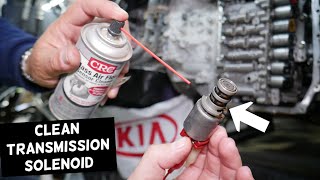
This bulletin applies to various models with the 6-speed automatic. It addresses multiple DTCs (including P0741, P0743, P0748, P0753, P0758) caused by individual shift solenoid failures. The recommended fix is to replace the specific faulty solenoids on the valve body, which can be done without removing the transmission, rather than replacing the entire unit.
Transmission Fluid Temperature (TFT) Sensor Failure (TSB 043 Rev 2)
This issue can cause DTCs P0711, P0712, or P0713. It is often due to a fault in the internal wiring harness that contains the sensor. The updated repair involves installing a revised, one-piece internal wiring harness (Part No. 46386-3B900) that integrates the sensor, which resolves the problem. This can also be done with the transmission in the vehicle.
Front Pump Seal Leaks
A widely reported issue in repair communities is the failure of the front pump/torque converter seal. This causes a significant transmission fluid leak from the bellhousing area. If not caught quickly, the resulting fluid loss can lead to catastrophic internal damage. It is highly recommended to replace this seal on any used transmission before installation.
Brake-Shift Interlock Failure (Recall 15V611000 / SC125)
This severe recall affects 2014-2015 Sorento models. The brake-shift interlock mechanism can fail, making it possible to shift the vehicle out of Park without depressing the brake pedal. This creates a dangerous rollaway risk. The remedy is for a Kia dealer to replace the faulty interlock mechanism.
Right Front Axle Shaft Fracture (Recall 13V-356 / SC099)
While this specific recall primarily targets some 2014 Sorento FWD models with the 2.4L engine, it is an important platform note. It involves inspecting the front axle integrity, as a fractured axle will result in a sudden loss of drive power.
What Fails at Every Mileage Band
Pro Tip: The mileage bands below describe the typical condition and known failures of used replacement units at that specific mileage. The checklists provided are critical steps you must take WHILE INSTALLING the purchased unit to ensure it lasts, not general maintenance advice for your current vehicle.
Under 60,000 Miles
Transmissions in this range are generally healthy, but they are not immune to early component failures. The Brake-Shift Interlock Failure (Recall 15V611000) is common here, where the gear selector gets stuck in Park. Owners also report harsh shifting, shuddering on the 1-2 shift, and a surging sensation at 40-50 mph. Transmission experts note that valve body bores can show significant wear in as few as 40,000 miles.
- ✓Do during install (required): Perform a full transmission fluid exchange with genuine Hyundai/Kia SP-IV fluid. Replace the front pump seal and both axle shaft seals.
- ✓Do during install (recommended): Upgrade the internal wiring harness to the revised one-piece design that includes an integrated TFT sensor to prevent future sensor failures (TSB 043 Rev 2).
- ✓Cheap insurance while the engine is out: Inspect the valve body for bore wear, a known issue even at low mileage.
60,000 - 100,000 Miles
This is the mileage where fluid degradation becomes critical. Symptoms like slipping, harsh shifts, and delayed gear engagement are common first signs of internal problems, often due to old fluid or low fluid levels. Diagnostic trouble codes related to specific shift solenoids (per TSB TRA 051) frequently appear in this band.
- ✓Do during install (required): Perform a full transmission fluid exchange with genuine Hyundai/Kia SP-IV fluid. A simple drain-and-fill is insufficient. Replace the front pump seal and both axle shaft seals. Upgrade the internal wiring harness to the revised one-piece design with integrated TFT sensor if not already done.
- ✓Do during install (recommended): Replace the internal transmission filter.
- ✓Cheap insurance while the engine is out: Replace the shift solenoid pack on the valve body as preventative maintenance against the common solenoid failure TSB.
100,000 - 150,000 Miles
At this mileage, especially if fluid services were missed, internal components like clutch packs and transmission bands are more likely to be worn, leading to slipping. Issues like shuddering or slipping can also originate from a failing torque converter, which may be damaged by old, contaminated fluid. Widespread shift issues become more common and severe.
- ✓Do during install (required): Perform a full transmission fluid exchange with genuine Hyundai/Kia SP-IV fluid. Replace the front pump seal, axle shaft seals, and transmission filter. Install the updated one-piece internal wiring harness/TFT sensor.
- ✓Do during install (recommended): Replace the entire valve body solenoid pack to prevent near-term shift issues.
- ✓Cheap insurance while the engine is out: Replace the torque converter if the original failure involved significant debris or shuddering complaints.
150,000+ Miles
This is the range where the transmission is approaching its expected end-of-life, and total failure from accumulated wear is common. Slipping is a primary symptom. With consistent, preventative maintenance (fluid exchanges every 30,000 to 60,000 miles), the expected service life is 200,000 to 250,000 miles. However, neglected units often fail between 150,000 and 200,000 miles. A used transmission in this mileage band is a high-risk purchase; a remanufactured unit is often safer.
- ✓Do during install (required): Perform a full transmission fluid exchange with genuine Hyundai/Kia SP-IV fluid. Replace all external seals (front pump, axles), the transmission filter, and the internal wiring harness/TFT sensor assembly. Replace the full shift solenoid pack.
- ✓Do during install (recommended): Replace the torque converter regardless of the original failure mode.
- ✓Cheap insurance while the engine is out: Install a new plastic side cover gasket when inspecting or replacing the valve body components.
Real Owner Experiences
The following table highlights real-world problems reported by 2014-2015 Kia Sorento owners, detailing the mileage at which the issue occurred and the financial impact.
| Source | Mileage | What Happened | Cost |
|---|---|---|---|
| Honest John Forums | 30,000 | During a test drive, the gear selector was stuck in Park and could not be moved without a mechanic using the manual override. This is related to the brake-shift interlock mechanism. | N/A (Dealer repair) |
| CarComplaints.com | 44,739 | Owner reported RPMs jumping and the engine lagging at consistent highway speeds, creating a sensation of the car being about to stall. The dealership could not find a fault code. | N/A |
| CarComplaints.com | 67,000 | After months of the car jerking when stopping/accelerating and getting stuck in 4th gear, the transmission failed completely. The owner had performed all required maintenance at the dealership. | $3,000 (for replacement) |
| Cars.com Consumer Review | 94,000 | Vehicle had stalling issues and metal shavings found in the engine, requiring engine replacement. | $10,000 for engine replacement |
| Reddit r/MechanicAdvice | 134,000 | While not a failure, an owner of a 2016 model (similar platform) reported the vehicle was still running solidly with no issues, highlighting the importance of maintenance. | N/A |
| 149,000 | Transmission was slipping, owner was considering replacing it. | Not specified | |
| Reddit r/MechanicAdvice | 187,000 | Owner reports that the transmission is noticeably slipping. The vehicle previously had its engine replaced under recall, making the transmission the next weak link. | N/A (seeking advice on replacement) |
| Kelley Blue Book Consumer Review | Unknown | Experienced transmission slipping. The transmission was rebuilt, then replaced, but the issue persisted. A recall was performed which temporarily helped. | Not specified |
Repair or Replace?
When facing transmission trouble, deciding whether to repair the existing unit or replace it entirely comes down to the specific failure and the overall mileage of the vehicle.
When Repair Makes Sense
- Brake-Shift Interlock Solenoid Failure: This is a minor, external repair that does not require transmission removal. Typical repair costs range from $214 to $281. It is always more economical to repair this specific part.
- Shift Solenoid Faults: If the transmission is otherwise healthy and only throwing solenoid-specific codes (e.g., P0741, P0743, P0748), the valve body can be accessed by removing the side pan. Individual solenoids cost between $60 and $105 for the part, with total repair costs between $300 and $600.
- TFT Sensor Failure: If the vehicle only has TFT sensor codes (P0711, P0712, P0713), replacing the internal wiring harness is labor-intensive but significantly cheaper than a full swap. Typical repair costs range from $600 to $1,000.
When Replacement is Smarter
Replacement is the better option when there is evidence of major internal mechanical failure, such as catastrophic gear or clutch failure, significant metal debris in the transmission pan, or multiple, non-specific trouble codes. If the cost of diagnosing and performing several smaller repairs approaches or exceeds the price of a low-mileage used unit, replacement becomes more economical. Given the high mileage of many of these vehicles, if the transmission has over 150,000 miles and starts slipping, replacement is often a more durable long-term solution.
Replacement Cost Comparison
The cost of replacing a transmission varies based on the type of part used and local labor rates. The job typically requires between 7.0 and 10.0 hours of shop time.
| Part Type | Estimated Price (Part Only) | Notes |
|---|---|---|
| New OEM | Replaced by Reman | New OEM parts (45000-3BGG0) are generally replaced by remanufactured units by the dealer. |
| Remanufactured OEM | $808 - $4,178 + Core | A factory-rebuilt unit (Part No. 450003BGG0R). Requires a significant core charge until the old transmission is returned. |
| Used OEM | $450 - $1,400 | A recycled unit from a donor vehicle. Price varies greatly with mileage and condition. |
| Installation Labor | $900 - $1,800 | Based on a labor time of 7.0 to 10.0 hours. Does not include fluids or other required consumables. |
Freight, Delivery, and Pre-Purchase Verification

Buying a used transmission assembly requires understanding how heavy freight works. This A6LF2 transmission weighs approximately 206 lbs and measures roughly 16" x 15" x 16" before crating. Because of its size and weight, it ships as LTL (Less Than Truckload) freight on a wooden pallet—it will NOT arrive as a standard parcel.
When receiving the shipment, a liftgate service is usually required to lower the pallet to the ground. You must inspect the transmission for physical damage (such as cracked bellhousings or broken sensor connectors) before signing the delivery receipt. Signing without noting damage releases the freight carrier from liability.
Pre-Purchase Verification Interview
Before buying a used unit, ask the supplier these critical questions to ensure you get the right part and a smooth installation:
- Have you confirmed this is a Front-Wheel Drive (FWD) model with the 3.3L V6 engine?
- Will you be flushing the transmission cooler and lines completely before installing the replacement unit?
- Do you have a professional, dealer-level scan tool (like Kia GDS/KDS) to perform the mandatory TCM adaptive value reset and relearn procedure after installation?
- Are you planning to replace the front pump seal and axle seals on the replacement transmission before installation?
- How do you verify the torque converter is properly seated to prevent pump damage?
- What specific brand and type of transmission fluid will you be using? (It must be Hyundai/Kia SP-IV).
- Does your quoted price include the ~8 quarts of required SP-IV fluid?
Installation and Programming: Critical Steps

Proper installation is crucial for the longevity of a replacement transmission. This is an advanced-level job that should be performed by a professional technician with the correct tools, including an engine support bar or heavy-duty transmission jack, a torque wrench, and a fluid pump or suction gun.
Warning: A mandatory programming step is required after installation. A dealer-level scan tool (like Kia GDS/KDS) must be used to reset the old transmission's adaptive learn values from the TCM. After the reset, a specific drive-cycle relearn procedure must be performed. Skipping this step will cause severe shift quality problems and can quickly destroy the replacement transmission's clutches.
Installation "Gotchas" and Best Practices
- Torque Converter Seating: The torque converter must be fully seated into the transmission's front pump. The installer must feel it drop into place three distinct times. Failure to do this will crush the pump gears when the transmission is bolted to the engine, destroying it instantly.
- Cooler and Line Flush: The transmission cooler and lines must be professionally flushed with an approved flushing agent (like Lubegard Kooler Kleen) to remove any metal debris from the previously failed unit. Re-introducing this debris will contaminate the replacement transmission and void its warranty.
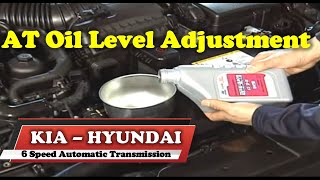
- Fluid Fill and Level Check: This transmission has no dipstick. It is filled through a plug on top, and the level is checked via an overflow plug on the side cover. This check must be done with the engine running and the transmission fluid at a specific temperature (122-140°F / 50-60°C), which must be monitored with a scan tool.
- Crankshaft Position Sensor: Located near the top of the bellhousing, this sensor is easily damaged during removal or installation of the transmission.
Pro Tip: Before installation, always replace the front pump seal, axle seals, internal oil filter, and use new, genuine Hyundai/Kia SP-IV automatic transmission fluid. Using older fluid types like SP-III or generic multi-vehicle fluids will cause damage.
Arrival Inspection for Your Used Transmission
When your used transmission arrives, inspect it closely before you spend time installing it. Catching a problem now saves you hours of wasted labor.
Check the Fluid Color and Smell
Open the fluid level check plug or drain plug to look at the leftover transmission fluid.
- Good fluid: Red, pink, or light brown.
- Bad fluid: Dark black fluid means the transmission got too hot.
Smell the fluid. If it smells like burnt toast, the internal clutches (the friction plates that change gears) are likely ruined. Do not install a transmission with burnt fluid.
Inspect the Drain Plug Magnet
The A6LF2 transmission does not have a traditional bottom pan. Instead, remove the magnetic drain plug on the bottom of the case to check for internal damage.
- A fine, dark paste on the magnet is normal wear.
- Large metal shavings, shiny metal flakes, or broken metal chunks mean the internal gears or bearings are broken. Reject the unit if you see large metal pieces.
Examine the Torque Converter Hub and Input Splines
The torque converter is the large, heavy metal bowl attached to the front of the transmission. It connects the engine power to the transmission.
Carefully pull the torque converter off the front shaft. Look at the metal tube sticking out of the back of the converter (the hub). The hub must be perfectly smooth. If it has deep scratches or grooves, it will ruin the front pump seal and cause a massive fluid leak.
Next, look at the input shaft splines. These are the metal teeth on the shaft sticking out of the transmission. The teeth must be straight and sharp. If the teeth are twisted, chipped, or worn flat, the transmission will slip or fail to move the vehicle.
Frequently Asked Questions (FAQ)
What fluid does the 2014-2015 Sorento 3.3L transmission use?
It requires Hyundai/Kia Genuine ATF SP-IV (also called SP-4). Do not use any other type of fluid like SP-III or Dexron VI. A full refill from dry requires approximately 7.8 to 8.2 quarts (7.8 Liters).
Does this transmission have a dipstick?
No, it does not have a dipstick for checking the fluid level. The level must be checked by a technician using a scan tool and the overflow plug on the side of the transmission case while the fluid is at a specific operating temperature (122-140°F / 50-60°C).
Do I need to program a used transmission?
Yes. The Transmission Control Module (TCM) stores adaptive shift data from the old unit. This memory must be cleared with a dealer-level scan tool (like Kia GDS/KDS), and a relearn procedure must be performed. Failure to do so will result in poor shifting and likely damage the replacement transmission.
What is included with a used transmission assembly?
A standard used assembly includes the transmission case, all internal parts, the extension/tail housing, the transmission oil pan, the valve body, internal solenoids, and the torque converter. It does not typically include external sensors, the external wiring harness, the Transmission Control Module (TCM), shifter linkages, cables, the flexplate/flywheel, or cooler lines. The inhibitor switch is excluded unless integrated into the internal harness.
How long should this transmission last?
With consistent, preventative maintenance—specifically performing a complete fluid exchange every 30,000 to 60,000 miles—the expected service life for the A6LF2 transmission is approximately 200,000 to 250,000 miles. Neglecting fluid changes drastically reduces this lifespan.
Can I use a transmission from a 2.4L Sorento?
No. The 2.4L 4-cylinder models use a completely different transmission family (A6MF2) which has a different bellhousing bolt pattern and will not bolt up to the 3.3L V6 engine.
Helpful Videos


Technical Specifications
OEM Part Numbers: 45000-3BGG0 450003BGG0R
Family: Hyundai/Kia A6; Variant: A6LF2; Type: 6-Speed Automatic Transaxle; Drivetrain: Front-Wheel Drive (FWD); Engine Compatibility: 3.3L V6 GDI; Weight: ~206 lbs; Fluid Type: Hyundai/Kia SP-IV; Fluid Capacity: ~7.8-8.2 quarts
We Have This Part in Stock


The information in this article is provided for general reference and educational purposes only. Vehicle specifications, procedures, and part compatibility can vary by production date, trim level, and region. Always consult your vehicle's factory service manual and verify part numbers before purchasing or performing repairs. Safety-critical components such as airbags, seat belts, and braking systems should be installed by a qualified professional.
- Kia Sorento:
- 🎬 Helpful Videos
- 🛍️ Shop This Part
- Identification: Is This the Right Transmission for Your Sorento?
- Vehicle Fitment Checklist
- How to Confirm on Your Vehicle
- Common Failure Symptoms and Diagnosis
- Signs of a Failing Transmission
- Confirming the Diagnosis
- Diagnostic Flowchart
- Known Problems, Recalls, and Technical Service Bulletins (TSBs)
- Shift Solenoid Faults (TSB TRA 051 / TSBTRA051R1)
- Transmission Fluid Temperature (TFT) Sensor Failure (TSB 043 Rev 2)
- Front Pump Seal Leaks
- Brake-Shift Interlock Failure (Recall 15V611000 / SC125)
- Right Front Axle Shaft Fracture (Recall 13V-356 / SC099)
- What Fails at Every Mileage Band
- Under 60,000 Miles
- 60,000 - 100,000 Miles
- 100,000 - 150,000 Miles
- 150,000+ Miles
- Real Owner Experiences
- Repair or Replace?
- When Repair Makes Sense
- When Replacement is Smarter
- Replacement Cost Comparison
- Freight, Delivery, and Pre-Purchase Verification
- Pre-Purchase Verification Interview
- Installation and Programming: Critical Steps
- Installation "Gotchas" and Best Practices
- Arrival Inspection for Your Used Transmission
- Check the Fluid Color and Smell
- Inspect the Drain Plug Magnet
- Examine the Torque Converter Hub and Input Splines
- Frequently Asked Questions (FAQ)
- 🎟️ Get 5% Off