

2019 Jeep Renegade 1.3L Turbo 4x4 Transmission: Problems, Identification, and Used Replacement
Identify the exact 948TE transaxle for your 1.3L Renegade, learn what causes it to fail, and know what to look for when buying a used replacement.
- Verify your vehicle is a 2019 Jeep Renegade with the 1.3L Turbo engine and 4x4 drivetrain, as transmissions from other models, engines, or drivetrain configurations are not compatible.
- A replacement transmission requires mandatory post-installation programming, including a PROXI Alignment and Quick Learn procedure, using a dealer-level scan tool.
- You must use the correct fluid, Mopar ZF 8 & 9 Speed ATF (P/N 68218925AB) or ZF LifeguardFluid 9, as incorrect fluid will cause shifting problems and internal damage.
- The case-mounted heat exchanger (transmission cooler) must be replaced or professionally flushed during installation to prevent debris from the old unit from contaminating and destroying the replacement.
Is This the Right Transmission for Your Jeep?


The 2019 Jeep Renegade with the 1.3L Turbo engine and 4x4 uses a specific version of the Chrysler 948TE nine-speed automatic transmission, also known by its manufacturer name, the ZF 9HP48. This is a transaxle, meaning it combines the transmission and differential into a single unit for a transverse (sideways-mounted) engine. Getting the correct used unit is critical, as many similar-looking transmissions will not work.
Confirming Your Vehicle's Build
Before ordering a replacement, verify your Renegade has the correct engine and drivetrain with these checks:
- Check the VIN: The 8th character of your Vehicle Identification Number (VIN) should be a "1" or "E", which identifies the 1.3L Turbo engine.
- Look Under the Hood: The engine cover should clearly state "1.3L MultiAir Turbo".
- Verify Drivetrain: Confirm your Renegade is a 4x4 model. The easiest way is to look underneath the vehicle for a rear driveshaft running to the rear wheels.
- Transmission ID Tag: For absolute certainty, you can find an identification tag or barcode sticker on the transmission case itself. It is often located on top of the case, underneath the shifter cable bracket and PCM.
Warning: This transmission is ONLY for the 2019 Jeep Renegade with the 1.3L Turbo engine and 4x4 (AWD) system. It is not interchangeable with transmissions from other vehicles.
What Will NOT Fit?
The Chrysler 948TE / ZF 9HP48 transmission family is used in many other vehicles, but they are NOT compatible. Do not use a transmission from:
- Renegades with the 2.4L engine: These have a different bellhousing bolt pattern to mate with the larger engine.
- Front-Wheel Drive (FWD or 4x2) Renegades: The FWD transaxle case lacks the necessary mounting points and output for the Power Transfer Unit (PTU), which sends power to the rear wheels in a 4x4 system.
- Other FCA vehicles (Jeep Cherokee, Jeep Compass, Chrysler Pacifica, Fiat 500X, Ram ProMaster City, Chrysler 200): Even if they use a 948TE transmission, they have different internal gear ratios, final drive codes, and crucial software calibrations in the valve body and Transmission Control Module (TCM). Installing one will result in shifting problems and error codes.
Common Failure Symptoms

The 9-speed transmission in the Renegade is known for performance complaints that can sometimes be resolved with software updates, but other symptoms point to a definite hardware failure. Watch for:
- Sudden Loss of Power: A catastrophic internal failure, such as a broken weld, can cause a complete loss of movement.
- Unexpectedly Shifting to Neutral: This dangerous condition can be caused by a faulty internal wiring harness.
- Harsh or Jerky Shifting: Owners report clunky, rough, or delayed gear changes. While sometimes a software issue, it can also indicate internal wear or valve body problems.
- Hesitation and Shuddering: A feeling of hesitation during acceleration or a shuddering sensation can point to issues with the torque converter or internal clutches.
- Check Engine Light: Specific trouble codes related to gear ratios (e.g., P0731), torque converter clutch performance (P1DB7-00), or loss of communication with the TCM can indicate an internal fault.
- Fluid Leaks: Leaks from the case seals or axle seals are a clear sign of a problem.
Diagnostic Flowchart
Known Issues, Recalls, and Technical Service Bulletins (TSBs)
Several factory communications address known problems with this transmission family. Always check with a dealer using your VIN to see if any recalls or warranty extensions apply to your specific vehicle.
| ID | Subject | Summary |
|---|---|---|
| NHTSA Recall 18V-492 (FCA U85) | Transmission Carrier Weld Failure | A small number of 2018-2019 models were recalled for an incomplete weld that could cause a sudden loss of power. The remedy was a complete transmission replacement. |
| NHTSA Recall 16V-529 | Unexpected Shift to Neutral | Primarily affecting 2015 models, this addressed insufficient wire harness crimps. The fix involved a software update and possible harness replacement. |
| TSB 21-040-25 | Torque Converter Clutch Performance (DTC P1DB7-00) | Applies to 2019-2023 models for premature reaction shaft bushing wear. The fix involves inspection and a potential service kit installation. |
| TSB 21-002-18 | Erratic Shifting & DTCs | Addresses general poor shift quality complaints by reprogramming the TCM with updated software, followed by a Quick Learn procedure. |
| TSB 21-040-20 | Transmission Case Oil Leak | Addresses potential oil leaks by tightening lower transmission bolts to updated torque specifications. |
What Fails at Every Mileage Band
Pro Tip: The mileage bands below describe what typically fails on USED replacement units at these mileages. The checklists provided are things you must do WHILE INSTALLING the purchased transmission, not maintenance for your current transmission.
Under 60,000 Miles
Transmissions in this range generally suffer from software-related issues causing harsh shifting, jerky behavior, or hesitation between gears. Early models may also be affected by NHTSA Recall 18V-492 (carrier weld failure) or NHTSA Recall 16V-529 (faulty wire harness crimps). TSB 21-040-25 (reaction shaft bushing wear) and TSB 21-040-20 (oil leaks) are also relevant here.
- ✓Do during install (required): Ensure all TCM software updates and relevant TSBs/recalls have been performed.
- ✓Do during install (recommended): Replace axle seals and the torque converter input shaft seal. Thoroughly flush or replace the case-mounted heat exchanger (transmission cooler) to prevent contamination.
- ✓Cheap insurance while the engine is out: Replace transmission mounts if they show any signs of wear or cracking.
60,000 - 100,000 Miles
In this band, there is an increased likelihood of shifting problems (harshness, hesitation) if the fluid has not been changed. Valve body failures become a common repair for shifting issues that are not resolved by software updates. Wear on internal components accelerates if the vehicle was subjected to severe use (towing, frequent stop-and-go) without fluid service.
- ✓Do during install (required): Perform a transmission fluid service with the correct Mopar ZF 8 & 9 Speed ATF or ZF LifeguardFluid 9.
- ✓Do during install (recommended): Replace all external seals (axle, torque converter). Flush or replace the transmission cooler.
- ✓Cheap insurance while the engine is out: Inspect and replace transmission mounts and driveshaft hardware (bushings, U-joints) if worn.
100,000 - 150,000 Miles
With proper maintenance, the Jeep Renegade transmission is reported to last between 100,000 and 150,000 miles. However, there is a higher potential for internal mechanical failure in this range, especially if maintenance has been neglected. Valve body and solenoid issues become more common, and complete transmission failure requiring replacement is more likely.
- ✓Do during install (required): Complete fluid change using approved fluid. Replace the case-mounted heat exchanger (cooler) rather than attempting to flush it, due to the high risk of trapped contaminants.
- ✓Do during install (recommended): Replace all external seals and mounts as a preventative measure.
- ✓Cheap insurance while the engine is out: Inspect the PTU splines for wear and grease them with high-pressure spline grease upon reassembly.
Over 150,000 Miles
While some owners report reaching over 200,000 miles, transmissions over 150,000 miles have an increased probability of requiring a complete rebuild or replacement. Failures related to internal clutches and mechanical parts become more prominent than electronic or hydraulic issues. Component fatigue failures, such as bearings and internal seals, are common.
- ✓Do during install (required): Mandatory fluid service with the correct fluid. Replace the transmission cooler, all external seals, and all mounts.
- ✓Do during install (recommended): Assume the unit has significant wear. Replace all accessible external components as a rule.
- ✓Cheap insurance while the engine is out: Carefully inspect the flexplate for cracks and the torque converter for any signs of damage before installation.
Real Owner Experiences
The following table highlights real-world experiences from Jeep Renegade owners regarding their 9-speed transmissions.
| Source | Mileage | What Happened | Cost |
|---|---|---|---|
| CarComplaints | 800 | While driving at 70 MPH, the car began jerking and would not accelerate. After exiting the freeway, the car stopped moving, although the engine remained on. | Not specified |
| 45,000 | Owner describes the transmission as a 'terrible design' and the only real issue with the vehicle, experiencing clunking and jerking on occasion. | Not specified | |
| CoPilot | 16,000 | Report of clutch plate disintegration within the housing, making the vehicle inoperable. | Not specified |
| 95,702 | Owner reports repeated problems with the transmission not shifting properly on an intermittent basis since purchasing the car with 50,000 miles. | Not specified | |
| Just under 100,000 | Owner of a 2015 model notes no major issues but is critical of the cargo space and gas mileage. | N/A | |
| 117,000 | Owner of a 2016 model considers the car reliable with regular maintenance, though some electrical glitches were noted and addressed. | Not specified | |
| 145,000 km (approx. 90,000 miles) | Owner of a 2015 2.4L model reports no problems but does not feel great about the long-term prospects. | N/A | |
| 190,000 | Owner reports the transmission still shifts smoothly, despite the dealer stating the fluid was 'lifetime'. | N/A | |
| Over 200,000 | Owner of a 2016 Trailhawk had no transmission problems, only performing regular oil changes and tire replacements. | N/A | |
| 206,000 | Owner of a 2015 Trailhawk had to replace the 'transmission computer chip thingie' among other non-transmission repairs like the starter and motor mounts. | Not specified | |
| N/A (2020 model) | Owner experienced klunking, jerking, and refusal to shift above 70mph. Dealer reset the computer multiple times with minimal improvement. | N/A | |
| N/A | Another owner reported a noticeable 'pop' when shifting into 5th gear, which was resolved by changing the transmission fluid. | $199 - $256 | |
| LembergLaw | 30,000 | An owner reported that after six months of buying a used 2019 model, the vehicle refused to start properly, sometimes taking 20 minutes. The vehicle was taken to the dealer four times for this issue. | N/A |
Repair or Replace?
When facing transmission issues, deciding whether to repair your current unit or replace it entirely depends on the specific failure and the vehicle's mileage.
When Repair Makes Sense
- Software Issues ($100 - $250): Erratic or harsh shifting is often a software issue. This is the first step for any shifting complaint, as software updates and a Quick Learn procedure can often resolve the issue without hardware replacement.
- External Leaks ($200 - $800): If the transmission is otherwise functioning correctly, replacing leaking axle seals or addressing gasket leaks is far cheaper than a full replacement.
- Faulty Solenoids or Valve Body ($400 - $1,800): If software updates do not fix the problem and diagnostic trouble codes point to a specific solenoid or the valve body, replacement can be a cost-effective repair, especially on lower-mileage vehicles.
When Replacement is Smarter
Replacement with a used or remanufactured unit is the recommended path when there is evidence of internal mechanical damage (like metal debris in the fluid), multiple clutch pack failures, or issues related to the transmission case itself. For high-mileage vehicles (over 150,000 miles), the economics often favor replacement over a rebuild, as other original components are likely nearing the end of their service life. Given the complexity of the 948TE and the special tools required, swapping in a verified used unit or a quality remanufactured unit with a warranty is often more reliable than a local shop rebuild.
Questions to Ask Your Installer
Before handing over your vehicle, ask your mechanic these critical questions:
- Do you have a dealer-level scan tool (like wiTECH 2.0, Autel MaxiSYS, or Launch) to perform the mandatory PROXI alignment, VIN programming, and Quick Learn procedures?
- Are you experienced specifically with the ZF 9-speed/Chrysler 948TE transmission family?
- How will you verify the torque converter is fully seated before installation to prevent pump damage?
- Will you be flushing the transmission cooler lines and replacing the case-mounted heat exchanger, or just flushing it?
- What specific brand and part number of transmission fluid will you be using? (It should be Mopar ZF 8 & 9 Speed ATF or ZF LifeguardFluid 9).
- Does your quoted price include the cost of the specialized fluid, seals, and the labor for the required programming and adaptation drive cycle?
- What warranty do you offer on your labor and the replacement unit?
Replacement Cost Estimates
The cost to replace a 948TE transmission can vary significantly based on the type of replacement unit you choose. These estimates reflect the potential range of costs.
| Item | Estimated Cost (USD) | Notes |
|---|---|---|
| New OEM | $4,800 - $6,100+ | A brand new unit from a Mopar dealer. |
| Remanufactured OEM | $4,000 - $7,000 (Installed) | A unit rebuilt to factory specifications, often including a warranty. Price typically includes installation. |
| Used OEM | $1,100 - $1,600+ | A unit from a recycled vehicle. Prices vary with mileage and condition. |
| Installation Labor | $1,000 - $2,400+ | Shop labor rates vary. The job takes between 7.5 and 12+ hours. |
Installation: Critical Steps & Common Mistakes

Installing this transmission is an expert-level job. Several steps are absolutely critical for success and to avoid damaging the replacement unit.
Required Programming & Special Tools
This is not a simple plug-and-play swap. Post-installation programming is mandatory.
- Special Tools: The job requires an engine support bar, a transmission jack, a special dipstick tool (Mopar P/N 10323A or 2064600210) to check the fluid level, and a bi-directional scan tool like the dealer's wiTECH 2.0, Autel MaxiSYS, or Launch.
- Programming: After installation, a technician must perform a PROXI Alignment to sync the transmission with the vehicle's other computers, followed by a Transmission Quick Learn procedure. Finally, an Adaptation Drive Learn must be completed to ensure smooth shifting. Skipping these steps will result in poor performance and error codes.
Warning: Failure to properly seat the torque converter before bolting the transmission to the engine will crack the internal oil pump, destroying the transmission. The converter must be carefully rotated until it drops into place three distinct times.
Common Buyer & Installer Mistakes
- Using the Wrong Fluid: This transmission requires a specific fluid: Mopar ZF 8 & 9 Speed ATF (P/N 68218925AB / 68157995AB) or an approved equivalent like ZF LifeguardFluid 9. Using standard ATF+4 or generic multi-vehicle fluid will cause damage.
- Skipping Programming: The Quick Learn and PROXI Alignment procedures are not optional.
- Contaminated Cooler: The case-mounted heat exchanger (transmission cooler) must be professionally flushed with transmission cooler-line flush solvent or replaced. If the old transmission failed internally, metal debris in the cooler will circulate into the replacement unit and destroy it.
- Ignoring Mounts: Worn or broken engine and transmission mounts can cause harsh clunking noises that are often mistaken for an internal transmission problem. Always inspect and replace them as needed.
- Powertrain Removal: Official procedures may call for removing the entire engine and transmission assembly as a single unit. The battery, battery tray, and computer modules must be removed to access the top transmission mount and bellhousing bolts.
Pro Tip: The transmission fluid level check is highly sensitive to temperature. It must be checked using a scan tool to monitor the fluid temperature, which must be between 122°F and 140°F (50°C to 60°C).
Freight & Delivery Reality

A used 2019 Renegade 1.3L 4x4 transmission assembly is a heavy and bulky item that ships via LTL (Less Than Truckload) freight on a pallet, not as a standard parcel. Typical measurements are:
- Weight: Approximately 189 lbs (before crating)
- Dimensions: Roughly 14" x 20" x 18" (before crating)
Because it ships on a pallet, you will need a commercial address with a forklift or loading dock, or you must request liftgate service for residential delivery. Always inspect the transmission carefully before signing the delivery receipt. Look for any damage to the case, sensors, or pan that may have occurred during transit. A reputable supplier will also conduct a pre-purchase verification interview to ensure you are buying the exact correct unit for your 1.3L 4x4 Renegade.
Frequently Asked Questions (FAQ)
Can I use a transmission from a Jeep Compass or Fiat 500X?
No. While those vehicles also use the ZF 9-speed transmission family, they have different software, gear ratios, and case designs that make them incompatible with the 1.3L 4x4 Renegade.
Do I have to program the replacement transmission?
Yes, programming is mandatory. A process called PROXI Alignment is needed to make the vehicle's computers recognize the new transmission, and a Quick Learn procedure is required to calibrate the shift points.
What fluid does the 948TE transmission use?
You must use Mopar ZF 8 & 9 Speed ATF (Part# 68218925AB / 68157995AB) or another fluid that explicitly meets the ZF LifeguardFluid 9 specification. Using the wrong fluid will lead to shifting problems and premature failure.
Can I service the transmission filter?
No. The main filter for the 948TE is internal and cannot be accessed or replaced without completely disassembling the transmission case. Fluid changes are your only maintenance option.
How often should I change the transmission fluid?
While Chrysler may market the fluid as 'lifetime' in the US, ZF (the manufacturer) recommends a fluid change every 150,000 km (approx. 93,000 miles) under normal conditions. Many mechanics recommend changing it every 30,000 to 60,000 miles to prevent shifting issues and extend the transmission's lifespan.
Helpful Videos
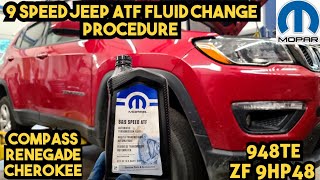

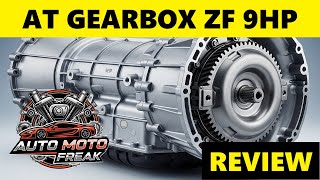
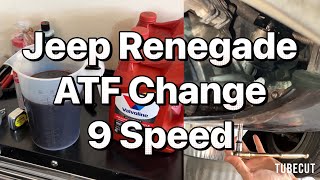
Technical Specifications
OEM Part Numbers: 68218925AB 68157995AB
Name: Chrysler 948TE / ZF 9HP48; Type: 9-Speed Automatic Transaxle; Application: 2019 Jeep Renegade 1.3L Turbo 4x4; Engine VIN Code: 8th character is '1' or 'E'; Required Fluid: Mopar ZF 8 & 9 Speed ATF or ZF LifeguardFluid 9; Weight: Approx. 189 lbs; Dimensions: Approx. 14" x 20" x 18"
We Have This Part in Stock


The information in this article is provided for general reference and educational purposes only. Vehicle specifications, procedures, and part compatibility can vary by production date, trim level, and region. Always consult your vehicle's factory service manual and verify part numbers before purchasing or performing repairs. Safety-critical components such as airbags, seat belts, and braking systems should be installed by a qualified professional.
- Jeep Renegade:
- 🎬 Helpful Videos
- 🛍️ Shop This Part
- Is This the Right Transmission for Your Jeep?
- Confirming Your Vehicle's Build
- What Will NOT Fit?
- Common Failure Symptoms
- Diagnostic Flowchart
- Known Issues, Recalls, and Technical Service Bulletins (TSBs)
- What Fails at Every Mileage Band
- Under 60,000 Miles
- 60,000 - 100,000 Miles
- 100,000 - 150,000 Miles
- Over 150,000 Miles
- Real Owner Experiences
- Repair or Replace?
- When Repair Makes Sense
- When Replacement is Smarter
- Questions to Ask Your Installer
- Replacement Cost Estimates
- Installation: Critical Steps & Common Mistakes
- Required Programming & Special Tools
- Common Buyer & Installer Mistakes
- Freight & Delivery Reality
- Frequently Asked Questions (FAQ)
- 🎟️ Get 5% Off