

2017-2019 Ford Escape 1.5L 4WD Transmission: Problems, Identification, and Used Replacement
Identify the exact 6F35 Gen 2 transaxle, understand its common failure points, and learn what to look for when buying a used replacement unit.
- Programming the 13-digit Solenoid Body Strategy code from the replacement transmission into the vehicle's computer is mandatory to prevent immediate and severe damage.
- Thoroughly flushing the transmission cooler and lines or replacing the cooler entirely is essential to remove metal debris from the old unit and prevent repeat failure.
- Before purchasing, you must verify the part number (GV6P-7000-BA, GV6P-7000-RA, or GV6Z-7000-B) and confirm your Escape is the 1.5L AWD model.
- The torque converter must be fully seated (3 distinct clicks) before installation to avoid breaking the front pump, and all external seals must be replaced.
- Use only Motorcraft MERCON LV fluid (approx. 9 quarts) and check the level via the side standpipe with the fluid at 185°F to 200°F, as there is no dipstick.
Is This the Right Transmission for Your 2017-2019 Escape?


The 2017-2019 Ford Escape with a 1.5L EcoBoost engine and All-Wheel Drive (AWD) or 4-Wheel Drive (4WD) uses a specific version of the Ford 6F35 (Generation 2) automatic transaxle. A transaxle is a single unit that combines the transmission and differential, common in front-wheel and all-wheel drive vehicles. Getting the exact match is critical, as other versions will not fit or function.
Use these steps to confirm this is the correct unit for your vehicle:
| Verification Method | Details |
|---|---|
| Check the VIN | The 8th digit of your Vehicle Identification Number (VIN) must be 'D', which designates the 1.5L EcoBoost engine. |
| Verify Drivetrain | Confirm your Escape is AWD/4WD. You can do this by looking for rear axle shafts connected to the rear wheels or by checking for an "Intelligent 4WD" display on your dashboard. |
| Read the Door Jamb Sticker | On the driver's side door jamb, find the Federal Safety Certification Label. The code under 'TR' (for Transmission) should be 'W' or '6'. |
| Match the Part Number | The most definitive check is to find the white barcode sticker on top of the transmission case itself, often near the shifter cable bracket. The part number prefix should be GV6P-7000-BA, GV6P-7000-RA, or the service part number GV6Z-7000-B. |
What Will NOT Fit?
The 6F35 transmission family was used in many Ford vehicles, but they are not interchangeable. Do not attempt to use a transmission from:
- A Front-Wheel Drive (FWD) Escape: FWD units lack the necessary connections for the Power Take-off Unit (PTU), also known as the transfer case, which sends power to the rear wheels.
- An Escape with a 2.0L or 2.5L Engine: The bellhousing bolt patterns, which connect the engine to the transmission, are completely different.
- Other Ford Models (Fusion, Focus, Edge, MKC, etc.): Even if they have a 6F35 transmission, the mounting points, wiring, internal gear ratios, and calibrations are different. 🎬 Watch: How to program the transmission solenoid strategy
Common Failure Symptoms

A failing 6F35 transmission often gives clear warning signs. If you experience the following, the transmission may be at fault:
- Harsh or Erratic Shifting: The vehicle may bang into gear, hesitate, or shift at the wrong times.
- Slipping Between Gears: The engine may rev up, but the vehicle doesn't accelerate as it should, as if it's briefly in neutral.
- Delayed Engagement: When shifting from Park to Drive or Reverse, there is a long pause before the gear engages, often with a clunk.
- Whining or Grinding Noises: A whining noise that changes with engine RPM can indicate a failing internal fluid pump. 🎬 Watch: Common 6F35 transmission failure symptoms explained
- Burnt Transmission Fluid: The fluid on the dipstick (or checked at the fill plug) may look dark and have a burnt smell, indicating overheating and internal damage.
Pro Tip: Some issues, like a clunking noise during low-speed turns, may not be the transmission itself but rather a software issue in the Powertrain Control Module (PCM) affecting the rear drive unit. Ford issued Technical Service Bulletin TSB 20-2165 for this, which is fixed by a simple PCM reprogram.
Diagnostic Flowchart
Known Problems, Recalls, and Technical Service Bulletins (TSBs)
This specific transmission has several well-documented issues. When buying a used unit, be aware of these potential problems and ensure the necessary fixes have been applied.
Shift Cable Bushing Degradation (Recall)
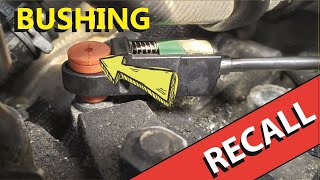
- Issue: The bushing that connects the shifter cable to the transmission can degrade and detach. This can cause a dangerous situation where the driver moves the shifter to Park, but the transmission remains in another gear, creating a rollaway risk.
- Documents: NHTSA Recall 22V-413 / Ford Recall 22S43.
- Affected Years: 2013–2019 Ford Escape models.
- Remedy: Ford dealers will replace the shift cable bushing and install a protective cap free of charge.
Flexplate Cracking
- Issue: The flexplate, a metal disc connecting the engine to the torque converter, can crack. This typically causes a rattling or grinding noise, especially at idle in gear. If it fails completely, it can damage the transmission's front pump and torque converter.
- Document: Ford Customer Satisfaction Program 22N12.
- Affected Years: 2015–2018 models.
- Remedy: Under the program, dealers inspect the flexplate and, if cracked, replace it along with the torque converter and transmission fluid pump.
Harsh Shifting and Internal Wear
- Issue: Wear inside the valve body, specifically in the solenoid regulator valve bores, can cause harsh shifting, slipping, and delayed gear engagement.
- Documents: TSB 18-2244, TSB 19-2195, TSB 20-2129.
- Affected Years: 2017-2019.
- Remedy: The fix involves addressing the wear in the valve body or replacing faulty solenoids.
Torque Converter Overheating
- Issue: The torque converter clutch (TCC) can degrade, causing the transmission to overheat and sending damaging metallic debris throughout the unit.
- Document: Ford Customer Satisfaction Program 20B27.
- Affected Years: 2017-2019.
- Remedy: The initial fix is a powertrain control module reprogram to better manage the TCC lockup strategy. If wear has already occurred, the torque converter must be replaced to prevent metal debris contamination.
Axle Seal Leaks
- Issue: The left-side half-shaft (axle) seal is known to develop minor leaks.
- Affected Years: 2017-2019.
- Remedy: Replace axle seals during installation.
What Fails at Every Mileage Band
Pro Tip: The mileage bands below describe the typical condition of USED replacement units at that mileage. The checklists provided are critical steps to perform WHILE INSTALLING the purchased transmission, not maintenance advice for your current failing unit.
Under 60,000 Miles
Some transmissions have experienced total failure well before 60,000 miles, sometimes with no warning. In some cases, this has been attributed to planetary gear sets coming apart, causing catastrophic damage to the case. Torque converter shudder, presenting as a hesitation or RPM fluctuation between 35-40 mph, can appear at this mileage. Failures have been reported as early as 42,000 miles, requiring a full rebuild or replacement under warranty. Additionally, the well-documented engine coolant intrusion issue on 1.5L and 2.0L EcoBoost engines can occur between 40,000 and 80,000 miles, which, while not a transmission problem, can lead to a major powertrain repair decision.
- ✓Do during install (required): Replace all external seals (axle seals, PTU compression seal) and the torque converter/front pump seal.
- ✓Do during install (recommended): Perform a complete transmission cooler flush using a dedicated cleaning product or replace the cooler entirely to remove any potential debris from the previously failed unit.
- ✓Cheap insurance while the engine is out: Consider a 'triple drain and fill' of the new unit with fresh MERCON LV fluid before installation to ensure it has 100% clean fluid, as even used units can have old fluid.
60,000 - 100,000 Miles
This range is a common window for transmission failure, often manifesting as slipping, rough shifting, or an inability to engage gears. Failures around this mileage are frequently attributed to issues with the torque converter, valve body, solenoids, or the internal fluid pump. Some owners report needing a full transmission rebuild or replacement around 70,000-80,000 miles.
- ✓Do during install (required): Replace all items from the 'Under 60K' band (all external seals, cooler flush/replacement).
- ✓Do during install (recommended): Carefully inspect the flexplate for cracks (related to Ford's Customer Satisfaction Program 22N12) before mating the transmission.
- ✓Cheap insurance while the engine is out: Given the mileage, it is wise to replace the OD/Direct drum, the tower support for the drum, the pump, and the input shaft if rebuilding, as these are known weak points. When installing a used unit, these are risks you accept.
100,000 - 150,000 Miles
This is a very common mileage for complete transmission failure, often with little warning. Failures often involve internal components like the pump, which can fail due to fluid breakdown over time, leading to a whining noise followed by loss of engagement. Reports of slipping, harsh shifting, and complete failure are frequent in this mileage range.
- ✓Do during install (required): Follow all recommendations for the lower mileage bands (seals, cooler flush/replacement).
- ✓Do during install (recommended): Replace the torque converter with a new or quality remanufactured unit. The old converter is a primary source of debris that can destroy a replacement transmission.
- ✓Cheap insurance while the engine is out: At this mileage, installing a used transmission carries significant risk. A remanufactured unit with updated parts and a warranty is a more reliable long-term solution.
Over 150,000 Miles
Survival to this mileage is possible but less common without at least one major repair or diligent maintenance. Failures at this stage are typically due to accumulated wear and tear on clutches, solenoids, and the torque converter. A user reported complete, un-warned failure at 165,000 miles, choosing to scrap the car rather than pay for a $6,000 repair.
- ✓Do during install (required): A used transmission with over 150,000 miles is a very high-risk purchase. If proceeding, all seals, a new torque converter, and a new external cooler are essential, not optional.
- ✓Do during install (recommended): At this mileage, purchasing a remanufactured transmission with a multi-year warranty is the most financially sound decision to avoid repeat failures.
- ✓Cheap insurance while the engine is out: N/A. Focus on the required replacements above.
Real Owner Experiences
| Source | Mileage | What Happened | Cost |
|---|---|---|---|
| CarComplaints.com | 54,354 | Total transmission failure due to metal debris, requiring replacement. | Not specified, but replacement was recommended over repair. |
| 50,000 | Catastrophic failure where planetary gears blew a hole through the transmission case. | Not specified. | |
| CarComplaints.com | 58,283 | Complete and sudden transmission failure while driving with no prior symptoms. | $9,500 for a remanufactured unit replacement. |
| 42,000 | First transmission failure, which was rebuilt under warranty. The second failure on the same vehicle occurred at 122,000 miles. | Warranty repair (first failure). | |
| 73,000 | Transmission began to shudder between 2nd and 3rd gear and required a rebuild. | ~$2,800 (rebuilt by independent shop). | |
| 81,000 | Transmission failed, requiring a full replacement. | $7,581+tax (dealer quote for replacement). | |
| 79,000 | After going over a bump, the car would no longer go into gear and displayed a 'Transmission Fault Service Now' message, leading to a tow. | Not specified. | |
| 97,000 | Transmission required replacement. | Not specified. | |
| CarComplaints.com | 121,000 | Complete transmission failure after a recent dealership inspection. | Not specified, but owner mentioned open lawsuits. |
| 124,000 | Transmission failed; 3rd gear was 'neutraling out'. | $5,677 (independent shop replacement). | |
| 105,000 | Transmission required a rebuild (this was after the engine block was replaced at 60k miles). | Not specified. | |
| CarComplaints.com | ~100,000 | Transmission went bad, requiring replacement. The owner noted that fluid may have slowly seeped out of the top vent cap over the life of the vehicle. | Not specified. |
| 120,000 | Transmission went out, owner considering options due to still owing on the vehicle loan. | Not specified. | |
| 154,000 | Transmission failure. | $7,500 (dealer quote, part was on backorder). | |
| CarComplaints.com | 165,000 | Complete transmission failure without warning. Fluid had been changed at 125k. | $6,000 (repair quote). |
| 170,000 | Owner reported zero transmission problems, attributing longevity to flushing the transmission every 60k miles. | $0 (preventative maintenance). | |
| ~75,000 | Undecided, seeking less costly options. | $7,800 for a factory rebuilt unit (3-year warranty) or $6,800 for a used unit (1-year warranty), including parts, labor, and taxes. | |
| ~80,000 | Seeking a second opinion. | $7,845.77 for a remanufactured transmission replacement. Parts: ~$5,200, Labor: ~$2,200. | |
| CarComplaints.com | 58,283 | Took the car to AAMCO for repair. | Between $3,000 and $5,000 |
| CarComplaints.com | Not specified | Awaiting repair. | $6,900 for a new or rebuilt transmission from the dealership. |
| 139,000 | Another user commented they paid $4,300 for a full remanufactured transmission installation from an independent shop after being quoted $9,000 by Ford. | $4,029 to replace the torque converter, valve body, and transmission solenoid at the dealership. | |
| 81,000 | Replaced the transmission. | Roughly $6,000 |
Repair or Replace?
The expected service life of the 6F35 transmission in a 2017-2019 Ford Escape is highly variable and heavily dependent on maintenance. Many owners experience significant problems or outright failure between 70,000 and 120,000 miles. With routine fluid changes every 30,000-60,000 miles, a lifespan of 150,000 to 200,000 miles is considered achievable. However, newer models (post-2013) are generally considered less likely to reach very high mileage (250,000-300,000 miles) compared to older Escapes.
The single most critical factor in 6F35 longevity is the transmission fluid. Ford's official 150,000-mile service interval is widely considered far too long by independent technicians. The fluid breaks down, darkens, and loses its lubricating properties much sooner, often looking nasty by 30,000-50,000 miles. Proactive owners and technicians strongly recommend a drain-and-fill or a full fluid exchange every 30,000 to 60,000 miles. This regular service is the 'cheap insurance' that helps prevent premature wear of the valve body, torque converter, and internal pump, which are the most common points of failure.
When Repair Makes Sense
- Flexplate Cracking (CSP 22N12): This repair almost always makes sense if the rest of the transmission is healthy, especially if covered under Ford's Customer Satisfaction Program 22N12. The program covers the flexplate, transmission pump, and torque converter. It is a no-cost one-time repair if the vehicle is within 10 years/100,000 miles (100% coverage) or 10 years/120,000 miles (50% coverage). Out of warranty, expect $800-$1,500 as labor is the main cost. The part itself can be under $100.
- Harsh Shifting / Solenoid Failure (TSB 18-2244, etc.): If the issue is isolated to the valve body or solenoids and there is no evidence of widespread metal contamination from other failing hard parts. A remanufactured valve body with solenoids can cost around $1,200 for the part. A set of solenoids alone can be found for $140-$170. Labor to replace the valve body is a few hours, as the pan must be dropped. A dealership PCM reflash for a TSB may cost 0.3 hours of labor if out of warranty.
- Torque Converter Failure (Shudder, Overheating): When the failure is caught early before the degrading converter sends metal debris throughout the entire transmission. Total replacement cost ranges from $1,500 to $2,500, with much of that being 5-10 hours of labor to remove the transmission. The part itself can be $200-$500. If contamination has occurred, a full replacement is necessary.
- Left-side half-shaft (axle) seal leaks: Always repair this. It has minimal parts cost, but requires removing the axle shaft. It's an inexpensive repair that should be done preventatively whenever the transmission is serviced or replaced.
When Replace is Smarter
A full replacement (used or remanufactured) is the smarter choice when there has been a major internal hard-part failure (like a clutch pack or front pump) that has sent metal debris throughout the system. Reusing a contaminated cooler or not flushing lines will cause the replacement unit to fail quickly. Many owner reports indicate total failure happens with little warning, making replacement the only option. Given the high labor cost to remove the transmission for any major internal repair, the incremental cost of swapping in a complete, warrantied unit is often more economical than attempting a complex internal rebuild on a high-mileage transmission with multiple known failure points.
Replacement Cost
The cost to replace a 6F35 transmission in a 2017-2019 Escape varies significantly based on the type of replacement unit chosen.
| Part or Service | Estimated Cost (USD) |
|---|---|
| New OEM Unit | $7,000+ (Part only, may be discontinued) |
| Remanufactured Unit | $3,100 - $4,800 (Part only) |
| Used OEM Unit | $1,600 - $2,500 (Part only, depending on mileage) |
| Installation Labor | $1,200 – $2,200 (8 to 11 hours) |
Note: Prices are estimates and can vary by supplier, location, and vehicle condition.
Freight & Delivery Reality

When ordering a used transmission assembly, understand that it will not arrive via standard parcel delivery. This unit weighs approximately 212 lbs and measures roughly 33" x 28" x 25" before crating. It ships as LTL (Less-Than-Truckload) freight on a pallet. Delivery requires a loading dock, a forklift, or a truck equipped with a liftgate. Always perform a pre-purchase verification interview with the seller to confirm the exact part numbers, and critically, inspect the pallet and transmission for any physical damage before signing the delivery receipt.
Key Considerations for Used Assembly Installation

Proper installation is crucial to the longevity of a replacement transmission. A used unit can be a cost-effective solution, but only if these steps are followed. This is an Advanced / Expert level job requiring specialized tools, including a transmission floor jack, an engine support bar / stand, subframe alignment pins, a torque converter alignment tool, a Ford-compatible scan tool (e.g., OBDLink EX with FORScan or Ford IDS), Allen/hex sockets, axle nut sockets, and a torque wrench.
Mandatory Programming: Solenoid Body Strategy
Warning: This is the most critical step. Every 6F35 transmission has a unique 13-digit Solenoid Body Strategy and a 7 or 12-digit Solenoid Body ID printed on a tag on the case. This code MUST be programmed into the vehicle's computer (PCM/TCM) using a Ford-compatible scan tool like FORScan or the dealer's IDS tool before driving. After programming, you must clear the transmission adaptive tables and perform the adaptive drive cycle. Driving without programming the new code will cause immediate, severe shifting problems and will quickly destroy the replacement transmission.
What's Included (and What's Not)
A used transmission assembly typically includes the core components but requires swapping over several parts from your old unit.
- Included: Transmission case, all internal parts, extension / tail housings, transmission pan, valve body, internal solenoids, and the torque converter (which ships installed on the unit).
- Not Included (Must Reuse): Power Take-off Unit (PTU/transfer case), external sensors, wiring harness, Transmission Control Module (TCM, which is an external computer located in the engine compartment), shifter linkage, cables, brackets, flexplate / flywheel, and cooler lines.
Installation Gotchas & Common Mistakes
Warning: The single most common cause of repeat failure is a contaminated transmission cooler. Always flush the cooler and lines with a dedicated product (e.g., Lubegard Kooler Kleen) or replace the cooler entirely to remove metal debris from the previous failure.
Warning: The torque converter must be fully seated into the transmission's front pump. You should feel it drop into place in three distinct steps (clicks), and it should sit recessed by about 9/16" (14mm). If it's not fully seated, tightening the bellhousing bolts will break the front pump gear, instantly ruining the transmission.
- Replace Seals: Always install new seals, including the Torque Converter Seal (Front Pump Seal), Left and Right CV Axle Seals, and the PTU Compression Seal and Intermediate Shaft Seals. Leaks from old seals are a common issue.
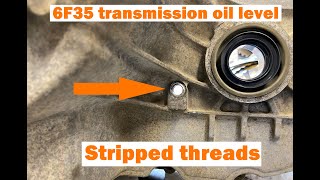
- Fluid Level Check: This transmission has no traditional dipstick. The fluid level must be checked via a leveling plug/standpipe on the side of the case while the engine is running, the transmission is in Park, the vehicle is level, and the fluid is at operating temperature (185°F to 200°F). You will need approximately 9 quarts of Motorcraft MERCON LV ATF (Part # XT-10-QLV).
- Subframe Alignment: You must use subframe alignment pins during reinstallation to maintain proper steering geometry.
- Dowel Pin Alignment: Ensure alignment dowels between the engine block and transmission bellhousing are present and clean to prevent misalignment.
- PTU Alignment: Align splines perfectly when reinstalling the PTU to avoid nicking the new compression seal.
- Ordering Mistakes: Do not order a FWD unit instead of AWD (FWD models lack the mounting bosses and internal splines required to connect to the PTU), and do not mix up engine sizes (a 1.5L transmission will not bolt to a 2.0L or 2.5L engine).
Questions to Ask Your Installer
Before handing over your vehicle, ensure your mechanic is prepared for this specific job by asking:
- Have you confirmed this is the correct part for my 1.5L AWD model (GV6P/GV6Z prefix)?
- Will you be programming the 13-digit solenoid body strategy code from the replacement unit into my car's computer before driving it?
- What is your procedure for flushing the transmission cooler and lines to prevent contamination?
- Do you have the tools to properly check the fluid level using the standpipe at the correct operating temperature (185-200°F)?
- How will you ensure the torque converter is fully seated (3 clicks) before mating the engine and transmission to avoid breaking the pump?
- Will you be replacing the axle seals and the PTU compression seal during installation?
- Do you have the subframe alignment pins required for reinstallation to maintain vehicle alignment?
- Does your quote include the required ~9 quarts of Motorcraft MERCON LV fluid?
Frequently Asked Questions (FAQ)
Do I have to program a used replacement transmission?
Yes, absolutely. You must program the 13-digit Solenoid Body Strategy from the replacement unit into your vehicle's computer before driving it. Failure to do so will cause severe damage.
Can I use a transmission from a FWD Escape or one with a 2.0L engine?
No. The FWD version lacks the output for the PTU (transfer case), and the version for the 2.0L engine has a different bellhousing pattern that will not bolt up to the 1.5L engine.
Does the used transmission come with the transfer case (PTU)?
No. The PTU is considered part of the driveline, not the transmission assembly. You must unbolt it from your old transmission and install it onto the replacement unit with new seals.
How much fluid does the 6F35 transmission take?
A completely dry transmission takes approximately 9 quarts of Motorcraft MERCON LV ATF (Part # XT-10-QLV). A simple drain and fill takes less, but a replacement unit will require a full fill.
How do I check the transmission fluid level?
There is no traditional dipstick under the hood. The fluid level must be checked using a leveling plug/standpipe located on the side of the transmission case. This must be done with the engine running, the vehicle in Park and perfectly level, and the fluid temperature between 185°F and 200°F.
What happens if the torque converter isn't seated properly during installation?
If the torque converter is not fully seated (it requires three distinct drops/clicks and should be recessed about 9/16" or 14mm), tightening the bellhousing bolts to mate the transmission to the engine will crush and break the front pump gear. This will destroy the transmission instantly upon startup.
Helpful Videos
![How to Program Ford Escape 6F35 Transmission Solenoid Strategy [Required if Replaced Transmission!]](https://img.youtube.com/vi/gKPTkzr1Hd0/mqdefault.jpg)
Technical Specifications
OEM Part Numbers: GV6P-7000-BA GV6P-7000-RA GV6Z-7000-B
Name: Ford 6F35 (Generation 2); Drivetrain: All-Wheel Drive (AWD/4WD); Engine Compatibility: 1.5L EcoBoost (VIN 8th digit 'D'); Door Jamb Code (TR): W or 6; Weight: ~212 lbs; Dimensions: ~33" x 28" x 25"; Fluid Type: Motorcraft MERCON LV ATF (XT-10-QLV); Fluid Capacity: ~9 quarts (dry fill); Solenoid Body ID: 7 or 12-digit; Solenoid Body Strategy: 13-digit
We Have This Part in Stock


The information in this article is provided for general reference and educational purposes only. Vehicle specifications, procedures, and part compatibility can vary by production date, trim level, and region. Always consult your vehicle's factory service manual and verify part numbers before purchasing or performing repairs. Safety-critical components such as airbags, seat belts, and braking systems should be installed by a qualified professional.
- Ford Escape:
- 🎬 Helpful Videos
- 🛍️ Shop This Part
- Is This the Right Transmission for Your 2017-2019 Escape?
- What Will NOT Fit?
- Common Failure Symptoms
- Diagnostic Flowchart
- Known Problems, Recalls, and Technical Service Bulletins (TSBs)
- Shift Cable Bushing Degradation (Recall)
- Flexplate Cracking
- Harsh Shifting and Internal Wear
- Torque Converter Overheating
- Axle Seal Leaks
- What Fails at Every Mileage Band
- Under 60,000 Miles
- 60,000 - 100,000 Miles
- 100,000 - 150,000 Miles
- Over 150,000 Miles
- Real Owner Experiences
- Repair or Replace?
- When Repair Makes Sense
- When Replace is Smarter
- Replacement Cost
- Freight & Delivery Reality
- Key Considerations for Used Assembly Installation
- Mandatory Programming: Solenoid Body Strategy
- What's Included (and What's Not)
- Installation Gotchas & Common Mistakes
- Questions to Ask Your Installer
- Frequently Asked Questions (FAQ)
- 🎟️ Get 5% Off