

2016-2017 Dodge Charger 3.6L 8-Speed 845RE Transmission: Problems, Identification, and Used Replacement
Identify the exact ZF 8HP45 variant for your RWD Charger, understand common failure points, and learn when replacing with a used OEM transmission is the smartest choice.
- A used 845RE transmission requires mandatory VIN programming, known as a 'Proxi Alignment', by a professional with a dealer-level scan tool before it will function in a new vehicle.
- Use only the specified Mopar 8 & 9 Speed ATF (Part # 68218925AA) or ZF Lifeguard 8 fluid; using incorrect fluid like ATF+4 will cause severe and irreversible damage.
- The transmission filter is integrated into the disposable plastic oil pan, so the entire pan assembly must be replaced with a new one during installation.
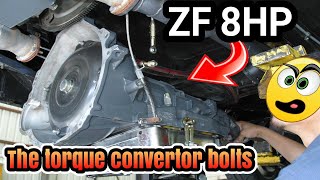
- Before mating the transmission to the engine, ensure the torque converter is fully seated (felt as three distinct drops) to avoid destroying the replacement unit's internal oil pump.
- Many drivability issues like harsh shifting can be caused by outdated software; always check for and apply available TSBs to update the TCM before condemning the transmission.
Part Identification: Is This the Right Transmission?

The automatic transmission in the 2016-2017 Dodge Charger with the 3.6L V6 engine is a sophisticated 8-speed unit. It was designed by the German company ZF as the 8HP45 and is built under license by Chrysler (now Stellantis) under the name 845RE. This transmission is engineered specifically for rear-wheel drive (RWD) applications.
Before purchasing a replacement, you must verify it fits your exact vehicle. Here’s how to confirm compatibility:
- Check the VIN: The 8th character of your vehicle's VIN should be a 'G', which signifies the 3.6L Pentastar V6 engine.
- Confirm Drivetrain: This unit is strictly for Rear-Wheel Drive (RWD) models. It will not fit All-Wheel Drive (AWD) versions of the Charger, which use a different transmission and transfer case assembly.
- Find the Sales Code: Look for a three-character code on the body code plate, typically found on the driver's side door jamb or in your vehicle's build sheet. The correct codes for this transmission are DFG or DFL.
- Physical Stamp: For final confirmation, you can locate the model number stamped on the driver's side, at the rear and bottom of the transmission case. It should read 845RE or 8HP45.
What Doesn't Interchange?
While other Dodge, Chrysler, Jeep, and Ram vehicles use similar 8-speed transmissions (like the 8HP50, 8HP70, or other 845RE variants), they are not direct replacements. This specific 8HP45/845RE unit is configured only for the vehicles listed. Units from a Dodge Durango, Challenger, Ram 1500, or Jeep Grand Cherokee will have different bellhousing bolt patterns, mounting points, torque converters, internal software, and oil pans, making them incompatible without major modifications.
Common Failure Symptoms

Transmission failure can manifest as drivability problems or dashboard warning lights. If you experience any of the following, the transmission may be the culprit:
- Harsh or Erratic Shifting: You might notice clunky or jerky shifts, especially the 1-2 shift when the vehicle is cold. This can also feel like a bump from behind when coming to a stop.
- Delayed Engagement: A noticeable delay when shifting from Park into Drive or Reverse.
- Check Engine Light: A Malfunction Indicator Lamp (MIL) can be triggered by transmission-related issues. A common fault code is P0731 (Gear Ratio Error In 1st), which points to an internal problem.
- Limp Mode: The vehicle may enter a self-preservation or "limp" mode, where it gets stuck in a single gear (often 2nd or 3rd) to prevent further damage. 🎬 Watch: Diagnose and fix a Charger that won't shift
- Fluid Leaks: Reddish transmission fluid pooling under the vehicle is a clear sign of a leak, often from the plastic oil pan or its gasket. 🎬 See: Step-by-step 8-speed transmission filter and pan service
Diagnostic Flowchart
Known Issues, Recalls, and Technical Service Bulletins (TSBs)
Several issues are well-documented for this transmission family. Software updates have resolved many of the early drivability complaints.
Monostable Shifter Rollaway Recall (NHTSA 16V240000)
A widely publicized recall (FCA code S27) was issued for the electronic shifter used in 2012–2014 Chargers. This shifter design could make it difficult for drivers to be certain the vehicle was in Park. Note: The 2016-2017 Charger uses an updated "polystable" shifter design and is not affected by this recall.
Software and Drivability TSBs
- TSB 21-017-16 REV. A: For vehicles built on or before June 7, 2016, this TSB addresses a Check Engine Light caused by Diagnostic Trouble Code (DTC) P0731 - Gear Ratio Error In 1st. The fix is to reprogram the Transmission Control Module (TCM) with updated software.
- TSB 21-004-15: Addresses harsh shifting on 3.6L models. The remedy requires a technician to reprogram the TCM and perform a "Quick Learn" procedure with a scan tool to reset the transmission's adaptive memory.
- TSB 21-026-16: For 2016 models specifically, this TSB provides a TCM software update to fix delayed upshifts after the driver lets off the accelerator.
Component and Maintenance Issues
- Plastic Oil Pan Leaks: The original oil pan is made of plastic and can warp over time from heat cycles, causing fluid leaks. The filter is integrated into this pan, so the entire assembly must be replaced. Many owners upgrade to a more durable aftermarket aluminum pan.
- One-Time Use Bolts (TSB S1821000001): When servicing the transmission, the bracket-to-case bolts are "stretch" bolts designed for single use. If removed, they must be replaced with new ones (Part Number 06511385AA) to ensure proper torque and prevent them from backing out.
- Harsh 1-2 Cold Shifts: It is a common characteristic for this transmission to have a firm 1-2 shift when the fluid temperature is below 40°F. This is a normal software behavior that typically disappears once the unit reaches operating temperature.
Replacement Cost Estimates

The cost to replace this transmission varies widely based on the type of replacement unit you choose. These estimates do not include taxes or potential shipping fees.
| Part or Service | Estimated Cost (USD) | Notes |
|---|---|---|
| New OEM | $5,000 - $8,400+ | Brand new unit from a Chrysler/Mopar dealership. Often includes a core charge. |
| Remanufactured OEM | $3,000 - $5,200 | Professionally rebuilt to factory specifications, usually with a warranty. |
| Used OEM | $1,000 - $2,400 | Price depends heavily on mileage, condition, and warranty offered by the recycler. |
| Installation Labor | $700 - $1,637 | Represents 5-9 hours of shop time. Does not include programming. |
What Fails at Every Mileage Band
Pro Tip: The mileage bands below describe what to expect from used replacement units of that mileage. The checklists provided are things to do while installing the purchased engine (or transmission), not maintenance for your current broken unit.
Under 60,000 Miles
Known Failures: At this low mileage, mechanical failures are rare. Issues are primarily software-related, such as harsh or delayed shifting, which are often resolved with a Transmission Control Module (TCM) software update. Occasional leaks from the Mechatronic sleeve O-rings can happen due to heat cycles.
- ✓Do during install (required): Ensure all TSBs and software updates for the TCM have been performed. Always install a new pan/filter assembly, new fluid, and a new torque converter seal.
- ✓Do during install (recommended): Inspect the Mechatronic sleeve connector for any signs of fluid leakage.
- ✓Cheap insurance while the engine is out: Replace the sealing sleeve O-rings as a low-cost preventative measure.
60,000 to 100,000 Miles
Known Failures: Torque converter lock-up clutch wear can begin, leading to shuddering, slipping under light load, and potential contamination of the fluid with clutch debris. Valve body and solenoid issues may arise due to fluid degradation, causing harsh or delayed shifts and downshift clunks. Leaks from the plastic oil pan due to warping or seal degradation become very common.
- ✓Do during install (required): Mandatory replacement of the transmission fluid and the plastic pan/filter assembly. Flush transmission cooler lines professionally to remove any potential debris.
- ✓Do during install (recommended): Inspect the torque converter for any signs of bluing from heat or scoring on the hub.
- ✓Cheap insurance while the engine is out: Strongly recommended to replace the Mechatronic sealing sleeve and the two cooler line O-rings.
100,000 to 150,000 Miles
Known Failures: Internal component failure becomes more likely, especially if fluid service has been neglected. Failures of the 'E' clutch and 'A' clutch assemblies can occur, leading to slipping in multiple gears or shaky takeoffs. Torque converter failure and planetary gear set failure can cause catastrophic internal damage.
- ✓Do during install (required): All items from the 60-100K band are critical. Careful inspection of the input shaft and pump for scoring is necessary.
- ✓Do during install (recommended): Given the mileage, replacing external seals like axle seals is highly recommended.
- ✓Cheap insurance while the engine is out: Consider replacing the entire solenoid set and Mechatronic sealing sleeve as 'insurance' while the unit is out, as old solenoids can activate slowly and cause issues.
Over 150,000 Miles
Known Failures: There is an increased probability of failure in all major internal components, including clutch packs, valve body, and torque converter, especially if maintenance has been deferred. Wear in valve body bores and end plugs can cause cross-leaks, leading to pressure loss, slippage, and gear ratio codes. The internal TCM (part of the Mechatronic unit) can fail due to sustained high temperatures over its life.
- ✓Do during install (required): Assume the unit will need significant preventative parts. A complete replacement of all seals, solenoids, and the Mechatronic sealing sleeve is wise.
- ✓Do during install (recommended): If the budget allows, installing a remanufactured torque converter is recommended over using the high-mileage used one.
- ✓Cheap insurance while the engine is out: At this mileage, purchasing a lower-mileage used unit or a professionally remanufactured one may be more cost-effective than installing a high-mileage used transmission without preventative parts replacement.
Real Owner Experiences
| Source | Mileage | What Happened | Cost |
|---|---|---|---|
| carparts.com | N/A (Affects 2011-present models) | Owners reported slippage, intermittent hard shifting, and decreased acceleration. Chrysler addressed this by updating the TCM software. | N/A |
| fcpeuro.com | N/A | Leaks can occur at the oil cooler connections where O-rings can deform from heat cycling, causing fluid to run down the driver's side of the transmission. | Minor (cost of O-rings and labor). |
| bimmerlife.com | 60,000 | A faint groan at startup and cold shifts hanging longer than usual prompted a fluid and filter service, which resolved the symptoms. | Cost of fluid/filter service. |
| Reddit r/BmwTech | 80,000 | Owner performed a preventative fluid and filter change with no prior issues and reported no problems after the service. | Cost of fluid/filter service. |
| Reddit r/GrandCherokee | 130,000 | Transmission was slipping, especially when cold and during highway passing. The fluid had never been changed. The likely cause was either extreme fluid degradation or internal failure like a bad torque converter. | Potentially a full replacement or rebuild. |
| youtube.com (Trans-Medic) | ~100,000 | A 2017 Ram 1500 with an 845RE experienced binding and noise in reverse. Teardown revealed a destroyed planetary gear set and significant damage to aluminum clutch drums. | Complete rebuild or replacement. |
| ramforum.com | 150,000+ | Transmission would disengage when engine RPM exceeded 4,000, but only when at operating temperature. This acted like a limp mode, potentially caused by a faulty sensor or internal issue. | Diagnostic costs, potential for major repair. |
| Reddit r/Audi | 336,000 | An Audi with a ZF8 transmission is still running on the original unit after the engine was replaced at 180k miles, demonstrating the potential for very high mileage with proper care. | N/A |
| youtube.com (Trans-Medic) | 121,000 | Owner of a Ram with an 845RE performed partial fluid changes every 20k miles and a full pan/filter change at 100k. The transmission is reported to be shifting perfectly, showing the benefit of proactive maintenance. | Preventative maintenance costs. |
| Car Talk Community | Not Stated | Considering options, seeking advice. Quoted Option 1: Valve body replacement at $2,600. Option 2: Full remanufactured transmission replacement at $7,150 from a dealer. | N/A |
| Reddit r/Charger | 40,000 | Inquiring about the necessity and cost of service. Dealer quoted $1,000 for a package including transmission fluid service. If the pan/filter is replaced, the quote increases to $1,700. | N/A |
| Reddit r/AskMechanics | 116,000 | Seeking advice on which option is better. Quoted $1,500 for valve body replacement vs. $2,500 for a used transmission replacement. | N/A |
Repair or Replace?
When facing transmission trouble, deciding whether to repair your current unit or replace it entirely depends on the specific failure mode.
When Repair Makes Sense
- Leaking plastic oil pan/filter assembly: This typically costs $250 - $500 to fix. It is a maintenance item and should be done with any fluid service. An aftermarket aluminum pan is a worthwhile upgrade.
- Faulty valve body / mechatronics unit: If you have harsh shifts or delayed engagement, replacing the valve body ($1,500 - $2,600) makes sense only if the rest of the transmission's mechanical components (clutches, gears) are confirmed to be in good condition. A valve body replacement can often fix shift quality issues that mimic a complete transmission failure.
- Software glitches: Addressed by TSBs, a simple TCM re-flash at the dealer ($150 - $400) can often resolve drivability issues without physical repairs. Always attempt this first for any shift quality complaints.
When Replacement is Smarter
Replacement is the better route when there is evidence of internal mechanical failure. This includes finding metal debris in the pan (beyond the normal fine paste on the magnet), hearing whining or grinding noises, or experiencing a complete loss of movement that isn't resolved by addressing the valve body or fluid level. Given the high cost of a remanufactured unit ($3,000+) and labor, a lower-mileage used assembly ($1,000 - $2,400) becomes the most economical choice for major failures.
Questions to Ask Your Installer
Before handing over your vehicle, ensure your mechanic is prepared for this specific transmission:
- Have you worked on the ZF 8-speed / 845RE transmission before?
- Are you aware of the mandatory VIN programming (Proxi Alignment) required when swapping this transmission? Do you have the appropriate scan tool, like wiTECH, to perform this?
- Will you be installing a brand new oil pan/filter assembly, or do you plan to reuse the old one?
- What specific fluid will you be using? (Verify it is Mopar 8&9 Speed ATF or ZF Lifeguard 8, NOT ATF+4).
- How do you plan to flush the transmission cooler and lines to prevent contamination of the new unit?
- Are you familiar with the specific fluid level check procedure, which requires the engine to be running and the fluid to be between 30°C-50°C (86°F-122°F)?
- How will you ensure the torque converter is fully seated (three distinct clicks) before mating the transmission to the engine?
- Does your quote include replacing the single-use torque-to-yield transmission bracket bolts (Part No. 06511385AA)?
Installation & Programming Guide
Replacing this transmission is an advanced job. Several steps are critical for success and to avoid damaging the new unit.
Warning: This transmission does NOT use ATF+4 fluid. Using the wrong fluid will cause severe damage. You must use a fluid that meets the manufacturer's specification.
Required Parts & Fluids
- Transmission Fluid: Use only Mopar 8 & 9 Speed ATF (Part # 68218925AA) or an approved equivalent like ZF Lifeguard 8. A full, dry system requires about 9.0 to 9.7 quarts. You can expect to pay $20-$35 per quart/liter.
- Transmission Pan/Filter Kit: The filter is built into the plastic oil pan. Always install a brand-new pan assembly with a new gasket and plugs when replacing the transmission.
- Seals: It is best practice to replace the front pump (torque converter) seal and axle seals during installation.
- Cooler Flush: The transmission cooler and lines must be professionally flushed to remove any metal debris from the old, failed unit.
Special Tools & Procedures
Beyond a standard mechanic's toolset, this job requires specialized equipment:
- A professional scan tool (like wiTECH) for reading fluid temperature and performing mandatory programming.
- An engine support bar to hold the engine while the transmission and crossmember are removed.
- A fluid pump to fill the transmission, as there is no dipstick tube.
- A low-range torque wrench to tighten the plastic pan bolts to exactly 10 Nm (89 in-lbs) in a crisscross pattern.
- A pass-thru electrical connector release tool (Mopar P/N 10377A). The electrical connector on the case is fragile and notorious for breaking if pried with pliers.
Pro Tip: The torque converter must be fully seated into the transmission's front pump before installation. You should feel it drop into place three distinct times as you rotate it. Failure to do this will crack the oil pump when the engine and transmission are bolted together, destroying the replacement unit.
ECU/TCM Programming: A Critical Step
This step is not optional. The Transmission Control Module (TCM) is integrated into the valve body inside the transmission. It is a security component that is locked to the original vehicle's VIN.
If you install a used transmission with its accompanying TCM, the vehicle will not shift out of Park or will enter limp mode until it is programmed. A dealership or a properly equipped independent shop must use a dealer-level scan tool to perform a VIN alignment or "Proxi Alignment" to marry the replacement TCM to your car's security system. After programming, a "Quick Learn" adaptive relearn procedure is also mandatory to ensure smooth shifting.
Can I avoid programming by swapping my old valve body/TCM into the new transmission?
Yes, this is a possible workaround for advanced technicians. If you are certain your original TCM and valve body are functioning correctly, you can carefully install them into the replacement transmission. This avoids the need for VIN security programming. However, you MUST still perform the scan-tool-based Quick Learn procedure for the transmission to learn the clutch engagement points and shift properly.
Freight & Delivery Reality

If you are ordering a used 845RE transmission online, it will not arrive in a standard cardboard box via regular mail. This is a heavy, bulky industrial component.
- Size and Weight: Verified shipping data shows this transmission assembly weighs approximately 229 lbs. Before crating, the dimensions are roughly 48" x 40" x 32".
- LTL Freight: Because of its size and weight, it ships as Less-Than-Truckload (LTL) freight strapped to a wooden pallet.
- Delivery Requirements: You will need a delivery location capable of handling freight. If delivering to a residential address or a shop without a loading dock or forklift, you must request a truck with a liftgate to lower the pallet to the ground.
- Inspect Before Signing: When the freight carrier arrives, inspect the transmission carefully before signing the delivery receipt. Check for any damage to the fragile plastic oil pan, the electrical connector, or the bellhousing that may have occurred during transit.
Frequently Asked Questions (FAQ)
What is the correct fluid for the 2016-2017 Charger 3.6L 8-speed?
The correct fluid is Mopar 8 & 9 Speed ATF (part number 68218925AA) or ZF Lifeguard 8 fluid. Do not use ATF+4 or any other type of universal fluid, as it will cause irreversible damage.
Why is my car stuck in Park after installing a used transmission?
The replacement transmission's internal control module (TCM) is still programmed to the donor car's VIN. It must be electronically aligned with your vehicle's VIN using a dealer-level scan tool before it will function correctly.
Do I have to replace the transmission oil pan?
Yes. The transmission filter is integrated into the disposable plastic oil pan. It is mandatory to install a new pan/filter assembly with a used transmission to ensure clean fluid and prevent leaks from a warped old pan.
How do you check the fluid level on an 845RE?
There is no dipstick. The level must be checked via a fill plug on the side of the transmission case while the engine is idling and the transmission fluid is within a specific temperature window of 30°C to 50°C (86°F to 122°F). This requires a scan tool to monitor the fluid temperature accurately. Note that some vehicles have a cooler thermostat that opens at 75°C, so the engine must run long enough to open the thermostat and fill the cooler before the final level check.
How long does the 845RE transmission last?
With proper maintenance, the ZF 8HP45 / 845RE transmission can be very durable, with many examples reaching 180,000 to 250,000 miles or more. The single most critical factor for longevity is regular fluid and filter changes. ZF recommends a service interval of 50,000 to 75,000 miles (or 8 years) under normal conditions.
What is included when I buy a used 845RE transmission?
A standard used assembly typically includes the transmission case, all internally lubricated parts, the extension/tail housing, the plastic transmission oil pan with integrated filter, the torque converter, and the valve body/mechatronics unit. It generally excludes external sensors, wiring harnesses beyond the integral case connector, the shifter, linkage, cables, flexplate/flywheel, and transmission cooler lines.
Helpful Videos
Technical Specifications
OEM Part Numbers: 06511385AA 68218925AA
Model Name: 845RE; ZF Equivalent: 8HP45; Drivetrain: Rear-Wheel Drive (RWD); Engine Compatibility: 3.6L Pentastar V6 (VIN 8th digit 'G'); Sales Codes: DFG, DFL; Fluid Type: Mopar 8 & 9 Speed ATF / ZF Lifeguard 8; Fluid Capacity (Dry): 9.0 - 9.7 quarts; Weight: ~229 lbs
We Have This Part in Stock


The information in this article is provided for general reference and educational purposes only. Vehicle specifications, procedures, and part compatibility can vary by production date, trim level, and region. Always consult your vehicle's factory service manual and verify part numbers before purchasing or performing repairs. Safety-critical components such as airbags, seat belts, and braking systems should be installed by a qualified professional.
- Dodge Charger:
- 🎬 Helpful Videos
- 🛍️ Shop This Part
- Part Identification: Is This the Right Transmission?
- What Doesn't Interchange?
- Common Failure Symptoms
- Diagnostic Flowchart
- Known Issues, Recalls, and Technical Service Bulletins (TSBs)
- Monostable Shifter Rollaway Recall (NHTSA 16V240000)
- Software and Drivability TSBs
- Component and Maintenance Issues
- Replacement Cost Estimates
- What Fails at Every Mileage Band
- Under 60,000 Miles
- 60,000 to 100,000 Miles
- 100,000 to 150,000 Miles
- Over 150,000 Miles
- Real Owner Experiences
- Repair or Replace?
- When Repair Makes Sense
- When Replacement is Smarter
- Questions to Ask Your Installer
- Installation & Programming Guide
- Required Parts & Fluids
- Special Tools & Procedures
- ECU/TCM Programming: A Critical Step
- Freight & Delivery Reality
- Frequently Asked Questions (FAQ)
- 🎟️ Get 5% Off