

2007-2008 Audi Q7 3.6L Transmission: Problems, Identification, and Used Replacement
Identify the JTU transmission code, understand common valve body and seal failures, and learn what to check before buying a used replacement unit.
- You must verify the transmission code is 'JTU' and your Q7 has the 3.6L engine (VIN 5th digit D or E), as units from V8 or TDI models will not fit.
- The most common failures are harsh shifting and leaks caused by the valve body, solenoids, and mechatronic connector sleeve; these parts should be addressed when installing a used unit.
- Always use the correct OEM-spec fluid (G 055 162 A2 for ZF or G 055 025 A2 for Aisin) and flush the transmission cooler before installing a replacement to prevent immediate damage.
- Be aware of Audi's 'Component Protection' system on ZF units, which requires dealer-level tools to unlock a replacement transmission's control module after installation.
- When installing a used unit, it is critical to replace common leak-prone seals, verify the torque converter is fully seated, and perform a post-install adaptation reset with a VAG-compatible scan tool.
2007-2008 Audi Q7 3.6L Transmission: Problems, Identification, and Used Replacement
Part Identification and Fitment Confirmation

The automatic transmission in the 2007-2008 Audi Q7 equipped with the 3.6L VR6 FSI engine is identified by the three-letter transmission code JTU. This code corresponds to either an Aisin TR-60SN (also known by the VW/Audi designation 09D) or a ZF 6HP19X (VW/Audi designation 0AT) six-speed automatic. Both units were used during the 2006-2010 production years and are designed specifically for the Quattro All-Wheel Drive (AWD) system.
The most critical factor for interchange is that this transmission's bellhousing—the section that bolts to the engine—is unique to the 3.6L VR6 FSI engine (engine code: BHK). It cannot be used with the 4.2L V8 or 3.0L TDI diesel engines, which use different transmission models.
Pro Tip: To confirm your vehicle requires a JTU transmission, check the build specification sticker. This sticker is typically located in the spare tire well or inside the original maintenance booklet. The transmission code is clearly listed along with the engine code. You can also verify that the 5th digit of your VIN is D or E, which confirms the 3.6L V6 engine, or inspect the metal tag riveted to the side of the transmission case.
Warning: Do not order a transmission for a 2007-2008 Q7 based on the model year alone. You must verify that your Q7 has the 3.6L engine and the JTU transmission code. Units from V8 or TDI models will not bolt up to the 3.6L engine.
Common Failure Symptoms
When the transmission begins to fail, it can exhibit several distinct symptoms. Recognizing these signs early can help in diagnosing the problem correctly. The transmission control system may trigger a warning light on your dashboard and put the vehicle into "limp mode" to prevent further damage, which often limits the transmission to a single gear.
- Harsh Shifting or Shuddering: Rough or jerky gear changes, especially during the 1-2 and 2-3 upshifts, are a common complaint. This can feel like a shudder or vibration through the vehicle.
- Delayed Engagement: A noticeable delay when shifting from Park into Drive or Reverse.
- Slipping Gears: The engine RPMs may flare up between shifts, indicating the clutches inside the transmission are not engaging properly.
- Visible Fluid Leaks: Puddles of red or brownish fluid under the vehicle are a clear sign of a leak from a seal or gasket.
- Grinding or Whining Noises: Any unusual noises from the transmission area during operation should be investigated immediately.
Diagnostic Flowchart

Known Problems, Recalls, and Technical Service Bulletins (TSBs)

Several known issues affect this transmission family. Technical Service Bulletins (TSBs) are documents issued by Audi to dealerships that provide information on how to fix common or unforeseen problems.
Valve Body and Solenoid Failure
The most widely reported severe issue is related to the valve body, the complex hydraulic control center of the transmission. Over time, the solenoids (small electronic plungers that direct fluid) can wear out, or the channels within the valve body itself can become worn from contaminated fluid. This degradation leads to poor hydraulic pressure control, causing the harsh shifts, shudders, and gear-shifting flares mentioned above. In many cases, performing a complete fluid flush, adaptation reset, or replacing the valve body and solenoids can resolve these shifting problems.
Mechatronic Connector Sleeve and Seal Leaks
A frequent and well-documented failure point across all years is the plastic mechatronic connector sleeve. This part creates a seal where the main wiring harness passes into the transmission. Over time, the O-rings on the sleeve become hard and brittle from heat, causing transmission fluid to leak. If enough fluid is lost, it can lead to erratic shifting and eventually severe internal damage. While the transmission is being serviced, it is also best practice to replace the rubber bridge seal and four tube seals inside the mechatronic unit, as these are also known to degrade and cause internal pressure loss.
Transmission Cooler Line Leaks (TSB 2018289/5)
Audi issued TSB 2018289/5 for 2007-2008 Q7 models regarding leaks from the automatic transmission cooler lines. The issue stems from burrs on the connections at the oil temperature regulator, which can damage the seals and cause leaks. The official remedy is to inspect the cooler line connections and replace the seals with an updated, deburred design.
Transfer Case Oil Leaks (TSB 2016880/8)
Another TSB (2016880/8) was released for moderate oil leaks originating from the integrated transfer case on 2007-2008 models. The leaks can occur at two main points: the input shaft seal between the transmission and transfer case, or the front driveshaft output flange seal. The remedy requires replacing the transfer case input shaft seal or the front driveshaft output flange seal.
Warning: Note that if the output flange seal leaks, it requires a full transfer case replacement.
What Fails at Every Mileage Band
Pro Tip: The mileage bands below describe the typical condition of used replacement units at that mileage. The checklists provided are critical steps you must take WHILE INSTALLING the purchased transmission to ensure it survives, not just maintenance for your current broken unit.
Under 60,000 Miles
Early failures are uncommon but are often linked to manufacturing defects or neglect rather than mileage-based wear. Leaking mechatronic connector sleeves can cause fluid loss, leading to shifting problems. Solenoid-related issues in the valve body can occur even at lower mileages, causing harsh shifts or gear engagement delays. In rare cases, issues like a faulty shifter mechanism or other electrical gremlins have been reported.
- ✓Do during install (required): Perform a complete fluid and filter service with the correct OEM-spec fluid (VW G 055 162 A2 for ZF or G 055 025 A2 for Aisin). Flush the transmission cooler and lines with a professional-grade flush to remove any debris from the previously failed unit. Replace the torque converter input shaft seal (front pump seal) and axle/driveshaft seals.
- ✓Do during install (recommended): Replace the mechatronic connector sleeve, bridge seal, and four tube seals. These are inexpensive parts that are common leak points and much harder to access later.
- ✓Cheap insurance while the engine is out: Use new one-time-use torque-to-yield bolts for the axles and driveshafts.
60,000 - 100,000 Miles
Valve body and solenoid wear becomes more prevalent in this range, leading to harsh shifting, shuddering, and delayed gear engagement. Torque converter lock-up clutch issues can begin to surface, causing vibrations or RPM fluctuations. Fluid degradation is a major factor if the unit has not been serviced; old fluid loses its lubricating properties and can lead to overheating and accelerated wear. Leaks from the oil pan gasket, cooler lines, and mechatronic sleeve are very common.
- ✓Do during install (required): All items from the Under 60,000 Miles band, plus a new oil pan gasket.
- ✓Do during install (recommended): Overhaul or replace the valve body/mechatronics unit, or at a minimum, replace all solenoids.
- ✓Cheap insurance while the engine is out: Inspect and consider replacing the torque converter, especially if shuddering was a symptom of the original failure.
100,000 - 150,000 Miles
Internal mechanical wear is much more likely here. This includes worn clutch packs, bushings, and seals, often resulting from prolonged use with degraded fluid or unresolved valve body issues. Complete transmission failure requiring replacement becomes more common, with symptoms like slipping in multiple gears or loss of drive. Solenoid failure is a very common diagnosis in this range. Lab testing on factory ATF fluid shows that by 100,000 miles, the additive package is significantly depleted and the fluid is oxidized.
- ✓Do during install (required): Assume the replacement used unit will need, at minimum, a new filter, fluid, mechatronic seals, and solenoids to be reliable.
- ✓Do during install (recommended): Thoroughly inspect the oil pan magnets for excessive metallic sludge before installing.
- ✓Cheap insurance while the engine is out: Given the high mileage, replacing the torque converter along with the transmission is highly advised.
Over 150,000 Miles
At this mileage, survival is highly dependent on a history of consistent fluid changes. Units running on original fluid are highly likely to have failed by now. Failures are typically due to cumulative mechanical wear of hard parts: clutch packs, bushings, planetary gears, and the torque converter. Even with maintenance, high-mileage units can suffer from issues like a clogged transmission oil cooler or internal pressure loss from worn seals and valve body channels.
Pro Tip: A used transmission in this mileage band is a significant gamble. A remanufactured unit is a much safer investment.
- ✓Do during install (required): A complete teardown and inspection for wear on clutches and bushings is advisable. Mandatory replacement of all seals, gaskets, solenoids, filter, fluid, and the torque converter should be considered part of the job cost.
- ✓Do during install (recommended): A used transmission in this mileage band is a significant gamble. A remanufactured unit is a much safer investment.
- ✓Cheap insurance while the engine is out: Replace all external sensors that are easy to reach while the unit is unbolted.
Real Owner Experiences
| Source | Mileage | What Happened | Cost |
|---|---|---|---|
| Reddit r/AudiQ7 | Shortly after 60,000 miles | Vehicle began showing "Drive System: Malfunction" and "Electrical System Failure" messages, sometimes causing the vehicle to lose power or enter limp mode. | Not specified, but noted as costly with multiple dealership visits not providing a permanent solution. |
| BAVLOGIC, LLC | Can occur under 70,000-80,000 miles | General ZF 6HP issues like harsh 2-1 downshifts, weak torque feel, and gear ratio faults are related to valve body pressure loss from solenoids or internal seals. | Preventative valve body rebuild with new solenoids ($300-$400) and a seal kit is recommended. |
| AudiWorld Forums | ~90,000 miles | Owner of a 4L Q7 TDI with an 8-speed Aisin transmission (similar family) noted whining noises starting around 90k miles despite dealer servicing. The manufacturer (Aisin) recommends a 40-50k mile service interval, contrary to Audi's "lifetime fluid" claim. | Not specified. |
| Reddit r/E90 | 100,000 km (~62,000 miles) | A user with a ZF 6HP transmission experienced a fault alert for a worn clutch and failing solenoid, causing slipping between 4th and 5th gear. | Quoted NZ$6,800 for a full rebuild. |
| Reddit r/AudiQ7 | 105,000 miles | Transmission failure with slipping out of reverse and severe bucking in forward gears with gear ratio faults. | A dealership quote for a new transmission was $30,000. A shop quote for a used replacement (including labor and programming) was $10,000-$11,000. |
| FCP Euro (YouTube) | 107,000 miles | A Q7 on its original fluid was brought in for its first transmission service, noted as being "absolutely overdue." The magnets in the pan showed considerable metallic sludge. | Preventative service, not a failure repair. |
| AudiWorld Forums | 120,000 miles | A 2017 Q7 experienced transmission failure where gears 1-3 were "pretty much shot." | Audi quoted $20,000 for a new factory transmission. |
| Reddit r/whatcarshouldIbuy | 180,000 miles | An owner reported enjoying their Q7 at this mileage, acknowledging it had some problems but was a "very nice car." | Not specified. |
| AudiWorld Forums | 190,000 km (~118,000 miles) | Owner reported sluggish/slipping behavior from 1st to 2nd gear, which was worse when cold. A fluid/filter change and adaptation reset did not fix the issue, pointing towards more significant internal wear. | Not specified. |
| Unknown (2015 model) | Decided to move on from the vehicle rather than repair it. | ~$20,000 quote. $0 paid (did not repair). | |
| Unknown (2007 model) | Owner was planning a DIY replacement due to a friction plate E error causing limp mode. They had already replaced mechatronic solenoids. | Not specified. |
Repair or Replace?

Deciding whether to repair your existing transmission or replace it entirely depends on the specific failure mode. Used replacement units typically run $350 - $1,700, while remanufactured units range from $3,500 - $5,500. A brand new OEM unit can cost $10,000 to $14,500 or more. Labor for this 8-12 hour job generally adds $1,200 - $2,400 to the total bill.
When Repair Makes Sense
If the issue is isolated and there is no evidence of widespread mechanical damage (like metal debris in the pan), a targeted repair can be cost-effective.
| Repair Scenario | Estimated Cost (Parts & Labor) |
|---|---|
| Valve Body / Mechatronic Failure | $800 - $2,800 |
| Mechatronic Connector Sleeve & Internal Seal Leaks | $700 - $1,500 |
| External Transmission Fluid Leaks (e.g., cooler lines, pan gasket) | $362 - $500 |
When Replacement is Smarter
Replacement is necessary when catastrophic internal failure has occurred, such as broken gear sets, clutch pack failure, or significant metal debris found in the transmission fluid and pan. In these cases, the cost and complexity of a full rebuild often exceed the price of a quality used or remanufactured unit. Also, if the vehicle has very high mileage, a replacement unit with lower mileage can be a more durable long-term solution.
Questions to Ask Your Installer
- Have you worked on this specific Aisin/ZF transmission for the Q7/Touareg/Cayenne platform before?
- Will you be flushing the transmission cooler and lines completely before installing the replacement unit?
- Do you have the VAG-compatible diagnostic tools (like ODIS or VCDS) required for the post-installation procedures?
- How will you handle the Component Protection (security) unlock and the TCM adaptation reset?
- Does your quote include the specific required fluid (e.g., VW G 055 162 A2 or G 055 025 A2), or are you using a universal fluid?
- What warranty do you offer on your labor, and how does it interact with the warranty from the part supplier?
- Will you inspect and replace common 'while-you-are-in-there' seals, like the torque converter seal and axle seals?
- How will you verify the torque converter is fully seated before mating the transmission to the engine?
Freight & Delivery Reality

If you are purchasing a used replacement transmission online, it is crucial to understand how it will arrive. This assembly weighs approximately 248 lbs and measures roughly 33" x 28" x 25" before crating. Because of this size and weight, it ships as LTL (Less Than Truckload) freight on a wooden pallet—it will NOT arrive via standard parcel services like UPS or FedEx Ground.
When scheduling delivery to a residential address or a shop without a loading dock, you must request a truck with a liftgate to safely lower the pallet to the ground. Always inspect the transmission thoroughly before signing the driver's delivery receipt. Check for any damage to the oil pan, bellhousing, or electrical connectors that may have occurred during transit. Finally, expect reputable sellers to conduct a pre-purchase verification interview to confirm your VIN's 5th digit (D or E) and the JTU transmission code before they will ship the unit.
Frequently Asked Questions (FAQ)
What is "Component Protection"?
Component Protection is an anti-theft system used by Audi. If your Q7 has the ZF 6HP19X (0AT) transmission, its internal Transmission Control Module (TCM) is electronically locked to the original vehicle. When a used transmission is installed, this lock is triggered, putting the car in "limp mode." It must be released by an Audi dealer or a qualified independent shop using a special online diagnostic tool (ODIS). Alternatively, the original TCM/mechatronics unit can be carefully swapped into the replacement transmission to avoid this issue. If you have the Aisin 09D, an adaptive relearn procedure using VCDS/ODIS is required post-install.
Can I use universal transmission fluid?
Warning: No. Using a generic or universal Automatic Transmission Fluid (ATF) will cause shifting problems and can lead to premature failure. These transmissions require a very specific fluid. For the ZF 6HP19X (0AT), use a fluid meeting VW specification G 055 162 A2. For the Aisin TR-60SN (09D), use a fluid meeting VW specification G 055 025 A2 (which is equivalent to JWS 3309 / Toyota Type T-IV).
Is a used transmission a good idea for this vehicle?
A used transmission can be a cost-effective solution, but it carries risks. Given the known issues with valve bodies and internal seals, it's crucial to purchase from a reputable recycler that offers a warranty. It is highly recommended to perform preventative maintenance before installation, such as replacing the mechatronic connector sleeve, internal seals, pan/filter, and flushing the transmission cooler lines to avoid contaminating the replacement unit with debris from the old one.
What is included with a used transmission assembly?
A standard used assembly includes the transmission case, internally lubricated parts, extension/tail housing, transmission oil pan, torque converter, and the valve body with internal solenoids. It does NOT include external sensors, wiring harnesses extending beyond the case, the shifter assembly, linkage, selector cables, the engine flexplate/flywheel, or external transmission fluid cooler lines. Note that TCM inclusion varies: the ZF 0AT TCM is internal and included (but locked), while the Aisin 09D TCM is external and not included.
What special tools are required for installation?
This is an expert-level DIY job that requires specific tools. You will need a heavy-duty transmission jack, an engine support fixture/bridge (tool 10-222 A), stubby Torx and Hex/Allen bits, triple square sockets, a fluid transfer pump with a curved hook adapter, and a VAG-compatible diagnostic scan tool (such as VCDS, OBDeleven, or ODIS) to monitor fluid temperatures and reset adaptations.
What are the biggest installation gotchas?
Warning: First, the torque converter must be fully seated (you must feel three distinct clicks/drops) before bolting the transmission to the engine; failing to do this will crush the internal oil pump. Second, the fluid level check must be performed with the vehicle perfectly level, the engine idling, and the fluid temperature strictly between 35°C and 45°C using a diagnostic scanner. Third, the wiring harness connector must be perfectly aligned before locking the lever to prevent crank-inhibit issues. Finally, missing or dirty alignment dowel pins can cause misalignment and destroy the torque converter hub or front pump seal.
Helpful Videos
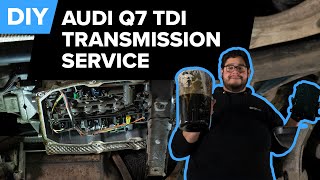
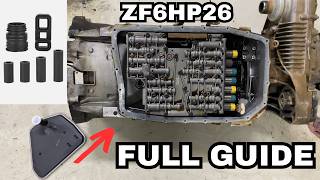
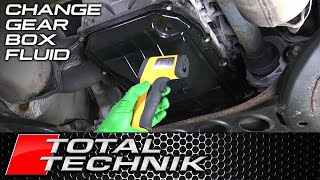
Technical Specifications
Transmission Code: JTU; Engine Compatibility: 3.6L VR6 FSI (BHK); Model Years: 2007-2008; Vehicle: Audi Q7; Type: 6-Speed Automatic; Drivetrain: Quattro AWD; Possible Models: Aisin TR-60SN (09D) or ZF 6HP19X (0AT); Weight: ~248 lbs; Crated Dimensions: ~33" x 28" x 25"; ZF Fluid Spec: VW G 055 162 A2; Aisin Fluid Spec: VW G 055 025 A2
We Have This Part in Stock


The information in this article is provided for general reference and educational purposes only. Vehicle specifications, procedures, and part compatibility can vary by production date, trim level, and region. Always consult your vehicle's factory service manual and verify part numbers before purchasing or performing repairs. Safety-critical components such as airbags, seat belts, and braking systems should be installed by a qualified professional.
- Audi Q7:
- 🎬 Helpful Videos
- 🛍️ Shop This Part
- Part Identification and Fitment Confirmation
- Common Failure Symptoms
- Diagnostic Flowchart
- Known Problems, Recalls, and Technical Service Bulletins (TSBs)
- Valve Body and Solenoid Failure
- Mechatronic Connector Sleeve and Seal Leaks
- Transmission Cooler Line Leaks (TSB 2018289/5)
- Transfer Case Oil Leaks (TSB 2016880/8)
- What Fails at Every Mileage Band
- Under 60,000 Miles
- 60,000 - 100,000 Miles
- 100,000 - 150,000 Miles
- Over 150,000 Miles
- Real Owner Experiences
- Repair or Replace?
- When Repair Makes Sense
- When Replacement is Smarter
- Questions to Ask Your Installer
- Freight & Delivery Reality
- Frequently Asked Questions (FAQ)
- 🎟️ Get 5% Off